
90s Sweater Vest Outfit Ideas: 12 Easy Formulas (Preppy, Grunge, Minimal)
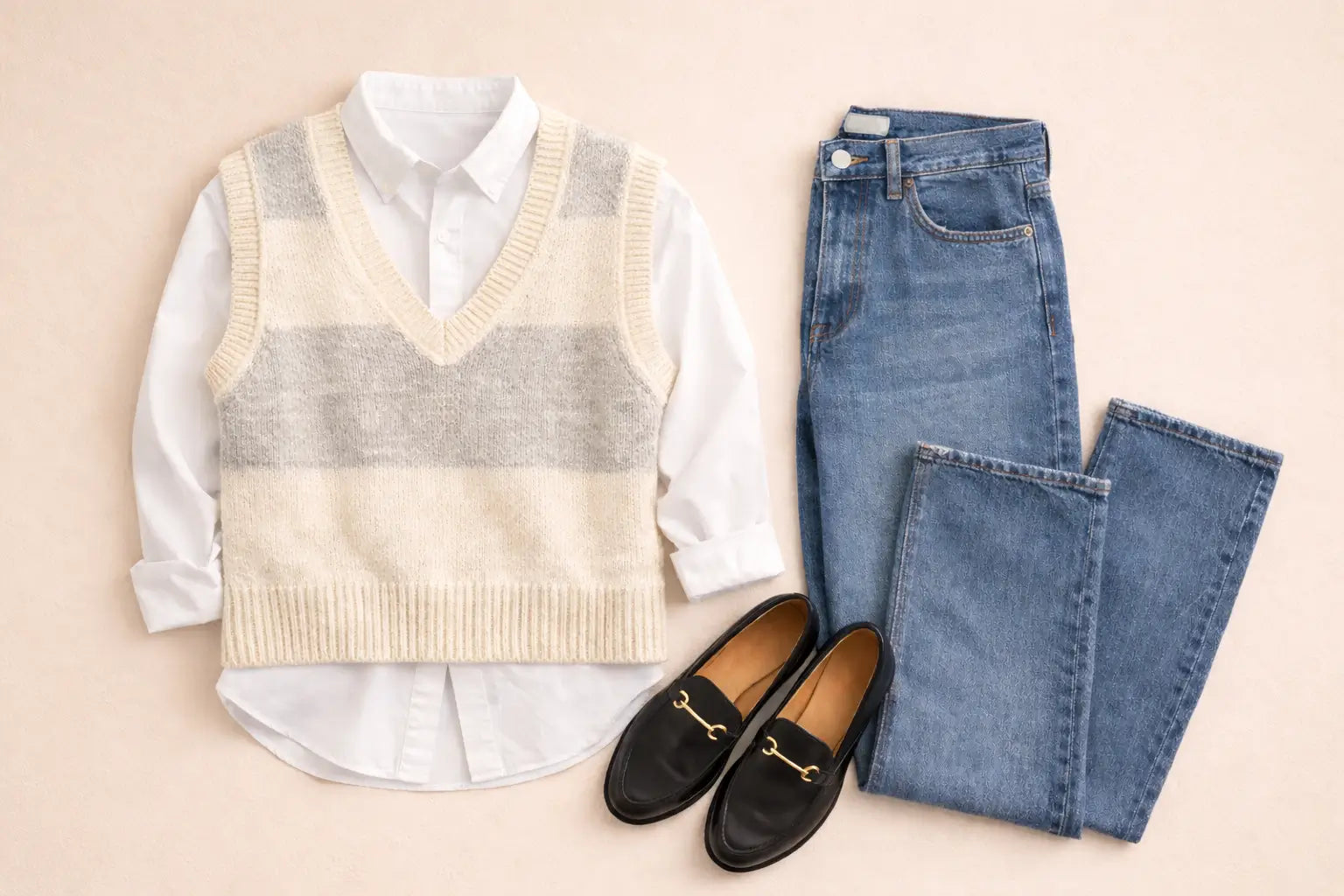
Sweater vests are one of the easiest ways to get a 90s-inspired outfit without looking like you’re in costume. Below you’ll get copy/paste formulas first, then the rulebook (vibe lanes, layering, fit, patterns, and quick fixes).
Start with the fastest wins—ready-made outfit templates you can copy in seconds.
How to Style a Sweater Vest for a 90s Outfit (Fast Formulas)
Pick a vibe lane (preppy, grunge, or minimal), then build one simple template: base layer + vest + bottoms + shoes. Use the formulas below and change one element (usually shoes or denim shape) to push the look more “90s.”
Key points (fast formulas you can copy):
- White tee + solid vest + straight-leg jeans + loafers (90s cue: slightly heavier shoe anchors the look)
- Button-down + argyle vest + pleated trousers + loafers (90s cue: campus layering with collar showing)
- Turtleneck + solid vest + wide-leg jeans + boots (90s cue: long line + boot weight)
- Band tee + oversized vest + baggy jeans + sneakers (90s cue: relaxed silhouette reads grunge)
- White tee + patterned vest + mini skirt + boots (90s cue: short hem + boots)
- Button-down + cropped vest + high-rise jeans + sneakers (90s cue: sharper proportion with higher rise)
- Tee + vest + denim skirt + loafers (or sneakers) (90s cue: simple pieces; shoe sets the vibe)
Boundary conditions (what it depends on):
- If the vest is patterned, keep the rest quieter (solids win).
- In warm weather, go lighter on layers; in cold weather, go thinner under the vest to avoid bulk.
- If the outfit feels “costume-y,” modernize with cleaner colors and simpler accessories.
Bridge sentence: If you like a template, the “formula cards” below make it easier to repeat the look with small swaps.
5–7 Outfit Formula Cards (Copy/Paste Templates)
Use these as repeatable cards—swap only one piece at a time to keep the outfit cohesive.
Key points (grouped by vibe):
-
Preppy / Campus
- Oxford shirt + argyle vest + pleated trousers + loafers (best for: school/work polish)
- White tee + solid vest + straight jeans + loafers (best for: everyday, low-risk 90s)
-
Grunge
- Band tee + oversized vest + baggy jeans + sneakers (best for: casual weekends)
- Turtleneck + vest + worn-in straight jeans + boots (best for: colder days, more edge)
-
Minimal
- Fitted tee + solid vest + wide-leg trousers + sleek sneakers (best for: modern 90s energy)
- Button-down + solid vest + straight jeans + boots (best for: clean but still casual)
-
Work-friendly 90s
- Button-down + solid vest + trousers + loafers (best for: office-safe styling)
Boundary conditions:
- If you’re unsure, start with the “white tee + solid vest + straight jeans” card and change only shoes.
- Wide bottoms pair best with a neater (less bulky) vest fit.
Bridge sentence: Once you have a formula, these quick “90s cues” help it read 90s-inspired instead of just “preppy.”
Fast “90s Cues” Checklist (Make It Read 90s, Not Just Preppy)
You only need one or two cues to sell the vibe—don’t stack every throwback element at once.
Key points (quick checklist):
- Choose straight or wide bottoms more often than super-skinny.
- Let the base layer show (tee neck, collar, or turtleneck).
- Use a heavier-looking shoe (loafers/boots) to anchor the outfit.
- Keep the outfit to one statement piece (usually the vest).
- If it feels dated, modernize with cleaner colors and simpler accessories.
Boundary conditions:
- “Heavier shoe” can still be subtle—think shape/structure, not necessarily chunky soles.
- The more patterned the vest, the simpler everything else should be.
Bridge sentence: If you want the look to feel intentional, picking a clear vibe lane makes every next choice easier.
Pick Your Vibe Lane — Preppy vs Grunge vs Minimal (What to Wear With It)
Choose the lane that matches your setting (work vs weekend) and your comfort level (tidy vs relaxed), then follow the lane’s default base layer and shoe.
Key points (decision map table):
| Vibe lane | Base layer | Bottoms | Shoes | Outerwear | Palette / pattern | Modern tweak |
|---|---|---|---|---|---|---|
| Preppy / Campus | Button-down, white tee | Pleated trousers, straight jeans, pleated skirt | Loafers, simple sneakers | Blazer, trench | Argyle, stripes, clean neutrals | Keep one “campus” element (collar or loafers), simplify the rest |
| Grunge | Band tee, long-sleeve tee, turtleneck | Baggy jeans, straight jeans, mini skirt | Boots, chunkier sneakers | Denim or leather jacket | Darker tones, worn-in denim, higher contrast | Make the vest the “odd” piece; keep everything else plain |
| Minimal | Fitted tee, crisp tee, thin knit | Wide-leg trousers, straight jeans, long skirt | Sleek sneakers, boots | Long coat, simple jacket | Solids, tonal looks, low-contrast stripes | Sharpen the proportion (clean tuck or cropped vest line) |
Boundary conditions:
- Work settings usually prefer cleaner denim/trousers and fewer distressed details.
- If you dislike attention, choose a solid vest and let the silhouette do the “90s” work.
Bridge sentence: If you want to build a mini capsule around one lane, the starter kits below keep the shopping and styling simple.
Mini “Starter Kits” (Optional)
A small set of repeatable basics makes sweater-vest outfits feel effortless.
Key points:
-
Preppy kit
- Solid or argyle vest, white button-down, straight jeans or pleated trousers, loafers, blazer/trench, simple belt/bag
-
Grunge kit
- Oversized vest (solid or muted), band tee/long-sleeve tee, baggy/straight jeans, boots, denim/leather jacket, minimal accessories
-
Minimal kit
- Solid vest (neutral), fitted tee, wide-leg trousers, sleek sneakers, long coat, one tonal bag
Boundary conditions:
- If you live in a hot climate, keep the base layers lighter and the vest less bulky.
- If you prefer bolder looks, add one patterned vest and keep everything else solid.
Bridge sentence: Next, the underlayer you choose will do most of the heavy lifting for “vibe”—especially across seasons.
What to Wear Under a Sweater Vest (90s Layering by Season)
In general, tee = casual, button-down = campus/preppy, and turtleneck = instantly 90s and best for cold weather. Keep underlayers thinner than you think to avoid bulk.
Key points (underlayer cheat sheet):
| Underlayer | Reads like | Best season | Notes (bulk control) |
|---|---|---|---|
| White tee | casual, clean 90s | warm / mild | Choose a clean neckline; avoid extra-thick tees if layering feels bulky |
| Button-down | campus/preppy | mild / cool | Let collar/cuffs show; avoid a too-tight armhole fit in the vest |
| Turtleneck | classic 90s + cozy | cool / cold | Go thin to prevent a stuffed neckline and armholes |
| Long-sleeve tee | casual/grunge | mild / cool | Great with oversized vests; keep the bottom silhouette relaxed |
| Thin knit top | minimal/polished | mild / cool | Best for clean lines; comfort depends on armhole ease |
Boundary conditions:
- V-neck vests usually look best with collars and turtlenecks; crew necks often pair best with tees.
- If you hate bulk, choose a simpler neckline and a lighter base layer first.
Bridge sentence: Use the rules below to adapt the same vest to warm weather and cold weather without losing the 90s-inspired feel.
Underlayer Cheat Sheet (Tee vs Button-Down vs Turtleneck)
Pick the underlayer based on the setting: tee (casual), button-down (polished), turtleneck (cold weather + strong 90s cue).
Key points:
- Tee: easiest everyday base
- Button-down: fastest way to look “campus”
- Turtleneck: strongest “90s cue” when temperatures drop
Boundary conditions:
- If your vest neckline is high, avoid bulky collars and thick turtlenecks.
- If the vest is tight at the armhole, button-downs can bunch—size or fit choice matters.
Bridge sentence: Now apply the same logic by temperature—keep it light in heat and thin-but-layered in cold.
Warm Weather vs Cold Weather Rules (Avoid Bulk)
Warm weather is about lighter layers; cold weather is about thin layers stacked cleanly.
Key points (steps):
-
Warm-weather rules
- Choose a lighter base layer (tee or thin top) and avoid overly bulky vests.
- Keep bottoms breathable (straight jeans, lighter trousers, or a skirt).
- Use one strong cue (loafers OR straight denim) rather than stacking multiple throwback elements.
-
Cold-weather rules
- Use a thin long-sleeve or turtleneck to reduce bunching.
- Add outerwear that matches your lane (blazer for preppy, denim/leather for grunge, long coat for minimal).
- Balance volume: if the top is layered, keep bottoms straight or wide (not super tight).
Boundary conditions:
- Temperature and comfort vary; if you run warm, treat “mild” rules as your default.
- If the vest is patterned, keep outerwear and bottoms more neutral.
Bridge sentence: If your outfit still looks “off,” the next section fixes the most common cause—fit and proportions.
Fit & Proportions — How a 90s Sweater Vest Should Fit (So It Doesn’t Look Costume-y)
Most sweater-vest styling problems are fit problems. Focus on length, armholes, and shoulder width, then match the vest to your bottom silhouette.

Key points (fit checklist):
-
Length
- Cropped: strongest 90s proportion with high-rise jeans/trousers
- Classic: easiest and most versatile with straight jeans and skirts
-
Shoulders
- A bit more shoulder presence often reads more 90s than a very narrow shoulder
-
Armholes
- If layering over a shirt, choose enough ease so fabric drapes cleanly
-
Neckline
- V-neck: classic campus/preppy lane
- Crew: minimal or sporty lane
-
Hem
- A clean hem/rib helps the vest sit flat rather than ride up
Boundary conditions:
- If you’re layering a button-down, armhole ease matters more than you think.
- Bottom rise changes how “cropped” feels; use the pairing guide below.
Bridge sentence: Use the quick pairing rules below to balance your vest with your jeans, trousers, or skirt in seconds.
Fit Checklist (Length, Armholes, Shoulder, Neckline, Hem)
The goal is clean lines—comfort at the armholes, a length that matches your rise, and a neckline that supports your underlayer.
Key points:
- Choose the length based on bottoms rise (higher rise tolerates shorter lines)
- Prioritize armhole comfort for layered looks
- Match neckline to underlayer (collar/turtleneck vs tee)
Boundary conditions:
- If you prefer a more relaxed look, let the vest be looser but keep bottoms more defined (or vice versa).
- If you dislike attention, choose solid colors and rely on proportion.
Bridge sentence: With fit handled, the last big “why doesn’t this work?” issue is bottom silhouette—here’s the fastest match-up.
Quick Pairing Guide — Match the Vest to Your Bottoms
Balance volume—if the bottom is wide, keep the vest cleaner; if the bottom is straight, almost any vest works.
Key points (if/then):
- If bottoms are wide-leg → choose a cropped or neater vest to avoid looking swamped
- If bottoms are straight-leg → most vest fits work; use shoes to set the lane (loafers = preppy, boots = grunge)
- If you wear a skirt → choose classic length for preppy or cropped for sharper minimal looks
- If you layer a button-down → choose a vest with enough armhole room for clean drape
Boundary conditions:
- Your comfort level matters: if you hate cropped lines, use classic length and modernize via color/shoes instead.
- If you’re adding heavy outerwear, keep the vest a bit cleaner to avoid stacking bulk.
Bridge sentence: Once silhouette is balanced, patterns and colors become the next big decision—especially if you’re tempted by argyle.
Patterns & Colors — How to Style Argyle (and Other 90s-Friendly Looks) Without Clashing
If the vest is patterned, treat it as the statement and keep everything else simpler—solids and calm colors win.
Key points (pattern pairing table):
| Vest pattern | Easiest pairing | Avoid | Quick fix |
|---|---|---|---|
| Argyle | White tee or button-down + straight jeans | Multiple loud patterns at once | Pull 1–2 colors from the argyle and repeat them in shoes/bag |
| Stripes | Solid tee + trousers | Busy plaid + stripes together | Keep stripes low-contrast; bottoms solid |
| Solid | Almost anything | N/A | Add interest with collar or stronger shoe choice |
| Color-block | Neutral base layer + simple denim | Too many competing bright colors | Make one block color the only accent |
Boundary conditions:
- Higher contrast patterns need calmer bottoms and outerwear.
- If you mix patterns, make the scale clearly different (one small, one large).
Bridge sentence: If you’d rather not think too hard about color, the “safe palettes” below keep it 90s-inspired without feeling costume-y.
Pattern Pairing Table (Argyle / Stripes / Solid / Color-Block)
Patterned vest = simplified outfit. Solid vest = you can experiment more with silhouette and shoes.
Key points:
- Make the vest the hero; don’t compete with loud prints elsewhere
- Repeat one color from the vest in a small way (shoes, bag, or belt)
Boundary conditions:
- The brighter the vest, the calmer the rest of the outfit should be.
- If you feel unsure, switch the base layer to white or black.
Bridge sentence: Now lock in an easy palette, then you can focus on proportions and shoes instead of second-guessing color.
3 “Safe Palettes” That Still Feel 90s-Inspired
Pick one of these palettes and your outfit will feel coherent immediately.
Key points:
- Neutral + denim: cream/gray vest + white tee + blue straight jeans + loafers
- Tonal dark: black/navy vest + dark tee + dark jeans + boots
- One accent color: argyle with one accent + neutral bottoms + shoes echo the accent
Boundary conditions:
- If your vest already has multiple colors, choose one accent and ignore the rest for the outfit.
- If you want a more modern read, reduce contrast and keep accessories minimal.
Bridge sentence: With color and pattern sorted, the examples below show how the same rules work across women’s, men’s, and unisex styling.
Outfit Ideas for Women, Men, and Unisex Styling (Quick Builds)
The formulas stay the same across styles—change fit preference (oversized vs neat) and bottom shape (straight vs wide) to match your comfort.
Key points:
-
Women
- White tee + argyle vest + mini skirt + boots (cue: boots + simple top)
- Button-down + solid vest + straight jeans + loafers (cue: collar + loafers)
- Turtleneck + vest + wide-leg trousers + boots (cue: long line + heavier shoe)
-
Men
- White tee + solid vest + straight jeans + loafers (cue: clean denim + structured shoe)
- Button-down + argyle vest + pleated trousers + loafers (cue: campus tailoring)
- Long-sleeve tee + oversized vest + baggy jeans + sneakers (cue: relaxed silhouette)
-
Unisex
- Tee + solid vest + straight jeans + sneakers (cue: shoe sets lane)
- Button-down + vest + trousers + boots (cue: mix polished top with heavier shoe)
- Turtleneck + vest + jeans + boots (cue: turtleneck = instant 90s feel)
Boundary conditions:
- If you prefer a cleaner look, keep the vest and bottoms neater and modernize with color.
- If you prefer a grungier look, loosen the silhouette but keep colors controlled.
Bridge sentence: If your outfit still doesn’t feel right, the troubleshooting section below fixes the most common issues in under a minute.
Mistakes That Make Sweater Vests Look Dated (and Easy Fixes)
If the outfit feels dated, it’s usually one lever: proportion, bulk, pattern conflict, or shoe weight. Fix one thing at a time.

Key points (mistake → fix):
- Mistake: Everything is oversized → Fix: keep one piece clean (either top or bottom)
- Mistake: Too much bulk at the armholes → Fix: thinner base layer or more armhole ease
- Mistake: Pattern-on-pattern chaos → Fix: vest is the statement; everything else solid
- Mistake: Shoe feels too light → Fix: switch to loafers or boots to anchor the look
- Mistake: Colors are too matchy (costume-y) → Fix: reduce to 2–3 main colors; keep one accent
- Mistake: Vest length fights your bottoms rise → Fix: cropped for higher rise; classic for easier styling
- Mistake: Neckline looks messy → Fix: choose either a clean tee neckline or a crisp collar—not both plus extra layers
Boundary conditions:
- In colder weather, bulk problems are more common—thin underlayers help most.
- If you love bold patterns, keep the rest of the outfit very plain.
Bridge sentence: If you want the vibe to stay 90s-inspired but feel current, use the quick modernization checklist below.
Mistake → Fix (10-second Troubleshooting)
Identify the single “off” element, then correct it with one swap (shoe, base layer thickness, or color control).
Key points:
- Shoe swap is the fastest fix (loafers/boots change the read instantly)
- Simplifying patterns is the second fastest fix (solid base layer + solid bottoms)
Boundary conditions:
- If you’re in a hurry, change shoes first; if it still feels off, simplify color next.
- If comfort is the issue, prioritize armhole ease and thinner underlayers.
Bridge sentence: These small upgrades keep the formula intact while making the outfit feel more modern.
Modernize Without Losing the 90s Vibe (Mini Checklist)
Keep the same outfit formula, but modernize with cleaner color, cleaner proportions, and simpler accessories.
Key points (mini checklist):
- Keep the vest as the statement; simplify accessories
- Use cleaner neutrals (or lower contrast) to avoid costume-y color matching
- Balance proportions: one relaxed piece + one cleaner piece
- Swap one “now” element (sleeker sneaker or cleaner trouser cut) and keep the rest 90s-inspired
Boundary conditions:
- If you want a stronger 90s read, keep the shoe more structured (loafers/boots) even with modern colors.
- If you want a subtler 90s read, keep the shoe lighter and rely on straight denim + visible underlayer.
Bridge sentence: To wrap up, here are quick FAQ answers to the most common sweater-vest questions people ask while styling the look.
FAQ
-
Q: How do you style a sweater vest for a 90s-inspired outfit?
A: Choose a lane (preppy, grunge, minimal), then build a template: base layer + vest + straight/wide bottoms + loafers/boots/sneakers. If you want it more 90s-inspired, adjust the shoe weight or denim shape first. -
Q: What do you wear under a sweater vest for a 90s look?
A: The most reliable options are a white tee (casual), a button-down (campus/preppy), or a thin turtleneck (cold weather + strong 90s cue). If layers feel bulky, use thinner underlayers or a vest with more armhole ease. -
Q: Can you wear a sweater vest in warm weather?
A: Yes—keep layers light, choose a less bulky vest, and pair it with straight jeans, lighter trousers, or a skirt. Use one strong 90s cue (loafers or straight denim) instead of stacking multiple throwback pieces. -
Q: How should a sweater vest fit (length, armholes, neckline)?
A: Aim for comfort and clean lines: enough armhole ease for your underlayer, a length that matches your bottoms rise, and a neckline that supports your base layer. Cropped often pairs best with high rise; classic length is the easiest default. -
Q: What pants and shoes go best with a sweater vest outfit?
A: Straight-leg jeans are the safest, and wide-leg trousers/jeans create a stronger silhouette. Loafers read preppy, boots read grunge, and sneakers read casual/minimal—if the outfit doesn’t feel 90s enough, try loafers or boots. -
Q: What mistakes make sweater-vest outfits look dated, and how do you modernize it?
A: Common issues are bulk, clashing patterns, overly matchy colors, and mismatched shoe weight. Modernize by simplifying colors, keeping one statement piece, and balancing proportions (one relaxed + one clean).
Bridge sentence: If you’re developing a product inspired by these looks, the optional section below turns “inspo” into a clear spec you can sample.
For Brands / Designers (Optional) — Specs to Sample a Custom 90s-Style Knit Vest
A clear reference set plus a measurement-driven spec makes sampling faster and reduces back-and-forth. Feasibility, cost, and timelines can vary by design, materials, and quantity.
Key points (what to define before sampling):
- Your target vibe lane (preppy/grunge/minimal) and 3–8 reference images
- Intended wear (over a button-down vs over a tee vs solo)
- Core measurements (length, chest, shoulder, armhole, neckline depth, hem)
- Pattern/color direction (solid vs argyle vs stripes) and trim/finishing notes
- A simple sample feedback method (photos + fit notes + revision list)
Boundary conditions:
- Pattern complexity and special trims can increase sampling iterations.
- Comfort depends heavily on armhole ease and neckline choice when layering.
If you’re preparing a custom knit vest, a copy/paste spec checklist (references + measurements + pattern/trim notes) is the fastest way to get a useful first sample and avoid avoidable revisions.
Bridge sentence: The step list and checklist below are designed to be pasted into a brief or tech pack draft.
Step List — From Inspo to a Sample-Ready Spec
Start from vibe and fit intent, then lock measurements and pattern details before you request a sample.
Key points (steps):
- Define the vibe lane and highlight what matters in your references (fit, pattern, trims, neckline)
- Define intended wear and season (layering needs change ease and neckline choices)
- Define measurements for the sample size (length/chest/shoulder/armhole/neckline/hem)
- Define pattern placement and color direction (and what must match)
- Plan the feedback loop (try-on notes + photos + revision priorities)
Boundary conditions:
- If your product is meant for layering over shirts, prioritize armhole ease early.
- If your vest is patterned, clarify color and placement expectations upfront.
Bridge sentence: Use the checklist below as a “minimum send” package to reduce clarification emails.
Copy/Paste Checklist — What to Send a Factory
Send references plus a clear measurement list and construction notes; that’s the minimum for a productive first sample.
Key points (copy/paste):
- Reference images + notes on what matters most (fit/pattern/trim)
- Target customer + intended styling (over shirt vs over tee)
- Size chart + measurement points
- Pattern/color placement notes (if applicable)
- Trim/neckline/armhole finishing notes
- Label/packaging requirements (if any)
- Basic quality checkpoints (clean finishing, comfortable layering, consistent stitching)
Boundary conditions:
- If you don’t have a size chart yet, start with one sample size and define your measurement points clearly.
- If you plan multiple sizes, decide grading expectations after the first fit is approved.
Bridge sentence: For more consumer styling, revisit the vibe-lane table and the mistake-to-fix section—they’re the fastest decision tools on the page.
External reference: InStyle sweater vest outfit formulas
External reference: Wardrobe Oxygen on styling sweater vests
)