
How to Style a Black Sweater: Simple Outfit Formulas (Work, Weekend, Date Night)
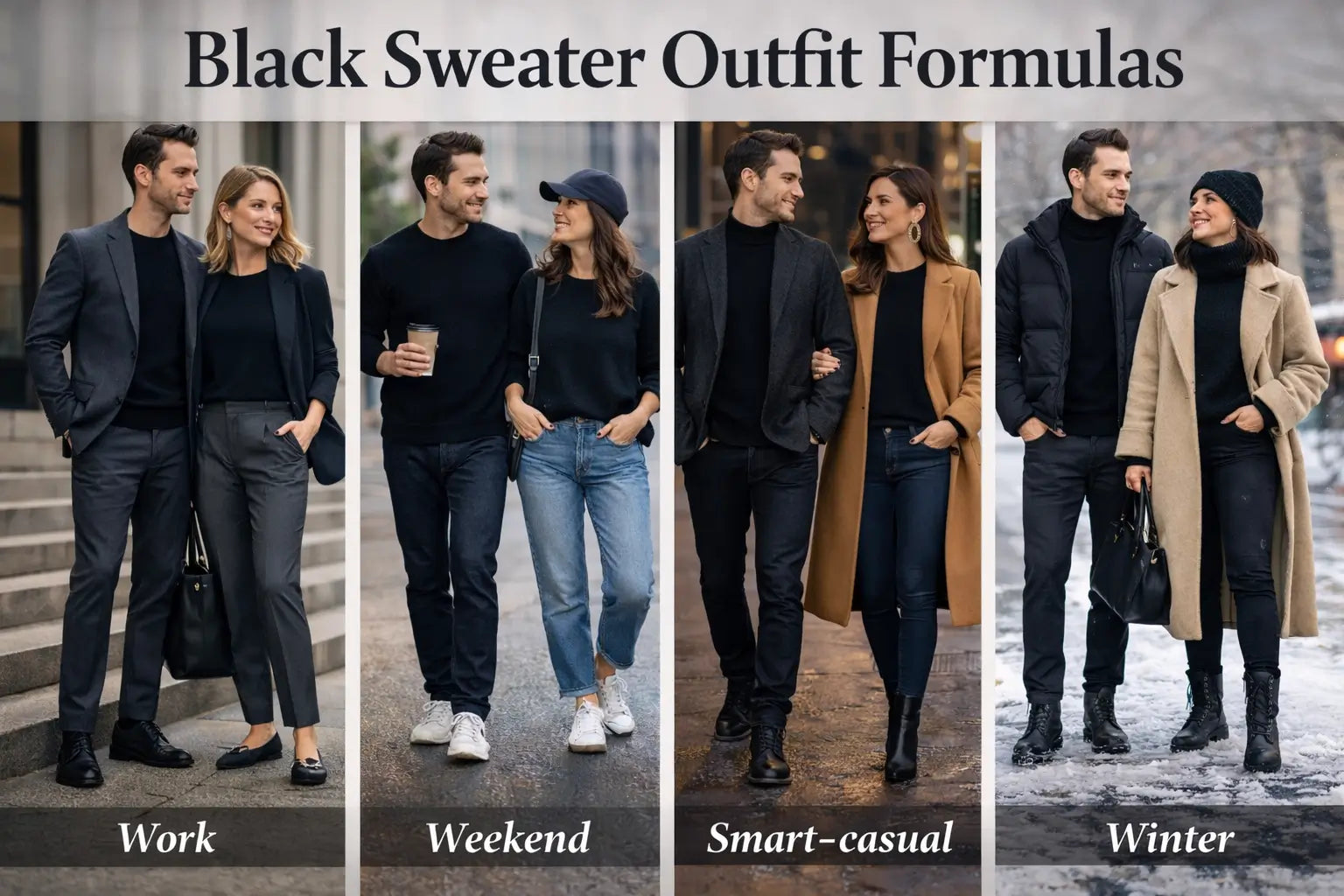
5 black sweater outfit formulas you can copy
Use a black sweater as your anchor, then pick (1) a bottom, (2) an outer layer (optional), and (3) shoes to set the formality.
Key Points
- Shoes + outerwear change the vibe fastest.
- Balance volume: if one piece is oversized, keep the other streamlined.
- Add contrast through texture (denim/leather/satin/wool), not just color.
Outfit formulas
- Work: Black crewneck sweater + tailored trousers + blazer + loafers
- Weekend: Black relaxed sweater + straight jeans + sneakers
- Smart-casual: Black sweater + dark denim + wool coat + Chelsea boots
- Date night: Black fitted sweater + slip skirt (or sleek trousers) + heeled boots
- Winter: Black sweater + warm base layer + long coat (or puffer) + ankle boots
Boundary Conditions / Caveats
- Your climate + dress code matter more than “rules.”
- If you run warm, swap chunky knits for lightweight knits and add outerwear instead.
Want these to look instantly more polished? Use the 3-rule checklist next.
The 3 rules that make a black sweater outfit look put-together
If you only remember three things: balance proportions, add texture contrast, and let shoes set the formality.
Key Points
- Balance volume: oversized top → slimmer bottom; slim top → wider bottom works.
- Texture contrast: black-on-black looks best when textures differ (rib knit + leather + denim).
- Formality dial: sneakers (casual) → loafers/boots (smart) → heels/polished boots (dressy).
How / Steps / Comparison
- Fast upgrades: belt + structured bag, or swap sneakers for loafers/boots.
- All-black tip: mix matte + shine (knit + leather) or fine + chunky textures (smooth knit + wool coat).
Boundary Conditions / Caveats
- “Flattering” is personal—use these as starting points, then tweak for comfort.
- Keep it simple: one statement piece at a time (e.g., bold coat or bold shoes).
Next, pick the most versatile black sweater type so the formulas work year-round.
What type of black sweater is most versatile?

For most wardrobes, a black crewneck in a regular-to-relaxed fit is the easiest “do-it-all” starting point—then add a turtleneck for cold weather or a cardigan for layering flexibility.
Key Points
| Sweater type | Best for | Pairs especially well with | Notes |
|---|---|---|---|
| Crewneck | Everyday + work | Blazers, coats, jeans, trousers | Most universal neckline |
| Turtleneck | Winter + dressier looks | Coats, tailored trousers, boots | Warm + sleek, but can feel “formal” |
| Cardigan | Layering + casual-smart | Tees, dresses, wide-leg pants | Easiest to take on/off |
Quick decision rules (IF/THEN):
- IF you need one sweater for work + weekends, THEN start with a crewneck.
- IF you want “instant polish” in cold weather, THEN pick a turtleneck.
- IF you layer a lot indoors, THEN pick a cardigan.
Boundary Conditions / Caveats
- “Most versatile” depends on your climate and dress code.
- Fabric/knit weight changes how dressy it looks (a chunky knit reads more casual).
Next, choose the fit (fitted vs oversized) so your outfits look intentional—not accidental.
Fitted vs relaxed vs oversized: how to choose
Pick fitted when you want sleek layering, relaxed for everyday versatility, and oversized when you’re building a cozy, casual silhouette.
Key Points
- Fitted: clean under blazers/coats; great for date night.
- Relaxed: easiest “default” for most outfits.
- Oversized: statement shape; needs balance with slimmer bottoms or structured outerwear.
How / Steps / Comparison
- Oversized sweater + straight/slim jeans + boots = balanced and easy.
- Fitted sweater + wide-leg trousers + loafers/heels = modern and polished.
Boundary Conditions / Caveats
- If the sweater is oversized and the bottom is wide, add structure (belted coat, sharp shoes).
- Comfort wins—choose what you’ll actually wear often.
Next, knit weight (lightweight vs chunky) changes how you layer—especially in winter.
Lightweight vs chunky knits: what changes in styling
Lightweight knits layer under blazers and coats easily; chunky knits look best with simpler layers and cleaner lines to avoid bulk.
Key Points
- Lightweight knit: sharp, office-friendly, easy under jackets.
- Chunky knit: cozy, casual, more “statement texture.”
- Bulk control rule: one volume piece at a time.
How / Steps / Comparison
- Lightweight: sweater + blazer + trousers + loafers (clean, minimal bulk).
- Chunky: sweater + straight jeans + long coat (or simple puffer) + boots.
Boundary Conditions / Caveats
- Warmth depends on fiber/blend and knit density, not just thickness.
- If you run warm, go lighter and add/removes layers as needed.
Now let’s apply this to real-life occasions—starting with work outfits.
How do you style a black sweater for work?
For work, keep the silhouette clean: pair a black sweater with tailored bottoms, add a structured layer (blazer/coat), and choose polished shoes.
Key Points
- Tailored bottoms do most of the “professional” work.
- A blazer instantly upgrades even a simple knit.
- Shoe choice sets the dress code: loafers/ankle boots > sneakers.
How / Steps / Comparison
Work-ready outfit ideas:
- Black crewneck + tailored trousers + blazer + loafers
- Black turtleneck + midi skirt + long coat + ankle boots
- Black sweater + dark straight jeans + structured coat + sleek flats/boots
- Black cardigan + blouse/tee + wide-leg trousers + loafers
Boundary Conditions / Caveats
- If your office is conservative, stick to fine-gauge knits and minimal texture.
- If your office is casual, keep sneakers clean and pair with a blazer or tailored pant.
Prefer low-effort outfits? Here are weekend formulas you can repeat on autopilot.
Easy black sweater outfits for weekends

On weekends, lean into comfort: a relaxed black sweater plus denim (or casual trousers) and easy shoes is the fastest repeatable combo.
Key Points
- Denim + knit is a timeless texture contrast.
- A casual jacket (denim/leather/bomber) keeps the outfit from feeling “plain.”
- Sneakers or flat boots make it feel intentional.
How / Steps / Comparison
Weekend outfit ideas:
- Black sweater + straight jeans + sneakers
- Black sweater + cargo pants + bomber jacket + sneakers
- Black oversized sweater + leggings + long coat + chunky boots (casual-only)
- Black sweater + wide-leg jeans + leather jacket + ankle boots
Boundary Conditions / Caveats
- Leggings read casual; swap to straight jeans or trousers if you need polish.
- If you’re going oversized, keep shoes a bit structured (boots/clean sneakers).
Need something dressier? Use the “dress it up” checklist for date night or events.
How do you dress up a black sweater for date night or events?
To dress up a black sweater, add one “evening signal”: sleeker fabric (satin/leather), sharper silhouette (tuck/belt), and more polished shoes.
Key Points
- Texture contrast = instant elevation.
- A defined waist (tuck, belt, high-rise bottom) looks more intentional.
- Jewelry and a structured bag do a lot with minimal effort.
How / Steps / Comparison
3-step “dress it up” checklist:
- Texture: pair with satin, leather, or tailored wool
- Shape: tuck in, half-tuck, or belt a coat to create a waist
- Shine: add jewelry + polished boots/heels
Dressy outfit ideas:
- Black fitted sweater + slip skirt + heeled boots + statement earrings
- Black turtleneck + tailored trousers + pointed flats/boots + structured bag
- Black sweater + leather pants + long coat + sleek boots
- Black sweater + midi skirt + belt + ankle boots
Boundary Conditions / Caveats
- “Dressy” varies—choose shoes and jewelry that fit your venue.
- Keep one focal point: bold earrings or bold skirt or statement boots.
If it’s cold out, winter layering is the real difference-maker—here’s the no-bulk method.
Black sweater outfits for winter: layering without bulk
In winter, focus on a warm base layer, choose the right knit weight, then add structured outerwear so the outfit stays streamlined.
Key Points
- Layering order matters more than adding random thickness.
- Chunky knit + simple coat = clean; thin knit + blazer + coat = warm and polished.
- Boots and outerwear carry the winter look.
How / Steps / Comparison
5-step winter layering order:
- Base layer (light, close to skin)
- Black sweater (choose weight for your climate)
- Outerwear (coat, puffer, or blazer+coat)
- Warm accessories (scarf/hat/gloves)
- Winter-ready footwear (boots)
Winter outfit ideas:
- Black turtleneck + wool trousers + long coat + Chelsea boots
- Black crewneck + straight jeans + wool coat + ankle boots
- Black chunky sweater + slim/straight pants + simple puffer + boots
- Black sweater + midi skirt + tights + long coat + heeled boots
Boundary Conditions / Caveats
- Warmth depends on fiber/blend and construction—adjust layers based on comfort.
- If you feel bulky, simplify: remove one layer or switch to a lighter knit.
Want more variety than jeans? Here are the best “beyond denim” pairings.
What can you wear with a black sweater besides jeans?
Besides jeans, black sweaters pair especially well with tailored trousers, skirts, leggings (casual), or layered over dresses—your shoe choice controls how dressed-up it feels.
Key Points
- Trousers = polished; skirts = feminine/dressy; leggings = casual comfort.
- Contrast helps: pair matte knits with shinier or structured bottoms.
- Keep proportions intentional: tuck or half-tuck when you need shape.
How / Steps / Comparison
Trousers (polished):
- Black sweater + wide-leg trousers + loafers
- Black sweater + tailored trousers + ankle boots
Skirts (easy to dress up):
- Black sweater + satin midi skirt + heeled boots
- Black sweater + denim skirt + sneakers/boots
Leggings (casual-only):
- Black oversized sweater + leggings + long coat + boots
Over a dress (layering trick):
- Black cardigan + slip dress + ankle boots
Boundary Conditions / Caveats
- Skirt length + footwear should match weather and comfort (tights help in winter).
- Leggings can look “unfinished” without a strong shoe/outerwear choice—add boots or a structured coat.
Shoes are the quickest upgrade—here’s a simple guide.
What shoes go with a black sweater outfit?

Choose shoes based on the vibe you want: sneakers for casual, loafers for smart-casual, boots for fall/winter polish, and heels for dressy.
Key Points
- Sneakers: weekend, streetwear, relaxed outfits
- Loafers: work, smart-casual, “clean” outfits
- Chelsea/ankle boots: fall/winter, easy polish
- Heeled boots/heels: date night, events
How / Steps / Comparison
- If the outfit feels too basic, upgrade shoes first (sneakers → loafers/boots).
- Match shoe “weight” to knit weight: chunky knit looks great with boots; fine knits can go with loafers/heels.
Boundary Conditions / Caveats
- Prioritize comfort and the ground/weather (winter traction matters).
- Keep shoes clean—especially sneakers—if you’re aiming for “put-together.”
Need men’s outfit ideas? Here are four easy modes.
Men’s black sweater outfits: 4 easy modes

Men can style a black sweater by choosing one of four “modes” (office, smart-casual, weekend, night-out) and adjusting shoes + outerwear.
Key Points
- Office: cleaner lines, tailored pants, polished shoes
- Smart-casual: denim or chinos + structured outerwear
- Weekend: relaxed bottoms + sneakers
- Night-out: darker palette, sharper shoes/boots
How / Steps / Comparison
Office-ready: black crewneck + chinos/trousers + coat/blazer + loafers
Smart-casual: black sweater + dark jeans + wool coat + Chelsea boots
Weekend: black sweater + jeans + sneakers + simple jacket
Night-out: black turtleneck + tailored trousers + long coat + sleek boots
Boundary Conditions / Caveats
- Dress codes vary—swap trousers for chinos/jeans and loafers for clean sneakers as needed.
- If you want the most versatile single pick, a crewneck is usually easiest.
To keep your black sweater looking sharp, use the care checklist next.
How do you keep a black sweater looking new: avoid pilling, fading, and stretching
Follow the care label first, then reduce friction (abrasion), use gentler washing, and store knits properly to slow pilling and keep shape.
Key Points
- Care labels are required for most apparel and give the “regular care” method—use them as your default. (ftc.gov)
- Pilling is largely caused by friction/abrasion—less rubbing = fewer pills over time. (woolmark.com)
- Turning sweaters inside out and using gentler cycles can help reduce surface wear. (woolmark.com)
Do / Don’t
- Do: turn the sweater inside out before washing. (woolmark.com)
- Do: choose cold water when unsure and handle gently (especially knits). (cleaninginstitute.org)
- Do: dry knits in a shape-friendly way (often flat drying is safest for sweaters). (cleaninginstitute.org)
- Don’t: over-wash—air out and spot-clean when appropriate (if the care label allows). (woolmark.com)
- Don’t: hang heavy knits for long periods; folding helps prevent stretching. (woolmark.com)
How to remove pills
- Lay the sweater flat and smooth the fabric.
- Use a fabric shaver/comb gently—don’t press hard.
- Focus on high-friction zones (underarms, sides, cuffs).
- Wash inside out next time to reduce repeat friction. (woolmark.com)
Boundary Conditions / Caveats
- Some pilling is normal; the goal is reducing how quickly it builds up, not “eliminating it forever.” (woolmark.com)
- Always follow your sweater’s specific care label (fiber blends and constructions differ). (ftc.gov)
If you’re developing a black sweater for a brand drop, the next section turns these styling needs into a spec checklist.
For brands/design teams: black sweater spec checklist before sampling
To sample a black sweater efficiently, decide the core specs up front (type, fit, knit weight/structure, measurements, trims/labels, packaging) so fewer revisions are needed.
Key Points
- Specs reduce back-and-forth: clearer inputs → cleaner sample feedback loop.
- Styling intent should drive specs (e.g., “workwear polish” usually prefers cleaner knits and stable shape).
- Avoid “undefined” choices: neckline, hem/cuff finish, and fit are the usual revision triggers.
Checklist table (spec → options → why it matters → common pitfalls)
| Spec item | Options to decide | Why it matters | Common pitfalls |
|---|---|---|---|
| Sweater type | Crewneck / turtleneck / cardigan | Controls layering + season use | Choosing a type that clashes with target outfits |
| Fit & silhouette | Fitted / regular / relaxed / oversized | Drives proportions + size grading | Vague fit notes (“slightly loose”) without references |
| Knit weight (non-numeric) | Lightweight / mid / chunky | Affects layering + drape | Too chunky for blazer layering; too thin for winter brief |
| Knit structure | Rib / jersey / cable / textured | Changes look, stretch, and “casual vs polished” | Adding texture that pills/wears faster in high-friction zones |
| Neckline finishing | Rib depth/feel, collar height | Comfort + shape retention | Neckline stretching or discomfort complaints |
| Measurements & grading | Base size + grade rules | Fit consistency across sizes | Missing tolerances; inconsistent sleeve length targets |
| Color standard | “True black” target, lab dip process | Consistency across lots | “Black” drifting (too warm/cool) across reorders |
| Trims & labels | Care label, woven label, hangtag | Compliance + brand identity | Late label decisions causing delays |
| Packaging | Polybag, box, inserts | Customer experience + logistics | Packaging not aligned with shipping method |
Complexity drivers
- More complex stitches/textures (e.g., heavy cables), special trims, and extra finishing steps generally increase sampling iteration risk and production complexity.
Boundary Conditions / Caveats
- Sampling timelines and production details vary by yarn availability, design complexity, and quantities—avoid locking expectations until specs are confirmed.
- Keep this checklist as a starting point; your factory may request additional details depending on construction.
Want the simplest “hero” black sweater for maximum outfit versatility? Re-check the crewneck/turtleneck/cardigan chooser above.
Quick recap: build your black sweater outfit in 30 seconds
Pick a sweater type, pick a bottom, then use outerwear + shoes to set the vibe.
Key Points
- Most versatile base: black crewneck, regular-to-relaxed fit
- Fastest upgrade: add a blazer/coat or swap shoes upward
- Best winter move: layer in order, don’t stack bulk randomly
Boundary Conditions / Caveats
- Climate and comfort come first—adjust knit weight and layers accordingly.
If you’re still deciding, start with the “5 formulas” section and copy the closest match to your day.
FAQ
How do you style a black sweater for work?
Pair it with tailored bottoms, add a structured layer (blazer/coat), and choose polished shoes.
- Key tip: fine-gauge knits read more “office” than chunky textures.
- Caveat: dress codes vary—use loafers/boots to upgrade quickly.
See the work section above for 4 copy-ready formulas.
How do you layer a black sweater in winter without looking bulky?
Use a warm base layer, then one main knit layer, then structured outerwear—one volume piece at a time.
- Key tip: chunky knit + simple coat; thin knit + blazer + coat.
- Caveat: warmth depends on fiber/blend and construction.
Jump to the winter section for the 5-step order.
Is a turtleneck or crewneck more versatile?
Crewneck is usually more versatile across seasons; turtleneck wins for cold-weather polish.
- Key tip: crewneck layers under more jacket types.
- Caveat: if you dislike tight necklines, turtlenecks won’t feel “versatile” for you.
Use the sweater-type table for quick pairing ideas.
What can you wear with a black sweater besides jeans?
Tailored trousers, skirts, leggings (casual), or layered over dresses all work—shoes decide the formality.
- Key tip: add texture contrast (satin/leather/wool).
- Caveat: leggings are typically casual unless styled with strong outerwear and boots.
See the “beyond jeans” section for grouped options.
How should men style a black sweater?
Choose one of four modes (office, smart-casual, weekend, night-out) and adjust shoes + outerwear accordingly.
- Key tip: Chelsea boots and wool coats quickly move it into smart-casual.
- Caveat: workplace norms vary—swap trousers/chinos/jeans as needed.
Use the “4 easy modes” section above.
How do you stop a sweater from pilling?
You can’t always prevent pilling entirely, but you can slow it by reducing friction and washing more gently (often inside out). (woolmark.com)
- Key tip: turn inside out before washing; handle gently. (woolmark.com)
- Caveat: always follow the care label first. (ftc.gov)
See the care section for do/don’t + removal steps.
)