
Chunky Crochet Cardigan: What “Chunky” Means + Yarn, Gauge, Fit, and Style Options
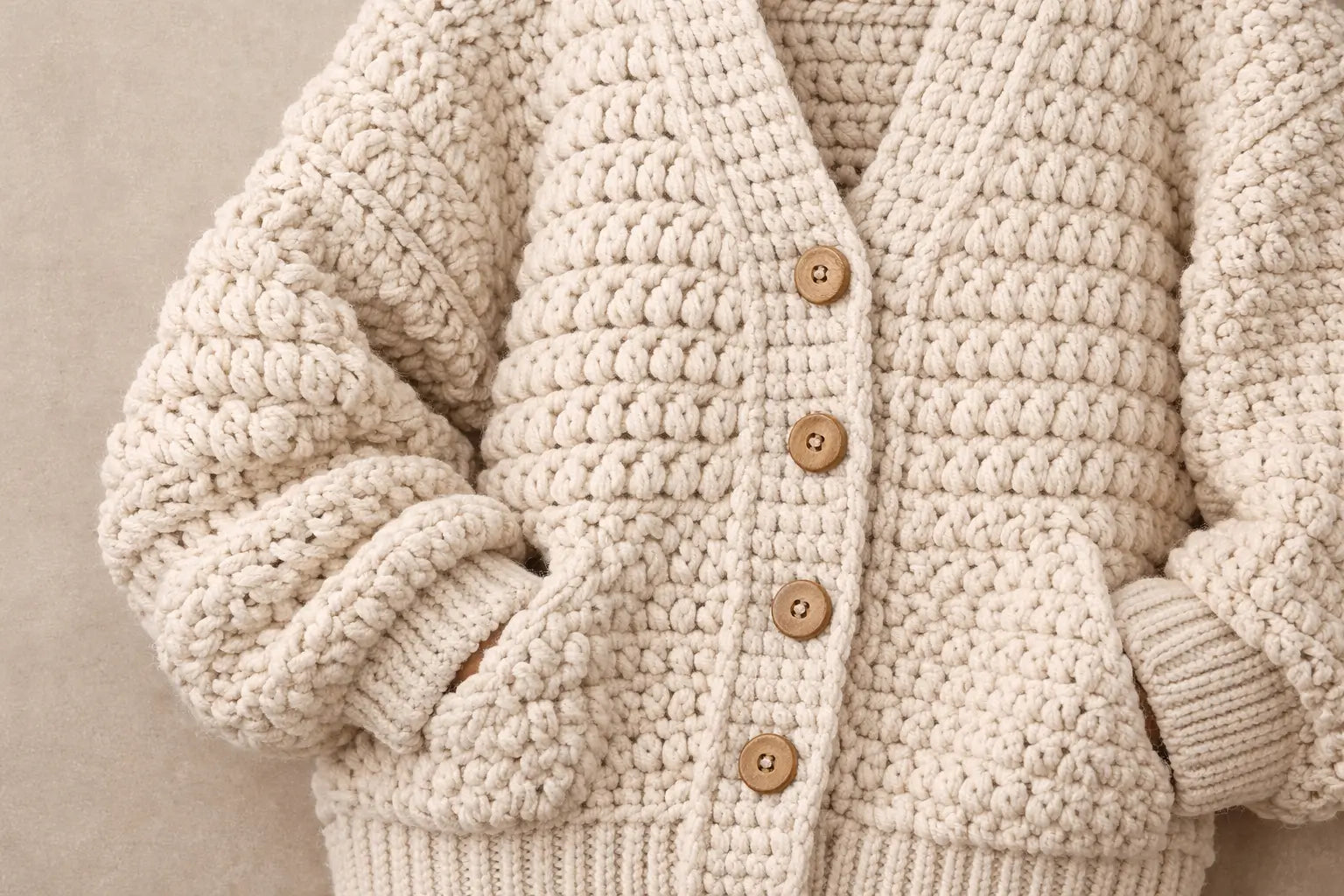
Chunky Crochet Cardigan: quick definition + what to decide first
A chunky crochet cardigan looks “thick” and cozy because of a combination of yarn weight (often bulky or super bulky), stitch scale/density (bigger, more dimensional stitches), and an oversized silhouette. “Chunky” isn’t just about the yarn—fit and fabric structure can make the same yarn read chunkier or lighter.
What makes a crochet cardigan “chunky”?
Key Points (bullets)
- Thicker yarn (often weight 5 bulky or weight 6 super bulky) creates visible thickness fast.
- Bigger stitch scale (more texture and height) makes the fabric look fuller.
- Looser, oversized fit (drop shoulders, roomy sleeves) adds “bulk” visually.
- Shorter, denser stitches can feel chunky but heavier; taller stitches can look chunky with more drape.
Boundary Conditions / Caveats (1–3 bullets)
- A chunky look can come from yarn weight or stitch scale—but both affect garment weight and stretching differently.
- Longer cardigans and wide sleeves can stretch out more simply because there’s more fabric weight pulling downward.

Decide-first checklist (yarn weight, intended fit, length)
Before you choose stitches or details, decide the three levers that control the look and behavior: yarn weight, intended fit, and cardigan length.
Key Points (mini checklist)
- Choose your yarn weight target: bulky (5) or super bulky (6).
- Decide the fit goal: relaxed vs very oversized (how much ease you want).
- Decide the length: cropped, hip-length, or longline (length strongly affects weight and stretch).
- Decide the texture priority: smooth “big stitch” vs very dimensional texture.
Boundary Conditions / Caveats
If your goal is “chunky but not heavy,” you’ll usually want to manage stitch density, length, and sleeve volume (not just the yarn label).
Crochet vs knit: what changes for stretch, texture, warmth, and the chunky look
Crochet and knit fabrics can both look chunky, but they behave differently: crochet often feels more structured and textured, while knit often has more natural stretch and recovery. Your fiber and stitch pattern can shift these “typical” behaviors a lot—so treat this as a decision framework, not a rule.
Comparison table: crochet vs knit (what you’ll feel and see)
Key Points (comparison table)
| What you care about | Crochet cardigan (typical) | Knit cardigan (typical) | What changes the result |
|---|---|---|---|
| Stretch & recovery | Often less “springy” unless designed for it | Often more stretch and recovery | Fiber blend, stitch choice, ribbing/structure |
| Texture | Easy to create bold, dimensional texture | Can be smooth or textured, but different look | Stitch pattern and yarn construction |
| Warmth / wind | Can be dense and cozy (depends on stitch density) | Can be warm with good drape | Stitch density, fabric openness, fiber |
| Drape | Can range from structured to drapey | Often drapey depending on knit structure | Yarn weight, gauge, stitch pattern |
| “Chunky look” | Very achievable with big stitches and texture | Very achievable with bulky knit stitches | Same levers: yarn weight + gauge + silhouette |
Boundary Conditions / Caveats
- A “crochet-look” cardigan can be made to drape more by using taller stitches, looser gauge, and softer fibers—but that can increase stretch-out risk.
- The word “chunky” is sometimes used loosely in shopping listings; always check yarn weight/gauge (or fabric thickness) if you’re trying to match a specific feel.
“Knit-look” with crochet: when it works (high-level)
If you like the chunky knit aesthetic but prefer crochet construction, aim for a stitch pattern that produces a flatter, more uniform surface and control your gauge carefully.
Key Points (bullets)
- Choose less lacy, more continuous stitch patterns if you want a knit-like surface.
- Keep gauge consistent across panels so the cardigan doesn’t look patchy or uneven.
- If the look depends on very uniform surface texture, sample more than once (small changes show up more in bulky yarn).
Boundary Conditions / Caveats
Stitch choice alone won’t solve everything—fiber, yarn twist, and finishing can change how “knit-like” the surface reads.
Yarn weight + gauge: bulky vs super bulky, sizing, and drape
Bulky and super bulky yarns create a chunky look quickly, but they also make sizing more sensitive: a small gauge change can shift the finished measurements a lot. Gauge is the bridge between “how it looks” and “how it fits.”

Mini-table: Bulky vs Super Bulky — what changes for cardigans
Key Points (mini-table)
(Industry yarn weight references often label bulky as weight 5 and super bulky as weight 6.)
| Yarn weight (common label) | What it tends to do | Common risks to watch | Good use-cases |
|---|---|---|---|
| Bulky (5) | Chunky look with a bit more flexibility | Slightly easier to manage fit than super bulky, but still sensitive | Hip-length cardigans, structured-but-wearable warmth |
| Super bulky (6) | Very chunky, fast build, bold texture | Size can shift quickly; garment can get heavy and stretch | Statement cardigans, very cozy outer-layer feel |
Boundary Conditions / Caveats
“Bulky vs super bulky” is a labeling system; yarns within the same category can still differ a lot in thickness, softness, and twist.
Step-by-step: keep sizing predictable (swatch → measure → adjust → re-check)
To keep a chunky cardigan fitting the way you expect, treat swatching as a sizing tool: you’re testing measurement stability and drape, not just stitch appearance.
How / Steps (ordered steps)
- Swatch bigger than you think you need. Make a generous swatch in your intended stitch pattern (not just a tiny square).
- Finish the swatch the way you’ll finish the garment. If you’ll block or steam, do it now so the fabric behavior is realistic.
- Measure stitches and rows over a fixed area. Record stitch gauge and row gauge, then compare to your target pattern/spec.
- Adjust one lever at a time. Change hook size, yarn choice, or stitch pattern—then swatch again.
- Check drape and weight in-hand. A cardigan can match gauge but still feel too stiff or too heavy for the silhouette you want.
- Lock the “recipe.” Once you like fit + feel, write down the exact yarn, hook, stitch pattern, and finishing so you can repeat it.
Boundary Conditions / Caveats
- With bulky yarn, a small gauge shift can become a big measurement shift across the body and sleeves—especially in oversized fits.
- If your cardigan will be longline, test for stretch by hanging the swatch briefly and re-measuring.
Common mistakes checklist (why it feels heavy / stretches out)
Chunky cardigans often feel heavy or stretch out because the fabric weight is pulling on a loose structure, or because the gauge changed between panels.
Key Points (checklist)
- Skipped swatching (or swatched in a different stitch than the final fabric)
- Chose a very long length + wide sleeves without adjusting stitch density
- Mixed tension between panels (fronts vs sleeves)
- Used a very soft, low-twist yarn that relaxes a lot
- Joined motifs/panels without checking measurements at each stage
- Finished differently than planned (blocking/steaming changed size)
Boundary Conditions / Caveats
Some stretch is normal in cozy oversized silhouettes; the goal is to control it, not eliminate it.
Fiber choices for chunky crochet cardigans (cotton vs wool vs acrylic blends)
The best fiber depends on the outcome you want: warmth, ease of care, softness, and how much you want to manage pilling and stretching. Use this section to choose by performance, not by hype.
Fiber decision mini-table (by outcome: warmth, care, feel, pilling)
Key Points (mini-table)
| Fiber (common) | What it’s good at | Trade-offs to consider | When it fits the “chunky cardigan” goal |
|---|---|---|---|
| Wool / wool blends | Warmth, cozy hand-feel, spring | Can require gentler care; can felt/shrink if mishandled | Cold-weather cardigans; structured warmth |
| Acrylic | Easy-care options; consistent supply; often budget-friendly | Can pill; warmth varies by yarn; can feel less breathable | Everyday chunky cardigans where easy care is key |
| Cotton | Breathability, smoother feel | Can feel heavier; can stretch under weight; warmth is lower | Transitional seasons; “chunky look” with less heat |
| Blends (wool/acrylic, cotton/acrylic, etc.) | Balance of warmth, care, cost, feel | Behavior depends on blend ratio and yarn construction | Great for dialing in the exact comfort/care target |
Boundary Conditions / Caveats
Yarn construction (twist, ply, “roving” styles) can change stretch and pilling as much as the fiber name does.
Care label considerations (general, non-legal)
Care guidance should match the most sensitive component of the garment (fiber + finishing + trims). For chunky cardigans, the biggest issues are shrink risk, stretching under weight, and surface fuzz/pilling.
Key Points (bullets)
- If a fabric can shrink, plan for it in sampling and communicate appropriate care.
- Heavy garments can stretch when wet—flat drying and gentle handling can matter more than people expect.
- Trims (buttons, metal details) and labels can change what “safe care” looks like.
Boundary Conditions / Caveats
Specific legal labeling requirements vary by market and seller role; treat this as general guidance and confirm requirements for your sales channel.
Chunky-looking stitches and common cardigan constructions
Chunky-looking crochet cardigans usually rely on bold texture and simple geometry. The most common “paths” are motif-based builds (like granny squares), hexagon constructions, or panel-built cardigans.
Stitch texture choices that read “chunky” (high-level)
- Dense, dimensional stitches can look very chunky, but they can also increase garment weight.
- Taller stitches can create a chunky look with more drape (often feeling lighter for the same visual scale).
- Consistency matters more with chunky yarn: uneven tension is easier to see.
Boundary Conditions / Caveats
“Best stitch” depends on your comfort goal: structured vs drapey, smooth vs textured.
3 common builds: hexagon vs panels vs motifs (granny squares)
- Hexagon construction: popular for “easy cardigan” builds; simple shaping with a bold look.
- Panel construction: predictable sizing and fit control; easier to standardize measurements.
- Motifs (granny squares/patchwork): iconic chunky look; joining quality and measurement consistency become critical.
Boundary Conditions / Caveats
Motif-based cardigans can be very scalable visually, but they require careful control of motif size and joining to keep fit consistent.
Design options that change fit, weight, and complexity
In chunky cardigans, design choices like length, sleeve volume, and panel/motif count often change the final feel more than the stitch pattern does. Make these choices early so you don’t fight weight and stretch later.
Silhouette choices (open-front vs buttoned; cropped vs longline)
- Cropped: less weight, often less stretch-out; bold chunky texture shows well.
- Hip-length: classic wearable balance for chunky yarn.
- Longline: very cozy, but heavier—plan for stretch and reinforcement where needed.
- Open-front: easy layering; less stress on closure points.
- Buttoned: can look polished; buttons/holes add complexity and QC points.
Boundary Conditions / Caveats
Longline + super bulky + wide sleeves can produce a very heavy garment; sample the drape before committing.
Details that spike complexity (pockets, patchwork, trims)
- Pockets: add weight and require careful placement to avoid sagging.
- Patchwork / color blocking: increases joining and measurement checkpoints.
- Trims and closures: button alignment and stability become visible quickly in chunky textures.
Boundary Conditions / Caveats
If you want “simple but premium,” invest in consistent measurements and neat finishing—those show up strongly in chunky textures.
If you’re developing this for a brand: spec sheet checklist for sampling
To turn a chunky crochet cardigan idea into a repeatable product, the fastest wins come from a clear spec sheet: measurements, stitch/fabric references, and a consistent “recipe” for yarn + gauge + finishing.
Measurement checklist (what matters most for oversized chunky fits)
- Body length (from high point shoulder to hem)
- Chest width (flat measurement) and intended ease level (relaxed vs oversized)
- Shoulder/drop shoulder point position
- Sleeve length and sleeve width (especially bicep and cuff)
- Hem width and cuff width
- Front opening depth (if open-front) or button placement spacing (if buttoned)
- Pocket size and placement (if included)
Boundary Conditions / Caveats
Tolerances depend on construction (motifs vs panels) and stitch texture; avoid assuming one universal tolerance.
“Must send for quoting” mini-table (refs, size range, yarn target, trims)
| What to provide | Examples | Why it matters |
|---|---|---|
| Reference visuals | photos, sketch, inspiration links | Aligns look, texture, and silhouette |
| Measurement spec sheet | size chart + key points | Controls fit and reduces revisions |
| Yarn/fiber target | bulky vs super bulky; fiber goal | Drives hand-feel, care, cost drivers |
| Stitch/fabric reference | stitch photo, swatch note | Improves consistency expectations |
| Size range and ratio | XS–XL or S–2XL, etc. | Affects sampling and grading effort |
| Trims and branding | buttons, labels, hangtags, packaging | Impacts lead steps and readiness |
If you’re preparing a chunky crochet cardigan for sampling, send (1) reference images, (2) size range, (3) target yarn weight/fiber outcome, and (4) a simple measurement table. That’s usually enough to start a practical discussion about feasibility and next steps.
Quality control: checkpoints to prevent size drift and uneven texture
Chunky textures magnify small inconsistencies. Quality control works best when it’s staged: verify gauge and measurements early, then re-check at key assembly points.
QC checklist (what to check every time)
- Stitch consistency (tension and texture) across panels or motifs
- Key measurements at each stage (not only at the end)
- Motif/panel size consistency (if using granny squares/patchwork)
- Join quality (alignment, seam strength, neatness)
- Sleeve symmetry (left vs right)
- Button placement alignment (if applicable)
- Final garment hang and drape (especially in heavier silhouettes)
Boundary Conditions / Caveats
Handmade elements can increase variation; define what “acceptable” looks like during sampling so bulk expectations are realistic.
Stage table (swatch → sample → pre-production → bulk)
| Stage | What to confirm | Why it prevents problems later |
|---|---|---|
| Swatch | gauge, drape, texture | prevents wrong size and wrong feel |
| Sample | full measurement check, construction details | catches fit and assembly issues |
| Pre-production | repeatability and consistency standards | reduces bulk variation risk |
| Bulk | ongoing measurement and texture checks | catches drift before it compounds |
Production models at scale: handmade vs hybrid vs crochet-look alternatives
Crochet-style cardigans can be produced in different ways depending on how authentic the crochet look needs to be and how consistent you need the output to be. The right model is usually a trade-off between visual authenticity, consistency, and throughput.
Comparison table: handmade vs hybrid vs alternatives (when to choose which)
| Model | What it means | Strengths | Trade-offs | Best when… |
|---|---|---|---|---|
| Handmade crochet | High handwork share | Authentic look; flexible design details | Variation risk; throughput depends on labor | The crochet identity is the product |
| Hybrid | Some handwork + more standardized steps | Better consistency; scalable components | Still needs strong QC and clear specs | You want the look with more repeatability |
| Crochet-look alternatives | Alternative constructions that mimic crochet texture | Highest repeatability; predictable sizing | May not satisfy “true crochet” buyers | Consistency and scale are the priority |
Boundary Conditions / Caveats
Complexity (panel count, motif joining, trim work) can dominate feasibility as much as the method choice.
MOQ / lead time / cost drivers: what changes a quote
For chunky crochet cardigans, quotes and timelines move mainly with material choice, stitch/assembly complexity, size range, and the number of approval rounds. Instead of expecting one fixed number, plan around the drivers.
Mini-table: key drivers (material, stitch complexity, panel count, sizes, trims)
| Driver | What it changes | Why it matters |
|---|---|---|
| Yarn/fiber choice | hand-feel, care, cost structure | some fibers and yarn constructions cost more or behave differently |
| Stitch/texture complexity | labor steps and QC checkpoints | more complexity increases variation risk |
| Panel/motif count | joining time and measurement control | more joins = more chances for drift |
| Size range and grading | sampling effort and repeatability | more sizes require stronger spec control |
| Trims and closures | additional components and alignment | buttonholes/placements need consistent QC |
| Approval rounds | timeline variability | more revisions often add time |
Boundary Conditions / Caveats
Shipping mode/destination and approval cycles can shift delivery expectations; treat timelines as a plan that depends on decisions and confirmations.
Quote-prep checklist (what to confirm before requesting pricing)
- Final silhouette (length, sleeve volume, closure type)
- Yarn weight target (bulky vs super bulky) and desired fiber outcomes
- Stitch/texture reference (photo or swatch description)
- Measurement table and size range
- Colorways and trims (buttons, labels, packaging)
- Target delivery window as a planning goal (not a guarantee)
If you want a more accurate quote conversation, share your reference images and a simple spec sheet first. “Chunky” can be achieved many ways—your yarn weight, stitch texture, and silhouette choices are what make pricing and timelines meaningful.
Private label execution: labels, packaging, and shipping inputs for US orders
Private label execution goes smoother when you lock label and packaging assets early and keep shipping inputs clear. Most delays here come from missing files, unclear carton marks, or last-minute packaging changes.
Steps: what to lock before bulk (labels, packaging, carton marks)
- Confirm what labels you need: brand label, size label, and care label plan.
- Finalize hangtags and packaging style (polybag, inserts, or other retail needs).
- Confirm carton packing requirements (carton marks, assortment, folding method).
- Check that all artwork files are print-ready (correct dimensions, colors, and approvals).
- Align packaging choices with your sales channel needs (warehouse, boutique, direct-to-consumer).
Boundary Conditions / Caveats
Requirements vary by channel and destination; treat this as a planning checklist, not legal advice.
Shipping inputs checklist (destination, freight preference, timelines as “depends”)
- Ship-to destination and receiving requirements
- Preferred freight approach (air vs sea vs express)
- Desired delivery window (planning target)
- Packaging dimensions and carton quantities (affects shipping planning)
- Required documents per your channel or importer process (confirm with your partners)
If you’re shipping to the US, it helps to share your destination, preferred freight approach, and packaging plan early. That lets logistics planning start while sampling and approvals are underway.
FAQ
FAQ Q1: What makes a crochet cardigan “chunky”?
“Chunky” usually comes from thicker yarn (often bulky or super bulky), larger stitch scale/texture, and an oversized silhouette. The look is a combination of materials and design—not one single label.
Boundary Conditions / Caveats
A longer, heavier cardigan can look chunkier but may stretch out more over time.
FAQ Q2: Crochet vs knit cardigan—what changes?
Crochet often creates bolder surface texture and can feel more structured, while knit often has more natural stretch and recovery. Fiber and stitch choice can shift either fabric toward drapier or sturdier behavior.
Boundary Conditions / Caveats
“Typical” behavior changes with stitch pattern, gauge, and fiber blends.
FAQ Q3: How do bulky/super bulky yarn and gauge affect sizing?
With bulky yarn, small gauge differences can create noticeable size differences across the body and sleeves. Swatching and measuring in your actual stitch pattern is the most reliable way to keep fit predictable.
Boundary Conditions / Caveats
Stitch density and garment length strongly affect final weight and stretch-out.
FAQ Q4: Which fibers work best for chunky crochet cardigans?
Choose fibers based on the outcome you want: wool blends for warmth and spring, acrylic for easy-care options, cotton for breathability with less warmth, and blends for balance. Yarn construction also matters—two “acrylic” yarns can behave very differently.
Boundary Conditions / Caveats
Care expectations should match your customer and sales channel.
FAQ Q5: How many skeins of chunky yarn for a cardigan?
There isn’t one universal skein count because it depends on size, length, stitch density, and yarn yardage per skein. The best approach is to estimate by (1) your target garment size/length, (2) the yarn’s yardage per skein, and (3) your swatch density.
Practical method (bullets)
- Check your yarn’s yardage per skein.
- Decide size range and length (cropped vs hip vs longline).
- Swatch to understand how dense your fabric is.
- Use a yardage guide as a starting point, then add a buffer for sleeves, pockets, and revisions.
Boundary Conditions / Caveats
Motif/patchwork cardigans can require more yarn due to joins, borders, and density changes.
FAQ Q6: What production approaches exist for crochet-style garments at scale?
Common approaches include handmade crochet, hybrid methods that standardize parts of the process, and crochet-look alternatives designed for high repeatability. The right choice depends on how critical “true crochet” authenticity is versus consistency and throughput.
Boundary Conditions / Caveats
Complexity and the number of joins/panels often affect feasibility as much as the method.
Wrap-up + next steps
A chunky crochet cardigan is easiest to get right when you treat it as a system: yarn weight, gauge, fiber, and silhouette working together. If you want predictable fit and repeatable production, lock your “recipe” early and build your spec and QC around it.
Key Points (bullets)
- Decide-first: yarn weight, fit, length, texture priority.
- Use gauge swatching to control sizing and drape.
- Choose fiber by outcome (warmth vs care vs feel).
- For brand development, a clear spec sheet and staged QC reduce avoidable revisions.
References (credible external links)
- Craft Yarn Council: Standard Yarn Weight System (bulky and super bulky categories)
https://www.craftyarncouncil.com/standards/yarn-weight-system - Craft Yarn Council: Guide to yarn weights (bulky vs super bulky, suggested gauges and hook sizes)
https://www.craftyarncouncil.com/blog/ydkwydk-guide-yarn-weights - Craft Yarn Council: Gauge and why it’s important
https://www.craftyarncouncil.com/blog/ydkwydk-gauge-and-why-its-important - Lion Brand: How much yarn do I need? (estimation guidance; not exact)
https://www.lionbrand.com/pages/how-much-yarn-do-i-need - U.S. FTC: Care Labeling Rule (official rule text)
https://www.ftc.gov/legal-library/browse/rules/care-labeling-textile-wearing-apparel-certain-piece-goods-text
