
Grey (Gray) Sweater Outfit Ideas for Men: 12 Easy Looks + Color Pairing Cheat Sheet
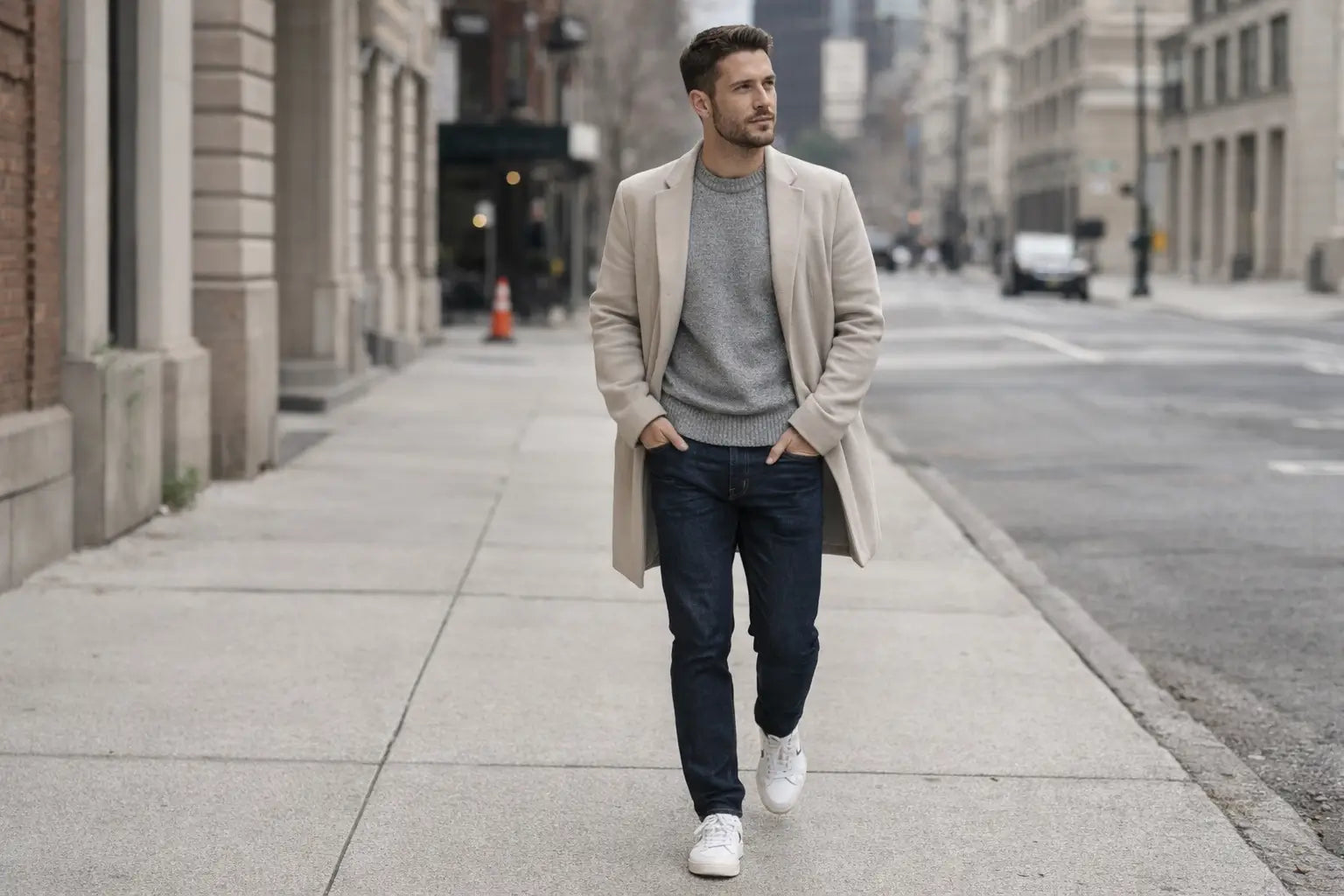
A grey (or gray) sweater is one of the easiest “do-more-with-less” pieces in menswear: it works with denim, chinos, and trousers, and it can lean casual or smart depending on the knit and what you pair it with.
Grey/Gray Sweater Outfit Cheat Sheet (Colors + Pants + 5 Formulas)
A grey sweater looks best when you treat it like a neutral base and control two things: contrast (light vs dark) and formality (fabric + shoes).
Key points
- Light grey reads cleaner and brighter; charcoal reads sharper and more “evening.”
- Change formality fastest by swapping shoes (sneakers → boots/loafers) and bottoms (denim → chinos/trousers).
- Add interest with texture (heather, rib, cable) or one extra layer—without stacking bulky fabrics.
Quick “best pants” mini-table
| Pants option | Best for | Default shoes | Quick note |
|---|---|---|---|
| Dark indigo jeans | Casual → smart casual | White sneakers / brown boots | Easiest all-around pairing |
| Khaki chinos | Smart casual | Brown leather shoes / clean sneakers | Great contrast with charcoal |
| Black jeans/chinos | Sleek casual | Black boots / white sneakers | Add texture to avoid “flat” look |
| Navy chinos/trousers | Office-leaning | Loafers / derbies | Very “safe” palette |
| Grey trousers | Modern monochrome | Black loafers / sneakers | Use texture + contrast in layers |
Boundary conditions
- Office dress codes vary: sneakers may be fine in some workplaces and a no-go in others.
- Knit thickness changes how much you can comfortably layer under or over the sweater.
To make these choices even faster, start with a simple palette you can repeat all season.
Quick color palette (safe combos)
Grey is neutral, so the “best” colors are the ones that give you clean contrast without fighting the sweater’s tone.
Key points (safe combos)
- Grey + navy (easy, classic)
- Grey + indigo denim (casual staple)
- Grey + black (sleek, but watch contrast)
- Grey + olive (earthy, modern)
- Grey + camel/tan (warm contrast)
- Grey + white (fresh, minimal)
Boundary conditions
- Charcoal + black can look flat if both fabrics are smooth—add texture (heather knit, suede boots, denim).
- If your grey leans warm (slightly brownish), camel and olive usually look more natural than icy blues.
Once your color palette is set, picking pants becomes mostly a formality decision.
Best pants with a grey sweater (mini-table)
The right pants depend on the vibe you want: rugged, clean casual, or office-ready.
| If you want… | Choose | Why it works | Easy upgrade |
|---|---|---|---|
| Easy weekend | Dark jeans | Denim adds texture and contrast | Add a neutral coat |
| Clean smart casual | Khaki chinos | Strong light/dark contrast | Swap sneakers for brown leather |
| Sleek and minimal | Black jeans/chinos | Simple, graphic palette | Add a lighter outer layer |
| Office-leaning | Navy chinos/trousers | Classic, conservative | Add a collared shirt underneath |
Boundary conditions
- Slim pants pair best with a trimmer sweater; wider pants look better with a slightly roomier knit.
- If you’re short, keep contrast closer (mid-grey + dark jeans) to avoid chopping the silhouette.
With color and pants handled, you can copy one of these outfit formulas and be done.
5 copy-ready outfit formulas (top + bottom + shoes + layer)
These are “plug-and-play” combinations you can repeat with small swaps.
Key points
- Each formula uses one neutral base (grey) plus one anchor color (indigo, navy, khaki, black).
- Shoes control the formality; outerwear controls the seasonal feel.
5 quick formulas
- Casual clean: grey crewneck + dark jeans + white sneakers + denim jacket
- Smart casual: charcoal sweater + khaki chinos + brown boots + field jacket
- Office-ready (business casual): fine-gauge grey sweater + navy chinos + loafers/derbies + wool overcoat
- Date night: charcoal turtleneck + black jeans + black Chelsea boots + dark jacket
- Cold-weather classic: heather-grey sweater + dark jeans + rugged boots + camel coat
Boundary conditions
- In warmer climates, replace heavy coats with overshirts or lightweight jackets.
- If you run warm, pick a lighter knit (fine-gauge cotton/merino) and keep layering minimal.
If you want the outfit to feel “more polished,” the fastest lever is choosing the right shade and texture of grey.
Choose Your Grey: Shade + Texture + “Dressy vs Casual”
Grey isn’t one color—shade and knit texture change how formal the sweater looks and how easily it layers under jackets.
Key points
- Light grey feels brighter and casual-to-smart depending on the knit.
- Charcoal/dark grey often reads sharper and more evening-friendly.
- Heather/texture adds visual interest (great for casual), while fine-gauge/smooth reads cleaner (great for office).
| Grey type | Best with | “Vibe” | Watch out for |
|---|---|---|---|
| Light grey | Dark denim, navy, olive | Fresh, casual-smart | Shows stains more easily |
| Charcoal | Khaki, black, deep navy | Sleek, sharper | Can look flat with black if both are smooth |
| Heather grey | Denim, olive, tan | Relaxed, textured | Can look very casual in chunky knits |
Boundary conditions
- “Dressier” is an outfit result: smooth knit + trousers + leather shoes can dress up light grey, too.
- Chunkier knits add bulk—plan layering accordingly.
Once you know which grey you’re wearing, matching colors becomes almost automatic.
Color Pairing Rules: What Colors Go With a Grey Sweater (Men)
A grey sweater pairs best when you pick one strong anchor color (pants or outerwear) and keep everything else neutral.
Key points
- For a classic look, anchor with navy or indigo denim.
- For a warm, modern look, anchor with camel/tan or olive.
- For a sleek look, anchor with black—but add texture or a lighter layer so it doesn’t feel flat.
Easy “rules” that work
- Grey + navy: office-safe and balanced.
- Grey + indigo denim: always casual-friendly.
- Grey + olive: adds depth without being loud.
- Grey + camel/tan: warm contrast that feels intentional.
- Grey + black: keep one piece textured (heather knit, suede/denim outerwear).
Boundary conditions
- If you go monochrome (grey on grey), vary shade (light top, darker bottom) or texture (smooth knit + textured coat).
- Avoid stacking three different heavy textures at once (cable knit + chunky scarf + heavy tweed) unless you want a very rugged look.
If your main question is khaki pants, here’s the cleanest way to make it work.
Scenario: Dark grey sweater + khaki pants (and what shoes)
Yes—charcoal/dark grey with khaki is one of the most dependable smart-casual combinations because it gives strong top/bottom contrast.
Key points
- Keep the sweater dark enough (charcoal) and the khaki a classic mid-tone.
- Choose shoes based on formality: sneakers (clean casual) → boots (smart casual) → loafers/derbies (office-leaning).
Shoe options
- Casual: white leather sneakers
- Smart casual: brown boots (Chelsea or lace-up)
- More formal: brown loafers/derbies (or black if the rest of the outfit is darker)
Boundary conditions
- If your khaki is very light (almost stone), keep the rest darker to avoid looking washed out.
- In strict offices, leather shoes usually read more appropriate than sneakers.
Now let’s turn these rules into a full set of outfit ideas by occasion.
Outfit Ideas by Occasion: Casual, Office, Date Night (Formula Table)
If you dress for the occasion first (casual vs office vs date night), the outfit builds itself: pick the right bottom fabric, then match shoes to that level.

Key points
- Casual: denim + sneakers/boots
- Smart casual: chinos + boots/clean sneakers
- Office/business casual: trousers/chinos + leather shoes
- Date night: darker palette + sharper footwear
| Occasion | Sweater choice | Bottom | Shoes | Outer layer | Notes |
|---|---|---|---|---|---|
| Weekend casual | Heather grey crewneck | Dark jeans | White sneakers | Denim jacket | Easy, modern contrast |
| Smart casual | Charcoal crewneck | Khaki chinos | Brown boots | Field jacket | Great balance of tones |
| Office-leaning | Fine-gauge grey | Navy chinos/trousers | Loafers/derbies | Overcoat/blazer | Keep knit smooth |
| Date night | Charcoal turtleneck | Black jeans | Black Chelsea boots | Dark jacket | Sleek, intentional |
| Cold weather | Light grey knit | Dark jeans | Rugged boots | Camel coat | Warm contrast |
7 more “easy looks” to reach 12 total
- Grey sweater + navy chinos + white sneakers + bomber (clean casual)
- Grey cardigan + white tee + dark jeans + brown boots (relaxed layering)
- Grey sweater + black chinos + black boots + lighter coat (contrast fix)
- Light grey sweater + olive chinos + sneakers + overshirt (modern casual)
- Charcoal sweater + grey trousers (slightly darker) + loafers (monochrome smart)
- Grey quarter-zip + khaki chinos + sneakers + lightweight jacket (sporty smart casual)
- Grey sweater over OCBD + navy trousers + derbies + coat (classic business casual)
Boundary conditions
- “Business casual” differs by workplace—use shoes as the dial (sneakers vs loafers) and match to your office norms.
- If you’re in a hot climate, pick lighter knits and use overshirts instead of coats.
To fine-tune the vibe even more, the sweater type (neckline and shape) matters a lot.
Style by Sweater Type: Crewneck vs Turtleneck vs Cardigan vs Quarter-Zip
Different sweater types signal different levels of polish and change what you can layer underneath.
Key points
- Crewneck: most versatile, easiest to layer over tees and under jackets.
- Turtleneck/mockneck: looks sharper fast, especially in darker shades.
- Cardigan: great for layering; keep it clean and modern (fit matters).
- Quarter-zip: sporty smart-casual; looks best when the rest is simple.
| Type | Best for | Under-layer | Over-layer | Best bottoms | Best shoes | Notes |
|---|---|---|---|---|---|---|
| Crewneck | Everyday versatility | Tee, OCBD | Coat, bomber, denim jacket | Jeans, chinos | Sneakers, boots | Safest “starter” option |
| Turtleneck/mockneck | Polished smart casual | Usually none, or thin tee | Overcoat, blazer | Trousers, dark denim | Boots, loafers | Darker greys feel sharper |
| Cardigan | Easy layering | Tee, OCBD, henley | Coat or none | Jeans, chinos | Sneakers, boots | Avoid overly long or baggy fits |
| Quarter-zip | Sporty smart casual | Tee, polo, OCBD | Light jacket | Chinos, jeans | Sneakers, casual boots | Keep the zip neat; don’t over-layer |
Boundary conditions
- Turtlenecks can run warm; pick lighter knits if you overheat easily.
- If you dislike a tight neckline, mocknecks/half-zips can give a similar “polished” effect.
No matter which sweater type you choose, layering cleanly is what separates “put together” from “bulky.”
Layering Guide: What to Wear Under & Over a Grey Sweater (No-Bulk Steps)
The cleanest layering uses thin base layers and one outer layer with enough structure to hold shape.
Key points
- Keep the layer under the sweater thin (tee, lightweight button-down).
- Add interest with one outer layer (overshirt, jacket, coat) instead of stacking multiple thick pieces.
- Let small details look intentional (a clean collar, a slight hem peek, or a neat neckline).
No-bulk layering steps
- Pick the base layer: thin tee for casual; lightweight OCBD for smarter looks.
- Match knit thickness to layers: fine-gauge sweaters handle collared shirts and blazers better; chunky knits prefer tees.
- Choose one outer layer: overshirt for mild weather; jacket/coat for cold weather.
- Control the silhouette: if the sweater is roomy, keep the outer layer structured (or vice versa).
- Finish with shoes that match the level: sneakers for casual, leather for smarter settings.
Boundary conditions
- Chunky knit + thick flannel shirt often feels bulky—swap to a thinner shirt or a lighter knit.
- In warm climates, “layering” can mean tee + light sweater only, or sweater + overshirt.
Once layering is under control, fit and proportions are the next big win—especially with different pants cuts.
Pants & Proportions: Jeans, Chinos, Trousers + Fit Rules (Decision Guide)
A grey sweater looks best when the sweater volume matches your pants: slim with slim, relaxed with relaxed, and avoid extreme mismatches unless you’re intentionally going for a fashion-forward silhouette.
Key points
- Slim/straight pants pair best with a trim-to-regular sweater.
- Wider pants pair best with a slightly roomier sweater (or a shorter hem to balance volume).
- The sweater hem should usually end around the hip—long enough to cover the belt line, not so long it looks like a tunic.
| If your pants are… | Choose sweater fit… | Hem rule | Layering note |
|---|---|---|---|
| Slim jeans/chinos | Trim or regular | Hits around mid-hip | Works well under most jackets |
| Straight/regular fit | Regular | Hip to slightly below | Great “default” silhouette |
| Relaxed/wide leg | Slightly roomier or shorter | Avoid overly long hems | Keep layers structured to avoid slouch |
| Trousers (dressier) | Fine-gauge, clean fit | Clean line at hip | Pair with leather shoes for polish |
Boundary conditions
- If you have a shorter torso, slightly shorter hems can make legs look longer.
- Knit garments can relax or shrink depending on fiber and care—follow the care label and expect small changes over time.
With fit dialed in, shoes become the quickest way to shift the outfit from casual to smarter.
Shoes That Work: Sneakers, Boots, Loafers + Color Anchors
Shoes are the “formality switch” for a grey sweater outfit: keep the outfit simple, then choose footwear that matches the setting.
Key points
- Sneakers = clean casual
- Boots = smart casual and winter-friendly
- Loafers/derbies = office-leaning, more polished
- Shoe color should anchor the palette: brown warms the outfit; black sharpens it.
| Formailty level | Best shoes | Best bottoms | When it works |
|---|---|---|---|
| Casual | White sneakers | Dark jeans, olive chinos | Weekends, casual dinners |
| Smart casual | Brown boots (Chelsea/lace-up) | Khaki chinos, dark jeans | Dates, casual offices |
| Office-leaning | Loafers/derbies | Navy chinos, trousers | Meetings, business casual |
| Sleek evening | Black boots | Black jeans/trousers | Night out, darker palette |
Boundary conditions
- Weather matters: in rain/snow, boots are usually the practical pick.
- If your office is strict, default to leather shoes until you know sneakers are acceptable.
If you prefer relaxed fits, you can absolutely do an oversized grey sweater—just keep the proportions intentional.
Oversized / Relaxed Grey Sweaters: How to Wear Without Looking Sloppy
Relaxed and oversized knitwear has shown up frequently in recent menswear coverage, but “in style” depends on your environment—so treat it as an option, not a requirement. (gq.com)
Key points
- Keep one side controlled: roomy sweater + straighter pants is usually easier than “baggy everything.”
- Choose cleaner materials/finishes (fine rib, neat cuffs) if you want it to look intentional.
- Footwear should match the silhouette: chunkier shoes can balance volume, while sleek shoes can look mismatched.
Easy oversized formulas
- Oversized grey crewneck + straight dark jeans + white sneakers + structured coat
- Relaxed grey sweater + straight khaki chinos + brown boots + overshirt
- Roomy charcoal knit + wide trousers (slightly cropped) + loafers + minimal outerwear
Boundary conditions
- In most offices, “relaxed” reads safer than truly oversized—keep hems and sleeves from swallowing your hands.
- If the sweater is chunky, avoid piling on extra thick layers.
Now let’s fix the common issues that make grey sweater outfits look dull, bulky, or worn out.
Common Mistakes & Quick Fixes (Boring, Bulky, Flat Contrast, Pilling)
Most grey sweater “fails” come from low contrast, too much bulk, or knitwear that looks rough from friction and pilling.

Key points
- Add interest with one change: texture, a layer, or a shoe upgrade.
- Reduce bulk by keeping base layers thin and outer layers structured.
- Pilling is commonly caused by abrasion; managing friction and depilling carefully keeps knits looking cleaner. (woolmark.com)
| Problem | What it looks like | Quick fix | Prevent it |
|---|---|---|---|
| Looks “boring” | Flat, one-note | Add olive/camel outerwear or textured shoes | Vary texture (heather knit, denim) |
| Too bulky | Puffy midsection/arms | Swap thick shirt for thin tee/OCBD | Match knit thickness to layers |
| Grey + black feels flat | No separation | Add a lighter coat or textured pant | Use heather/texture or contrast shades |
| Sweater looks sloppy | Saggy hem/sleeves | Choose cleaner fit; steam lightly | Follow care label; store folded |
| Pilling (little balls) | Fuzzy patches | Use a fabric shaver/comb gently | Reduce abrasion; turn inside-out when washing |
Quick checklist (do this once and you’ll look sharper)
- Pick one anchor color (navy, indigo, khaki, black, olive) and keep the rest neutral.
- Match sweater thickness to your layering plan.
- Use shoes as the formality dial (sneakers → boots → loafers/derbies).
- Add interest with texture before adding loud colors or patterns.
- Treat knitwear gently—friction is the enemy of a clean surface. (woolmark.com)
If you still have a specific “can I wear X with Y?” question, the FAQ below covers the most common ones.
FAQ: Grey Sweater Outfit Questions (PAA-ready)
-
Q: What color goes with a gray sweater?
A: Grey is neutral, so navy, indigo denim, olive, camel/tan, black, and white all work well. Use contrast to control the vibe: light grey with dark pants looks crisp, while charcoal with khaki looks sharp and balanced. -
Q: What to wear with a grey sweater for men?
A: Start with dark jeans or chinos, then choose shoes based on formality. A reliable formula is grey crewneck + dark jeans + white sneakers for casual, or fine-gauge grey sweater + navy chinos + loafers for office-leaning outfits. -
Q: Can you wear a dark grey sweater with khaki pants?
A: Yes—charcoal + khaki is a classic smart-casual combo. Brown boots or brown leather shoes usually look natural; use clean white sneakers if the setting is casual. -
Q: What pants go best with a grey sweater?
A: Dark indigo jeans, khaki chinos, and navy chinos/trousers are the easiest. Choose denim for casual, chinos for smart casual, and trousers for more polished settings. -
Q: What shoes go with a grey sweater outfit?
A: White sneakers for casual, brown boots for smart casual, and loafers/derbies for office-leaning outfits. Shoe color anchors the palette: brown warms it up, black makes it sharper. -
Q: How do you layer a shirt under a grey sweater without looking bulky?
A: Use a thin base layer (tee or lightweight OCBD) and a finer knit if you want a clean silhouette. Avoid stacking a chunky knit over a thick flannel—swap one of them for a lighter piece. -
Q: Is a grey sweater business casual or smart casual?
A: It can be either, depending on the knit and what you pair it with. Fine-gauge grey with chinos/trousers and leather shoes often reads business casual, while chunkier knits with denim and sneakers read smart casual or casual. -
Q: What’s the difference between light grey and charcoal sweaters for styling?
A: Light grey feels brighter and usually looks best with darker bottoms for contrast. Charcoal reads sharper and pairs especially well with khaki, black, and deep navy for a cleaner, more “evening” look. -
Q: Are oversized sweaters in style 2025 men?
A: Relaxed/oversized knits have been common in recent menswear coverage, but “in style” depends on where you wear it. If you like the look, keep one side controlled (roomy top + straighter pants) so it stays intentional. (gq.com) -
Q: How do you keep a grey sweater outfit from looking boring?
A: Add interest with texture (heather knit, denim, suede) or one warm anchor color (camel or olive). You usually only need one upgrade—either outerwear, shoes, or a textured knit—to make the outfit feel intentional.
For Brands: Core Grey Sweater SKUs That Style Easily (Optional)
If you’re building a men’s knitwear capsule, these “core” grey items are the easiest to merchandise into outfits (because they map cleanly to casual → office looks).
| Core SKU | Why it sells | Spec notes (high-level) | Suggested greys |
|---|---|---|---|
| Fine-gauge crewneck | Most versatile | Clean neckline, stable rib | Light grey, mid grey |
| Charcoal mockneck/turtleneck | “Polished” fast | Comfortable neck opening | Charcoal |
| Modern cardigan | Layering piece | Avoid overly long body | Heather grey |
| Quarter-zip | Sporty smart casual | Neat collar/zip finish | Mid grey, charcoal |
Boundary conditions
- Any MOQ/lead time/shipping expectations depend on style, yarn, and quantity; confirm per order.
If you want to develop a grey sweater line (OEM/ODM), send your tech pack (or reference photos), target quantities, preferred yarn/material, and target ship date so the factory can advise sampling and production options.
A quick recap will help you apply all of this without overthinking.
Summary: The 3-Step Grey Sweater Outfit Builder
3-step builder
- Step 1: Pick your grey. Light grey = brighter; charcoal = sharper; heather/texture = more casual.
- Step 2: Pick pants for the occasion. Denim (casual) → chinos (smart casual) → trousers (office-leaning).
- Step 3: Use shoes and one layer to set the tone. Sneakers = casual, boots = smart casual, loafers/derbies = more polished.
If you’re stuck, use these defaults
- Grey crewneck + dark jeans + white sneakers + simple jacket
- Charcoal sweater + khaki chinos + brown boots + field jacket
- Fine-gauge grey sweater + navy trousers + loafers + overcoat
With those defaults, you can build a reliable rotation and adjust formality with small swaps instead of reinventing the outfit each time.
%20Sweater%20Outfit%20Ideas%20for%20Men:%2012%20Easy%20Looks%20+%20Color%20Pairing%20Cheat%20Sheet)