
How to Wear a Cardigan Sweater (Guys): Outfit Formulas + Fit Rules
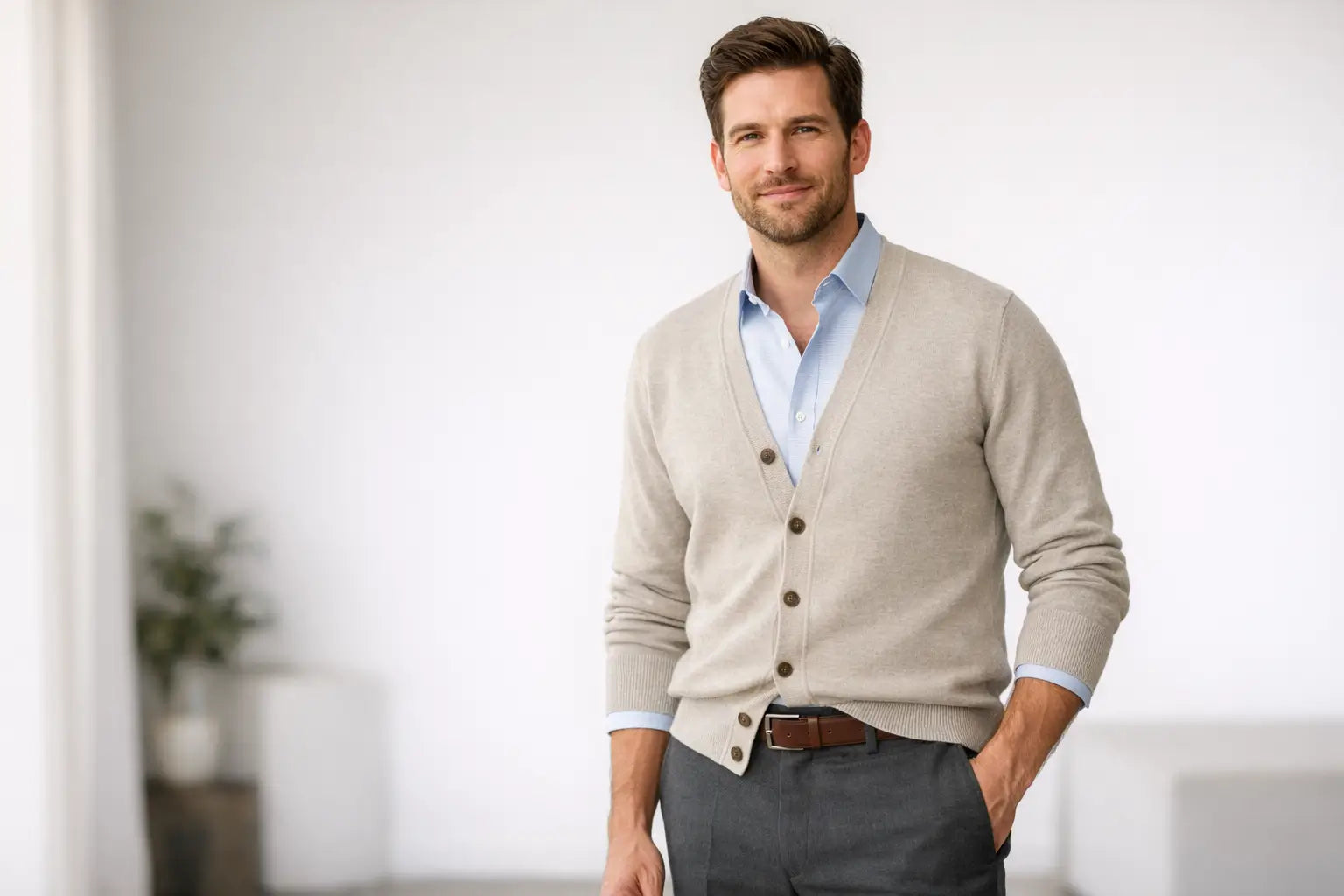
A cardigan is one of the easiest ways to look more put-together without feeling overdressed—if you get the type, fit, and layering right. This guide gives you a 30-second cheat sheet, a quick picker for what to wear underneath, and 10 outfit formulas you can copy for casual, smart casual, and business casual settings.
30-Second Cardigan Cheat Sheet (Guys)
A cardigan looks good when it reads “intentional”: clean fit, the right knit for the occasion, and shoes that match the vibe. Use this mini ladder to choose quickly.
| Setting | Cardigan type | Best under-layer | Easiest shoes |
|---|---|---|---|
| Casual | Chunky or textured | T-shirt / henley | Clean sneakers / casual boots |
| Smart casual | Medium knit | OCBD / polo | Loafers / boots / minimal sneakers |
| Business casual | Fine-gauge, smooth | Dress shirt (tie optional) | Loafers / derby-style shoes |
Key points
- Start with fit (shoulders, sleeves, length). If the buttons pull, the size is fighting you.
- Let texture set the tone: chunkier = more casual; smoother = more polished.
- Shoes often decide the “dress level” more than your pants.
If you want a cleaner silhouette fast, the next checklist will save you from the most common cardigan mistakes.
Quick rules (3) — the “don’t look sloppy” checklist
Most “this looks off” problems come down to fit, strain, and mismatched signals.
- No pulling at the buttons. If it strains when you move, wear it open or size up.
- Hem and sleeves should look tidy. No extra-long sleeves puddling; no hem hanging like a robe unless you’re going oversized on purpose.
- Match one “polish signal.” If you’re wearing dressier shoes, keep the cardigan smoother and the shirt cleaner; if you’re in sneakers, keep everything more casual.
Once your baseline rules are set, copy one of the formulas below so you don’t overthink it.
Fast outfit formulas (3) — copy/paste combos
- Casual: Chunky cardigan + tee + straight jeans + clean sneakers
- Smart casual: Medium-knit cardigan + OCBD + chinos + loafers (or boots)
- Business casual: Fine-gauge cardigan + dress shirt + trousers + loafers/derbies
If you’re unsure which cardigan style is “right” for your setting, this next section makes the choice simple.
Choose the Right Cardigan Type for the Occasion
The “right” cardigan is the one whose texture, collar/closure, and drape match your setting—then everything else (shirt, pants, shoes) becomes easier.
Key points
- Fine-gauge / smoother knits generally read more polished because they look cleaner and less bulky.
- Chunky / textured knits generally read more casual because they look cozier and more rugged.
- Shawl collar often feels relaxed and classic; zip cardigans lean casual; button-front is the most flexible.

| Cardigan type | Best for | What it “signals” | Easy pairing |
|---|---|---|---|
| Fine-gauge (smooth) | Business casual, date night | Clean, refined | Dress shirt + trousers |
| Medium knit | Smart casual | Relaxed polish | OCBD + chinos |
| Chunky knit | Casual, weekend | Cozy, rugged | Tee/henley + jeans |
| Shawl collar | Smart casual to casual | Classic, comfortable | OCBD + dark denim |
| Zip cardigan | Casual, travel | Sporty, practical | Tee + jeans/chinos |
Boundary conditions
- Workplace “business casual” varies—if your office is stricter, swap the cardigan for a blazer.
- Climate matters: in cold weather you may need thicker knits, but plan for bulk under coats.
If the words “cardigan” and “sweater” still feel interchangeable, here’s the clean distinction.
Cardigan vs sweater (30 seconds)
A cardigan is a sweater or sweater-like layer that opens down the front, while a sweater can be a jacket or pullover knit (often pulled over the head). (merriam-webster.com).
With the type settled, the next step is making sure the cardigan fits in a way that looks sharp (even if you like it relaxed).
Fit Checklist: How a Men’s Cardigan Should Fit
A cardigan looks best when it follows your frame instead of fighting it—clean shoulders, tidy sleeves, and no strain at the buttons.
Key points
- Shoulders: seams sit near your shoulder edge (not drooping far down your arm unless intentionally oversized).
- Sleeves: end near your wrist bone; slight break is fine, pooling looks sloppy.
- Length: most classic fits end around the hip; longer can work if the rest of the outfit is balanced.
- Button strain test: button it, move your arms forward—if it pulls hard, it’s too tight.
Fit checklist (quick steps)
- Put it on over your intended under-layer (tee vs shirt changes fit).
- Check shoulder seams first.
- Check sleeve length with arms relaxed.
- Check hem length in the mirror from front and side.
- Button it and do a quick movement test for pulling/strain.
- If it looks boxy, try a cleaner under-layer and straighter pants to balance.
Boundary conditions
- If you plan to wear it under a coat/blazer, prioritize a smoother knit and less bulk.
- Stretchy knits exaggerate pulling—fit issues show up quickly at the buttons.
If you prefer oversized cardigans, the goal isn’t “tight fit”—it’s balanced proportions.
Oversized cardigan: how to balance it (without looking top-heavy)
Oversized can look great when the rest of the outfit supports the volume.
Key points
- Pair volume with volume: straight or slightly wider pants balance an oversized top.
- Keep the palette calm: one or two main colors looks intentional.
- Choose shoes with some presence (chunkier sneakers/boots can help).
Practical balance steps
- If the cardigan is long, avoid ultra-skinny pants (it amplifies “top-heavy”).
- Use a simple base (tee + straight jeans) before adding patterns or bold colors.
- Leave it open more often than fully buttoned to avoid bulk at the midsection.
Boundary conditions
- Some oversized looks are intentionally relaxed or grungy; these tips are for a cleaner, more balanced version of the style.
Now that fit is handled, your under-layer choice becomes the easiest way to control how casual or polished you look.
What to Wear Under a Cardigan (Quick Picker)
Guys can wear almost anything under a cardigan, but the safest choice depends on the dress code and the cardigan’s thickness.

Key points
- Casual: tee or henley keeps it relaxed.
- Smart casual: an OCBD (Oxford button-down) or polo looks clean and effortless.
- Business casual: a dress shirt (tie optional) works best with a smoother, finer knit.
- Avoid stacking bulk: chunky cardigans don’t love hoodies or thick collars underneath.
| Dress code | Best under-layer | Works best with | Quick warning |
|---|---|---|---|
| Casual | T-shirt / henley | Chunky/medium knits | Skip bulky hoodies under thick cardigans |
| Smart casual | OCBD / polo | Medium knits, shawl collar | Keep collar tidy; avoid wrinkled shirt points |
| Business casual | Dress shirt (tie optional) | Fine-gauge knits | If it feels “too soft,” use a blazer instead |
| Cold weather | Turtleneck / thin thermal | Fine/medium knits | Keep it thin to prevent chest bulk |
Boundary conditions
- A V-neck cardigan shows more of your shirt; a shawl collar reads more casual and hides more layering.
- If the cardigan gapes at the chest when open, a smoother base layer helps.
Once you know what’s underneath, the easiest way to dress well is to copy a full outfit formula.
10 Easy Cardigan Outfit Formulas (Casual → Business Casual)
A cardigan outfit works when the top layer, pants, and shoes all point to the same “dress level.” Use these formulas as templates, then adjust colors and textures.
Key points
- Change one thing to level up: shoes, shirt collar, or cardigan smoothness.
- Keep silhouettes consistent: relaxed cardigan pairs best with straight/relaxed pants; refined cardigan pairs best with tailored pants.
- Darker, smoother pieces usually read more polished than light, chunky textures.
If you want maximum ease, start with the casual set and move up as needed.
Casual formulas (weekend, errands)
Casual cardigan outfits look best when they feel simple: textured knit, easy base layer, and practical shoes.
-
Chunky cardigan + tee + straight jeans + clean sneakers
Why it works: texture reads casual; sneakers keep it light. -
Shawl-collar cardigan + henley + dark jeans + casual boots
Why it works: the collar adds structure; dark denim feels intentional. -
Zip cardigan + tee + chinos + minimal sneakers
Why it works: sporty cardigan matches sneaker vibe; chinos keep it neat. -
Oversized cardigan + tee + straight/wide pants + chunkier sneakers
Why it works: balanced volume prevents the “top-heavy” look.
Boundary conditions
- If the cardigan pulls when you button it, wear it open or size up—strain reads sloppy.
- If your cardigan is very long, keep pants straighter to balance the silhouette.
For a more “dressed” look without going full officewear, smart casual is the sweet spot.
Smart casual formulas (dinner, casual office)
Smart casual cardigan outfits use cleaner shirts, simpler colors, and shoes that look a little sharper than sneakers.
-
Medium-knit cardigan + OCBD + chinos + loafers
Why it works: collar + loafers signals polish without stiffness. -
Medium-knit cardigan + polo + dark jeans + boots
Why it works: polo cleans up the neckline; boots add structure. -
Shawl-collar cardigan + tee + tailored chinos + minimalist sneakers
Why it works: keeps casual comfort while tightening the fit and palette.
Boundary conditions
- In stricter offices, swap the sneakers for loafers/derbies and keep the cardigan smoother.
- If the collar looks messy, go with a polo or crew tee instead of a flimsy shirt collar.
When you need business casual, the details matter most: smooth cardigan, crisp shirt, and structured shoes.
Business casual formulas (meetings, client-facing)
Business casual cardigan outfits work best with fine-gauge knits, collared shirts, and tailored trousers.
- Fine-gauge cardigan + dress shirt + trousers + loafers/derbies
Why it works: smooth knit reads refined; trousers finish it. -
Fine-gauge cardigan + dress shirt + tie (optional) + trousers + derbies
Why it works: tie pushes it more formal; cardigan keeps it approachable. -
Fine-gauge cardigan under a blazer + dress shirt + trousers
Why it works: blazer adds structure; cardigan adds warmth and softness.
Boundary conditions
- If your workplace expects a blazer, treat the cardigan as a mid-layer rather than the main top layer.
- Avoid bulky cardigans in client-facing settings; thickness can read too casual.
If you want a cardigan to look polished for the office or a date, the next templates make it repeatable.
Business Casual + Date Night: Make a Cardigan Look Polished
Yes—guys can wear a cardigan to the office or on a date, as long as the knit is refined, the fit is clean, and the outfit has at least one “sharp” element (shirt collar, tailored pants, or structured shoes).

Key points
- Choose fine-gauge (or smooth) knits for more polish.
- Keep colors cohesive (neutrals or muted tones).
- Decide cardigan vs blazer based on how “structured” you need to look.
| Situation | Safe cardigan choice | Shirt | Bottoms | Shoes |
|---|---|---|---|---|
| Business casual | Fine-gauge, neutral | Dress shirt / OCBD | Trousers / clean chinos | Loafers / derbies |
| Date night | Fine/medium knit (texture OK) | Polo / clean tee / dress shirt | Dark jeans / trousers | Boots / loafers |
Boundary conditions
- If you need a sharper silhouette, a blazer wins—structure is hard to beat.
- If you’re layering under a coat, keep the cardigan thinner to avoid bulk.
A polished look can still fall apart if the cardigan gapes or strains, so buttoning mechanics matter.
Buttoning Rules: Open vs Buttoned + How to Stop Gaping
Buttoned looks cleaner and more “finished,” while open feels casual and shows your layers. The right choice depends on fit and knit thickness.
Key points
- Button it when you want a cleaner line (office, dinner, cooler weather).
- Wear it open when you want relaxed ease (weekend, layering, thicker knits).
- If it pulls at the buttons, it’s a fit issue first—don’t force it.
Micro-steps: stop gaping and pulling
- Check fit: if the fabric is tugging, go up a size or wear it open.
- Try partial buttoning: button the middle button(s) to shape the torso; leave the bottom unbuttoned if it strains.
- Flatten the under-layer: a smooth tee or a cleaner shirt front reduces gaping.
- Mind bulk: thick knits + thick shirts stack up fast—go thinner underneath.
Boundary conditions
- Chunky cardigans can look bulky fully buttoned; open or partially buttoned often looks better.
- If you’re sitting a lot, open-front styling can prevent the cardigan from bunching.
Once buttoning is sorted, layering by season becomes easier and more comfortable.
Layering by Season: Cardigan as Mid-Layer or Outerwear
A cardigan can be outerwear in mild conditions, but it’s usually best as a mid-layer when wind or rain is involved.

Key points
- Mild weather: medium or chunky cardigan can replace a light jacket.
- Cold weather: cardigan works best under a coat; choose thinner knits under structured outerwear.
- Bulk management: thinner base layers + smoother cardigans = easier movement.
Boundary conditions
- Wind/rain often require real outerwear no matter how warm the knit feels.
- Thick knits under tailored jackets can restrict movement—choose a finer cardigan if you’re layering.
Color and pattern are the final “easy win” for looking intentional without changing your whole wardrobe.
Color & Pattern: Easy Cardigan Palettes for Men
The easiest cardigan colors to style are the ones that play well with your existing pants and shoes—especially neutrals.

Key points
- Safest neutrals: navy, charcoal, medium gray, cream, and olive.
- If the cardigan is patterned, keep the rest of the outfit simple (solid pants, simple shoes).
- Use one “anchor” neutral (dark denim, gray trousers, or chinos) to calm the look.
Pattern control rules
- If the cardigan has a bold pattern, pair it with solid pants and low-contrast shoes.
- If you want business casual, keep patterns subtle and the knit smoother.
Boundary conditions
- Offices usually reward muted palettes; save bold patterns for weekends and dates.
If your outfit still feels “off,” it’s almost always one of the common mistakes below.
Common Cardigan Mistakes (and Fast Fixes)
When a cardigan outfit looks sloppy, the fix is usually quick: adjust fit, reduce bulk, or match the shoe signal.
Mistake → cause → fix checklist
- Buttons pulling → cardigan too tight → wear open or size up; choose thinner under-layer.
- Cardigan looks baggy → too much volume everywhere → swap to straighter pants or a cleaner base layer.
- Too much bulk at the chest → thick shirt + thick knit → go thinner under the cardigan or switch to finer knit.
- Outfit feels mismatched → shoes too dressy/casual for the rest → change shoes first (fastest upgrade/downgrade).
- Collar looks messy → flimsy shirt collar + cardigan neckline → use OCBD, polo, or crew tee.
- “Older” vibe you didn’t want → overly classic + dull palette → sharpen with darker denim, cleaner shoes, or a modern fit.
Boundary conditions
- Some “sloppy” looks are intentional relaxed aesthetics; these fixes are for a cleaner, more tailored result.
If you’re choosing a cardigan to look more dressy (or trying to avoid pilling), the next cues help you pick smarter.
Fabric & Knit Cues: Dressier vs Casual + Pilling Basics
A cardigan looks dressier when it’s smoother, finer, and cleaner in color; it looks more casual when it’s thicker, more textured, and visibly cozy. Pilling is normal in many knits, but you can reduce it with smarter wear and care.
Key points
- “Gauge” in knitwear often refers to stitch density (stitches per inch): higher stitch density generally looks finer and smoother. (pringlescotland.com)
- Pilling is the formation of small fuzzy balls on the surface caused by rubbing during wear. (woolmark.jp)
- “Dressy vs casual” is context-dependent—fit, color, and the rest of the outfit matter too.
| More polished cues | More casual cues |
|---|---|
| Fine-gauge / smoother surface | Chunky knit / heavy texture |
| Dark or muted solids | Light heathers, big patterns, rugged textures |
| Cleaner drape (less bulk) | Cozy volume (more bulk) |
| Collared shirt pairing | Tee/henley pairing |
| Loafers/derbies | Sneakers/boots |
Pilling basics (simple prevention)
- Minimize high-friction wear areas (repeated rubbing against rough straps or surfaces). (woolmark.jp)
- Turn knits inside-out when washing and use gentle handling to help keep the surface looking newer. (woolmark.com)
Boundary conditions
- Any knit can pill depending on friction and wear patterns; prevention reduces it but rarely eliminates it completely.
- If you need maximum polish, prioritize smoother knits and clean fit before obsessing over fiber details.
To wrap it up, here are short answers to the most common questions guys ask about cardigans.
FAQ
What should guys wear under a cardigan sweater?
Q: What should guys wear under a cardigan sweater?
A: For casual looks, a T-shirt or henley is the easiest choice; for smart casual, an OCBD or polo looks clean; for business casual, use a dress shirt (tie optional) with a smoother cardigan. If your cardigan is chunky, keep the layer underneath thin to avoid bulk.
How should a men’s cardigan fit?
Q: How should a men’s cardigan fit?
A: It should sit cleanly at the shoulders, have sleeves that don’t pool, and button without pulling or straining. If you like oversized, balance the volume with straighter pants and a simple color palette.
What is the difference between a cardigan and a sweater?
Q: What is the difference between a cardigan and a sweater?
A: A cardigan opens down the front, while a sweater can be a pullover or knit jacket. (merriam-webster.com)
What type of cardigan is best for business casual?
Q: What type of cardigan is best for business casual?
A: A fine-gauge (smooth), neutral cardigan is the safest pick—wear it over a dress shirt or OCBD with tailored trousers and loafers/derbies. If your office is stricter, choose a blazer instead.
Should you button a cardigan or wear it open?
Q: Should you button a cardigan or wear it open?
A: Button it when you want a cleaner, more finished line; wear it open for a relaxed, casual feel. If the buttons pull, it’s usually better worn open or in a larger size.
What are common cardigan mistakes men make?
Q: What are common cardigan mistakes men make?
A: The big ones are wearing a cardigan that strains at the buttons, stacking too many bulky layers, and pairing dressy shoes with an otherwise casual outfit (or the reverse). Fix those first before changing everything else.
If you’re reading this as a brand or buyer rather than for personal styling, the optional checklist below can help you communicate what you need clearly.
Optional: For Brands — How to Spec a Men’s Cardigan (Conversion Block)
If you’re developing a men’s cardigan for your brand, the fastest way to get an accurate sample is to send a clear “spec pack.” Here’s a practical checklist:
- Style & silhouette: V-neck / shawl collar / zip; regular vs oversized; target length
- Size set: at least one “base size” with key measurements (chest, body length, sleeve length)
- Knit look & feel: fine/medium/chunky visual target (include reference photos), and whether you want a smooth or textured surface
- Fiber preference: wool/cotton/blend preference (or performance goals like “soft hand feel” or “less bulky,” without making guarantees)
- Closure & details: buttons/zip, placket style, rib details at cuff/hem, pocket requirements
- Colorways & artwork: pantone references, jacquard/intarsia placement if applicable
- Trims & packaging: labels, hangtags, polybag/box requirements
- Quantity range & timeline: target quantity and target ship window (these can vary by design and destination)
A clear pack reduces back-and-forth and helps everyone align on what “polished,” “chunky,” or “fine” means in the real sample.
To finish, here’s a simple way to decide what to wear tomorrow without rethinking your whole wardrobe.
Summary: Your 3-Step Cardigan Plan
Use this order and you’ll avoid most cardigan outfit problems.
- Choose the type for the setting: chunky for casual, smoother for business casual.
- Check fit fast: shoulders, sleeves, hem, and no button strain.
- Copy a formula: pick one of the 10 outfits and adjust only color and shoes.
Takeaways
- Texture sets the tone; shoes set the formality.
- A clean fit matters more than “the perfect cardigan.”
- Thin layers under chunky knits keep you from looking bulky.
If you want a polished look quickly, start with the business casual template (fine-gauge + collared shirt + trousers) and adjust down for weekends by swapping in a tee and sneakers.
:%20Outfit%20Formulas%20+%20Fit%20Rules)