
Custom Oversized Sweater Manufacturer: How to Choose the Right Factory (Specs, MOQ, Samples & QC)
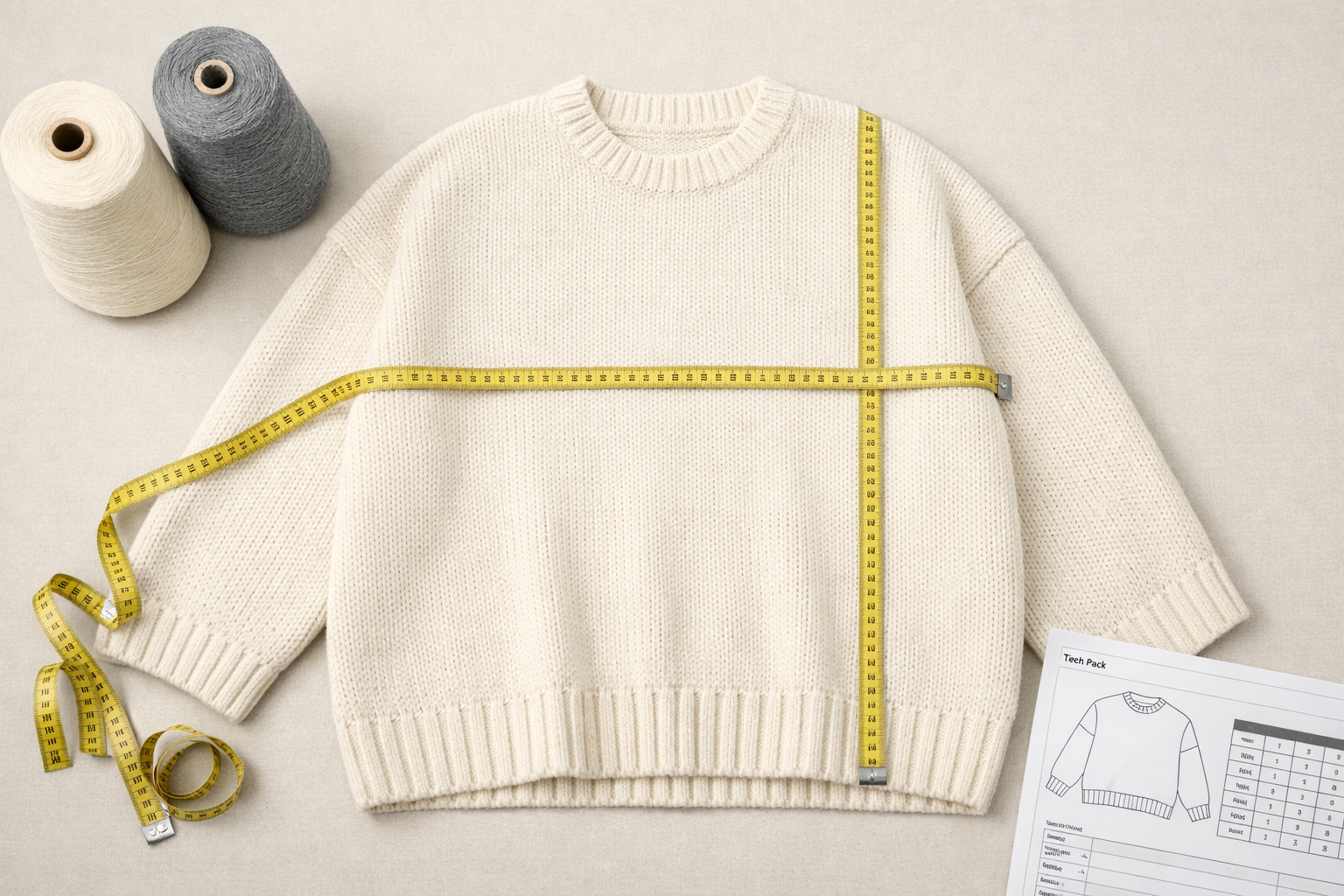
Shortlist + What to Send
Choosing a custom oversized knit sweater manufacturer is easiest when you do two things: vet the factory with proof-based criteria, and send a quote-ready tech pack so the first sample matches your fit and handfeel goals.
Shortlist fast (what to check)
- Knitwear track record (not unrelated “oversized” categories)
- Clear sampling workflow (how revisions and approvals are handled)
- Comfort discussing yarn + knit technique trade-offs (not just “yes we can”)
- QC checkpoints (inline + final) and defect handling clarity
- Private label readiness (labels/packaging files) and shipping support scope
Send this for a faster, more accurate quote
- Flat sketch + construction notes for the oversized silhouette
- Size spec + how you define “oversized” (your reference fit)
- BOM basics (fiber/yarn target, trims, labels)
- Artwork files + placement (if using jacquard/intarsia/embellishment)
- Quantity estimate + colorways + target ship date (even if rough)
3 takeaways
- “Oversized” must be measurable, not a vibe.
- Most delays come from missing inputs and slow approvals.
- MOQ and timelines depend on yarn availability, complexity, and order plan—confirm in the quote and sample.
With those basics in mind, it helps to align on what “manufacturer” and “private label” usually cover.
What a Custom Oversized Sweater Manufacturer Does (and what “Private Label” means)
A custom oversized sweater manufacturer typically produces knitwear to your specifications (often called OEM), and may also help develop or refine the design for manufacturability (often called ODM), depending on what you provide and what services they offer.
Key points
- OEM usually means: you provide the design/specs; the factory manufactures.
- ODM usually means: the factory helps develop the design/specs from a concept or reference.
- Private label usually means: your brand elements are applied (labels, hangtags, packaging) based on your files and instructions.
Table: OEM vs ODM (quick compare)
| Topic | OEM (you lead) | ODM (factory helps develop) |
|---|---|---|
| Starting point | Tech pack / clear specs | Concept, reference photos, rough sketch |
| Best for | Brands with established fit standards | Brands needing development support |
| Risk to manage | Spec completeness | Alignment on revisions and ownership of decisions |
Boundary conditions
- Terms vary by supplier; confirm scope in writing (what’s included in development vs manufacturing).
- “Private label” does not automatically mean legal compliance in every market; requirements can vary.
From here, use a proof-based scorecard so you compare factories on what actually prevents bulk surprises.
How to Vet and Compare Manufacturers (Decision Scorecard)
The “right” factory is the one that can prove they can make your oversized knit sweater consistently—fit, handfeel, workmanship, and labeling—using a repeatable process.
Key points
- Ask for proof of capability, not marketing claims.
- Evaluate process clarity (sampling, approvals, QC) as much as product photos.
- Treat vague guarantees as a risk signal until the design has been reviewed.
Table: Decision scorecard
| Criteria | What “good” looks like | What to request | Red flag |
|---|---|---|---|
| Knitwear focus | Real knitwear examples with close-up details | Similar samples + detail photos/videos | Only generic catalog images |
| Sampling workflow | Steps + revision handling are clear | Sample steps + how changes are tracked | “No problem” with no process |
| Oversized fit competence | Talks in measurement points and silhouette controls | How they measure + what they control tightly | Cannot explain measurement method |
| Yarn guidance | Explains trade-offs (drape, pilling risk, recovery) | Yarn options aligned to your handfeel target | Pushes one yarn for everything |
| Artwork feasibility | Reviews files and explains constraints | File review notes + technique recommendation | Approves without seeing files |
| QC checkpoints | Inline + final checks are defined | QC checklist + defect handling approach | “Strict QC” with no details |
| Private label readiness | Lists files needed + placements | Label/packaging file checklist | “Send later” with no requirements |
| Commercial clarity | Explains what drives MOQ and schedule | Quote assumptions + drivers | Absolute promises before review |
Practical vetting steps
- Send a minimal file set (sketch, size spec, yarn target, artwork if any).
- Ask them to restate the critical details in their own words (fit, yarn, technique, approvals).
- Request their sampling flow and QC checklist before payment.
- Confirm who owns what decisions (you vs factory) during development.
- Compare two factories using the same checklist to reduce bias.
Boundary conditions
- The best fit depends on your order plan (complexity, quantities, timeline, and how strict your QC needs are).
- A quote is only “real” after the supplier reviews your files and confirms feasibility.
Once you have a shortlist, the biggest risk becomes a vague definition of “oversized,” so lock that down in manufacturing terms.
Define “Oversized” Fit in Manufacturing Terms (So Samples Match Your Vision)
“Oversized” is a set of measurable fit decisions. When you define it in measurement points and silhouette controls, your sample rounds become faster and more predictable.

Key points
- Choose a reference fit (existing garment, graded chart, or target measurements).
- Control oversized via: ease, shoulder drop, sleeve volume, body length.
- Specify measurement points consistently so sample and bulk match.
Oversized mini glossary
- Ease: extra room added versus body measurements (brand-defined)
- Drop shoulder: how far the shoulder line extends past the shoulder point
- Sleeve volume: bicep width + cuff shape (how “balloon” it feels)
- Body length: cropped vs standard vs longline oversized
Checklist: measurement points to include
- Chest width (flat) or finished circumference (define method)
- Body length (define the top point and the hem point)
- Shoulder width or shoulder drop (define the shoulder reference)
- Sleeve length (define where it starts and ends)
- Bicep width / sleeve opening + cuff width
- Hem width + rib height
- Neck opening + rib height (if relevant)
How to handle tolerances without overpromising
- Identify “key measurements” you want controlled tightly (often chest, body length, sleeve length).
- Identify “flexible zones” where knit stretch/recovery affects readings (often ribbing and some widths).
- Confirm on the sample using the exact measurement points you provided.
Boundary conditions
- Yarn elasticity and knit structure affect stretch and recovery, so measurements behave differently across materials.
- “Oversized” varies by brand aesthetic; your reference fit defines the target.
With the fit clarified, you can now send a quote-ready tech pack that reduces back-and-forth and avoids feasibility surprises.
Quote-Ready Tech Pack Checklist (Must-have vs Nice-to-have)
A quote is only as accurate as the inputs you provide. A minimum viable tech pack helps the supplier confirm feasibility and plan sampling correctly.

Key points
- Must-haves get you an accurate quote and a realistic sample plan.
- Nice-to-haves reduce revisions and improve handfeel matching.
- Artwork needs special handling for knit techniques (file quality and placement clarity).
Table: Must-have vs nice-to-have
| Item | Must-have | Nice-to-have | Notes |
|---|---|---|---|
| Flat sketch | ✅ | Front/back + key details (drop shoulder, rib specs) | |
| Size spec | ✅ | Measurement points and base size defined | |
| BOM basics | ✅ | Fiber/yarn target, trims, labels (as applicable) | |
| Colorways | ✅ | If custom dyeing, define your color standard approach | |
| Artwork files | If used | ✅ | Vector preferred; provide color separation if possible |
| Artwork placement | If used | ✅ | Placement coordinates, size, and repeat notes |
| Quantity estimate | ✅ | Include rough size run and colorway count | |
| Target ship date + destination | ✅ | Needed for production and shipping planning | |
| Packaging/label needs | ✅ | Finalize before bulk; early note helps planning | |
| Handfeel reference | ✅ | Photos/samples help match expectations | |
| QC/testing expectations | ✅ | Mention if you need pilling/shrinkage checks |
Checklist: artwork essentials for jacquard / intarsia
- Original artwork file (vector if possible)
- Color count and separations
- Placement and size (where it sits, how big, whether it repeats)
- “Must-not-change” elements (so feasibility compromises are negotiated early)
Boundary conditions
- Some details can be refined after the first prototype, but missing must-haves slows the entire process.
- Feasibility and timelines depend on yarn availability and technique complexity, confirmed during quoting and sampling.
If you want a factory to respond faster, the inquiry template below helps you structure the first message without turning the article into a sales page.
Copy/paste first inquiry template (optional)
Subject: Custom oversized knit sweater — quote + sample request
- Style: (pullover/cardigan), silhouette: (boxy/longline/cropped), shoulder: (drop/set-in)
- Reference photos/links:
- Base size + size chart attached (measurement points defined)
- Yarn/fiber target + handfeel reference (if any):
- Knit technique: (plain/cable/rib/jacquard/intarsia) + artwork files (attached)
- Quantity estimate + colorways + size breakdown (if known):
- Target ship date + destination country:
- Private label needs: labels/hangtags/packaging (basic or detailed)
- QC expectations: (measurement checks, pilling/shrinkage checks, etc.)
With the tech pack sent, a clear sampling workflow with approval gates is what prevents “bulk differs from sample” pain later.
Sampling Workflow: Steps + Approval Gates (Fit / Color / Handfeel / Workmanship / Labels)
A predictable sampling workflow reduces misunderstandings and makes bulk consistency much easier to manage.

Key points
- Separate “prototype learning” from “approval gates” so decisions are documented.
- Approve fit, handfeel, workmanship, and labeling explicitly.
- Track revisions with annotated photos and a change list.
Numbered workflow
- Inquiry + feasibility review (supplier reviews fit specs, yarn target, technique, artwork)
- Quote + sample plan (what is being sampled and what can change)
- Prototype sample (first physical reference)
- Revision loop (measurements, construction, handfeel, artwork)
- Approvals (explicit sign-off items below)
- Pre-production sample (recommended when risk is higher: new yarn, complex artwork, tight deadlines)
- Bulk production
- QC checks + packing confirmation
- Shipping coordination
Approval gates checklist
- Fit and measurements (using your measurement points)
- Handfeel and drape (match your brand expectation)
- Construction and workmanship (stitch consistency, finishing, rib execution)
- Artwork clarity and placement (if applicable)
- Labels and packaging placements/content (if included)
Boundary conditions
- The number of sample rounds varies by complexity and how complete your first input set is.
- Some yarn and color processes can add time before the sample is truly representative of bulk.
Once the sample is approved, planning gets easier when you understand what drives MOQ and schedule instead of chasing one “standard” number.
MOQ and Lead Time: What Drives Them (and What You Can Control)
MOQ and lead time are outcomes of your design and order plan. The most reliable approach is to understand the drivers and decide what you can simplify or finalize early.
Key points
- Yarn sourcing and complexity are common schedule drivers.
- Approvals often become the hidden timeline risk.
- You can reduce uncertainty by minimizing late changes and providing complete files early.
Table: MOQ and lead-time drivers
| Driver | Can impact MOQ | Can impact lead time | What you can do |
|---|---|---|---|
| Yarn availability | Often | Often | Confirm in-stock options or approve sourcing early |
| Custom dye / color development | Sometimes | Often | Align color standard and reduce late changes |
| Technique complexity (jacquard/intarsia/cable) | Sometimes | Often | Simplify or phase complexity into later drops |
| Number of colorways | Sometimes | Often | Start with fewer colorways, expand on reorder |
| Size range breadth | Sometimes | Sometimes | Tighten size run for first release if needed |
| Trims/labels/packaging | Sometimes | Sometimes | Provide files early and avoid reprints |
| QC scope and special checks | Rarely | Sometimes | Specify expectations early so they’re planned |
| Approval speed | No | Often | Use clear acceptance criteria and fast feedback |
| Shipping mode | No | Often | Align shipping plan to launch date early |
Checklist: what you control most
- Spec completeness (fit + artwork + BOM basics)
- Speed and clarity of approvals
- Complexity choices (technique, colorways, size breadth)
- File readiness (labels/packaging, artwork placement)
Boundary conditions
- Final MOQ and timelines depend on yarn availability, complexity, quantity, and approval speed—confirm during quoting and sampling.
- Treat unconditional “guarantees” as risk until your files are reviewed.
If you’re still deciding materials, a quick yarn trade-off guide helps you pick options that fit your handfeel and durability expectations.
Yarn Choices for Oversized Sweaters (Softness vs Pilling vs Cost Control)
There isn’t a single “best” yarn for oversized sweaters. Choose based on season, price point, care expectations, and the look/feel your customers expect.
Key points
- Softer handfeel can increase pilling risk depending on yarn quality and knit structure.
- Shape retention depends on both fiber behavior and construction.
- Sampling is the safest way to validate handfeel, drape, and post-care appearance.
Table: yarn trade-offs (starter guide)
| Fiber / blend direction | Often chosen for | Watch-outs | Good for |
|---|---|---|---|
| Wool / wool blends | Elasticity and recovery (shape retention) | Care sensitivity; shrink risk varies | Warm oversized silhouettes |
| Cotton / cotton blends | Breathability and clean handfeel | Can feel heavier; can grow/sag depending on structure | Transitional seasons, structured looks |
| Acrylic blends | Cost control and easy-care potential | Pilling risk varies by yarn quality and structure | Budget-focused drops |
| Lofty / brushed fashion blends | Cozy texture and trend-driven feel | Shedding/pilling can increase; needs validation | Chunky, fashion-forward styles |
Steps: choose without guessing
- Define your target: season + care behavior (how customers will actually wash it)
- Pick 2–3 yarn directions that match your positioning
- Sample and confirm: handfeel, drape, recovery, and appearance after intended care method
- Decide on a simple risk plan: pilling/shrinkage checks before bulk for new yarns
Boundary conditions
- Fiber behavior depends on yarn construction, finishing, and knit structure, so validate with sampling.
- Any performance expectations should be confirmed using your chosen check method and acceptance criteria.
After yarn, technique choice is the next big lever that affects how artwork reads, how heavy the sweater feels, and how repeatable production is.
Knit Techniques and Construction: What Works for Oversized Looks (Jacquard vs Intarsia Included)
Technique selection influences feasibility, visual clarity, weight, and repeatability—especially for oversized silhouettes and knit artwork.
Key points
- Plain and textured knits rely heavily on yarn choice and fit execution.
- Artwork techniques need clean files and clear placement specs.
- Gauge and structure affect drape and how details “read.”
Technique menu (common choices)
- Plain knit: clean and minimal; shows yarn quality clearly
- Rib structures: essential for trims; can shape silhouette
- Cable / textures: adds visual weight and thickness; affects drape
- Jacquard: patterned knitting; complexity rises with detail and color count
- Intarsia: placed motif blocks; needs clear artwork and placement
Table: jacquard vs intarsia (simple comparison)
| Factor | Jacquard | Intarsia |
|---|---|---|
| Best for | Repeating/overall patterns | Large motif blocks and placed graphics |
| Risk driver | Many colors/details can add complexity | Many shapes/joins can add complexity |
| What you must provide | Clean files + color separations | Clean files + placement + size definition |
Boundary conditions
- Artwork scale, color count, yarn choice, and gauge can force technique changes; early file review helps prevent rework.
With technique chosen, QC becomes the guardrail that keeps bulk consistent with the approved sample.
Quality Control Checklist for Oversized Knitwear (Inline + Final Packing)
QC problems in knitwear commonly show up as measurement drift, appearance defects, and labeling/packing mistakes. A simple two-phase checklist catches most issues early.
Key points
- Use the same measurement points you defined in the spec.
- Check both workmanship and appearance (defects can be subtle in knits).
- Verify labels and packaging before cartons are sealed.
Checklist: inline QC (during production)
- Key measurements spot-check (especially the base size)
- Stitch/tension consistency across panels
- Common knit defects: holes, dropped stitches, laddering, uneven texture
- Artwork clarity and placement (if applicable)
- Trim consistency: neck/cuff/hem finishing and rib height
Checklist: final QC (before packing/shipping)
- Re-check key measurements across sizes and colorways (spot-check)
- Appearance: stains, snags, panel mismatch, loose threads
- Label content and placement match provided files
- Packaging matches instructions (folding, size stickers, polybags)
- Carton marks and packing list align with shipment plan
Boundary conditions
- QC scope should match risk (new yarn/technique and tight timelines need tighter control).
- Any standards-based testing names should only be added when you can cite the standard used.
Once product quality is controlled, private label and packaging details become the common cause of last-minute delays—handle them like a file-and-placement project.
Private Label Options: Labels, Hangtags, Packaging (and the Files You Need)
Private label work is smooth when you provide clear files and placement instructions early enough to avoid reprints and rework.
Key points
- Private label items are straightforward but detail-sensitive.
- File format and text accuracy matter as much as artwork.
- Packaging choices can affect protection and shipping efficiency.
Checklist: common private label items
- Woven main label
- Care/content label (text may vary by selling market)
- Size label (if separate)
- Hangtag (artwork + copy)
- Polybag (optional warnings or barcode)
- Carton marks + packing list format
Checklist: files and instructions to prepare
- Artwork files (vector preferred when possible)
- Exact label text content (fiber content and care instructions you intend to use)
- Placement notes (where it sits, how it’s attached)
- Packing instructions (folding method, size stickers, carton count plan)
- Carton marks layout (if needed)
Boundary conditions
- Care labeling requirements can be market-specific; confirm requirements in the markets where you sell.
- Packaging decisions can change if shipping mode or destination constraints change.
If you buy internationally, a short Incoterms section can help you avoid confusion about responsibilities without turning this page into legal advice.
Shipping and Incoterms Basics for Overseas Orders
Incoterms clarify responsibilities for tasks, costs, and risk between buyer and seller. Use them to reduce ambiguity in shipping arrangements and paperwork expectations.
Reference: International Chamber of Commerce — Incoterms® rules and U.S. International Trade Administration — Know Your Incoterms.
Key points
- Choose an Incoterm that matches how you want freight and paperwork handled.
- Confirm who handles export paperwork vs import clearance.
- Align documents (commercial invoice, packing list, etc.) with your forwarder/broker.
Boundary conditions
- Destination requirements vary; confirm details with a qualified forwarder or customs broker.
- Duties and taxes depend on destination rules and shipment terms.
If you want quick wins on conversion and SEO, the FAQ below answers the most common buyer questions in an extractable format.
FAQ
-
Q: How do I choose the right custom oversized sweater manufacturer?
A: Use a proof-based scorecard: knitwear focus, sampling workflow clarity, measurement competence for oversized fit, yarn/technique guidance, QC checkpoints, and private label readiness. Ask for evidence (similar samples, QC checklist, sampling steps) and treat vague guarantees as a risk signal. -
Q: What should I send to get an accurate quote and sample?
A: Send a flat sketch, size spec with defined measurement points, BOM basics (fiber/yarn target), artwork files and placement notes (if any), quantity estimate and colorways, plus a target ship date and destination. Add handfeel references and packaging needs to reduce revisions. -
Q: What specs define an oversized sweater fit consistently?
A: Define oversized in measurable terms—ease, shoulder drop, sleeve volume, and body length—then document the measurement points you will use to approve the sample. Consistency comes from using the same reference fit and measurement method each time. -
Q: What affects MOQ and lead time for custom oversized sweaters?
A: Yarn availability, custom dyeing, technique complexity, number of colorways, size breadth, trims/labels readiness, QC scope, and approval speed can all affect planning. Final MOQ and timelines are confirmed during quoting and sampling based on your design and order plan. -
Q: What are the steps from inquiry to an approved sample?
A: Most projects follow: inquiry and feasibility review, quote and sample plan, prototype sample, revision loop, explicit approvals (fit/handfeel/workmanship/labels), optional pre-production sample, then bulk and QC checks before shipping. The number of revisions depends on complexity and input completeness. -
Q: Which yarns or blends help reduce pilling and keep the sweater soft?
A: There’s no universal winner because pilling and softness depend on yarn quality, knit structure, and care behavior. Shortlist 2–3 yarn directions, validate with sampling, and define acceptable outcomes for pilling/shrinkage checks before bulk. -
Q: What private label options (labels, hangtags, packaging) can a sweater factory provide?
A: Common options include woven labels, care labels, hangtags, polybags, carton marks, and packing lists. Provide clean artwork, exact text content, and placement instructions early so labeling and packaging don’t become last-minute delays.
)