
How to Wear an Oversized Sweater With a Skirt (Mini, Midi, Maxi)
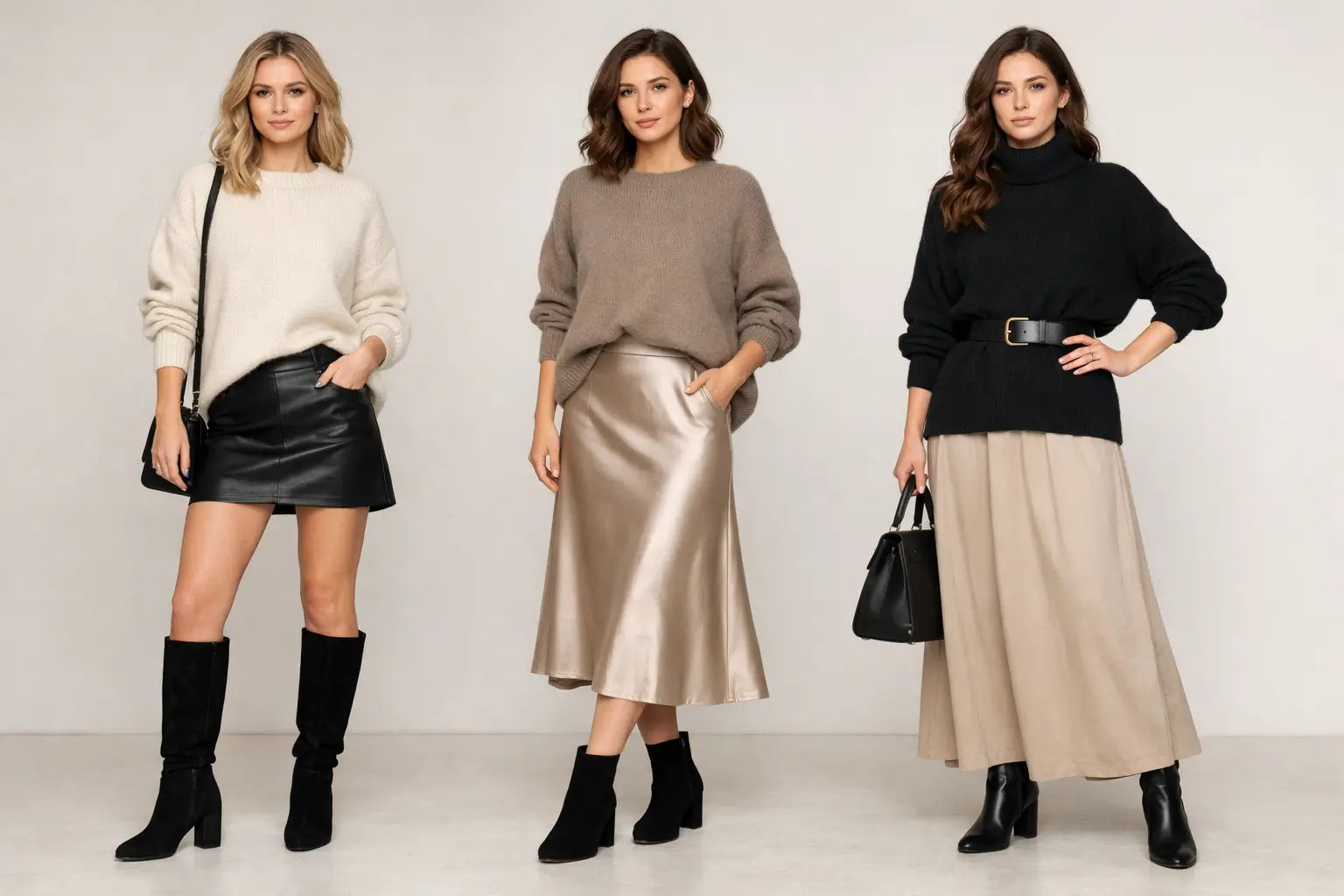
Oversized Sweater + Skirt in 30 Seconds
The easiest way to make an oversized sweater + skirt look intentional is to balance volume on top with structure (or a clear waist signal) on the bottom.
Key points:
- Pick your “anchor”: legs (mini) or waist (midi/maxi). Don’t try to highlight everything at once.
- Control the hem: if the sweater is long and chunky, either half-tuck it or add a belt (or choose a skirt with a defined waistband).
- Choose one contrast: chunky knit + sleek skirt (like satin) or drapey knit + structured skirt (like a tailored mini).
Keep in mind:
- Chunky knits usually need more shape somewhere else (waistline, skirt structure, or footwear line).
- Results vary by proportions and comfort preferences—use the options below as a menu, not a rulebook.
If you’re not sure which skirt length you’re working with, the quick definition and proportion rules below will make everything else easier.
For extra outfit examples (inspiration, not “proof”), see: InStyle’s sweater-and-skirt outfit roundup and Macy’s guide on styling oversized sweaters without looking frumpy.
What Counts as an Oversized Sweater?
An oversized sweater is intentionally roomier than a standard fit—think relaxed shoulders, extra sleeve volume, and a body that doesn’t cling.
Signs it’s “oversized” (in a practical, wearable way):
- The shoulder seam sits slightly past your natural shoulder (not halfway down your arm).
- Sleeves feel roomy and stack a bit at the cuff.
- The body has extra ease through the chest and waist (you can move freely without it grabbing).
- The hem is long enough to cover some hip, or it’s purposefully boxy even when shorter.
Keep in mind:
- “Oversized” varies by brand and style—don’t chase a single measurement.
- If you feel like you’re “drowning,” you likely need one of the waist/hem controls in the next section.
Once you’ve identified the sweater type (chunky vs drapey, long vs mid-hip), proportion becomes much easier to manage.
The 3 Proportion Rules That Keep It From Looking Bulky
To avoid the “too much fabric” look, you only need three principles: balance volume, show a waist cue, and control where the hem hits.

Rule 1: Balance volume (one big, one clean)
- If the sweater is very oversized, keep the skirt silhouette cleaner (slip skirt, straight midi, structured mini).
- If the skirt has volume (full pleats), keep the sweater less bulky or add a stronger waist cue.
Rule 2: Give the eye a waist signal
- Use a half-tuck, belt, or a skirt with a strong waistband/high rise.
- A “waist signal” can be subtle—your goal is shape, not tightness.
Rule 3: Control the hem (where the sweater ends matters)
- Mini skirts look easiest when the sweater ends at mid-hip or you create a hem break with a tuck.
- Midi/maxi skirts look easiest when the sweater ends above the widest hip point or the waist is clearly defined.
Keep in mind:
- Chunky knits usually need more structure below or a clearer waist signal.
- Comfort/modesty preferences change the “best” skirt length and tuck choice—use the same rule set with a longer skirt or opaque tights if you prefer.
If tucking feels impossible with thick knits, the step-by-step method below will help.
How to Tuck a Bulky Sweater Into a Skirt (Step-by-Step)
You don’t need a perfect “full tuck.” For bulky sweaters, a clean partial tuck (or fold-under) usually looks better and feels more comfortable.

Steps (choose one method):
- Start with a smooth base (optional): a thin tank/tee underneath can reduce bunching.
- Find your waistband “front center” point: this is where a small tuck makes the biggest impact.
- Do a half-tuck: tuck a 2–4 inch section at the front, then gently pull a little fabric back out so it blouses.
- Smooth the sides: don’t tuck the whole side seam—just guide the sweater so the side silhouette stays clean.
- For extra-thick knits, try the fold-under: fold the hem inward (like a soft roll) to shorten it, then tuck only a small section.
- If you want maximum definition, belt over the sweater (on a midi/maxi): keep the belt narrow/medium and place it at the natural waist or slightly above.
Keep in mind:
- Some knits are genuinely too thick to tuck well—belt-over-sweater or a shorter/boxier sweater can be a better solution.
- If the skirt fabric is delicate (like satin), a gentler tuck and minimal friction helps reduce pulling or static.
Now that the “bulky” problem is handled, picking the right skirt type becomes the fastest win.
Skirt Chooser: Mini vs Midi vs Maxi + Best Skirt Types
The best skirt for an oversized sweater is the one that gives you either a clean line (structure) or a clear waist cue—especially if your sweater is chunky.
Mini vs Midi vs Maxi: A Quick Decision Checklist
Use this quick router before the table:
- If you want the most “easy” proportions: choose midi (especially with a defined waistband).
- If you want legs as the focal point: choose mini + add tights/boots when cold.
- If you want maximum coverage: choose maxi + keep the waist visible (tuck/belt) or keep the knit less bulky.
- If your sweater is very chunky: favor slimmer or more structured skirts over full volume.
Keep in mind:
- Your comfort level matters: the “best” mini is the one you’ll actually wear confidently.
- Waistband height changes everything—high-rise skirts make oversized knits easier.
Skirt Type Matches: Slip/Satin, Pleated, Structured
Here’s a decision table you can actually use.
| Skirt option | Best sweater length | Waist definition method | Shoes that usually work | Why it works |
|---|---|---|---|---|
| Slip/satin midi | Mid-hip or slightly cropped | Small half-tuck (front) | Ankle boots, flats | Texture contrast (cozy + sleek) keeps it intentional |
| Structured mini (A-line or tailored) | Mid-hip | Minimal tuck or none | Boots, loafers, sneakers | Clean skirt structure balances top volume |
| Pleated midi | Less bulky or drapey | Belt or clean half-tuck | Boots, flats | Pleats add volume—waist signal keeps it from ballooning |
| Straight/column midi | Mid-hip or boxy | Small tuck or belt | Ankle boots, flats | Simple line lets the sweater be the statement |
| Maxi (flowy) | Shorter/less bulky | Belt-over-sweater or tuck | Cleaner shoe line (boots/flats) | A waist cue prevents the “all one shape” look |
Keep in mind:
- Chunky knit + full pleats can become “all-volume.” If you love pleats, tighten the silhouette elsewhere (waist cue, cleaner shoe).
- Climate and dress code can override the “best” option—use the same logic with warmer layers or more coverage.
Once you know your skirt type and length, the outfit formulas below make getting dressed almost automatic.

If you’re short on time, use these formulas like templates: sweater + skirt + shoe + one finishing piece.
Keep in mind:
- Swap shoes to change formality.
- Swap outerwear to change season (without changing the core outfit).
Mini Skirt Formulas (Fall/Winter Included)
Mini skirts work best when the sweater hem is controlled (mid-hip or tucked) and you add a clear leg/boot line.
Quick checklist (cold-weather friendly):
- Add tights when you want warmth or a cleaner transition (opaque tends to read more “winter”).
- Choose boots when it’s cold or when you want the outfit to feel more grounded.
- Keep the skirt structured if the sweater is very chunky.
Formulas:
- Casual: oversized crewneck + structured mini + sneakers + simple tote.
- Elevated: chunky knit + mini + opaque tights + ankle boots + long coat.
- Edgy: oversized sweater + mini + tights + chunky boots + leather (or leather-look) jacket.
Keep in mind:
- In warm climates, drop tights and use lighter shoes (flats or sneakers) to keep the look breathable.
- If the sweater is extra long, use the fold-under method or a more structured mini to avoid “all fabric.”
If you want more coverage without losing the vibe, the midi/maxi templates are next.
Midi and Maxi Skirt Formulas (Coverage-Friendly)
Midi and maxi skirts shine when you keep the waist visible (even subtly) and maintain a clean shoe line.
Formulas:
- Polished midi: oversized sweater (mid-hip) + slip midi + ankle boots + trench or tailored coat.
- Cozy midi: relaxed knit + pleated midi + belt + flats or boots.
- Maxi (clean line): less bulky knit + flowy maxi + belt-over-sweater + boots/flats with a simple silhouette.
Keep in mind:
- Very long maxis can look heavier if everything is oversized—use a belt, a shorter knit, or a cleaner shoe.
- Stiffer skirts handle chunky knits better; flowy skirts often need a clearer waist cue.
If you’re choosing outfits by occasion, the “by vibe” list below is the fastest way to decide.
8 Easy Outfit Formulas by Vibe (Casual, Elevated, Office-ish)
These are copy/paste outfits with one swap rule each.
Casual:
- Oversized sweater + structured mini + sneakers + baseball cap (swap sneakers → loafers to elevate).
- Boxy knit + straight midi + flats + crossbody bag (swap flats → ankle boots for fall).
Elevated:
- Chunky knit + slip midi + ankle boots + long coat (swap boots → pointed flats for a sleeker line).
- Drapey sweater + leather (or leather-look) midi + boots + minimal jewelry (swap boots → heels for night).
Office-ish (dress code dependent):
- Oversized sweater (less bulky) + column midi + loafers + structured bag (swap loafers → ankle boots in winter).
- Sweater + pleated midi + belt + simple coat (swap belt → cleaner half-tuck for a softer look).
Weekend cozy:
- Sweater + maxi + belt-over-sweater + boots (swap belt → shorter knit if you prefer less waist emphasis).
- Sweater + midi + tights + flats (swap tights → bare legs + sneakers in mild weather).
Keep in mind:
- “Office-ish” depends on your workplace. When in doubt, go longer (midi), add structure (bag/shoes), and keep the knit less bulky.
Shoes are the quickest lever to change the entire look, so the next section maps them cleanly.
Shoes That Finish the Outfit
The right shoes depend on skirt length and the vibe you want—casual, elevated, or more polished.
Key points:
- Mini skirts often look best with boots (ground the outfit) or sleek flats (clean leg line).
- Midi skirts are the most flexible: ankle boots and flats are easy wins.
- Maxi skirts usually benefit from a cleaner shoe profile (less visual clutter at the hem).
Quick shoe picks by vibe:
- Casual: sneakers, flat ankle boots, simple flats.
- Elevated: ankle boots with a cleaner shape, heeled boots (if you like), refined flats.
- Polished: loafers, pointed flats, sleek ankle boots.
Keep in mind:
- Weather and walking needs matter. If it’s icy/rainy, function comes first—choose traction and warmth, then adjust the outfit (tights, coat length, bag).
If you’re styling this combo in cold weather, layering matters as much as shoes.
Cold-Weather Layering Without Extra Bulk
To stay warm without looking puffy, layer with intent: add warmth in thin layers, and choose outerwear shapes that don’t fight the sweater.

Layering checklist (no temperature math, just practical tiers):
- Mild: tights (optional) + ankle boots + a trench or light coat.
- Cold: tights + boots + a longer coat with clean lines (avoid ultra-bulky layers on top of a chunky knit).
- Very cold: warm tights/leggings + boots + long coat + scarf/hat; keep accessories streamlined to avoid “all-volume.”
Bulk-control tips:
- If your sweater is chunky, choose outerwear that’s either structured or intentionally roomy (so it layers smoothly).
- If the skirt is delicate (slip/satin), keep base layers smooth to avoid pulling or static.
Keep in mind:
- If you’re commuting outdoors, you’ll need a different layering plan than “indoors only.”
Once warmth is covered, texture and color are what make the outfit feel styled—not accidental.
Texture + Color: Make the Look Feel Intentional
A knit + skirt outfit looks most intentional when you choose either a clear texture contrast or a clean, tonal color story.
Key points:
- Texture contrast: chunky knit + sleek skirt (satin/leather-look) reads “done” quickly.
- Tonal styling: keep sweater and skirt in similar tones for a long, clean line (especially nice for midi/maxi).
- One statement piece: let either the sweater texture or the skirt be the focus, not both.
Keep in mind:
- If both pieces are visually heavy (chunky knit + heavy pleats), simplify elsewhere (sleeker shoes, fewer accessories).
If the outfit still feels “off,” it’s usually one of a few common mistakes—and they’re easy to fix.
Common Mistakes (and Quick Fixes)
Most oversized sweater + skirt problems come down to “all-volume” or missing structure. Fix the cause, not the whole outfit.

Mistake → fix:
- Everything feels boxy → add one waist cue (half-tuck, belt, defined waistband).
- Sweater hem is too long for the skirt → fold-under to shorten, or switch to a skirt with more structure.
- Chunky sweater + full pleats feels huge → keep pleats slimmer, add belt, or choose a straighter skirt.
- Outfit looks “heavy” with maxi → keep colors tonal, show the waist, and use a cleaner shoe line.
- Shoes feel disconnected → match shoe “weight” to the skirt: chunkier boots with minis, cleaner shoes with maxis.
- Satin slip skirt clings/static → add a smooth base layer, reduce friction, and keep tucks gentle.
Keep in mind:
- Chunky knits and stiff skirts behave differently than drapey knits and flowy skirts—adjust your tuck/waist method accordingly.
- Comfort choices matter: if you don’t like belts or tucks, pick a skirt with a strong waistband and a cleaner silhouette.
If you need this combo to feel more conservative or work-appropriate, the next checklist keeps it simple.
Office-Friendly and Modest Variations
Yes—you can wear an oversized sweater with a skirt to the office, as long as you lean into structure and coverage.
Key points:
- Choose midi lengths (or a longer mini with tights) for easier “polish.”
- Favor structured skirts (column midi, tailored A-line) over very flowy shapes if the sweater is chunky.
- Use polished footwear (loafers, flats, sleek ankle boots) and a structured bag.
A quick “office-ish” checklist:
- Waist cue: half-tuck or a subtle belt.
- Hem control: avoid overly long sweater hems that hide the skirt shape.
- Layering: clean-line coat or blazer-style outerwear.
- Accessories: keep it minimal to avoid visual clutter.
Keep in mind:
- Dress codes vary—when unsure, choose longer hemlines and more structured pieces.
If you’re developing products around this look (for a brand), the section below keeps the manufacturing conversation focused and efficient.
For Brands: Developing an Oversized Sweater Style That Pairs With Skirts
If you’re building an “oversized sweater” style meant to pair well with skirts, the key is designing for controlled volume and clean styling outcomes—before you ever get to bulk production.
Key points:
- Plan the intended pairing (mini, midi, maxi) early—hem length and sleeve volume should support it.
- Consider the knit “feel” (chunky vs drapey) because it changes how easily the sweater tucks and how it sits on the waistband.
- Build in at least one waist/hem control option (shape, rib hem behavior, or styling compatibility).
Keep in mind:
- Specific specs depend on your customer, season, and price point—avoid one-size-fits-all decisions.
- This section is about sweater/knitwear development, not skirt manufacturing.
Specs That Style Well With Skirts
A practical checklist for an oversized sweater that styles smoothly:
- Clear silhouette intent: relaxed vs very oversized (and which skirt lengths it’s designed to complement).
- Hem behavior: does it hang straight, blouse, or hug at the hem (rib)? (This affects whether it looks clean untucked.)
- Sleeve volume: roomy is good, but excessive volume can overwhelm full skirts.
- Drape vs structure: chunkier knits often need cleaner skirt pairings; drapier knits pair well with more structure below.
Keep in mind:
- If you want easy styling for end customers, optimize for “works untucked” plus “works with a half-tuck.”
What to Send a Knitwear Manufacturer for Sampling
To reduce back-and-forth, send a “minimum set” first—then refine.
Minimum (good first message):
- Reference photos (front/back) and the intended fit vibe (relaxed vs very oversized).
- Target measurements in relative terms (e.g., “mid-hip length,” “drop shoulder,” “roomy sleeve”) plus a size range.
- Any artwork/technique needs (e.g., jacquard/intarsia/crochet) if applicable.
- Colorways and quantity plan (even rough) so the manufacturer can advise feasibility.
Ideal (speeds sampling accuracy):
- Tech pack with construction notes, measurement points, and tolerances (if you use them).
- Yarn/material preferences (or performance needs: softness, warmth, easy-care).
- Label and packaging requirements (hangtags, woven labels, folding/bagging expectations).
- A clear approval flow: who signs off and what counts as “approved.”
Keep in mind:
- Lead times and MOQ can vary by design, yarn availability, and order quantity; treat timelines as “typical,” not guaranteed.
If you’re developing an oversized knitwear style and want a smoother sampling process, prepare your reference photos/tech pack and share your target quantity, material preference, and required ship window via xtclothes.com so the factory can review feasibility and suggest next steps.
Now, here are quick answers to the most common questions people ask about this outfit.
FAQ
-
Q: What is considered an oversized sweater?
A: It’s a sweater designed to fit roomier than standard—extra ease in the body, relaxed shoulders, and more sleeve volume. If it makes you feel “boxy,” add a waist cue (half-tuck/belt) or choose a more structured skirt. -
Q: What type of skirt should I wear with an oversized sweater?
A: The easiest options are a slip/satin midi, a straight/column midi, or a structured mini—because they balance top volume with a clean line. If your sweater is chunky, lean toward structure below or a stronger waist signal. -
Q: How do I avoid looking frumpy in an oversized sweater?
A: Use one of these: (1) define the waist, (2) control the hem, (3) keep the skirt silhouette cleaner. Most “frumpy” looks happen when both top and bottom are volume-heavy with no waist cue. -
Q: How do I tuck a bulky sweater into a skirt?
A: Do a small front half-tuck or a fold-under tuck, then smooth the sides so you don’t create bunching at the hips. If the knit is too thick, belt over the sweater (for midi/maxi) or switch to a skirt with a defined waistband. -
Q: What shoes go with an oversized sweater and skirt outfit?
A: Mini skirts pair easily with boots or sleek flats; midi skirts work with ankle boots, flats, or loafers; maxi skirts usually look best with a cleaner shoe profile. For cold weather, prioritize warmth and traction first. -
Q: Can I wear an oversized sweater with a skirt to the office?
A: Yes—choose a midi (or tights with a longer mini), add a subtle waist cue, and use structured pieces (shoes and bag) to keep it polished. If your office is more formal, keep the knit less bulky and the skirt silhouette clean.
To make getting dressed even easier, here’s the whole approach condensed into three steps.
Summary: Build Your Outfit in 3 Steps
A reliable oversized sweater + skirt outfit comes from a simple decision flow: balance, choose, finish.
3-step checklist:
- Balance the silhouette: pick your anchor (legs or waist) and control the hem.
- Choose the skirt: clean line (slip/column/structured) is easiest with chunky knits.
- Finish with shoes + layering: pick by skirt length and weather, then adjust vibe with outerwear.
If you’re stuck, a fast troubleshooting route:
- Looks bulky? Add a waist cue or choose a cleaner skirt.
- Looks heavy? Go tonal, clean up the shoe line, or reduce volume on one piece.
- Not office-friendly? Increase coverage (midi) and add structure (bag/shoes/outerwear).
If you’re building a product around this look, focus your development on hem behavior, drape/structure, and styling compatibility so customers can wear it confidently.
)