
Men’s Sweater Vest Outfits: 15 Modern Looks (Casual to Smart Casual)
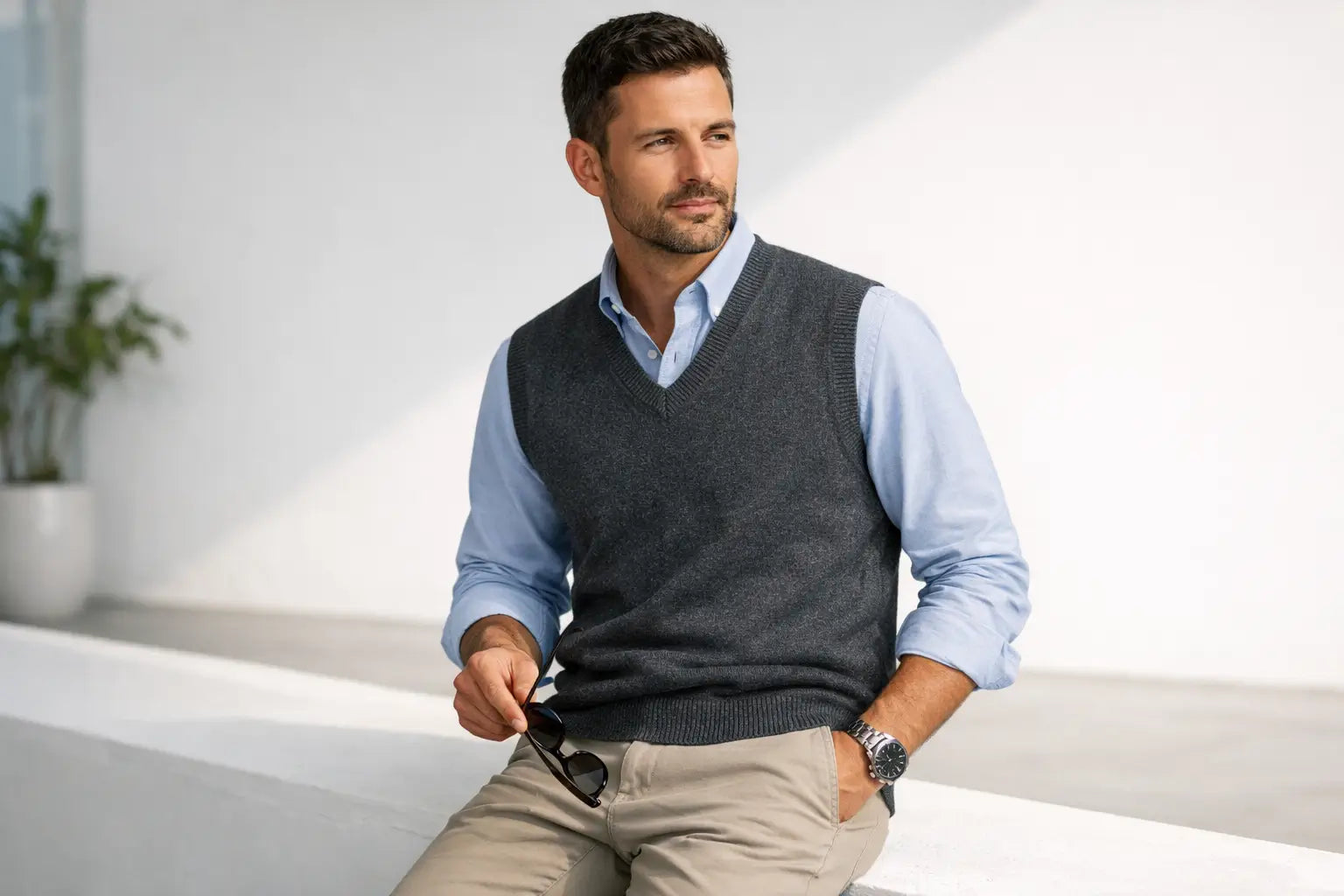
Sweater vests are easiest to wear when you treat them like a “vibe dial”: your base layer sets the formality, and your pants + shoes finish the story.
Modern Sweater Vest Rules + 3 Outfit Formulas
A sweater vest looks modern when the fit is clean, the layering feels intentional, and you keep the outfit balanced—one polished piece, one relaxed piece.
Key points (quick rules you can actually remember):
- Rule 1: Control the vibe with your base layer. Tee = casual. Button-down = smarter.
- Rule 2: Keep the silhouette clean. If the vest is relaxed, your pants should look intentional (straight or wider, not skin-tight).
- Rule 3: Let one thing be the “statement.” If the vest is patterned, keep shirt and pants simple.
- Rule 4: Shoes decide the ending. Sneakers relax; loafers/derbies sharpen; boots add rugged structure.
Quick decision table (fastest way to avoid “something feels off”):
| If you want… | Wear under the vest | Pants | Shoes | Keep the vest… |
|---|---|---|---|---|
| Easy casual | Solid tee | Straight jeans | Clean sneakers | Solid or subtle texture |
| Smart casual | Oxford/button-down | Chinos or trousers | Loafers/derbies | Fine-gauge or neat knit |
| Patterned but wearable | Solid tee or solid shirt | Neutral chinos/jeans | Simple shoes | The focal point (everything else quiet) |
3 outfit formulas you can copy today:
- Tee + vest + straight jeans + sneakers (add denim jacket if you want)
- Oxford shirt + vest + chinos + loafers (add a blazer for office-leaning smart casual)
- Patterned vest + solid tee + neutral trousers + simple shoes (let the vest do the talking)
If you want more options without overthinking it, start with a few “formula outfits” and rotate colors.
15 Modern Sweater Vest Outfit Formulas (Casual → Smart Casual)
These formulas work because they keep one consistent vibe and avoid mixing “too formal” and “too casual” signals in the same outfit.

Key points:
- Every formula below includes base layer + vest + pants + shoes (and optional outerwear).
- If you’re unsure, start with solid vests and add patterns later.
Casual Formulas (Tee + Denim + Sneakers)
-
Solid tee → crewneck vest → straight jeans → clean sneakers
Optional: denim jacket. -
Long-sleeve tee → ribbed vest → black jeans → minimal sneakers
Optional: overshirt (kept open). -
Plain tee → relaxed vest → cargo pants (clean fit) → sneakers
Optional: lightweight bomber. -
Tee → vest → wide-leg jeans → chunky sneakers
Optional: simple cap (keep the rest calm). -
Tee → vest → khaki chinos → retro sneakers
Optional: light windbreaker.
Smart-Casual Formulas (Button-Down + Chinos + Loafers)
-
Oxford shirt → V-neck vest → chinos → loafers
Optional: unstructured blazer. -
Button-down → fine-gauge vest → tailored trousers → derbies
Optional: light overcoat in cooler weather. -
Denim/chambray shirt → solid vest → dark jeans → loafers
Optional: simple belt; keep colors cohesive. -
Turtleneck → vest (fine or medium knit) → trousers → boots
Optional: wool coat (watch bulk at the armholes). -
Polo shirt → vest → chinos → loafers
Optional: light jacket (avoid overly sporty outerwear).
Patterned Vest Formulas (Argyle/Fair Isle Without Clashing)
-
Solid tee → argyle vest → neutral jeans → simple sneakers
Optional: keep jacket plain. -
Solid button-down → Fair Isle vest → cream/stone chinos → loafers
Optional: a quiet blazer (no bold patterns). -
Solid turtleneck → patterned vest → dark trousers → boots
Optional: long coat; keep it clean.
Layered Outerwear Formulas (When You Want More Structure)
-
Oxford shirt → vest → chinos → derbies → blazer on top
Tip: choose a finer vest to prevent bunching under the jacket. -
Long-sleeve tee → chunkier vest → straight jeans → boots → workwear jacket
Tip: chunkier vests read more casual—lean into rugged textures.
Boundary conditions (what changes the “right” choice):
- Knit weight changes layering comfort: chunkier vests feel casual and can add bulk; fine-gauge looks sharper and layers easier.
- Pattern intensity changes everything: when the vest is bold, simplify shirt, pants, and shoes.
Now that you have outfits, the quickest upgrade is learning what to wear under and over the vest.
What to Wear Under a Sweater Vest (and What to Layer Over It)
Wear a tee for casual, a button-down for smart casual, and add outerwear that doesn’t fight the vest’s bulk or neckline.
This is a common focus in mainstream men’s style coverage, which tends to frame sweater vests as highly adaptable across casual and dressed-up looks. (gq.com)
Key points:
- Under = vibe. Tee relaxes. Collar sharpens. Turtleneck modernizes without a collar.
- Over = structure. Blazers and coats add polish; denim and bombers keep it casual.
- Avoid bulk stacking. If the vest is chunky, keep the layers around it simpler.
Under vs. over table (fast picks):
| Your goal | Best underlayer | Best outerwear | Quick “avoid” |
|---|---|---|---|
| Easy casual | Solid tee / long-sleeve tee | Denim jacket / bomber | Dress shirt + running shoes mismatch |
| Smart casual | Oxford / button-down | Blazer / topcoat | Chunky vest under a tight blazer |
| Warm, sleek | Turtleneck | Coat / overshirt | Itchy fabrics directly on skin (comfort fails) |
| Patterned vest | Solid tee or solid shirt | Plain jacket | Patterned shirt + patterned vest (too noisy) |
Underlayers by Vibe (Casual → Smart)
- Casual: solid tee, long-sleeve tee, or henley (especially with a crewneck vest).
- Smart casual: Oxford or button-down (especially with a V-neck vest).
- Modern and clean: turtleneck (easy way to look intentional with minimal pieces).
- In-between: polo (sporty-smart; best with simple pants and cleaner shoes).
What to Wear Over It (Outerwear That Doesn’t Bulge)
- Blazer: best with fine-gauge or medium vests; keep the blazer unstructured if possible.
- Denim/bomber: easy casual pairing; works with chunkier vests.
- Coat/topcoat: great for colder weather; fine-gauge vests layer cleanly underneath.
- Overshirt: good middle layer; choose a relaxed cut if the vest is textured.
3-Step Layering Method (Choose Vibe → Choose Base → Add Outerwear)
- Choose your vibe: casual, smart casual, or pattern-forward.
- Choose your underlayer: tee (casual) / button-down (smart) / turtleneck (sleek).
- Add outerwear only if it improves the outfit: choose structure (blazer/coat) or casual (denim/bomber), then check bulk at the armholes.
Boundary conditions:
- Neckline matters: V-necks often look “complete” with a collar; crewnecks are easiest with tees and minimal layers.
- If the armholes feel tight, you’ll hate the outfit by hour two—size or layer accordingly.
Once your layers are right, fit becomes the difference between “modern” and “costume-y.”
How a Sweater Vest Should Fit (Length, Armholes, Neckline)
A sweater vest should sit comfortably through the chest, have armholes that allow movement, and end around your waistband area without swallowing your torso.

Key points:
- Chest: should lie flat without pulling lines across the front.
- Armholes: should allow you to move without the vest riding up or squeezing.
- Length: long enough to look intentional, short enough to keep your proportions sharp.
- Neckline: should frame your underlayer (collar or tee) instead of fighting it.
Fit Checklist (Quick Checks You Can Do in 30 Seconds)
- Raise your arms: the vest shouldn’t climb dramatically.
- Sit down: it shouldn’t bunch into a thick roll at your waist.
- Look at the hem: it should land near your waistband zone (not halfway down your thighs).
- Check the armholes: if the armholes pinch your shirt sleeves into folds, it’s likely too tight.
- Check the neckline: if your collar looks crushed or your tee looks crowded, adjust neckline or size.
Slim vs Relaxed: Pick the Silhouette That Matches Your Pants
- Slim vest + tapered pants: sharp, clean, more “smart casual.”
- Relaxed vest + straight/wider pants: modern, casual, and intentional.
- Avoid: relaxed vest + skin-tight pants (often reads unbalanced).
Should the Shirt Hem Show?
- Often looks best when it’s controlled: a small peek can look layered on purpose, especially in casual outfits.
- Looks sloppy when the shirt is too long or uneven: if the hem is dramatically longer than the vest, either tuck the shirt or choose a shorter shirt.
- If you’re dressing up: a tuck (or at least a cleaner front) usually reads more polished.
Boundary conditions:
- If you plan to layer thicker shirts underneath, you need more ease through the armholes and chest.
- Longer torsos can handle slightly longer vests; shorter torsos often look better with cleaner, not-too-long hems.
If fit is dialed in, color and pattern choices become “easy mode” for building outfits.
Easiest Colors & Patterns to Style (Pairing Table)
Neutral sweater vests are the easiest to style, and patterned vests look best when everything else stays simple.
Key points:
- Start with neutrals: navy, charcoal, mid-grey, or cream/beige.
- Let the vest be the focal point: when it’s patterned, your shirt and pants should be quieter.
- Use contrast intentionally: high contrast looks sharper; tonal looks softer.
Pairing table (low-risk combos):
| Vest color/pattern | Easiest underlayers | Easiest pants | Shoes that “just work” | Best vibe |
|---|---|---|---|---|
| Navy (solid) | white/grey tee, light blue Oxford | khaki chinos, dark jeans | sneakers, loafers | casual → smart casual |
| Charcoal/grey (solid) | white tee, striped tee (subtle), Oxford | black jeans, grey trousers | sneakers, boots, derbies | modern, versatile |
| Cream/beige (solid) | white/earth-tone tee, Oxford | dark jeans, olive chinos | sneakers, loafers | softer, elevated casual |
| Black (solid) | black/white tee, crisp shirt | black jeans, grey trousers | sneakers, boots | sleek, minimal |
| Argyle/Fair Isle | solid tee or solid shirt | neutral chinos/jeans | simple sneakers, loafers | pattern-forward |
Beginner-Safe Neutrals (The “Goes With Most Things” Shortlist)
- Navy (pairs with denim and chinos easily)
- Charcoal (looks modern with black jeans and boots)
- Mid-grey (easy tonal outfits)
- Cream/beige (soft contrast with darker pants)
“Easiest” depends on what you already own—pick the vest color that matches your most-worn pants.
Pattern Rules (Argyle/Fair Isle Without Clashing)
- One strong pattern at a time: if the vest is busy, keep the shirt solid.
- Match pattern scale: avoid big vest patterns with big shirt patterns.
- Keep pants neutral: let the vest carry the visual interest.
- Simplify shoes: clean sneakers or classic loafers keep the look grounded.
Boundary conditions:
- If your workplace is conservative, choose subtle patterns or keep patterned vests for weekends.
- If you prefer low contrast, build tonal outfits (grey vest + grey trousers) and add interest via texture, not color.
Now bring it together with pants and shoes—those two choices often make or break the overall vibe.
Best Pants & Shoes With a Sweater Vest (Decision Table)
Chinos and straight jeans are the easiest pants; sneakers, loafers, and boots cover most situations—pick the one that matches your intended formality.
Key points:
- Jeans = casual baseline (wash and shoe choice decide how casual).
- Chinos = easy smart casual (especially with a collar).
- Trousers = more polished (best with finer knits and cleaner shoes).
Decision table:
| Pants | Best shoes | Underlayer that matches | Overall vibe | Quick note |
|---|---|---|---|---|
| Dark straight jeans | Clean sneakers / boots | Tee / long-sleeve tee | modern casual | easiest “everyday” option |
| Light jeans | Sneakers | Tee | relaxed casual | keep the vest simple (solid) |
| Khaki chinos | Loafers / derbies | Oxford / button-down | smart casual | easiest office-leaning combo |
| Olive chinos | Sneakers / boots | Tee or Oxford | casual-smart | great with cream/grey vests |
| Tailored trousers | Loafers / derbies | Shirt / turtleneck | polished | keep knit finer to avoid bulk |
Boundary conditions:
- Relaxed vests usually look better with straight or wider pants than with very tight pants.
- Weather and commuting matter—boots might be the practical choice even in a “smarter” outfit.
If you’re deciding whether a sweater vest fits a dress code, treat it like any knit: keep it neat, coordinated, and context-aware.
Business Casual & Occasions (Office, Date, Weekend)
A sweater vest can be business casual when it’s neat, not overly chunky, and paired with a shirt and cleaner shoes—what counts as “business casual” varies by workplace.
Key points:
- Office-safe default: solid vest + button-down + chinos/trousers + loafers/derbies.
- Date-night smart casual: fine-gauge vest + turtleneck or crisp shirt + trousers + boots/loafers.
- Weekend casual: tee + vest + jeans + sneakers.
Practical occasion mapping:
- Office (business casual): Oxford shirt + solid vest + chinos + loafers. Add a blazer if your office leans formal.
- Dinner/date: turtleneck + vest + trousers + boots. Keep colors coherent (tonal works well).
- Weekend: tee + vest + jeans + sneakers. Add a denim jacket for easy layering.
Boundary conditions:
- If your office is conservative, avoid loud patterns and very chunky knits.
- If you’re unsure, dress slightly sharper (shirt + chinos) the first time and adjust after you see the vibe.
Seasonality matters less than your climate—especially if you live in a place with heavy AC indoors.
Seasonal Styling (Spring/Summer vs Fall/Winter + AC Offices)
For warm seasons, keep the knit lighter and the base layer breathable; for cold seasons, use the vest as an insulating layer and manage bulk with outerwear.
Key points:
- Spring/Summer (or warm climates): lighter knit, breathable tee/shirt, lighter colors.
- Fall/Winter: fine-gauge vests layer under coats; chunkier vests can be a top layer.
- AC offices: a vest can be your “desk layer” even in warmer months.
By season:
- Spring: tee or Oxford + lighter vest + chinos + sneakers/loafers.
- Summer (especially humid): only if you’re comfortable—choose a light vest, keep the outfit simple, and avoid heavy layering.
- Fall: add an overshirt or denim jacket; boots become easier to justify.
- Winter: turtleneck + vest + trousers + boots, then a coat on top (watch bulk).
Boundary conditions:
- Climate beats calendar—dress for your actual temperature swings, not the month.
- Comfort is personal: if the fabric irritates your skin, swap the underlayer (or skip the vest for all-day wear).
If the sweater vest still feels “off,” it’s usually one of a few common mistakes—and the fix is typically small.
Common Mistakes (What Looks “Dated” + Quick Fixes)
Most “dated” sweater vest looks come from fit problems, mismatched formality, or competing patterns—fixing one element (usually pants or shoes) often solves it.
Key points:
- “Modern” here means balanced silhouette + coherent formality + intentional layering (not a specific trend).
- You don’t need to replace your vest; you usually need to rebalance the outfit.
Mistake → what it looks like → quick fix:
- Too boxy or too long → torso looks swallowed → choose a cleaner fit or pair with straighter/wider pants for intentional proportion.
- Dress shirt + beat-up sneakers → mixed signals → either switch to clean sneakers + casual shirt, or keep the shirt and switch to loafers/derbies.
- Patterned shirt + patterned vest → visual noise → make either the shirt or the vest solid.
- Vest is the statement but everything else is loud → outfit feels busy → keep pants and shoes neutral and simple.
- Skinny pants + bulky vest → top-heavy imbalance → switch to straight pants or a finer vest.
- Shirt hem is wildly longer than the vest → looks accidental → tuck the shirt, choose a shorter shirt, or pick a longer vest on purpose.
- Office look feels too “preppy” → costume-y vibe → swap loafers for minimal derbies or boots, and choose a quieter vest color.
- “Grandpa” fear → you feel self-conscious → focus on: clean fit, modern pants silhouette, and simple shoes (the quickest confidence move).
Boundary conditions:
- Some vintage looks are intentional; if your goal is “retro,” a few of these “mistakes” become style choices—just keep them consistent.
If you’re buying your first vest, a quick definition and checklist can save you from wardrobe dead-ends.
What Is a Sweater Vest? Quick Buying Checklist (Versatility)
A sweater vest is a sleeveless sweater (often pullover or buttoned) worn over other clothing. (merriam-webster.com)
Key points:
- A sweater vest is knitwear (warmth + texture), while “vest” can mean many sleeveless garments depending on context. (merriam-webster.com)
- Your easiest-to-style vest is usually solid, moderate in fit, and easy to layer.
Quick buying checklist (for easy styling):
- Neckline: V-neck if you’ll wear collared shirts often; crewneck if you’re mostly tee-first.
- Armholes: enough room for your preferred shirts without bunching.
- Length: works with your most-worn pants (aim for clean proportions).
- Knit weight: fine-gauge for smarter outfits; chunkier for casual.
- Color/pattern: neutrals first; patterns later (and keep them wearable).
- Comfort: if it irritates your skin, you won’t wear it—prioritize comfort.
Boundary conditions:
- Terms vary: “sweater vest,” “knitted vest,” and similar phrases can overlap; focus on the garment’s function (sleeveless knit layer).
If you want quick answers to the most searched questions, the FAQ below keeps it simple.
FAQ: Sweater Vest Outfits for Men
- What do you wear under a sweater vest?
-
Wear a solid tee for casual and a button-down (like an Oxford) for smart casual. If you want a sleek, modern option without a collar, a turtleneck works well. Neckline matters—V-necks pair more naturally with collars than crewnecks.
- Is a sweater vest business casual?
-
It can be, if the vest is neat and you pair it with a shirt and cleaner shoes. A safe formula is a solid vest + Oxford/button-down + chinos + loafers/derbies. If your office is conservative, keep patterns subtle and the knit less chunky.
- How should a sweater vest fit (length and armholes)?
-
It should sit comfortably through the chest and allow easy arm movement without riding up. The hem should look intentional—often around the waistband area rather than very long. If you plan to layer thicker shirts, you’ll need more room in the armholes.
- Can you wear a sweater vest with jeans?
-
Yes—straight, dark-wash jeans are the easiest because they look cleaner and pair well with both sneakers and boots. If you’re aiming for smart casual, switch to chinos or add cleaner shoes and a collared shirt.
- What shoes go best with a sweater vest outfit?
-
Clean sneakers are best for casual outfits, loafers/derbies are best for smart casual, and boots are best when you want structure or need weather practicality. Choose shoes that match the rest of the outfit’s formality.
- What’s the easiest color sweater vest to style?
-
Navy, charcoal, mid-grey, and cream/beige are typically the easiest because they pair with common denim and chino colors. The easiest pick is the one that matches the pants you wear most often.
- How do you avoid looking “grandpa” in a sweater vest?
-
Focus on clean fit, a modern pant silhouette (straight or intentional wide), and simple shoes. Keep the outfit coherent—don’t mix very formal and very casual pieces. If you feel unsure, go solid-color vest first and keep patterns minimal.
Quick Recap + Optional Note for Brand Builders
If you remember three rules—control formality with the underlayer, keep the silhouette balanced, and keep patterns simple—you’ll be able to wear sweater vests confidently in real life.
Quick Recap: The 3 Rules to Remember
- Base layer sets the vibe: tee for casual, button-down for smart, turtleneck for sleek.
- Fit + pants silhouette must agree: relaxed with straight/wide; slim with tapered/clean.
- Patterns need quiet support: if the vest is loud, everything else gets calmer.
If you’re building a men’s knitwear line and want customers to style your sweater vests easily, spec choices matter more than “trend.” Consider:
- Neckline options that match common underlayers (V-neck for shirts; crew for tees)
- Comfortable armholes for layering (reduces “bunching” complaints)
- A balanced fit (not too long, not too tight)
- Core neutral colorways first, then a small set of wearable patterns
If you already have sketches or a rough tech pack, turning these styling-friendly specs into production-ready details is usually the fastest way to move from idea to sampling.
)