
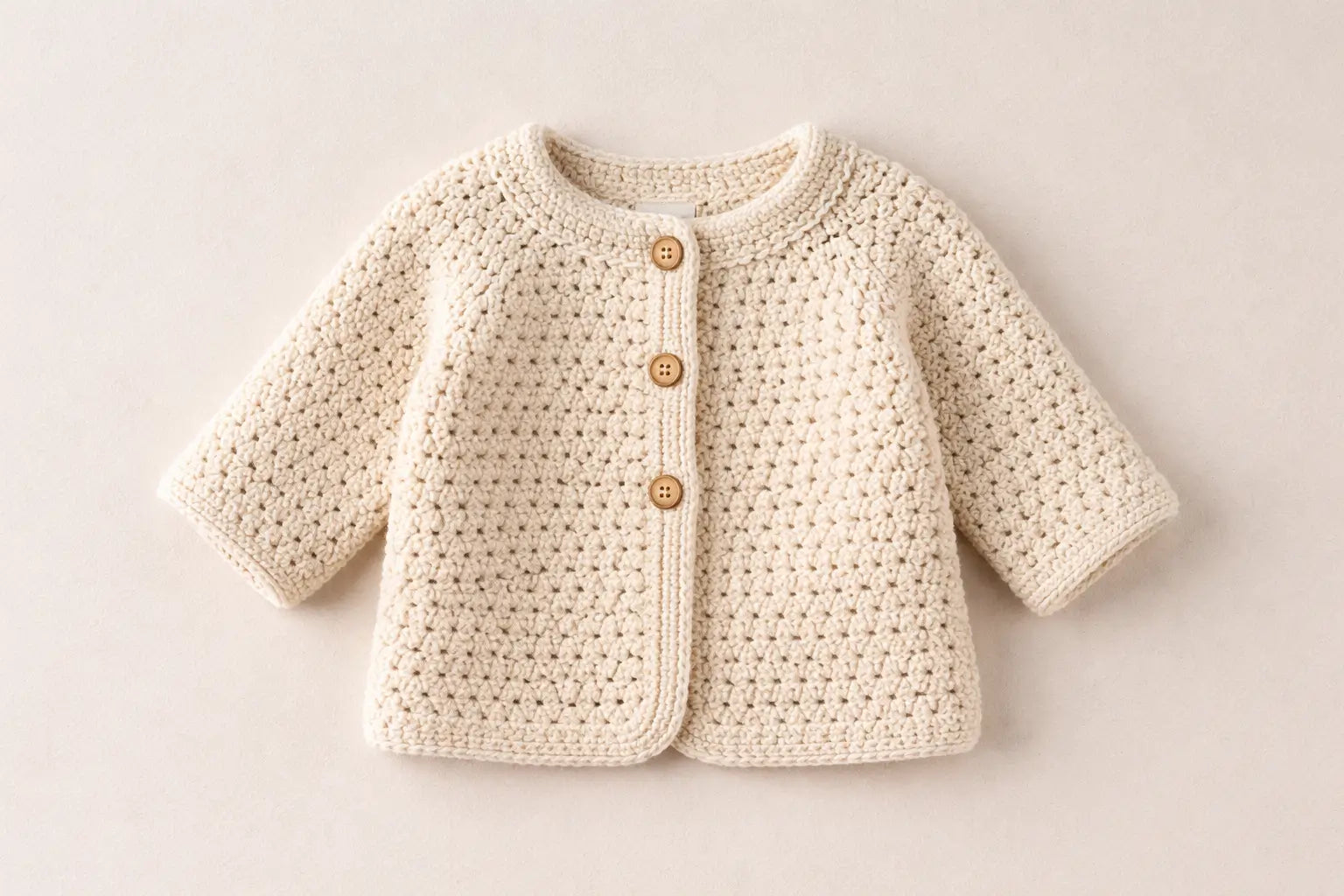
Baby Cardigan Crochet Pattern (Beginner-Friendly): Sizes, Yarn, Gauge & Steps
Contents
- What’s the easiest baby cardigan crochet pattern for beginners?
- How do I choose the right size for a baby crochet cardigan?
- What yarn is best for a baby crochet cardigan?
- Gauge (tension) — how to make sure your cardigan fits
- How do you crochet a baby cardigan? A simple build overview
- Finishing: neat edges, secure ends, and a quick safety note
- Troubleshooting: common problems and fast fixes
- Where to find a good baby cardigan crochet pattern (and what to look for)
- Crochet abbreviations (US terms) and US vs UK term differences
- FAQ
What’s the easiest baby cardigan crochet pattern for beginners?
The easiest baby cardigan crochet patterns are usually top-down raglan or hexagon cardigans. Top-down raglan lets you do fit checks as you go, while hexagon cardigans rely on repeating rounds that “fold” into sleeves and a body. Choose the one that matches how you like to work: shaping-and-try-on vs repeat-and-assemble.
- If you prefer minimal seaming and frequent fit checks: go top-down raglan.
- If you prefer simple repeats and don’t mind a little shaping/assembly: try a hexagon.
- If you’re new, look for patterns that clearly state: US terms, gauge, sizes included, and finishing steps.
| Method | Why it’s beginner-friendly | Watch-outs | Best for |
|---|---|---|---|
| Top-down raglan | Fit checks as you go; often mostly seamless; easy to lengthen body/sleeves | Requires counting increases and tracking yoke depth | “I want control over fit” |
| Hexagon cardigan | Repeating rounds can feel simple; construction is satisfying and visual | Sizing can be less intuitive; shaping/edging needs attention | “I like repeatable rounds” |
How do I choose the right size for a baby crochet cardigan?
Use measurements when you can, not just age labels. A simple approach: pick a target chest measurement, decide how much ease you want (a little room for layering), confirm your gauge, and do a quick mid-project fit check before you commit to sleeves and button bands.
- Step 1: Choose size by chest (best) or age (fallback).
- Step 2: Add a little ease for comfort/layers.
- Step 3: Match the pattern’s gauge (or adjust hook/yarn).
- Step 4: Fit-check after the yoke/upper body before finishing.
Here’s a baseline reference for baby body sizing (inches and centimeters). Age ranges can vary by baby, so treat these as starting points and prioritize measurements when possible.
| Age (baby) | Chest (in / cm) | Back waist length (in / cm) |
|---|---|---|
| 3 months | 16 in / 40.5 cm | 6 in / 15.5 cm |
| 6 months | 17 in / 43 cm | 7 in / 17.5 cm |
| 12 months | 18 in / 45.5 cm | 7.5 in / 19 cm |
| 18 months | 19 in / 48 cm | 8 in / 20.5 cm |
| 24 months | 20 in / 50.5 cm | 8.5 in / 21.5 cm |
Tip: If your cardigan is meant to go over a onesie and a layer, you’ll typically want more ease than a “photo outfit” cardigan.
What yarn is best for a baby crochet cardigan?
The “best” yarn for a baby cardigan is usually the one that’s soft on skin and easy to care for. Prioritize comfort and washability first, then choose weight based on the season and the drape you want.
- Soft, baby-friendly feel (not scratchy)
- Washable for real life (check care labels)
- Appropriate warmth: lighter for layering, thicker for winter
- Holds shape for button bands and edging
| Goal | Suggested fiber/weight | Care notes |
|---|---|---|
| Everyday + easy care | Soft acrylic blend, or washable wool blend; DK or worsted | Aim for machine-washable if possible |
| Cooler weather | Warmer fiber; worsted or heavier DK | Watch for itch; choose softer fibers |
| Light layering | DK or sport weight | Great for spring/fall; less bulky seams/edges |
Quick hook rule: start with the hook size the pattern recommends, then adjust only to hit the gauge you need.
Gauge (tension) — how to make sure your cardigan fits
Gauge is how many stitches and rows you get in a set measurement (commonly 4 inches / 10 cm). If your gauge differs from the pattern, your cardigan can come out noticeably bigger or smaller—even if you follow every step perfectly. (In UK terminology, gauge may be called “tension.”)
- Make a small swatch in the same stitch pattern the cardigan uses.
- Measure stitches/rows over 4 in / 10 cm (don’t measure just 1 inch; it’s too sensitive).
- If your fabric is too big/loose: switch to a smaller hook (tighter gauge).
- If your fabric is too small/tight: switch to a larger hook (looser gauge).
- Micro example (why it matters): if you’re off by about 1 stitch over 4 in, that difference can add up across the whole chest and change the fit.
If you’re using a size chart as a baseline for chest/body targets, pair it with your actual gauge so your finished width matches your goal.

How do you crochet a baby cardigan? A simple build overview
Here’s a generic top-down cardigan build outline (not a specific copyrighted pattern). It works as a mental map even if you choose a hexagon method.
- Choose method and size target (by measurement if possible).
- Swatch and confirm gauge.
- Start the yoke/upper section (often worked in rows for a cardigan opening).
- Increase until the yoke reaches the right depth.
- Divide for sleeves and continue the body.
- Work the body to length.
- Work sleeves to length.
- Add edging and a button band (or simple front edge).
- Finish: weave ends, reinforce stress points, attach closure if used.
Fit-check moments: after the yoke, after the sleeve divide, and before you finalize button band placement.

Finishing: neat edges, secure ends, and a quick safety note
A cardigan looks “store-bought” when the finishing is clean and consistent.
Finishing checklist:
- Weave ends in securely (don’t rely on one short tail).
- Keep edging stitch counts consistent (uneven counts often cause waviness).
- Reinforce button band edges if the fabric feels stretchy.
- Place buttons evenly and test the closure tension before sewing.
- Block lightly if appropriate for your yarn (follow yarn care guidance).
Quick safety note (practical, not legal advice): for items intended for very young children, small components can be a concern if they detach. If you use buttons on a baby cardigan, attach them extremely securely and consider age-appropriate choices and supervision.
Troubleshooting: common problems and fast fixes
| Problem | Likely cause | Fastest fix |
|---|---|---|
| Cardigan is too big | Gauge too loose; hook too large | Re-swatch; go down a hook size |
| Cardigan is too small | Gauge too tight; hook too small | Re-swatch; go up a hook size |
| Wavy front/button band | Extra stitches added; inconsistent tension | Recount stitches; keep edging stitch count consistent |
| Sleeves feel tight | Not enough sleeve circumference; tight gauge | Add sleeve rounds/rows; adjust hook size for sleeves |
| Sleeves are different lengths | Missed rounds/rows on one sleeve | Count rounds/rows; add to the shorter sleeve |
| Stiff fabric | Yarn too heavy or hook too small | Try larger hook or lighter weight yarn; swatch again |
| Gaps at underarm/sleeve join | Loose join or missed stitches at divide | Tighten join area; check stitch placement at split |
Where to find a good baby cardigan crochet pattern (and what to look for)
You’ll find patterns in designer blogs, pattern libraries, and video tutorials. The key is choosing a pattern that matches your skill level and gives you enough information to succeed.
Pattern quality checklist:
- Clear note: US terms or UK terms
- Gauge stated (and a stitch pattern for swatching)
- Size range and finished measurements (or clear measurement guidance)
- A stitch glossary or link to abbreviations
- Construction overview (what you’re building and when)
- Clear finishing instructions (edging, button band, closure)
Free page vs paid PDF (general differences):
- Free pages are great for browsing but may be heavy on ads and harder to print.
- PDFs are often easier to mark up and print, and may include cleaner formatting or updates.
Crochet abbreviations (US terms) and US vs UK term differences
Crochet patterns rely on abbreviations to keep instructions compact. A quick cheat sheet helps you read patterns faster—and prevents common mistakes when a pattern uses a different terminology system.
| Abbrev | US meaning | UK equivalent/notes |
|---|---|---|
| ch | chain | chain |
| sl st | slip stitch | slip stitch (often “ss”) |
| sc | single crochet | UK “dc” (double crochet) |
| hdc | half double crochet | UK “htr” (half treble) |
| dc | double crochet | UK “tr” (treble) |
| tr | treble crochet | UK “dtr” (double treble) |
How to avoid US/UK confusion:
- Look for a line near the start that states US terms or UK terms.
- If it’s not stated, compare stitch names: a “dc” in UK terms is not the same stitch as a “dc” in US terms.
FAQ
-
Q: What’s the easiest baby cardigan crochet pattern for beginners?
A: Top-down raglan and hexagon cardigans are often the easiest because they use repeatable structures and predictable steps. If you want fit checks as you go, choose top-down raglan; if you want simple repeating rounds, try a hexagon cardigan. -
Q: Top-down raglan vs hexagon: which is easier?
A: It depends on what feels “easy” to you. Raglan is easier if you like counting increases and doing fit checks; hexagon is easier if you enjoy repeating rounds and don’t mind a little shaping/assembly at the end. -
Q: How do I choose the right size for a baby crochet cardigan?
A: Measurements are usually more reliable than age labels. Start with chest (and a length target), decide ease, confirm gauge, then do a mid-project fit check. -
Q: What yarn is best for a baby crochet cardigan?
A: The best yarn is typically soft and easy-care. Choose a comfortable fiber and a weight that matches the season, then adjust hook size to hit gauge for the size you want. -
Q: How do I adjust a baby cardigan crochet pattern to a different size?
A: Start with gauge: if you don’t match gauge, the finished size will drift. Adjust hook size first to match gauge; then add length with extra rows/rounds and adjust width using the pattern’s increase structure or size options. -
Q: Are buttons safe on baby crochet cardigans?
A: Small parts can be a concern if they detach, especially for items intended for very young children. If you choose buttons, attach them very securely and consider age-appropriate closures and supervision. -
Q: What do common crochet abbreviations mean (US terms)?
A: Common US abbreviations include ch (chain), sl st (slip stitch), sc (single crochet), hdc (half double crochet), dc (double crochet), and tr (treble).
Optional: If you’re a brand, here’s what you need to recreate a baby cardigan look for production
If you want a “crochet-inspired” baby cardigan look for a product line, you’ll get faster sampling and fewer revisions when you start with a clear spec. (A crochet fabric doesn’t always translate 1:1 into knit production, so it’s often an inspired-by interpretation.)
Production-ready checklist (what to prepare):
- Target size range (e.g., 3–24 months) and key measurements (chest, body length, sleeve length)
- Desired handfeel and warmth (softness, stretch, drape)
- Yarn/fiber goals (and care requirements like machine wash)
- Stitch/texture references (photos close-up + full garment)
- Closure choice (buttons/snaps/no closure) and placement preferences
- Trim details (ribbing/edging look, label, packaging needs)
- Sample expectations: what must match (fit, feel, look), and what can vary
If you already have a tech pack or reference photos, many OEM/ODM knitwear manufacturers (including XTCLOTHES, as stated on our site) can support sampling and production planning.
:%20Sizes,%20Yarn,%20Gauge%20%26%20Steps)