
Crochet Dog Sweater: Fit-First Guide (Measurements, Sizing, Adjustments)
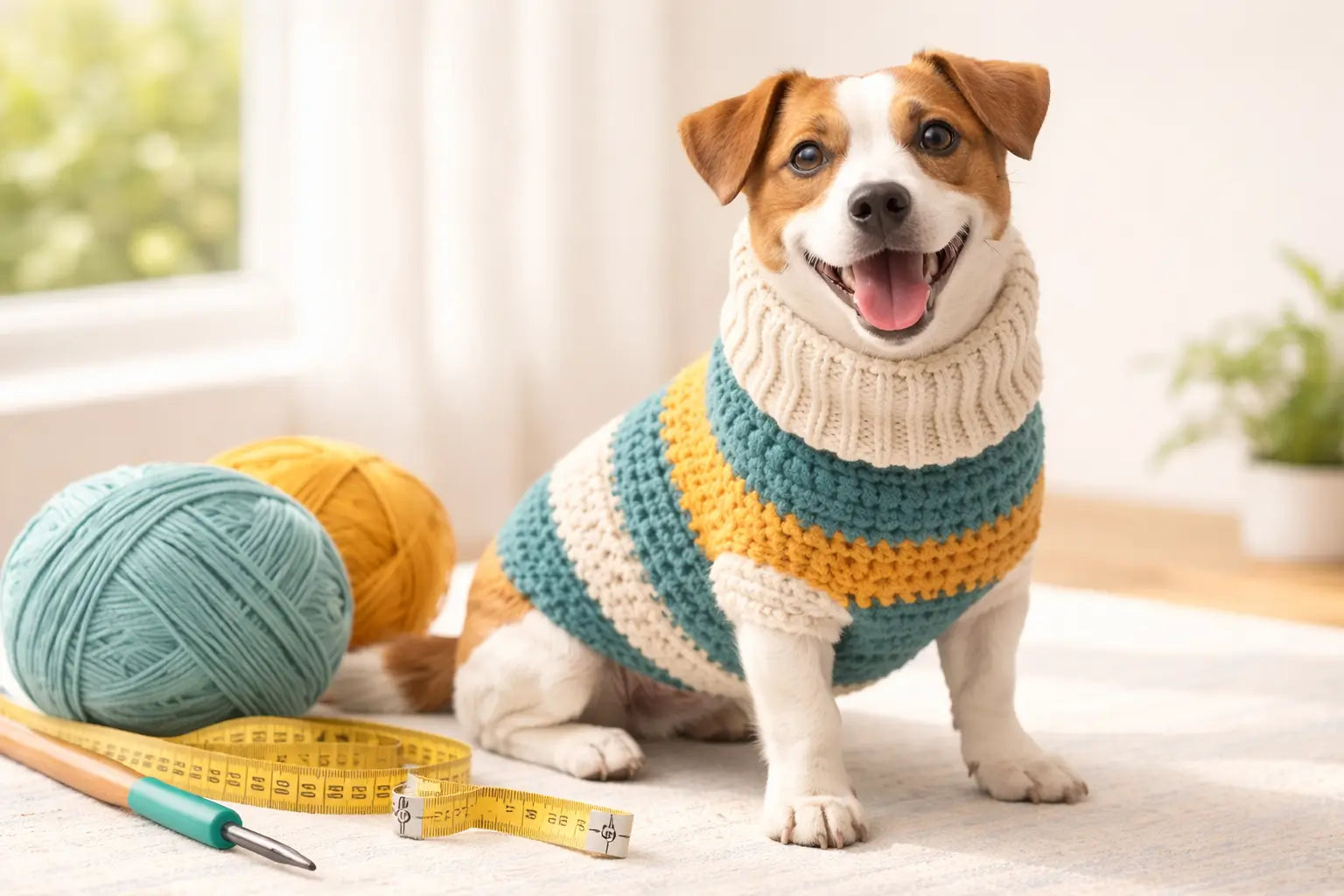
How to measure your dog for a sweater (and what to do between sizes)
Measure chest girth, neck girth, and back length with your dog standing naturally. Keep the tape snug-not-tight (two-finger rule). If you’re between sizes, choose the larger size and adjust from there.
- Stand your dog naturally (not sitting).
- Chest girth: wrap the tape around the widest part of the ribcage, usually just behind the front legs.
- Neck girth: measure where the collar sits.
- Back length: measure from the base of the neck to the base of the tail (where you want coverage to end).
- Use the two-finger rule: you should be able to slip two fingers under the tape for comfortable snugness.
- Between sizes? Choose the larger size, then fine-tune fit while crocheting.
Write these numbers down and reuse them for any pattern (or for ordering a finished sweater).
Dog sweater measurements you need (chest, neck, back length)
For most dog sweaters, these three measurements get you 90% of the way to a great fit: chest girth, neck girth, back length.
| Measurement | Where to measure | Why it matters |
|---|---|---|
| Chest girth | Widest part of ribcage, usually behind front legs | Primary driver for size and mobility |
| Neck girth | Where collar sits | Prevents choking/looseness; ribbing can add forgiveness |
| Back length | Base of neck → base of tail (coverage point) | Controls coverage; too long can ride or get messy |

How to choose the right crochet dog sweater size (even between sizes)
Choose size by chest girth first. If your dog sits between sizes, size up for comfort and adjust length/girth as needed.
The “between sizes” rule box
- If chest lands between two sizes: choose the larger size.
- Then fine-tune by:
- Shortening/lengthening the body (back length) without changing chest fit
- Adding/removing a small number of increase rounds (for girth) if your construction allows
- Using ribbing/edging for gentle stretch at neck/hem
Boundary conditions that change your decision
- Fluffy coat: thick fur can make a “perfect” measurement feel tight in real wear—roomier is often better.
- Thick yarn or tight tension: less stretch means sizing up is safer.
- Male dogs: you may prefer a slightly shorter body length for cleanliness (depends on pattern style).
How to adjust a crochet dog sweater pattern to fit your dog
Fit the chest first, then adjust length separately, and use gauge to prevent sizing surprises.
Quick adjustment checklist (do these in order)
- Check gauge (even a mini swatch). Many patterns size correctly only if your tension matches the pattern’s gauge.
- Fit to chest girth first. Tight around the ribcage is the most common “won’t wear it” failure.
-
Adjust girth with increase/decrease strategy.
- Too tight: add increases (or move up a size)
- Too loose: reduce increases or add decreases
- Adjust back length independently. Add/remove rounds/rows at the body section (without changing chest circumference).
- Use try-on checkpoints. If your sweater is top-down, test-fit after the yoke and again after the body starts.
- Add ribbing/edging for comfort stretch. Especially at neck and hem.
- Fix “rides up” early. Add a bit of length or revisit leg-hole placement (see next section).
Fit troubleshooting table
| Problem | Likely cause | Fast fix |
|---|---|---|
| Chest is tight | Size too small or not enough increases | Size up or add increases |
| Neck feels tight | Opening too small; edging too firm | Add ribbing rows or loosen neckline |
| Sweater rides up toward neck | Body too short or leg holes too far forward | Add length; shift leg-hole start back slightly |
| Armpit rub | Leg holes too small/close; stiff edges | Widen spacing; add smooth edging rounds |
| Twists to one side | Uneven stitch counts/placement | Recount rounds; keep increases symmetrical |
The easiest crochet dog sweater approach for beginners
Beginners usually do best with a top-down pullover using a simple stitch (like single crochet or half double crochet) because you can try it on mid-project.
What to look for in a beginner-friendly sweater
- Minimal shaping (fewer “math moments”)
- Simple stitches (sc/hdc)
- Clear sizing based on chest measurement
- A forgiving neckline finish (ribbing)
- A construction that allows quick fit checks
Leg holes and underarm comfort: how to avoid rubbing
Leg holes should allow full shoulder movement without pulling into the armpits. Create openings, try on, then smooth edges with edging rounds.
Step-by-step (best-practice workflow)
- Mark where leg holes begin: typically just behind the front legs (use a quick try-on to confirm).
- Create openings by chaining/skipping stitches (or following your pattern’s method).
- Try on and watch shoulder movement: the sweater shouldn’t tug forward when your dog steps.
- If it pulls into the armpit: increase the opening size or spacing (a little goes a long way).
- Add 1–2 edging rounds around leg holes to smooth and reduce chafing.
- Final test: let your dog walk a few steps indoors before you fully finish ends.
Common mistakes
- Making holes “just big enough” (they often need more ease)
- Skipping the try-on check
- Leaving rough edges (no edging/finish)
- Placing leg holes too far forward (causes rubbing and ride-up)
Best yarn for a crochet dog sweater (comfort + washability guide)
Choose yarn based on comfort, washability, warmth, and stretch—then monitor your dog so they don’t get too warm.
Quick decision guide (simple “if this, then that”)
- If the sweater is mostly for indoors / mild weather → choose lighter yarn and/or less coverage.
- If it’s for cold walks or a short-coated dog → choose a warmer option and a slightly denser fabric.
- If you expect frequent washing → prioritize easy-care and durability (check the yarn care label).
- If your dog seems sensitive to scratchy fibers → prioritize soft feel and avoid anything that feels prickly to your hand.
Yarn weight matters
Heavier yarn and denser stitches generally trap more warmth. If you notice your dog overheating signals (below), remove the sweater and reassess coverage.
Dog sweater comfort and safety checklist (fit, mobility, overheating)
A dog sweater should not restrict movement. If your dog seems too warm (heavy panting, distress signs), remove the sweater promptly and cool them down; contact a vet if you’re concerned.
Comfort & safety checklist
- ✅ Two-finger snugness at neck/chest (not tight)
- ✅ No rubbing at armpits (check after a short wear)
- ✅ Full shoulder/leg range of motion (walk test)
- ✅ No dangling trims that can snag or be chewed
- ✅ Monitor heat signals, especially indoors or during play (remove sweater if your dog seems too warm)
- ✅ Don’t leave it on indoors by default if your dog runs warm
- ✅ Supervise the first wear (new fit + new texture)
- ✅ Check for pressure marks/redness after 10–15 minutes on the first trial
- ✅ Keep it clean and dry
- ✅ If you see severe distress signs (weakness/collapse/disorientation), treat it as urgent and contact a veterinarian
Can you crochet a dog sweater without a pattern? (made-to-measure mini method)
Yes—especially with a top-down approach—but beginners usually benefit from referencing a pattern for neckline/leg-hole shaping.
Made-to-measure in 6 steps
- Measure chest/neck/back.
- Do a quick gauge check (even 10–15 stitches wide).
- Start top-down so you can try on early.
- Increase until the chest fits comfortably.
- Create leg holes, then try on and adjust opening size.
- Finish body length and add ribbing/edging for stretch.
Buy vs make: finished sweater or downloadable pattern?
Buying saves time; making gives you more sizing control and customization.
| Option | Best for | Trade-offs |
|---|---|---|
| Buy finished sweater | Quick solution, gift, no crochet time | Fit varies—measure carefully before ordering |
| Buy a PDF pattern | You want the look + instructions | Still requires crochet time and sizing/gauge attention |
| Make from a free pattern | Budget-friendly, many options online | Instructions vary; may need more troubleshooting |
Fit tip: Even when buying, your measurements (especially chest girth) are your best defense against poor fit.
For brands/sellers: how to spec a crochet-inspired sweater look for production
This is a business sidebar (not required for DIY crocheters).
If you want a “crochet look” that’s repeatable across sizes, a clear tech pack + measurement spec reduces sampling loops and misunderstandings with suppliers.
Spec checklist you can send to a manufacturer
- Size chart with measurement points (POM): chest, neck opening, back length, leg-hole circumference/position
- Tolerances (acceptable variation)
- Materials/BOM: fiber blend, yarn count/weight, trims
- Texture reference: close-up photos and a short description of the “crochet look”
- Construction notes: neckline finish, hem finish, leg-hole shape, labels, packaging
- Sampling request: prototype → fit sample → pre-production sample (workflow varies)
Practical note: Some crochet textures can be hard to reproduce at scale exactly; suppliers may suggest knit-structure alternatives to get a similar look and feel.
FAQ: Crochet dog sweater fit and sizing
How do you measure a dog for a sweater?
Measure chest girth (behind front legs), neck girth (collar line), and back length (base of neck to tail base). Keep tape snug and use the two-finger rule.
What measurements do you need for a dog sweater?
Chest girth, neck girth, and back length are the essentials—chest usually drives size.
What if my dog is between sizes?
Choose the larger size, then adjust length/girth while crocheting for comfort and mobility.
How do you adjust a crochet dog sweater pattern to fit?
Check gauge (even briefly), fit chest first, then adjust length separately; use try-on checkpoints if your construction allows.
What’s the easiest crochet dog sweater for beginners?
A top-down pullover with simple stitches (sc/hdc) is usually easiest because it’s forgiving and you can test-fit as you go.
What yarn is best for a crochet dog sweater?
Choose based on washability, comfort, and warmth—and monitor for overheating signs, especially indoors.
How do you make sure a dog sweater is comfortable and safe?
Check mobility, prevent armpit rub, and remove the sweater if your dog seems too warm (watch for overheating signs).
How do you make/place leg holes?
Create openings, try on, then adjust spacing/size until shoulders move freely—finish with edging rounds to reduce rubbing.
Quick recap (save this)
- Measure chest, neck, back length (two-finger rule).
- Choose size by chest; between sizes, size up.
- Use gauge + try-on checkpoints to adjust fit.
- Prioritize leg-hole comfort (no armpit rub).
- Watch for overheating signs and remove the sweater if needed.
)