
Dog Sweater Knitting Pattern Guide: Measurements, Gauge, and Fit Fixes (Plus a Factory-Ready Spec Checklist)
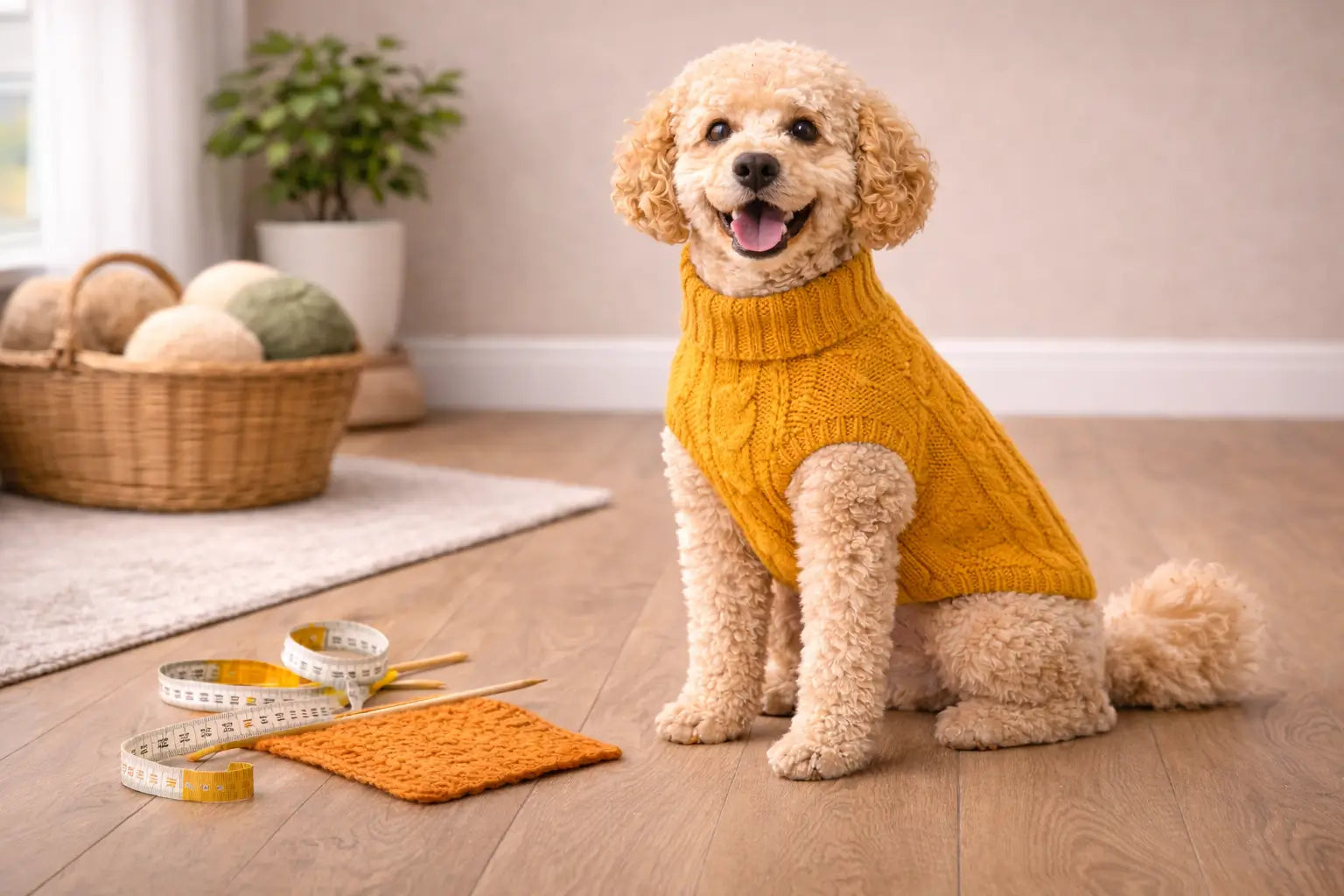
Knitting a dog sweater is mostly a fit problem, not a “finding the perfect pattern” problem. If you measure the right points, swatch for gauge, and pick a beginner-friendly construction, you can make almost any dog sweater knitting pattern work for your dog.
This guide is pattern-agnostic: it teaches the method (so we won’t copy or reproduce any pattern instructions). For anyone turning a design idea into a product, there’s also a clearly labeled brand section with a factory-ready checklist.
Measure your dog for a sweater that fits
Start with chest girth, then measure back length, then (optionally) belly/underbody length. Chest girth is commonly treated as the anchor measurement for dog apparel fit. (Example measurement guidance: AKC Shop measuring guide.)

Steps: how to measure (snippet-ready)
- Have your dog stand naturally (not sitting).
- Measure chest girth around the widest part of the rib cage (usually just behind the front legs).
- Measure back length from the base of the neck/shoulders to the base of the tail.
- Measure belly/underbody length (how far the sweater should extend underneath).
- Keep the tape snug but not tight (don’t compress the coat).
- Choose size by chest first, then plan to adjust length (back/belly) rather than forcing a “perfect chart match.”
(Measurement reference example: AKC Shop measuring guide.)
Chest-first sizing logic (why it helps)
- If the chest is too tight, comfort and movement suffer quickly.
- Back length is usually easier to tweak (add/remove length) than reworking chest circumference.
Boundary conditions
- Dogs vary a lot (deep chest, long back, narrow waist), so sizing charts are a starting point, not a guarantee.
- Ribbing and stitch choice change how forgiving the fit feels.
A good measurement note becomes much more reliable once you control gauge.
Gauge 101 + how to fix gauge issues
Gauge is the size of your knitted stitches—how many stitches and rows you get over a set measurement. If your gauge differs from the pattern’s gauge, the finished sweater size changes. (Clear gauge explanation example: Tin Can Knits—Gauge in Knitting.)
What to do if your gauge is off (snippet-ready)
- If you get too many stitches in the same width (fabric is tighter): try a larger needle, or use a yarn that knits up slightly looser.
- If you get too few stitches (fabric is looser): try a smaller needle, or use a yarn that knits up slightly denser.
- If you’ll knit in the round: consider swatching in the round, because many knitters’ gauge differs between flat knitting and circular knitting. (Example: Andrea Rangel—Swatching in the Round.)
Practical swatching tips (keep it simple)
- Swatch using the same stitch pattern the sweater uses (ribbing and stockinette can behave differently).
- Measure the swatch once it’s relaxed (not stretched on the needle).
- Your goal isn’t “perfection”—it’s reducing the odds of a sweater that’s clearly too big or too small.
Boundary conditions
- Gauge changes with tension, needle material, and stitch pattern—so treat swatching as “fit insurance,” especially for size-sensitive projects.
Once gauge is under control, the next big decision is construction style.
Beginner-friendly constructions
The easiest dog sweater is the one that matches your comfort with seaming vs shaping.
Construction comparison table
| Construction style | Skill feel | Finishing | Fit & mobility notes |
|---|---|---|---|
| Knit flat + seam | Often easiest to follow | Requires seaming | Easy to adjust length; bulky seams can rub |
| Seamless (top-down / raglan-style) | More shaping | Less seaming | Smooth inside; shaping can fit chest/neck well |
| Simple rectangle variant | Fastest “prototype” | Minimal shaping | Can twist/slide; armhole placement matters |
Quick recommendation rules
- Prefer clear step-by-step and don’t mind finishing? Knit flat + seam is straightforward.
- Hate seaming? Go seamless, but keep the shaping simple.
- Doing a rectangle-style approach? Treat it like a draft and plan to troubleshoot fit.
Boundary conditions
- No method is “best” for every dog; mobility and comfort matter more than a fancy stitch pattern.
If your dog’s shape doesn’t match a pattern’s assumptions, small fit adjustments make the difference.
Fit adjustments for long backs, deep chests, and short bellies
Adjust dog sweaters in three places—length, chest/width, and underbody/belly—and confirm neckline and armholes don’t restrict movement.

Adjust back length (without changing chest)
- Add/remove length in the body section after chest and armhole placement is established.
- Re-check back length against your measurement note before final edging.
Adjust chest (without making the neck huge)
- Add width around the body using shaping (distributed increases or extra stitches in the body), not by simply widening the neckline.
- Keep changes gradual to avoid bulky “steps” in the fabric.
Adjust belly/underbody length (mobility + practicality)
- Many dogs are more comfortable with a shorter underbody than the back length, especially for active movement and day-to-day practicality.
Armholes: place for stride, not aesthetics
- Too far forward can rub behind the legs.
- Too far back can restrict shoulder movement.
Boundary conditions
- Stretchy ribbing can mask small fit errors—but it can’t fix a fundamentally wrong chest size.
- If your dog shows rubbing or restricted movement during a try-on, it’s worth undoing and repositioning.
Comfort is also heavily influenced by yarn choice and how the sweater will be cared for.
Yarn choices: soft, warm, and washable
Choose yarn based on comfort and your care routine. There isn’t one perfect fiber—what matters is softness where the sweater moves and how easy it is to wash.
Fiber comparison table (compact, snippet-friendly)
| Fiber type | Feel/comfort | Warmth | Washability | Notes |
|---|---|---|---|---|
| Acrylic | Often soft; widely available | Warm | Often easy-care | Practical for frequent washing |
| Wool | Can be very warm | High | Care varies | Some dogs may find it scratchy |
| Cotton | Smooth | Lower | Often easy-care | Can feel heavier; less elastic |
| Blends | Tunable | Varies | Varies | Often balances softness + durability |
Comfort tips
- Prioritize softness in high-motion areas (chest and behind legs).
- If your dog seems sensitive, avoid scratchy yarn and start with short wear tests.
Boundary conditions
- Dogs differ in comfort and warmth tolerance—watch behavior and movement, and adjust.
Once you choose a yarn, keep the sweater wearable with sensible care.
Washing, drying, and durability
Follow the yarn’s care guidance and avoid harsh heat or agitation when you’re unsure—care needs vary by fiber and construction. (Example: Yarn brands often emphasize following care directions on pattern pages; see the care guidance sections on Yarnspirations dog sweater listings such as Red Heart Dog Sweater.)
Care basics
- Wash: gentler is safer unless the yarn label clearly supports machine washing.
- Dry: reshape and dry in a way that preserves size/shape; high heat can change dimensions.
- Repair: fix small snags early so they don’t spread.
Boundary conditions
- There is no universal “machine washable” promise; it depends on the exact yarn and knit structure.
For brands: turn a knitting pattern into a production-ready spec (tech pack lite)
If you’re a pet brand or product developer, a pattern concept becomes manufacturable when you turn it into a clear spec. This checklist helps you request a sample with fewer rounds of back-and-forth.
Important boundary: Manufacturing outcomes (MOQ, lead time, shipping) may vary by design, yarn availability, order quantity, and destination.

Tech-pack-lite checklist (table format)
| Spec section | What to include | Why it matters |
|---|---|---|
| Measurements & size chart | Measurement points (chest, back, belly, neck), size set, anchor measurement (often chest) | Enables consistent grading and fit targets |
| Materials | Fiber intent, softness target, care intent, colorways | Affects handfeel, durability, sourcing constraints |
| Construction | Knit method (seamed vs seamless), ribbing placement, neckline and armhole shaping notes | Determines comfort, mobility, and repeatability |
| Sample approval & QC | Measurement check, stretch recovery, neckline/armhole comfort checks, finishing standards, photo angles needed | Prevents surprises before bulk production |
Sample review checklist (quick bullets)
- Does it match the measurement spec (within your acceptable variation)?
- Does the neckline stay on without restricting movement?
- Do armholes allow a full stride without rubbing?
- Is finishing smooth in high-rub zones (behind legs, chest seam areas)?
- Are labels/packaging requirements clear and correct?
If you’re building a knit petwear line, sending a single package that includes the size chart, materials intent, and construction notes typically makes sampling and quoting faster. (Outcomes still vary by design and sourcing.)
What affects MOQ and sampling/bulk timelines (and why they vary)
MOQ and timelines depend on design complexity, size set breadth, yarn sourcing, trims/packaging, order quantity, and shipping destination—so the best way to reduce delays is sending a clean spec upfront.
Main drivers (no numeric promises)
- Complexity: stitch patterns, multi-color work, special finishing
- Size set breadth: more sizes usually means more grading and checks
- Yarn sourcing: availability and color matching requirements
- Branding: labels, hangtags, packaging requirements
- Quantity + destination: affects packing and shipping options
How to reduce sampling rounds
- Bundle your Q7 items (size chart + materials intent + construction notes + references) into one message.
- Clearly mark “must-have” vs “nice-to-have” (e.g., preferred yarn vs acceptable alternatives).
Boundary conditions
- Always treat MOQ and timelines as variable based on design, yarn availability, quantity, and destination.
Troubleshooting: common mistakes + quick fixes
Most issues come from skipping gauge, choosing the wrong anchor measurement, or placing armholes/neckline without a mobility check.
Problem → likely cause → fix
- Sweater twists/slides sideways → chest too loose or front/back balance is off → re-anchor on chest and adjust length separately; reconsider construction method.
- Chest too tight → sized by back length or gauge is tight → re-size using chest first; fix gauge before continuing.
- Neckline slips off → neckline too wide or ribbing too relaxed → adjust neckline shaping or use a firmer edge finish.
- Rubbing behind the legs → armholes too far forward or bulky seams → reposition armholes; reduce seam bulk; consider seamless.
- Back too long/short → length not adjusted independently → add/remove length in the body section.
Boundary conditions
- Comfort is observable: if your dog shows irritation or restricted movement, stop using the sweater and revise fit.
FAQ
What measurements do I need to size a dog sweater correctly?
Start with chest girth, then back length; add belly/underbody length to improve real-life comfort and practicality. (Example: AKC Shop measuring guide.)
What if my gauge doesn’t match the pattern?
Adjust needle size (often the simplest fix), or change yarn until your swatch matches the pattern gauge closely—because gauge drives finished measurements. (Example: Tin Can Knits—Gauge in Knitting.)
Is it easier to knit a dog sweater flat or in the round?
Flat + seam is often easier to follow; seamless avoids seams but needs more shaping. Choose based on whether you prefer seaming or shaping.
How do I adjust a pattern for a long-backed or deep-chested dog?
Anchor the size to chest girth, then adjust length separately. Add chest width around the body rather than expanding the neckline.
What yarn is best if I want something soft and washable?
An easy-care yarn (often acrylic or a soft blend) can be practical for frequent washing. Prioritize softness and do a short wear test for comfort.
What should I send a manufacturer to sample a custom knit dog sweater?
A measurement point list + size chart, materials intent, construction notes (neckline/armholes/ribbing), reference photos (or sample), and a sample approval checklist.
Wrap-up
A dog sweater knitting pattern is only as good as your measurement + gauge. Measure chest-first, swatch to control size, choose a construction you’ll finish, and adjust length/chest/belly with mobility in mind. If you’re turning a design into a product, the tech-pack-lite checklist helps you communicate clearly for sampling.
)