
Crochet Lace Sweater Pattern: How to Choose the Right Style & Fit (Plus Yarn, Gauge, and a Brand Guide)
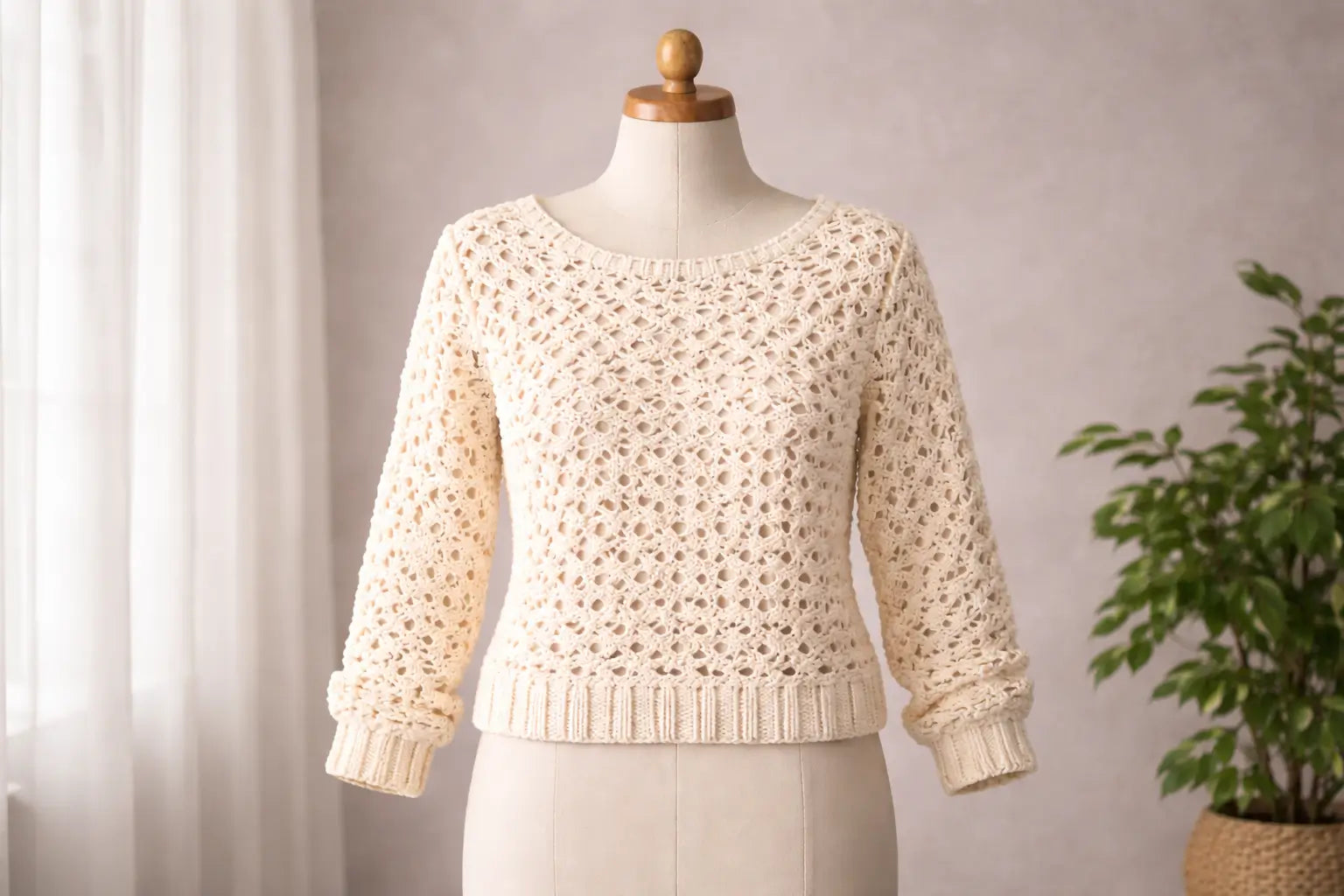
If you’re searching for a crochet lace sweater pattern, this guide helps you choose the right style and avoid the biggest fit surprises (especially “why did it grow after blocking?”). It won’t publish or recreate proprietary paid patterns—instead, you’ll get checklists, comparisons, and a repeatable sizing workflow.
Choose a Crochet Lace Sweater Pattern (Quick Checklist)
A good crochet lace sweater pattern is one that matches your skill level, includes clear sizing and gauge guidance, and creates the level of openness (sheerness) you actually want to wear. If you pick based on photos alone, the two biggest risks are fit drift (after blocking) and ending up with a sweater that’s far more see-through than expected.
Quick checklist (use this before you download or buy):
- Confirm the finished measurements and intended ease (not just “S/M/L”).
- Look for a clearly stated gauge and whether it’s measured after blocking.
- Check how the sweater is built: panels (seamed) vs seamless (worked in one piece).
- Assess “lace openness” from close-up photos: do you want airy or modest?
- Scan for repeat-based adjustments (helpful if you want to change length or sleeves).
- Make sure there’s a skill level note and enough support (photos, charts, video, or FAQs).
Boundary conditions (what changes the outcome most):
- Lace fabric behavior depends on yarn + hook size + your tension, so two people can get different results.
- If the pattern preview doesn’t show measurements or gauge, it’s higher-risk unless you can self-grade and test.
- A “lace” sweater can still be modest—openness is a design choice, not a guarantee.
From here, you can match your goal to the signals that show up in previews and pattern descriptions.
Mini-table: Your Goal → What to Look For in a Pattern Preview
Most lace sweater regret comes from mismatched expectations (coverage, drape, or difficulty). Use this mapping to choose faster and with less guesswork.
| Your goal | What to look for in the preview / description | Trade-off to accept |
|---|---|---|
| Beginner-friendly first lace sweater | Simple stitch repeat, minimal shaping, lots of photos/notes, clear sizing table | Fabric may look less “intricate” |
| Less see-through (more modest) | Denser motifs, smaller negative spaces, thicker yarn category, tighter stated gauge | Less airflow and sometimes less drape |
| Drape-heavy, summer-friendly | Lightweight yarn category, open motifs, relaxed shaping, simple sleeves | More transparency; needs layering plan |
| More structured “sweater” feel | Firmer yarn, defined edges/neckline, panels or stabilized seams | Can feel less fluid; more finishing time |
Boundary conditions:
- Lighting and styling photos can hide transparency—look for close-ups and flat-lay shots when possible.
- If the pattern doesn’t show the fabric at rest (not stretched), expect surprises.
Once you know what you’re looking at, it becomes much easier to tell “lace” from “mesh” and set realistic expectations.
Context: What “Lace” Means in Crochet (Lace vs Mesh) + Mini Glossary
In crochet, “lace” usually means a fabric built from repeating motifs or patterned openings (negative space), not just “holes.” Mesh is typically more uniform and grid-like. Both can be beautiful—your choice mainly affects coverage, drape, snag risk, and how easy it is to modify the garment.
Key points:
- Lace: patterned openings + motif definition (often floral, shells, fans, V-stitches, etc.).
- Mesh: more uniform openings (often net-like), typically more transparent.
- The “lace look” comes from motif scale + spacing + yarn choice + gauge, not from one stitch alone.
- Lace garments often change more after finishing because blocking opens the fabric and can affect measurements.
Boundary conditions:
- A lace sweater can be airy or modest—density is a design variable.
- Two lace patterns can behave very differently even with the same yarn weight category.
With the definitions set, you can apply a few quick signals to identify lace vs mesh in pattern photos before you commit.
Lace vs Mesh: How to Tell From Photos (3 Quick Signals)
If you can only see photos and a short description, these signals help you predict how the finished fabric will look and behave.

- Motif definition: Lace shows recognizable repeats (fans, shells, flowers). Mesh looks like a more even net.
- Negative space pattern: Lace often has varied opening sizes; mesh openings are more uniform.
- Edge stability: Lace patterns often show defined edges/columns or motif borders; mesh can look “floppy” unless stabilized.
Boundary conditions:
- Some “mesh-lace hybrids” exist—use your coverage goal to decide if that’s fine.
- Photos can mislead if the fabric is stretched on a model; look for flat photos if available.
Now that the visuals and terms are clearer, a mini glossary will keep the rest of the decisions and steps much easier to follow.
Mini Glossary: Gauge, Ease, Repeats, Blocking (Why They Matter in Lace)
- Gauge: stitches and rows per measurement unit in a specific stitch pattern.
- Blocked gauge: gauge measured after finishing (washing/steaming/pinning) the swatch.
- Ease: extra room built into the garment (positive ease = looser; negative ease = snug).
- Repeat: the smallest stitch sequence that repeats to form the lace motif.
- Blocking: finishing step that relaxes and shapes fabric, often opening lace and altering size.
Boundary conditions:
- In lace garments, row gauge often drives length changes more than stitch gauge.
- Repeats define where you can change length cleanly without ruining the motif.
With those fundamentals, you’re ready to choose a pattern based on skill level, fit, and how much you plan to customize.
Decision Guide: Pick the Right Pattern for Your Skill Level & Fit Goal
The fastest way to pick a crochet lace sweater pattern is to choose one with clear measurements and a construction style you can actually adjust. If you want fewer surprises, prioritize patterns that explain gauge (ideally blocked gauge), show repeat logic, and describe how fit is achieved (shaping vs simple rectangles).

Key points (what matters most):
- Sizing clarity beats everything: finished measurements + ease guidance are your fit insurance.
- Construction affects confidence: panels are often simpler to tweak; seamless can be elegant but harder to rework.
- Openwork is a choice: decide your comfort level with transparency before you fall in love with the motif.
- Support reduces friction: photos, charts, video, and a good FAQ matter more than “beginner-friendly” labels.
Boundary conditions:
- If you plan to alter length or sleeves, choose patterns that explain changes in terms of repeats.
- If you dislike see-through, avoid very open motifs unless you already have a layering or lining plan.
To reduce guesswork, the next step is to evaluate the pattern preview for fit, clarity, and risk before you start.
Pattern Preview Checklist (Fit + Clarity + Risk)
A pattern is “low risk” when it tells you how the sweater will fit and how the fabric behaves after finishing.
Before you commit, verify:
- A size range that includes your measurements, plus finished garment measurements.
- Ease guidance (loose fit vs fitted).
- A clear gauge statement and the stitch pattern used to measure it.
- A yardage estimate by size (or at least a strong guideline).
- Construction notes (panels/seamless, sleeve type, neckline details).
- Whether adjustments are described using repeat counts (especially for length).
Boundary conditions:
- If sizing info is missing, treat the pattern as advanced unless you’re comfortable grading and testing.
- If the fabric photos show heavy stretch or drape, plan for extra attention to gauge and blocking.
Once you know what to check, choosing by skill level becomes straightforward instead of emotional.
Choose by Skill Level (Beginner → Advanced)
Skill level is less about “how many stitches you know” and more about how much ambiguity you can manage.
- Beginner-friendly lace sweater: simple repeat, minimal shaping, clear seaming instructions, strong photo support, predictable sleeves.
- Intermediate: some shaping (raglan-style increases, sleeve caps, or neckline shaping), chart reading optional, more finishing steps.
- Advanced: complex charts, multiple stitch patterns, precise shaping, or construction that requires on-the-fly fitting.
Boundary conditions:
- Video support can offset complexity, but it does not replace sizing clarity.
- If you crochet inconsistently when learning a new stitch, practice the stitch pattern before you judge your gauge.
With skill level matched, you can choose by fit goals without accidentally breaking the motif structure.
Choose by Fit Goal (Ease, Length, Sleeves) Without Breaking Lace Motifs
Fit changes are easiest when the lace motif repeat stays intact. If you want a longer body or sleeves, look for patterns that describe modifications in repeat units.
Fit-goal guidance:
- More relaxed fit: look for patterns with positive ease and simple shaping (or adjustable width through repeats).
- More fitted look: expect more shaping and a higher need for accurate gauge.
- Longer body / longer sleeves: prefer patterns that say “add X repeats” rather than “add Y rows.”
- Neckline preference: check whether the neckline is stabilized (ribbing/edging) to prevent stretching out.
Boundary conditions:
- Length is often the most sensitive measurement in lace; plan using blocked gauge.
- If sleeves are heavily shaped, “just add length” may not work without testing.
Now that the pattern decision is grounded, yarn and gauge become your main controls for drape, coverage, and sizing accuracy.
Process: Yarn, Gauge & Blocking — Control Drape and Sheerness
Yarn weight, fiber, hook size, and your tension determine how open (and how drapey) the lace fabric becomes, which directly affects transparency and fit. Even within standardized yarn weight categories, gauge ranges are guidelines—lace and openwork are especially variable, so you still need to follow the pattern’s gauge and swatch.
Key points:
- Openness = transparency risk: bigger openings and looser gauge generally increase see-through.
- Fiber changes behavior: some fibers drape more, some bounce back more, and some grow more after blocking.
- Blocking changes size and look: lace usually looks better after blocking, but size can shift too.
- Gauge is a system, not a number: stitch gauge and row gauge both matter; row gauge often drives length.
Boundary conditions:
- Your gauge can shift with mood, speed, and grip—re-check if you change how you crochet.
- If the pattern expects blocking, measure gauge after blocking the swatch before you decide it “fits.”
To choose yarn intelligently, it helps to decide whether you care more about drape or structure.
Yarn Choices by Outcome (More Drape vs More Structure)
There’s no single “best” yarn for a lace sweater. Choose based on what you want to feel and see.
- More drape (flowy, summer-friendly): lighter yarn categories, smoother yarns, and patterns with larger negative spaces.
- More structure (motif definition, sweater-like feel): slightly firmer yarns and patterns with stabilized edges and denser motifs.
- Sensitive to transparency: choose denser motifs first; if needed, shift to a less-open gauge.
- Want an elevated look: prioritize even yarn (good stitch definition) so motifs read clearly.
Boundary conditions:
- “Best yarn weight” depends on climate, layering plan, and comfort with sheerness.
- Two yarns in the same yarn weight category can behave differently; swatching is still required.
With yarn direction chosen, use this workflow to avoid the most common lace sweater sizing surprise.
Step List: Swatch → Block → Measure → Decide (Repeatable Fit Workflow)
If you want the sweater to fit, treat the swatch like a mini prototype: crochet it in the pattern stitch, finish it the way you’ll finish the sweater, then measure.

- Crochet a swatch in the exact stitch pattern used for the garment gauge.
- Make it large enough that edge stitches won’t distort your measurement (measure in the center area).
- Block the swatch the way you’ll finish the sweater (wet block or steam block, as appropriate).
- Measure stitch and row gauge in a consistent area (not the edges).
- Compare to the pattern gauge, then adjust hook size (or yarn choice) and repeat if needed.
Interweave’s crochet swatching guidance specifically recommends blocking your swatch before measuring unless the pattern says otherwise, because the fabric can grow when stitches are blocked out.
Boundary conditions:
- If you plan to wash the finished sweater, swatch-finishing should match that reality.
- If you change hook size, yarn, or stitch pattern, measure again—don’t assume.
Once gauge is under control, you can decide how to manage sheerness without sacrificing the lace aesthetic.
Control Sheerness Without Losing the Lace Look (Practical Options)
You don’t need to abandon lace if you want more coverage—you just need the right control lever.
Options that preserve the lace vibe:
- Choose denser motifs (smaller negative spaces) rather than trying to “fix it later.”
- Use a slightly tighter gauge (smaller hook) to reduce openness.
- Plan for layering (a camisole, tank, or slip) as part of the outfit, not as a rescue.
- Add coverage strategically (e.g., denser stitch panels in high-coverage zones) if the pattern supports it.
Boundary conditions:
- Tightening gauge can reduce drape and comfort; balance coverage vs feel.
- If you tighten gauge dramatically, the motif may look different—test before committing.
If you’re swapping yarn, use a substitution checklist instead of relying on the yarn label alone.
Yarn Substitution Checklist (Don’t Trust the Label Alone)
Yarn substitution works when you match the fabric outcome (density + drape), not just the printed weight category.
Substitution checklist:
- Match the target gauge in the stitch pattern after blocking.
- Compare fiber behavior (stretch recovery, drape, and how it handles blocking).
- Check stitch definition (motifs should read clearly in lace).
- Re-test transparency: “same gauge” can still look more open if the yarn is smoother or less fuzzy.
- Buy enough yarn for extra swatching and small reworks.
Boundary conditions:
- Major fiber changes can change growth and drape even at the same gauge.
- If you can’t hit gauge without losing the look, choose a different yarn or a different pattern.
With yarn and gauge sorted, it’s easier to decide whether to use free or paid patterns—and how to avoid regret either way.
Options: Free vs Paid Patterns — What You Get + Before-You-Buy Checklist
Free patterns can be excellent, and paid patterns can still be confusing; the real difference is usually the level of clarity, support, and sizing detail. If you use a quick checklist before you start, you can choose the right option without wasting time or money.
Key points:
- Free patterns often trade money for time (more ads, less condensed formatting), but can still be well-tested.
- Paid patterns often offer better formatting, clearer grading, and more support—often, not always.
- Your biggest success predictor is still sizing + gauge clarity, not price.
Boundary conditions:
- Some paid patterns have limited size ranges; always verify before buying.
- Some free patterns have great tutorials; use the checklist rather than assumptions.
A comparison table makes the decision quicker and easier to scan.
Comparison Table: Free vs Paid (Clarity, Sizing, Support, Updates)
Use this table to decide what you need for your current skill level and timeline.
| Category | Free pattern (common strengths/limits) | Paid pattern (common strengths/limits) |
|---|---|---|
| Sizing & grading | Sometimes fewer sizes; may have less detailed measurement tables | Often more grading detail; may include more measurement guidance |
| Format | Web page format; sometimes harder to print/track | Often PDF-friendly; clearer layout and page navigation |
| Photos / tutorials | Can be excellent or minimal; varies widely | Often more photos, sometimes video support; varies by designer |
| Updates / errata | May be updated quietly | Often includes updates and a clearer place to find corrections |
| Support | Community comments may help | Designer support or pattern help channels more common |
Boundary conditions:
- “Often” is not “always”—use the next checklist to verify.
- If you’re a beginner, clarity and support usually matter more than novelty.
With free vs paid clarified, a short verification checklist prevents the most common beginner pain points.
Before You Buy (or Start): 8 Things to Verify
- Size range includes you, and there’s a clear finished measurement table.
- Gauge is stated in the right stitch pattern (not a different stitch).
- It’s clear whether gauge is blocked or unblocked.
- Yardage is listed by size (or at least a strong guideline).
- Construction is described (panels/seamless, sleeve type, neckline).
- The lace motif repeat is shown clearly enough to understand adjustments.
- You can access the pattern format you prefer (written, chart, printable PDF).
- The finishing expectations are clear (blocking, seaming, edging).
Boundary conditions:
- If #1–#3 are missing, expect fit surprises unless you can test and self-adjust confidently.
- If you’re short on time, prioritize clarity and proven sizing over intricate motifs.
Once you know what you’re making and how to evaluate the pattern, construction choice becomes the next major “risk lever.”
Options/Process: Construction Choices — Panel vs Seamless + Safe Modifications
Panel and seamless construction can both work beautifully for lace, but they behave differently when you try to adjust fit. If you expect to modify length or width, panels often give clearer “cut points,” while seamless construction can minimize seams but can be harder to rework cleanly.

Key points:
- Panels: easier to add/remove width and length in a controlled way; seaming adds structure.
- Seamless: fewer seams and often smoother drape; reworking sections can be more complex.
- Lace repeats: modification success depends on repeat boundaries more than construction alone.
Boundary conditions:
- Some “seamless” patterns still have stabilized seams or join points; read the construction notes carefully.
- If motifs must align across pieces, panel seaming can be more demanding.
A simple comparison table helps you choose the construction style that matches your confidence and desired finishing experience.
Comparison Table: Panel vs Seamless (Fit Adjustments, Finishing, Risk)
| Decision factor | Panel construction (seamed) | Seamless construction |
|---|---|---|
| Fit adjustments | Often simpler to adjust width/length by modifying pieces | Adjustments can be possible but may require reworking increases/decreases |
| Finishing | Seaming required; can add structure and stability | Less seaming; finishing focuses on edges/neckline stability |
| Motif alignment | Can require careful matching at seams | Alignment happens in the round/flow, but shaping can complicate repeats |
| Rework difficulty | Usually localized (one panel) | Rework may affect a larger continuous section |
| Best for | Beginners who want predictable assembly and modifiability | Makers who prefer minimal seams and can follow shaping logic closely |
Boundary conditions:
- A well-written pattern can make either method approachable; poor instructions can make either frustrating.
- If you hate seaming, choose seamless—but do not skip swatching and sizing steps.
With construction chosen, safe modification rules help you adjust length and sleeves without distorting the lace.
Safe Modification Zones (Length, Sleeves, Width) — Lace Repeat Rules
If you want a customized fit, modify in repeat units and test before committing.
Safer modifications:
- Body length: add or remove full repeat units in the body section (not random rows).
- Sleeve length: add repeats where the sleeve is straight before shaping intensifies.
- Width: adjust the number of repeats across the body, keeping symmetry.
Higher-risk modifications:
- Changing shaping angles (armholes, sleeve caps, neckline shaping) without a test swatch or try-on checkpoints.
- Altering a complex motif mid-repeat, which can distort the pattern visually.
Boundary conditions:
- If the motif is complex, do a mini test panel first to confirm the repeat math works.
- Plan modifications using blocked gauge so you’re not chasing moving measurements.
After you pick the pattern, yarn, and construction, the remaining failures usually come from a predictable set of mistakes—and they’re fixable if you catch them early.
Risks: Common Mistakes (Stretch, Distortion, Snagging) + Fixes
Most lace sweater problems fall into four buckets: inaccurate gauge, unexpected growth after blocking, distortion from uneven tension, and snagging/edge instability from openwork. A quick risk checklist helps you troubleshoot without ripping back half the garment.
Key points:
- Openwork is more sensitive to tension differences—small changes show up fast.
- Blocking improves lace definition, but can change measurements.
- Edges and seams stabilize lace; skipping finishing steps increases distortion risk.
Boundary conditions:
- The same symptom can have multiple causes; test changes on swatches or small sections.
- Fixes are easier early; do quick checks after major milestones (body, sleeves, neckline).
Use this checklist as a “diagnose first” tool before you decide to rework.
Risk Checklist: 10 Common Issues + Quick Fixes
- Problem: Sweater grew bigger after blocking → Likely: gauge measured unblocked → Fix: block swatch first, then adjust hook size and re-calc repeats.
- Problem: Too see-through → Likely: motif + gauge too open → Fix: tighter gauge, denser motif, or plan a lining/layering approach.
- Problem: Uneven lace motif (some repeats look stretched) → Likely: inconsistent tension → Fix: slow down, use stitch markers per repeat, practice the stitch pattern.
- Problem: Length is off even though width fits → Likely: row gauge drift → Fix: measure row gauge after blocking; adjust repeats or length sections accordingly.
- Problem: Neckline stretched out → Likely: edge not stabilized → Fix: add firm edging, ribbing-style edge, or reinforcement row.
- Problem: Seams look wavy → Likely: mismatched piece lengths or stretchy seam → Fix: block pieces to size, then seam with consistent tension.
- Problem: Sleeves twist or flare unexpectedly → Likely: shaping placed mid-motif → Fix: align increases/decreases with repeat boundaries; test on a mini sleeve panel.
- Problem: Snagging when wearing → Likely: openwork exposure → Fix: smoother underlayer, mindful wear, consider slightly denser fabric for high-friction areas.
- Problem: Fabric feels scratchy or “wrong” → Likely: fiber mismatch → Fix: swap yarn, or add a soft underlayer/liner; swatch for feel, not just gauge.
- Problem: Hem curls or distorts → Likely: edge too loose → Fix: add a firmer border/edging and block to set shape.
Boundary conditions:
- If you change yarn or hook size mid-project, your gauge may drift—re-check before you continue.
- If a fix changes the look, test on a small area so you don’t trade one problem for another.
If you’re a brand (or a designer thinking about production), the same “lace look” decisions translate into manufacturing method choices.
For Brands: How to Manufacture a Crochet-Lace Look at Scale
To manufacture a crochet-lace look at scale, you typically choose between true hand-crochet construction, machine-based openwork knit structures that resemble crochet lace, or hybrids (crochet-like trims plus a knit base). The best method depends on the exact look you need, the consistency you require, and how much variability you can accept.
Key points:
- Define the look with openness, motif scale, drape, and edge finishing—not just “crochet.”
- Sampling is where you lock the fabric handfeel and motif definition before bulk.
- Openwork increases snag risk; build your QC focus around stability, size consistency, and finishing.
Boundary conditions:
- Feasibility varies by design complexity, yarn availability, and order requirements—confirm during sampling.
- “Crochet look” is a spectrum; you may need multiple prototypes to match reference photos.
A decision tree helps you pick a method that matches your aesthetic and operational constraints.
Decision Tree: Hand Crochet vs Knit Openwork vs Hybrid Details

-
If your priority is the most authentic handmade crochet look:
- Consider hand crochet for the main body or key panels.
- Expect more variability and heavier dependence on skilled labor.
-
If your priority is consistent bulk production and repeatability:
- Consider openwork knit structures that replicate lace motifs visually.
- You’ll usually get more consistency, but the “handmade” feel may differ.
-
If you want a recognizable crochet signature but need production efficiency:
- Consider hybrids: crochet-like trims, panels, or edging on a knit base.
- This can preserve visual identity while controlling variability.
Boundary conditions:
- Don’t decide from photos alone; confirm on a real sample under your QC criteria.
- If your brand needs specific drape/handfeel, fiber choice can matter as much as the structure.
Once you’ve chosen a method, your next job is to specify the look in a way your factory can reproduce reliably.
Spec the Look: Openness, Motif Scale, Drape, and Finishing Details
A factory can only hit the “crochet lace look” reliably if your spec describes the fabric and the garment outcomes clearly.
What to specify (in practical terms):
- Reference images (front/back/close-up) showing openness and motif scale.
- The intended drape and silhouette (relaxed vs structured).
- Key fit points that must be stable (neckline, hem, cuff).
- Where transparency is acceptable vs not acceptable (e.g., body vs sleeves).
- Finishing expectations (how edges are stabilized; expected handfeel after finishing).
Boundary conditions:
- After-wash behavior can change drape and measurements; confirm with wash-tested samples.
- Small structure changes can alter the look; treat sampling as iterative, not one-and-done.
When you’re ready to source or request quotes, a quote-ready tech pack checklist prevents the most common misunderstandings.
For Sourcing: Tech Pack Essentials to Quote a Lace-Look Sweater
To get an accurate quote (and a sample that matches your intent), you need to send a manufacturer a complete, unambiguous spec: silhouette, measurements, fabric structure references, yarn targets, and finishing expectations. The more complete your tech pack, the fewer iterations you’ll burn on rework and “that’s not what I meant.”

Key points:
- Quote accuracy depends on spec completeness and material availability.
- The highest-risk ambiguities are usually: sizing/measurements, structure openness, and finishing expectations.
- If you don’t know the exact yarn yet, specify acceptable alternatives and priorities (handfeel vs price vs durability).
Boundary conditions:
- MOQ, lead time, and logistics timelines vary by style, yarn availability, and order size—confirm during inquiry.
- If you change yarn or structure after sampling, treat it as a new approval risk.
This must-have vs nice-to-have table makes it easy to send what a factory actually needs.
Table: Must-have vs Nice-to-have Tech Pack Items
| Must-have (send these for a quote) | Nice-to-have (speeds approvals and reduces revisions) |
|---|---|
| Reference photos (front/back/close-up) + target silhouette | Stitch/structure charts or swatches (if you have them) |
| Size range + key measurements (with measurement points defined) | Grading rules and tolerance notes (if available) |
| Fabric intent: openness, motif scale, drape expectations | Packaging dielines / label artwork files |
| Yarn targets: fiber preference, handfeel goals, colorways | Inspection plan checklist aligned to your QC risks |
| Trims and finishing: neckline/hem/cuff stabilization | Wash-test expectations and reporting format |
Boundary conditions:
- If your references conflict (photos show one thing, text says another), expect delays—align them first.
- If you’re flexible, state what can change and what must not.
A simple sampling workflow keeps the project moving while protecting you from bulk surprises.
Step List: Inquiry → Sample → Approvals → Bulk (Risk-Reducing Approvals)
- Inquiry: send your tech pack + references + target quantities and target dates.
- Pre-sample alignment: confirm materials options, structure approach, and measurement points.
- Sample: review fit, fabric handfeel, motif definition, edge stability, and after-finish size.
- Approvals: lock what matters most (measurements, openness, drape, finishing), then document it.
- Bulk: use the approved sample as the reference for production and final inspection criteria.
Boundary conditions:
- If you change the yarn, structure, or finishing, expect another approval loop.
- Document decisions in writing; it reduces disputes and accelerates repeat orders.
If you’re here primarily as a maker, the FAQ below covers the most common “I just need a quick answer” questions.
FAQ: Crochet Lace Sweater Patterns (Sizing, Yarn, Blocking, Beginner Questions)
-
Q: What is a crochet lace sweater (vs mesh)?
A: A crochet lace sweater uses repeating motifs or patterned openings to create a defined openwork fabric, while mesh is typically more uniform and net-like. Lace often has more visual structure, but both can be airy depending on yarn, gauge, and motif density. -
Q: How do I know if a crochet lace sweater pattern will fit before I start?
A: Check for finished garment measurements, ease guidance, and a clear gauge statement (ideally after blocking). If those are missing, you’ll need to swatch, measure, and possibly self-adjust the sizing before committing. -
Q: What yarn weight is best for a crochet lace sweater?
A: The best yarn weight depends on your goal: lighter yarns can feel airier and drapier, while slightly heavier or firmer yarns can improve coverage and motif definition. Always swatch in the pattern stitch to confirm drape, transparency, and blocked gauge. -
Q: How much yarn do you need for a lace crochet sweater?
A: It depends on size, sleeve length, stitch density, and how open the motif is, so use the pattern’s yardage estimate as your baseline. If you’re substituting yarn or changing length, buy extra for swatching and adjustments. -
Q: Why does my lace sweater look bigger after blocking (and how do I prevent it)?
A: Lace can grow when blocked because the fabric relaxes and openings expand. Prevent surprises by blocking your gauge swatch first, measuring blocked gauge, and adjusting hook size or repeats before you crochet the full sweater. -
Q: Is it better to crochet a lace sweater in panels or seamless?
A: Panels are often easier to modify for width and length, while seamless construction reduces seaming but can be harder to rework if fit is off. If you plan changes, choose the construction style that gives you clearer adjustment points and repeat guidance. -
Q: What are the most common mistakes in crochet lace sweater patterns (sizing, stretching, see-through)?
A: The most common mistakes are skipping a blocked gauge swatch, choosing a motif that’s too open for your comfort level, and altering length without respecting repeat structure. Most fixes start with swatching, measuring, and changing gauge or motif density early rather than after finishing. -
Q: Free vs paid lace sweater patterns: which should I choose as a beginner?
A: Choose the pattern (free or paid) that gives you the clearest sizing, gauge, and construction guidance plus enough support (photos, tutorials, or FAQs). Beginners usually benefit from clarity and support more than from a highly intricate motif.
If you want a quick recap, the summary below distills the decisions into a handful of practical next steps.
Summary: Key Takeaways + Next Steps (DIY + Brand)
Key takeaways:
- Choose patterns by sizing clarity + gauge guidance + construction, not just photos.
- In lace, blocked gauge is the safest way to avoid “it grew” surprises.
- Yarn, hook size, and tension control drape and transparency; use the swatch workflow to dial it in.
- Use repeat-based changes for length and sleeves to avoid distorting motifs.
- For brands, “crochet lace look” is a spectrum—define the look (openness, motif scale, drape) and validate via samples.
Next steps by scenario:
- DIY maker: pick 1–2 candidate patterns, run the swatch → block → measure workflow, then choose the one that matches your comfort level for coverage and finishing.
- Beginner on a deadline: prioritize clear sizing and support resources; avoid complex motifs and heavy shaping.
- Brand / buyer: prepare a quote-ready pack (references + measurements + structure intent + yarn targets), then run a sampling and approval loop before bulk.
If you’re developing a lace-look sweater for your brand, XTCLOTHES positions itself as an OEM/ODM knitwear manufacturer offering sampling, bulk production, custom labels/packaging, and logistics/customs support (as stated on xtclothes.com). For a productive first message, send: reference photos, size range + measurements, fabric openness/motif intent, yarn preferences, trims/labels, target quantity, and target ship window (lead time and MOQ can vary by design and materials).
)