
Granny Square Sweater: Layouts, Sizing, Joining, and Yarn Choices (Plus a Brand Spec Checklist)
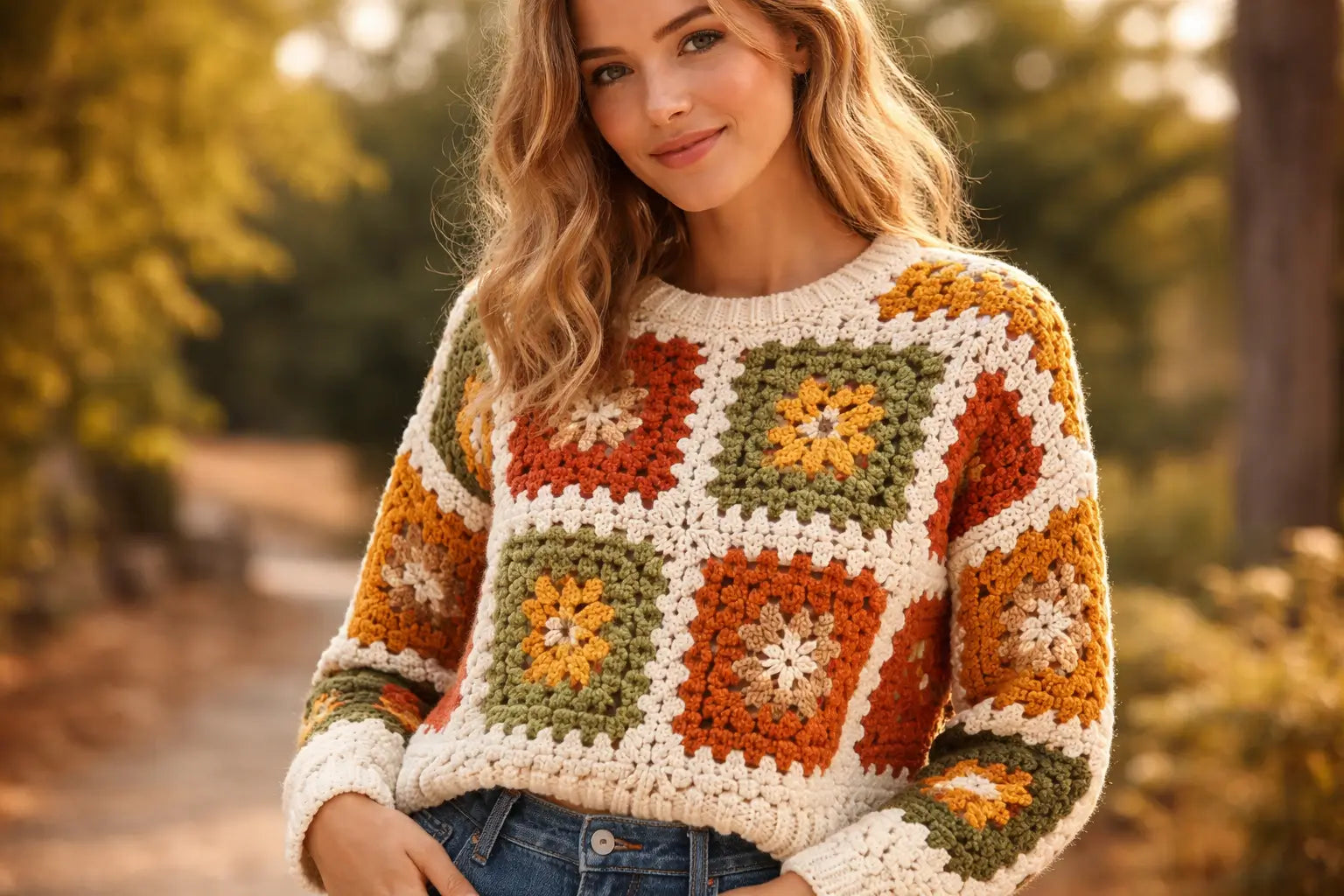
If you want a granny square sweater that actually fits (and feels good on), the trick is to treat it like a set of small decisions: layout, square size + gauge, ease, yarn, and joining. This guide gives you a clear build path and the “depends on” variables that stop most mistakes—plus an optional checklist for brands who want to sample the look.
Granny Square Sweater at a Glance
A granny square sweater is a wearable made from granny square motifs (often crocheted), joined into panels and shaped into a cardigan or pullover. The simplest version uses a 4-square layout, but fit depends mostly on square size, gauge, and how much ease you want.
| What you’re deciding | Quick rule of thumb | What to do first |
|---|---|---|
| “What is it?” | Motifs + joins create the signature grid look | Pick your style: cardigan or pullover |
| Simplest build | 4 squares → fold → seam → add sleeves/neckline finishing | Make 1 square, measure it, then repeat consistently |
| “How many squares?” | It depends on square size + gauge + ease + measurements | Decide target bust/length + ease, then map square count/layout |
| Comfort & drape | Fiber + yarn weight control softness and seam bulk | Choose fiber for feel/care, then choose weight for structure |
| Joining | Join method controls seam bulk, stretch, and comfort | Match join style to yarn weight + where seams sit (underarm matters) |

Before you start seaming, a tiny “sanity check” on square size and layout saves a lot of ripping later.
What Is a Granny Square Sweater?
A granny square sweater is a sweater or cardigan built by arranging and joining square motifs (most commonly crocheted granny squares) into a garment shape.
Key traits that define the look
- Motif grid: repeated squares (or a few large squares) create a clear geometric pattern.
- Visible joins: the joining seam often becomes a design feature, not something hidden.
- Flexible silhouettes: cardigan, pullover, cropped, oversized—most variations are layout + finishing changes.
Boundary note (so expectations stay realistic)
- “Granny square look” can also be mimicked by other constructions (for example, a knit structure that imitates a motif grid). If your goal is the look, you have multiple production paths.
If you’re building your first one, it’s usually easiest to start with the simplest layout and upgrade from there.
The Simplest Build: 4-Square Layout (Step-by-step)

The simplest granny square sweater uses four matching squares—two for the front, two for the back—then you fold and seam to create shoulder and side structure, leaving openings for the neck and arms.
Step-by-step (beginner-friendly)
-
Make 4 matching squares
Keep the stitch pattern and color order identical so the finished sizes match. -
Block or shape the squares (even lightly)
Your goal is consistency: corners square, edges even, same measurements. -
Lay out the sweater shape
Place two squares for the front and two for the back. Decide which edges become shoulders vs sides. -
Fold to form the body
Fold so front meets back. You’ll create a “T” or boxy torso shape. -
Pin seams and mark openings
Mark the neck opening at the top center and the armholes on each side before you join. -
Join shoulder seams first
This locks the neckline shape and gives you a stable body to try on. -
Join side seams, leaving armholes
Underarm comfort matters—leave enough space for movement. -
Add sleeves or sleeve extensions
You can add short sleeves by continuing rows around the armhole, or attach extra squares/rectangles for longer sleeves. -
Finish neckline, cuffs, and hem
Simple edging works; ribbing-style finishes add structure.
“Before you join” mini-check (the 2-minute sanity test)
- Measure all 4 squares. If one is larger, fix it now (block/adjust tension) rather than “hiding it in the seams.”
- Pin the fold and try it against your body (or a similar-fitting sweater) to confirm neck and arm placement.
- If the armholes feel tight, adjust by changing seam length or adding a little width before you fully join.
Once your layout works, sizing becomes much more predictable—because now you’re mapping real measurements to real square dimensions.
Sizing That Works: Square Size + Gauge + Ease (and “how many squares”)

You size a granny square sweater by starting from your square’s finished size (after blocking/shaping), then choosing ease (how loose you want it), and finally mapping a layout that hits your target bust/length/sleeve measurements.
The variables that control fit (in plain English)
- Square size (in inches/cm) is your “building block.”
- Gauge/tension controls square size even with the same pattern.
- Ease is the difference between body measurement and garment measurement (fitted vs relaxed vs oversized).
- Layout (4-square vs multi-square) determines where seams sit and how the garment drapes.
A practical sizing mini-table (variables-first)
| Target you care about | What to measure | What you change | Typical trade-off |
|---|---|---|---|
| Bust/Chest width | Body bust + desired ease | Square size, number of squares across, or added side panels | More width can add seam bulk if you add many joins |
| Body length | Shoulder-to-hem | Add rounds to squares, add a row of squares, or add hem finishing | Added length can pull the sweater down (stretch risk) |
| Sleeve length/width | Arm length + bicep/upper arm | Add rounds around armhole, add extra squares, or attach a sleeve tube | Wider sleeves feel comfy but can look boxier |
| Neck opening | Preferred neckline width/depth | Join less at center top, adjust finishing | Too small = tight; too wide = slipping |
Three sizing levers (change one at a time)
-
Change square size (by adding/removing rounds or adjusting gauge)
Best when you want overall scaling without changing the layout. -
Add squares/panels (more motifs, side panels, or extra rows)
Best when you want width/length while keeping square size consistent. -
Change the layout (how squares are arranged and where seams land)
Best when you want a different silhouette (cropped, oversized, drop-shoulder).
Boundary conditions (to keep “how many squares” honest)
- There is no universal square count that fits everyone—because a “6 inch square” and an “8 inch square” change everything.
- Yarn weight changes square size and seam bulk, so re-check measurements after any yarn change.
- If you’re aiming for a specific fit, use your measured square as the starting point—not a number from someone else’s pattern.
Now that sizing is grounded, yarn choice becomes easier—because you can choose for comfort and drape without guessing what it will do to the garment.
Yarn & Fiber Choices: Comfort, Drape, Care
The “best yarn” depends on your climate, skin sensitivity, and how much structure you want. Fiber controls feel and care, while yarn weight controls drape, warmth, and seam bulk.
Fiber families (wearability-focused comparison)
| Fiber/family | Feel on skin | Drape & warmth | Care considerations (general) | Good when… |
|---|---|---|---|---|
| Wool / wool blends | Warm, can be itchy for some | Warmth + bounce; holds shape well | Often prefers gentle washing and flat drying | You want warmth and shape retention |
| Cotton | Cool, often soft | Heavier drape; can feel “weighty” | Can relax/stretch with wear; may shrink depending on fabric/yarn | You want breathable, summer-friendly wear |
| Acrylic / synthetic blends | Often soft; varies by quality | Lightweight warmth; can pill | Heat-sensitive; shape can change if mishandled | You want easy availability + budget-friendly yarn |
| Alpaca / mohair blends | Very warm, often fuzzy | Soft halo, less stitch definition | Needs gentle handling; can stretch | You want cozy, fuzzy texture |
| Mixed blends | Balanced | Tunable warmth/drape | Depends on blend; check label | You want a “best of both” approach |
If you include specific care instructions on a finished garment, in the US those instructions generally need to be provided via a care label or another allowed method under the FTC Care Labeling Rule.
Yarn weight: what it changes
- Lighter weights: clearer motif definition, lighter seams, more drape (but slower to make).
- Heavier weights: faster build, warmer, but seams and joins get bulkier (especially underarms).
Quick picks by scenario
- Warm + structured: a wool blend with a join method that minimizes bulk under the arm.
- Soft for sensitive skin: a smooth, low-prickle fiber or a blend; prioritize feel over “traditional” fibers.
- Easy care: follow the yarn label and keep choices consistent across squares; avoid high heat.
- Maximum drape: lighter weight and a join that doesn’t create a thick ridge.
If comfort is your priority, your join method matters as much as your yarn—because the seam sits right where your skin moves.
Joining Methods: How to Avoid Bulky Seams

The best joining method is the one that matches your yarn weight and where the seam sits. Underarms and side seams need comfort; visible seams can be a design feature, but they shouldn’t feel scratchy or stiff.
Joining decision table (bulk / comfort / stretch)
| Joining approach | Seam bulk | Stretch & comfort | Look | Best use case |
|---|---|---|---|---|
| Flat join (low-profile seam) | Low–medium | Comfortable; less ridge | Clean, subtle | Underarm/side seams; everyday wear |
| Raised/outlined join (ridge seam) | Medium–high | Can feel bulky depending on yarn | Bold, graphic lines | Decorative outer seams; heavier yarns with care |
| Whip-style edge join | Low | Flexible; can be very comfy | Minimal line | Lightweight yarns; quick assembly |
| Continuous join-as-you-go | Low–medium | Even tension if done carefully | Unified “grid” look | Many-square layouts; consistent aesthetic |
How to choose in 30 seconds
- If the seam will rub (underarm), choose the lowest-profile option you can.
- If you’re using a heavier yarn, avoid joins that stack stitches into a thick ridge.
- If your squares stretch easily, choose a join that helps keep edges stable and consistent.
Finishing checklist (cuffs, hem, neckline)
- Add a simple edging to stop stretching at openings.
- Keep neckline comfortable (too tight = scratchy; too loose = slipping).
- Weave ends securely—loose ends can itch and can weaken seams over time.
A few common mistakes show up across almost every first sweater—and most are easy to prevent once you know what to watch for.
Style Variations: Cardigan vs Pullover, Cropped vs Oversized
Most style changes are layout + finishing changes. You don’t need to reinvent the sweater—you just need to decide where openings go and how much ease you want.
Mini-table: what changes by style
| Variation | What changes in construction | What to watch |
|---|---|---|
| Cardigan | Front opening + button band/edge finishing | Front edges can stretch; reinforce with finishing |
| Pullover | Smaller neckline opening | Neck size matters; try on early |
| Cropped | Shorter body length | Cropped can ride up; consider sleeve balance |
| Oversized | More ease + wider body panels | Extra weight can stretch; stabilize openings |
Boundary notes
- Big changes in length or width can shift stress points (shoulders, underarms). Try on early and adjust before seams are final.
- Keep squares consistent; change size by layout/rounds, not by mixing mismatched motifs.
To keep your sweater looking good after a few wears, focus on consistency and shape retention—especially at seams and openings.
Common Mistakes + Stretch Prevention + Care
Most granny square sweater problems come from inconsistent square size, bulky seams in high-friction areas, or care routines that change the garment’s shape.
Risk checklist (prevent the usual issues)
- Squares don’t match size → block/shape consistently; measure every square before joining.
- Armholes feel tight → shorten seam length at the underarm or add width before final joining.
- Bulky, scratchy seams → choose a lower-profile join for underarms; avoid heavy ridges with thick yarn.
- Sweater stretches out → stabilize neckline/hem/cuffs with finishing; store folded; avoid hanging when wet.
- Motif corners pucker → keep tension even on joins; don’t overtighten corners.
- Ends poke or itch → weave ends deeper and more securely (especially near seams).
Care guidance (keep it general and label-aware)
- Follow the yarn’s care guidance when available, and treat the garment gently when wet (wet weight can stretch).
- If you must give care instructions for a sold garment in the US, the FTC Care Labeling Rule is the baseline reference for what needs to be disclosed and how.
- For wool sweaters specifically, gentle wash methods and flat drying are commonly recommended by wool-care authorities.
If you’re deciding whether to make one or buy one, you can use a simple quality check to avoid the most common disappointments.
Buy vs Make: Quick Decision + Quality Signals
Make one if you want control over fit, color, and construction details. Buy one if you want the look immediately—then focus on seam comfort, material feel, and sizing.
| If you… | Making is better when… | Buying is better when… | Quick quality checks if buying |
|---|---|---|---|
| Want a precise fit | You can measure and adjust squares/layout | You can try on or return easily | Check shoulder/underarm comfort |
| Care about softness | You can choose fiber for your skin | You can feel the fabric in person | Rub seams lightly—no scratchy ridges |
| Want a specific look | You can plan motif colors and joins | You find the exact colorway you want | Look for even motifs + consistent joins |
| Have limited time | You enjoy the process anyway | You need it now | Confirm care requirements before purchase |
If you’re a brand, the same decisions still apply—but you’ll also want to define specs clearly so sampling doesn’t turn into guesswork.
For Brands: Tech Pack Checklist to Sample/Produce the “Granny Square Look”
To sample a granny-square-look sweater efficiently, lock the look-defining details (motif specs + join look) and the fit-defining details (measurements + ease) before you start sampling.
Tech pack essentials (motif → measurable specs)
| Spec area | What to define (examples) | Why it matters |
|---|---|---|
| Motif spec | Square finished size, color order, stitch texture target | Keeps the “look” consistent across sizes |
| Layout | Panel plan, seam placement, sleeve approach | Controls silhouette and comfort |
| Measurements | Size range, key points of measure, target ease | Prevents “fits like a different sweater” samples |
| Materials | Fiber/yarn targets, handfeel goals, weight/season | Impacts drape, comfort, care, and seam bulk |
| Finishing | Neckline/cuffs/hem approach, edge stability | Affects durability and stretch control |
| QC focus | Motif alignment, seam comfort, tolerance expectations | Stops small issues from scaling into bulk |
If you’re developing this style for a collection, it helps to share:
- Reference photos (front/back/close-up of joins)
- Target customer + season (warmth vs drape priorities)
- Size range and a base size measurement spec
- Preferred material direction (fiber feel + care expectations)
You can then align on a sample before committing to bulk production.
A common brand question is whether the “granny square look” can be achieved with different production techniques at scale—so here’s a clear comparison.
Crochet vs Knit Alternatives: How to Get the Look at Scale
You can produce a granny-square-inspired look in different ways; the right option depends on how closely you need to match the hand-made motif texture versus how important repeatability and scalability are.
| Approach | Look fidelity to hand-crochet | Repeatability | Notes (no cost claims) | Best when… |
|---|---|---|---|---|
| Hand-crochet motifs + joining | Highest | Variable (depends on process control) | Very authentic texture; join is part of the look | You need true hand-made character |
| Crochet-look knit structure (engineered) | Medium–high | High | Can imitate a grid/motif effect with consistent output | You want consistent repeats and stable sizing |
| Patchwork-inspired knit panels | Medium | High | Visual motif effect without true squares | You want the vibe, not the exact texture |
Boundary notes
- Avoid treating any approach as universally “best.” Choose based on look requirements, comfort, and repeatability needs.
- Whichever route you choose, the fastest alignment usually comes from clear motif visuals, measurements, and finishing expectations.
If you want quick answers to the most common questions, this FAQ section is designed to be scannable and practical.
FAQ
-
Q: What is a granny square sweater?
A: A granny square sweater is a sweater or cardigan built from square motifs (often crocheted granny squares) joined into a wearable shape. The exact construction varies—some use many small squares, others use a few large ones—but the signature is the motif grid plus visible joins. -
Q: How do you make a sweater from 4 granny squares?
A: Make four matching squares, lay them out as front/back panels, fold to form a body shape, then seam shoulders and sides while leaving openings for the neck and arms. After that, add sleeves and finish the neckline/hem/cuffs as needed. -
Q: How many granny squares do you need for a sweater (or cardigan)?
A: It depends on your square’s finished size, your target measurements, and how much ease you want—so there isn’t one universal number. Start by measuring one finished square, decide your desired fit, then map a layout that reaches your target bust and length. -
Q: What is the best yarn for a granny square sweater?
A: The best yarn is the one that matches your comfort and care needs while giving you the drape or structure you want. Fiber affects feel and care; yarn weight affects warmth, drape, and seam bulk—so pick fiber for skin/climate first, then choose weight for silhouette. -
Q: What’s the best way to join granny squares for a sweater?
A: The best join is usually the one that stays low-profile and comfortable where seams rub (especially underarms). Heavier yarns need flatter joins to avoid bulky ridges, while decorative joins can work well in low-friction areas where you want the seam to show. -
Q: How do you stop a granny square sweater from stretching out?
A: Keep square sizes consistent, stabilize openings with finishing (neckline/hem/cuffs), and handle the sweater gently when wet. Store it folded rather than hanging, and follow the yarn’s care guidance to avoid heat or agitation that can change shape.
Summary: What to Do Next
Key takeaways
- Start with a measurable square: square size + gauge drive everything.
- Choose a layout (4-square is simplest) and mark openings before you seam.
- Fit comes from measurements + ease, not from copying someone else’s square count.
- Yarn choice affects comfort and care; joining choice affects seam bulk and wearability.
- For brands, define motif specs + measurements early to keep sampling efficient.
If you’re turning this into a product (not just a personal make), a clean starting package is:
- A reference image set (front/back/close-ups)
- Target size range + base size measurement spec
- Motif specs (finished square size, color order, join look)
- Material direction (fiber feel, weight, care expectations)
That’s usually enough to start a focused sampling conversation.
)