
How to Crochet a Sweater Without a Pattern: The Simple “Sweater Recipe” (Measurements + Gauge + Fit)
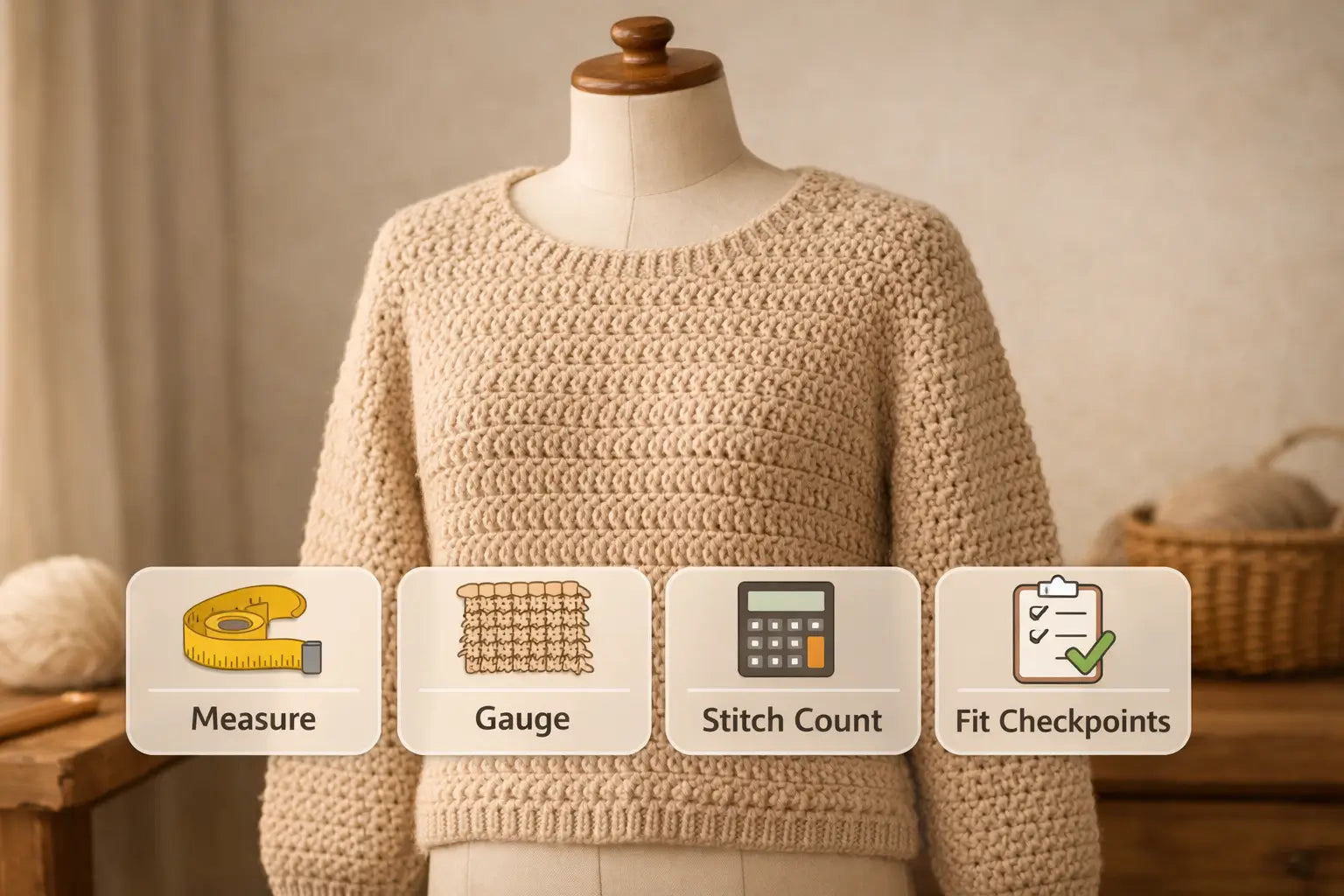
You can crochet a sweater without a written pattern by using a repeatable recipe: take a few measurements, choose your fit (ease), swatch for gauge, convert inches/cm to stitches and rows, then try on at checkpoints so the shape stays consistent.
Key points
- “No pattern” doesn’t mean “no plan”—it means made-to-measure.
- A gauge swatch is what turns measurements into stitch counts.
- Checkpoints + notes are how you keep both sides and sleeves matching.
Boundary conditions
- Changing yarn, hook, or stitch pattern changes gauge, so counts must change too.
- Blocking can improve drape/evenness, but it won’t fix a major size mismatch.
Before you start crocheting, the 7-step recipe below shows the full workflow in one glance.
The No-Pattern Sweater Recipe (7 Steps)
Treat your sweater like a recipe: measure → swatch → choose ease → calculate stitches/rows → build → checkpoint fit → finish edges.
| You need | Why it matters | Minimum version |
|---|---|---|
| Measurements (bust/chest, length, upper arm, sleeve length, neck opening) | Defines finished size | 5 measurements total |
| Gauge (stitches + rows per inch/cm) | Converts size into stitch/row targets | One swatch in your real stitch |
| Ease (fit choice) | Controls comfort and silhouette | Fitted / comfy / oversized |
| Notes (counts + checkpoints) | Prevents uneven sides/sleeves | Record counts as you go |
Steps
- Pick construction (panels, raglan, yoke, or set-in sleeves).
- Take key measurements (minimum set below).
- Make a gauge swatch in your real stitch + yarn.
- Choose ease (fitted, comfy, oversized).
- Convert measurements into stitches and rows using gauge.
- Crochet the body, split for sleeves, then finish neckline/edges.
- Try on at checkpoints and write down counts to keep symmetry.
Boundary conditions
- Round stitch counts to match stitch-pattern repeats when needed.
- Sleeves and neck openings are least forgiving—measure and test early.
- If you prefer “math-light,” you still need checkpoints and notes for consistency.
If “gauge,” “ease,” and “construction” feel like jargon, this quick glossary makes them practical.
Quick Glossary (so the rest makes sense)
Three concepts make freestyle sweater design predictable: gauge, ease, and construction.
Key points
- Gauge: how many stitches/rows your fabric makes per inch/cm (measured from a swatch).
- Ease: how much bigger (positive) or smaller (negative) the sweater is than your body.
- Construction: the shaping method (panels vs raglan vs yoke vs set-in sleeves).
How to use them
- Gauge turns “I want 42 inches/cm around” into “I need X stitches around.”
- Ease turns body measurements into finished sweater measurements you’ll enjoy wearing.
- Construction determines where shaping happens (shoulders, sleeves, neckline, underarm).
Boundary conditions
- Gauge is specific to yarn + hook + stitch pattern + your tension.
- Ease depends on fabric stretch and comfort preferences.
- Construction affects shoulder and underarm fit more than most beginners expect.
Once you know the construction style you’re using, the rest of the planning becomes much simpler.
Pick a Construction Style (Decision Tree)

Choose construction based on what you value most: simplicity, try-on flexibility, or tailored shaping.
Key points
- Drop-shoulder panels: easiest measuring and beginner-friendly.
- Top-down raglan: try on as you go; easy length adjustments.
- Top-down yoke: classic round-yoke look; needs steady, even shaping.
- Set-in sleeves: most tailored; most shaping and alignment work.
Quick comparison
| Method | Best for | Hard parts | Seaming |
|---|---|---|---|
| Drop-shoulder panels | First garment, relaxed fit | Underarm bulk if too boxy | Yes |
| Top-down raglan | Try-on fitting, easy length tweaks | Keeping increases even | Usually no |
| Top-down yoke | Round yoke silhouette | Managing increase rhythm | Usually no |
| Set-in sleeves | Tailored shoulder fit | Sleeve cap shaping, alignment | Often yes |
For a deeper explanation of common sweater constructions, see: https://doradoes.co.uk/2019/03/17/crochet-garment-making-demystified-6-common-ways-to-construct-a-crochet-sweater/
Boundary conditions
- Panels = easier shaping, more seaming; raglan/yoke = less seaming, more shaping.
- If you hate seaming, top-down methods are often more satisfying.
- If you want a very fitted shoulder, set-in sleeves usually win, but take more planning.
Now that you’ve picked a construction style, you’ll know which measurements matter most.
Measurements You Actually Need (Table)

You can freestyle a sweater with five measurements; everything else is optional refinement.
Key points
- Minimum set: bust/chest, body length, upper arm, sleeve length, neck opening.
- Optional measurements improve shoulder and underarm comfort.
- Measure over the layers you plan to wear underneath.
Measurement table
| Measurement | Where to measure | Used for | Common mistake |
|---|---|---|---|
| Bust/Chest circumference | Around the fullest part | Body width (with ease) | Pulling tape too tight |
| Body length | Shoulder high point to hem | Rows for body length | Forgetting edging length |
| Upper arm circumference | Around bicep | Sleeve width (with ease) | Measuring too low/too tight |
| Sleeve length | Shoulder to wrist (or desired cuff) | Rows for sleeve length | Not accounting for cuffs |
| Neck opening | A comfy head-sized loop | Starting neckline / finishing | Too small to pass over head |
| (Optional) Shoulder width | Shoulder tip to tip | Shoulder fit shaping | Measuring sloped lines poorly |
| (Optional) Underarm depth | Armpit to desired armhole depth | Underarm comfort | Choosing too shallow depth |
| (Optional) Hem/hip circumference | Around hips/hem area | Prevents riding up | Ignoring hip needs |
Boundary conditions
- The neck opening is a common “can’t wear it” failure—test it early.
- If your stitch pattern stretches, avoid negative ease unless you’re confident.
- For oversized silhouettes, re-check shoulder and underarm proportions early.
With measurements in hand, the next step is converting them into stitch and row targets.
Gauge Math in 30 Seconds (Formula Box + Example)
Use stitch gauge for width and row gauge for length, and add ease before you multiply.
Key points
- Stitch counts come from width; row counts come from length.
- Swatch in the actual stitch pattern you’ll use for the sweater’s main fabric.
- Round counts to suit stitch-pattern repeats and symmetry needs.
Formula box
- Stitches needed (width) = finished width × stitches per inch (or cm)
- Rows needed (length) = finished length × rows per inch (or cm)
Worked example (structure-only)
- You measured a finished body width (after adding ease).
- Your swatch shows X stitches per inch/cm.
- Multiply: finished width × X = target stitches.
- Round to your stitch pattern repeat if needed.
Gauge measuring walkthrough: https://www.yarnspirations.com/en-row/blogs/how-to/how-to-measure-crochet-gauge
Rounding rules
- If your stitch pattern repeats every R stitches, round totals to a multiple of R.
- If making panels, keep front/back identical unless deliberately shaping.
- If working in the round, keep totals compatible with joining and repeats.
Boundary conditions
- Gauge may change as you relax into the project—re-check if fit starts drifting.
- Blocking can shift gauge; if you plan to block, measure gauge on a lightly blocked swatch.
- Measuring rows in textured stitches is harder—measure over a larger area.
Once you can calculate counts, the biggest comfort decision is how loose you want the sweater to feel.
Ease: How Loose Should It Be?
Ease is your fit dial—it controls comfort, silhouette, and how forgiving the sweater is.
Key points
- Fitted: minimal positive ease (negative ease only if fabric is stretchy and you’re confident).
- Comfy everyday: moderate positive ease for movement.
- Oversized: more ease for a slouchy look, but watch underarm/shoulder bulk.
Mobility checks (at try-on checkpoints)
- Raise arms overhead (does the body ride up too much?)
- Hug test (does the fabric strain across upper back/chest?)
- Sit test (does the hem pull or flare?)
Boundary conditions
- Crochet fabric often has less snap-back than knit fabric, so tight fits can feel restrictive.
- Heavy yarn + dense stitch can make oversized looks bulky fast.
- Stitch choice affects how much ease you’ll enjoy, so swatching is your best guide.
With ease decided, choose one of the two build paths below to start crocheting.
Two Build Paths (Choose One)

Panels are the easiest first sweater; top-down raglan is the easiest to adjust while you crochet.
Key points
- Panels: simple shapes you can measure and match.
- Raglan: frequent try-ons and easy length changes.
- Both use the same core loop: measure → gauge → stitch count → checkpoint.
Boundary conditions
- If you hate seaming, pick raglan.
- If you dislike shaping, pick panels and keep the stitch pattern simple.
- Either way, record stitch/row counts so left and right match.
If you want the most beginner-friendly route, start with panels first.
Path A — Beginner Drop-Shoulder Panels (Most Forgiving)
Make a matching front and back rectangle, add sleeves, seam, then finish edges.
Key points
- Two matching body panels create predictable sizing.
- Sleeves can be tapered tubes (more wearable) or rectangles (easiest).
- Seaming order improves shoulders and underarm comfort.
Steps
- Plan body panel width (bust/chest + ease → stitches).
- Plan body panel length (rows).
- Crochet the back panel to target stitch/row count.
- Crochet the front panel to match (add a simple neckline opening if desired).
- Make sleeves from upper arm + ease, taper if desired.
- Seam: shoulders → attach sleeves → seam sleeves and sides.
- Finish neckline/hem/cuffs, weave ends, block.
Checkpoint list
- After a short start: confirm gauge hasn’t drifted.
- Mid-length: compare front and back panels.
- Before final sleeve attachment: pin and try on for underarm comfort.
- Before firm neckline edging: test head opening.
Boundary conditions
- If underarms feel bulky, attach sleeves slightly inward (modified drop) rather than widening everything.
- If neckline is tight, widen it before adding firm edging.
- Dense stitches can make seams stiff—choose a flexible seaming method.
If you prefer fitting as you go with less seaming, raglan is a strong alternative.
Path B — Top-Down Raglan (Try-On Friendly)
Start at the neckline, increase along raglan lines until underarm depth is right, split for sleeves, then finish body and sleeves.
Key points
- Stitch markers keep increases consistent.
- Try-ons guide yoke depth and ease adjustments.
- Symmetry comes from repeating the same increase rhythm and recording counts.
Steps
- Start a comfortable neckline and join (or work flat).
- Place four markers for raglan corners (front/back/sleeves).
- Increase evenly at markers to grow the yoke.
- Try on and stop when yoke depth feels comfortable.
- Split for sleeves; place sleeve stitches on hold; continue body.
- Finish body length with checkpoints.
- Work sleeves downward; taper toward cuffs if desired.
- Finish neckline/hem/cuffs and block.
Keep it even (simple rules)
- Write down starting count, increase frequency, and split point row.
- Match sleeve stitch counts before shaping.
- If one side looks taller, measure and correct early.
Boundary conditions
- If underarm feels tight, add a small underarm bridge at the split.
- If neckline starts stretching, stabilize sooner rather than later.
- Raglan slopes vary; try on early to confirm you like the look.
Good construction still needs good fabric, so the next section helps you avoid stiff, uncomfortable sweaters.
Stitches & Yarn Choices for a Sweater That Drapes (Not Stiff)
Prioritize fabric that bends and moves; swatch and test drape before committing to a full sweater.
Key points
- Denser stitches and smaller hooks often create stiffer fabric.
- Some textured stitches are beautiful but heavy or board-like at sweater scale.
- Yarn labels vary; swatching tells the truth for your stitch and tension.
Yarn weight standards reference: https://www.craftyarncouncil.com/standards/yarn-weight-system
Fabric test checklist (on your swatch)
- Fold test: does it bend easily?
- Stretch test: does it recover or stay stretched?
- Drape test: does it hang or stick out?
- Skin test: would you wear it against your neck/inner arm?
Boundary conditions
- Heavy fabric can grow with wear; hang your swatch for a few hours and re-measure.
- Very elastic fibers can change after washing; test-wash if possible.
- Open stitches may need layering; decide based on your comfort.
Even with great fabric, checkpoints are what stop small errors from becoming big ones.
Try-On Checkpoints (So You Don’t End Up Uneven)

Planned checkpoints catch gauge drift and sizing issues early, before they spread through the whole sweater.
Key points
- Most important checkpoints: shoulders/yoke, underarms, before finishing edges.
- Record row and stitch counts so both sides and sleeves match.
- Try on with the layers you’ll actually wear underneath.
Checkpoint checklist
- After shoulders/yoke is established
- Near underarm depth
- Right after sleeve split/attachment
- Mid-body length
- Before hem finish
- Mid-sleeve and before cuffs
- Before final neckline edging
What to record
- Row count since last checkpoint
- Stitch count across the key area (body or sleeve width)
- Any change made (hook size, stitch pattern, increase/decrease rhythm)
Boundary conditions
- For oversized fits, don’t over-correct minor looseness; focus on comfort and proportions.
- For panels, measure both panels flat before seaming.
- For in-the-round work, track where the start of round sits so shaping stays balanced.
With checkpoints in place, sleeves become much easier to manage.
Sleeves Without a Pattern (Comfort First)
Start sleeve sizing from the upper arm with your chosen ease, then taper gradually toward the cuff, checking fit at the elbow and wrist.
Key points
- Upper arm circumference is the anchor measurement.
- Gentle tapering is easier to control than big jumps.
- Underarm comfort depends on both sleeve width and underarm depth.
Steps
- Measure upper arm and choose sleeve ease (match body fit style).
- Convert upper arm target to stitches using gauge.
- Crochet to underarm length; try on and confirm you can bend your arm.
- Decide taper rate; adjust early if needed.
- Check at elbow and wrist; refine taper.
- Finish cuffs with a comfortable, stable edging.
Boundary conditions
- Underarm tightness is usually fixed by more width or depth, not a stretchier cuff.
- Stiff fabric needs more ease for comfort.
- If working top-down sleeves, match row counts and shaping rhythm on both sleeves.
Necklines and edges are the final “wearability” gate, so finish them with stability in mind.
Neckline + Finishing That Lasts
Keep necklines from stretching by working edging without pulling, testing the opening before firming it up, and using a stabilizing finish when needed.
Key points
- Necklines stretch from over-pulling, loose edges, or unstable edging choices.
- Finishing order helps you avoid locking in mistakes.
- A small stabilizing row can improve shape without adding bulk.
Finishing order
- Weave ends enough for safe try-ons.
- Seam (if needed).
- Finish neckline (test head opening first).
- Finish hem and cuffs.
- Block/shape as appropriate for fiber.
- Final tidy-up and symmetry check.
Neckline technique reference video: https://www.youtube.com/watch?v=O1WC56YVJ2w
Boundary conditions
- Always test neck opening over your head before making edging firmer.
- Some fibers relax with wear; choose a more stable finish if unsure.
- Blocking helps drape and evenness but won’t “fix” a too-small or too-large neckline reliably.
If something still goes wrong, this troubleshooting table helps you diagnose and fix the most common issues quickly.
Common Mistakes and Fixes (Troubleshooting Table)
Most no-pattern sweater problems come from gauge drift, insufficient ease in key areas, or skipping checkpoints—and they’re fixable if caught early.
Key points
- Fixes are easiest before final edging.
- Stiffness is usually a fabric choice issue, not a finishing issue.
- Uneven sides usually come from not counting and recording.
| Symptom | Likely cause | Fast fix (now) | Prevent next time |
|---|---|---|---|
| Fabric feels stiff/armor-like | Stitch too dense; hook too small; rigid stitch | Switch to larger hook or drapier stitch | Swatch + drape test first |
| Underarms feel tight | Not enough depth or sleeve/body ease | Add underarm stitches at split; increase sleeve width | Try on at underarm checkpoint |
| One side longer than the other | Not counting rows; tension shifts | Measure and match row counts before edging | Record counts at checkpoints |
| Neckline stretched | Overstretched edge; unstable edging | Add stabilizing reinforcement/firm edging | Test opening early; avoid pulling |
| Gauge changed mid-project | Tension change; hook change | Re-measure, adjust, recalc remaining counts | Re-check at mid-body checkpoint |
Boundary conditions
- If a section is dramatically off-size, ripping back can be faster than patching.
- Heavy fabric can grow; consider stable edging and shorter initial length.
- Minor boxiness can improve after finishing and blocking, even if it’s not perfect.
The FAQ below gives quick answers to the questions people ask most while doing this for the first time.
FAQ
-
Q: Do I need to swatch to crochet a sweater without a pattern?
A: It’s strongly recommended for reliable sizing because gauge converts your measurements into stitch counts. If you skip a swatch, plan extra try-ons and be ready to adjust counts—especially for sleeves and necklines. -
Q: What measurements do I need?
A: Start with five: bust/chest, body length, upper arm circumference, sleeve length, and a comfortable neck opening. Add shoulder width and underarm depth if you want a more refined fit. -
Q: What’s the easiest no-pattern sweater method for beginners?
A: Drop-shoulder panels are usually simplest: two matching rectangles plus sleeves, then seam and finish. If you dislike seaming, a top-down raglan is often more satisfying because you can fit it by trying on as you go. -
Q: How do I calculate stitch counts from gauge?
A: Add ease to your target measurement, then multiply by stitch gauge (stitches per inch/cm). For length, multiply by row gauge (rows per inch/cm). Round totals to suit stitch-pattern repeats. -
Q: How much ease should I add?
A: Use ease to match your desired look: minimal for fitted, moderate for everyday comfort, and more for oversized. Confirm comfort with mobility checks at checkpoints (raise arms and hug test). -
Q: Can I try on as I go to reduce math?
A: Yes—especially with top-down raglan or yoke styles—but you still need checkpoints and notes so both sides match. Try on at underarms, mid-body, and before finishing cuffs/hem/neckline. -
Q: Why does my crochet sweater feel stiff, and how do I fix it?
A: Stiffness usually comes from dense stitches, a small hook, or a rigid stitch pattern. Try a larger hook, a drapier stitch, or a yarn that hangs better, and confirm with a drape-test swatch. -
Q: How do I keep the neckline from stretching?
A: Don’t pull the base stitches while edging, test the opening before firming it up, and use a stabilizing edging if the neckline feels loose. Reinforcement techniques can help depending on fiber and construction.
If you need a conservative yarn plan before you start, the estimate-only section below can help you budget without overpromising accuracy.
Estimating Yarn Without a Pattern (Estimate Only)
Use a swatch as a “fuel meter,” scale up by area, and add a buffer because stitch choice, size, and drape change yarn usage.
Key points
- Treat this as an estimate—usage varies a lot by stitch density and size.
- Textured stitches and oversized fits typically use more yarn.
- If you’re close to the margin, buying extra from the same dye lot helps.
Steps
- Make a swatch large enough to measure and weigh (or track usage).
- Calculate swatch area (width × height) and yarn used for that area.
- Approximate sweater fabric area (body + sleeves) using your measurements.
- Scale up: (sweater area ÷ swatch area) × swatch yarn usage.
- Add a buffer for edging, adjustments, and mistakes.
Boundary conditions
- Colorwork and dense textures can increase usage.
- Heavier garments may “grow” and prompt adjustments; budget extra if you plan to tweak length.
- If you plan major modifications mid-project, pad the buffer.
Related: Need Custom Knit Sweaters for Your Brand?
If you’re developing sweaters for a label and need repeatable sizing, sampling, and bulk production support, XTCLOTHES offers OEM/ODM knitwear manufacturing with design-to-sample-to-bulk workflow support (details depend on style, yarn, and order needs). Reach out through xtclothes.com with your tech pack or reference photos to discuss feasibility and lead-time expectations.
)