
Easy Crochet Child Cardigan Patterns (Free): Beginner Styles, Sizing & Yarn — Plus a Brand-Ready Spec Checklist (Optional)
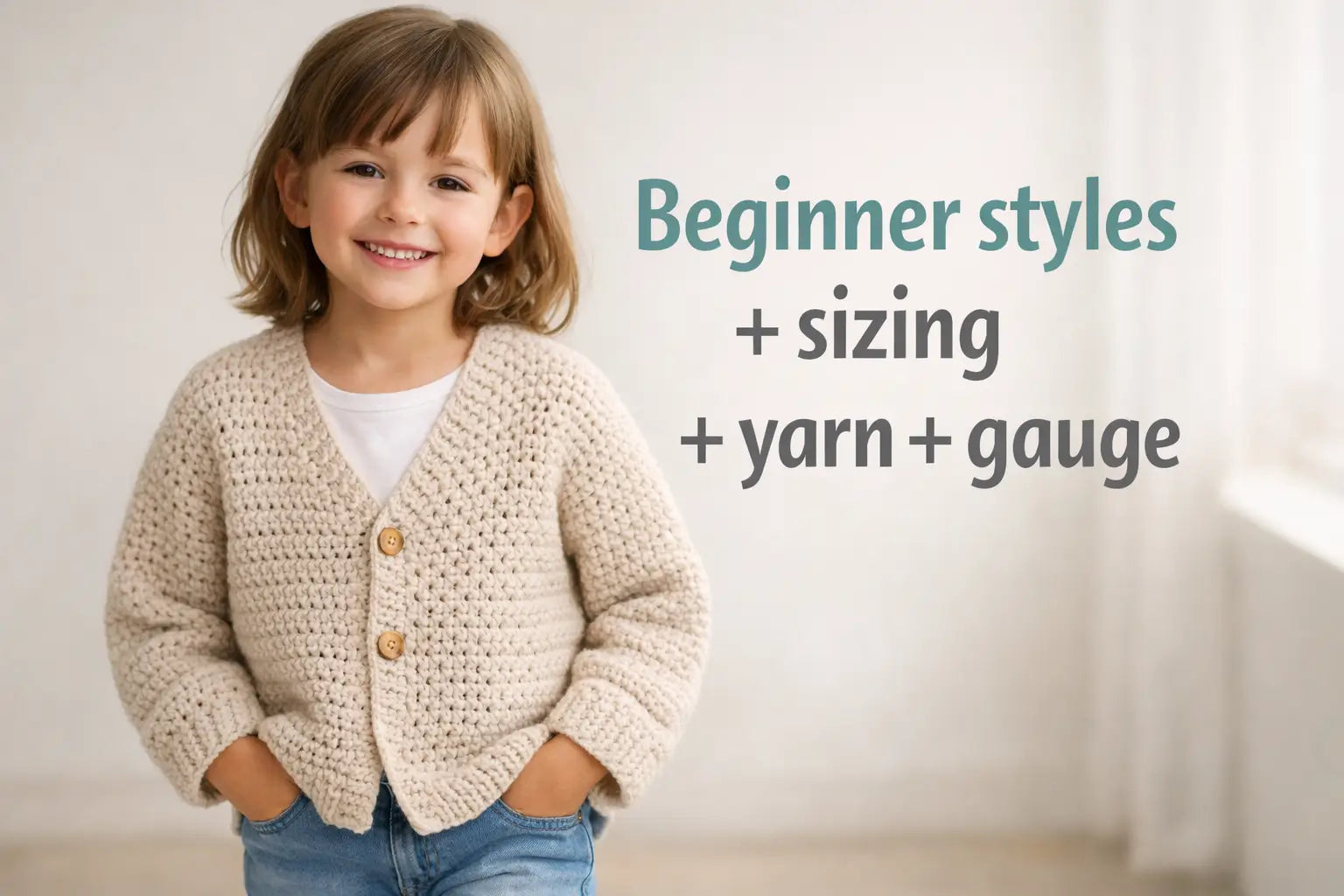
If you’re searching “easy crochet child cardigan pattern free,” you probably want two things: a cardigan that’s simple to make and a result that actually fits. This guide helps you choose an easy cardigan style family (hexagon, granny-based, or panels), pick kid-friendly yarn, get gauge under control, and finish it so it’s comfortable to wear.
We’re explaining pattern types and decision steps—not republishing designers’ full patterns. Before you start, it helps to know which construction style matches how you like to learn.
What’s the easiest crochet child cardigan style for beginners?
The easiest child cardigans usually use repeat stitches, minimal shaping, and clear sizing instructions—so you spend more time crocheting and less time “figuring it out.”
Beginner-friendly cardigan style families
- Two-hexagon cardigans: fast to understand and satisfying early progress; fit can be a bit boxy unless you adjust length/width.
- Granny-based cardigans (granny stitch / granny squares): repetitive and forgiving; finishing details (bands, buttonholes) matter for a polished result.
- Simple panel cardigans (front/back panels + sleeves): easiest to control fit because it’s “measure and build,” but you’ll do more seaming.
Pick this if…
- You want the simplest construction story → start with hexagons
- You like rhythmic repeats and don’t mind edging/button bands → try granny-based
- You care most about predictable fit (especially sleeve length) → choose panels
Boundary conditions
- “Easiest” depends on whether you’re comfortable with seaming and counting.
- Video-first learners often do best with patterns that show each step clearly, even if the construction isn’t “the simplest on paper.”
If you’re choosing between methods, a quick comparison makes the tradeoffs obvious.
Hexagon vs granny vs panels: which is easiest (and which fits best)?
All three can be beginner-friendly—the best pick depends on whether you value simple construction or fit control.

| Method | Beginner difficulty | Fit control | Finishing effort | Best for |
|---|---|---|---|---|
| Hexagon (2-piece) | Easy | Medium | Medium | Fast progress with simple shaping |
| Granny-based | Easy–Medium | Medium | Medium–High | Repeat stitches + easy color play |
| Panels | Medium | High | Medium | “I want it to fit like a store cardigan” |
Key points
- Hexagon/granny styles often feel easier early on because the repeats are satisfying.
- Panels usually win on predictable sleeve/body fit because you can measure and adjust in a more linear way.
Boundary conditions
- Some patterns include shaping or special edging that changes “difficulty” a lot—always skim the finishing steps before committing.
- Fit control depends on both construction and gauge; you can’t outsmart gauge with a “better method.”
Once you’ve picked a method family, sizing becomes the make-or-break step.
How do I choose the right size and adjust fit in a crochet child cardigan?
Most “wrong size” problems come from skipping gauge or choosing a size by age instead of measurements.
Size + fit workflow (use this every time)
- Measure chest, body length, and sleeve length (minimum set).
- Choose the pattern size using its measurement chart (not just age).
- Decide fit: roomy for layering or closer fit for everyday wear.
- Swatch gauge in the stitch pattern used for the cardigan.
- Only after gauge is right: adjust body length and sleeve length.
- Check symmetry: compare both fronts and both sleeves before final edging.
- Finish edges last—edging can change drape slightly.
| Adjustment goal | Safest place to change it | What it affects | Common mistake |
|---|---|---|---|
| Longer/shorter body | Add/remove rows in the main body area | Overall length | Changing length at neckline/shoulder and distorting fit |
| Longer/shorter sleeves | Add/remove sleeve rows/rounds before cuffs | Sleeve length | Adjusting only one sleeve (count drift) |
| Wider/narrower body | Choose the right size after gauge is correct | Chest/ease | Trying to “fix width” with edging alone |
| More/less drape | Yarn choice + gauge + stitch pattern | Handfeel + hang | Swapping yarn without re-swatching |
Boundary conditions
- Yarn can behave differently after washing/blocking; if the pattern suggests washing/blocking the swatch, follow that guidance.
- Multi-size patterns can be confusing—mark your size line before you start so you don’t accidentally combine instructions.
Now that you know how fit is determined, the next big decision is yarn.
What yarn is best for a child’s crochet cardigan (comfort + care)?
There isn’t one perfect yarn—your best choice balances comfort, easy care, and the look you want.
Priorities (in order)
- Comfort against skin (especially neckline and cuffs)
- Care/washability (kids’ clothes get washed a lot)
- Durability (how well it holds up to play)
- Season/warmth + drape (cotton hangs differently than wool blends)
Fiber at a glance (high-level)
- Acrylic: commonly chosen for easy care and everyday wear
- Cotton: breathable; often heavier with more drape
- Wool blends: warm and resilient; sensitivity varies by child
Yarn weight (why patterns care)
Many patterns specify a yarn “weight category” (like DK or worsted). The Craft Yarn Council’s Standard Yarn Weight System is a widely used reference for those categories. (craftyarncouncil.com)
Yarn substitution checklist
- Match the same yarn weight category whenever possible. (craftyarncouncil.com)
- Re-swatch gauge after any yarn change.
- If the new yarn is stretchier or slicker, expect more edge/button-band stretching and plan extra stabilization.
Boundary conditions
- “Soft” is personal: if possible, test yarn against the child’s neck/inner wrist area.
- Yarn labels and blends vary—when in doubt, prioritize comfort and care instructions you can realistically follow.
Once yarn is chosen, gauge is the lever that makes the size actually match the pattern.
How do I get gauge right (and what if it’s off)?
Gauge is the difference between “fits like a cardigan” and “mystery poncho.”

Gauge in 6 steps
- Swatch using the same stitch pattern as the cardigan.
- Make the swatch large enough to measure without edge distortion.
- Measure stitches/rows the way the pattern tells you.
- If gauge is too tight/small → try a bigger hook first.
- If gauge is too loose/large → try a smaller hook first.
- If you’re still far off, reconsider yarn choice (then swatch again).
Hook vs yarn: what to change first?
- Off by a little → change hook size
- Off by a lot → change yarn (or pick a pattern written for your yarn weight)
Do I really need a gauge swatch?
For wearables with sleeves and fronts, yes—because gauge affects chest width, sleeve length, and overall drape.
Boundary conditions
- Gauge must be checked in the stitch pattern used for the garment, not a different stitch.
- If you plan to wash the finished cardigan often, consider testing your swatch the same way (if the pattern suggests it).
If your goal is “free pattern,” you’ll also want to avoid low-quality sources that waste time.
Where to find reputable free child cardigan patterns (without wasting time)
A “free” pattern can still be high quality—but you’ll usually get the best experience from sources that provide clear instructions, sizing, and consistent formatting.
What to look for in reputable sources
- Pattern libraries with filters for kids/cardigans (good for browsing)
- Established designers who include step-by-step photos and/or video
- Patterns that clearly state sizes included, gauge, and abbreviation glossary
Boundary conditions
- Avoid pages that don’t show who wrote the pattern, don’t list gauge, or don’t explain construction—those are common “project-stoppers.”
- Always follow the designer’s stated usage terms.
Before you start crocheting, use this screening checklist to avoid frustrating patterns.
Quick checklist: how to tell a good free pattern (before you start)
Use this to avoid confusing pages:
- Includes multiple sizes (or clearly says “made to measure”)
- Has a size chart or clear “finished measurements” logic
- States gauge and the stitch pattern used for gauge
- Lists materials (yarn weight category + hook size)
- Explains construction overview (what you’ll make first and how it assembles)
- Provides checkpoints (stitch counts, row counts, or “stop and measure here”)
- Includes finishing instructions (edging/bands/closures)
- Uses standard abbreviations or provides a glossary
- The Craft Yarn Council maintains a commonly referenced crochet abbreviations list. (craftyarncouncil.com)
- Shows clear photos (and ideally a video)
- Shows usage terms (permission/crediting) clearly
Boundary conditions
- Some patterns use UK vs US terminology; if the pattern doesn’t state which, proceed carefully or choose a clearer source.
- If the pattern is “video only,” make sure you can pause and verify stitch counts at checkpoints.
Finishing is where a cardigan becomes comfortable and wearable.
Finishing steps that make it wearable for kids (seams, edges, closures)
Finishing is what makes a cardigan feel comfortable, not scratchy or bulky.

Finishing checklist
- Weave in ends securely (inside seams when possible)
- Keep underarm seams as flat as you can (bulk here is what kids feel most)
- Stabilize fronts and hems with edging/ribbing
- Try on (or measure against a well-fitting hoodie) before final buttonholes
- If adding buttons: reinforce the band so it resists stretching
- Check cuffs aren’t too tight
- Do a final symmetry check (both sleeves, both fronts)
Buttons vs zipper (practical view)
- Buttons are easier to customize and repair.
- Zippers can look “clean,” but require more precise installation.
Boundary conditions
- Bulky yarn changes everything—choose finishing methods that minimize thickness at the underarm and neckline.
- If the cardigan will be machine-washed often, edge stabilization matters more.
For kids’ items—especially if you’re selling—think about trims and practical wear.
Kid-safe trims and practical wear tips
This is general guidance (not product safety or legal advice). If an item is intended for very young children, be mindful that small parts can present choking hazards in some contexts, and U.S. regulations and labeling rules exist for certain children’s products. (cpsc.gov)
Safety
- Prefer trims and closures that are securely attached and appropriate for the child’s age.
- Avoid leaving loose ends where they can snag or be pulled.
Comfort
- Prioritize a soft neckline and smooth inner seams.
- Keep scratchy joins away from the neck and underarms.
Practical
- Choose yarn and closures that are easy to wash and easy to put on/off.
- Reinforce cuffs and button bands so they stay neat after wear.
Boundary conditions
- Requirements can differ by market, product category, and age grading—verify rules that apply to your selling channel and country.
- When in doubt, choose simpler trims and stronger attachment methods.
If something looks off, troubleshoot systematically instead of guessing.
Troubleshooting: wrong size, uneven sleeves, curling edges (fast fixes)
Most fixes start with three checks: gauge, counts, and assembly alignment.
Quick triage
- Re-check gauge
- Re-check stitch counts at key checkpoints
- Re-check assembly points (are sleeves/joins placed symmetrically?)
| Symptom | Likely cause | Quick fix |
|---|---|---|
| Too small / too big | Gauge mismatch; yarn substitution | Re-swatch; adjust hook; confirm size selection logic |
| Sleeves don’t match | Counting drift; tension changes | Count rows/rounds; match sleeve length before cuffs |
| Edges curl | No stabilizing edge; stitch behavior | Add edging/ribbing; block if fiber allows |
| Seams feel bulky | Thick yarn + seam choice | Choose a flatter seam; reduce bulk at underarms |
Boundary conditions
- Some issues can be fixed with finishing; others require redoing a section—identify which before you spend more time edging.
- If you changed yarn, assume you must re-validate gauge.
If you plan to sell finished items, pattern terms matter.
Can I sell items made from a free crochet pattern? What to check first (general info)
Start with the simplest rule: read the pattern’s stated terms.
A helpful concept from the U.S. Copyright Office: copyright generally does not protect ideas, systems, or methods of operation—though it may protect the way they’re expressed. (copyright.gov)
Practical checklist
- Check whether the designer allows selling finished items or restricts use (“personal use only” varies by designer).
- If terms are unclear, ask the designer or choose a pattern with explicit permission.
- Don’t repost or distribute the designer’s pattern text/photos unless you have permission.
- If selling apparel in the U.S., be aware that the FTC’s Care Labeling Rule requires care instructions for textile wearing apparel, and the FTC provides the rule and rule text. (ftc.gov)
Boundary conditions
- This section is general information, not legal advice; rules and enforcement can vary by country and situation.
- Always defer to the specific pattern’s stated terms and your selling market’s requirements.
If you’re a small brand, you may want a repeatable version of a crochet-inspired look.
Optional: From DIY pattern to a brand-ready spec checklist (for sampling/manufacturing)
If you love the crochet look but need something repeatable across sizes and production runs, the bridge is simple: convert the look into a clear spec checklist a manufacturer can sample from.
If you want to produce a crochet-inspired kids cardigan consistently, prepare a spec checklist first—then request sampling based on your exact design and materials (no guarantees on feasibility, MOQ, lead time, or shipping outcomes).
Pattern look → spec (step-by-step)
- Choose your target size range and define key measurements per size.
- Define materials intent (fiber/blend feel, yarn weight category, care expectations). (craftyarncouncil.com)
- Capture stitch/texture references (close-up photos of the look you’re aiming for).
- Specify construction (panel-like vs hexagon-like silhouette), seams, edging/bands, closures.
- Define quality expectations in plain language (stitch consistency, seam neatness, comfort).
- Prepare a single sampling pack (PDF is fine) and send it for a sample quote.
Brand-ready spec checklist (copy/paste)
- Size set + measurement chart (chest, body length, sleeve length, cuff width, hem width)
- Materials: fiber/blend preference, yarn weight category, handfeel notes
- Stitch/texture references: photos + “what matters most” notes
- Construction notes: assembly method, seam approach, edging style
- Closures: button plan (count/spacing intent) or alternative; reinforcement notes
- Labels/packaging requirements (if any)
- Care labeling plan for your target market (review FTC care labeling requirements if selling in the U.S.). (ftc.gov)
What to include when requesting a sample quote
- Reference photos or sketch
- Target size range + quantity estimate
- Target ship date window
- Yarn/fiber preference (or desired handfeel + budget range)
- Branding needs (labels, hangtags, packaging)
- Compliance requirements for your selling market
XTCLOTHES positioning note: as a knitwear/sweater OEM/ODM manufacturer, XTCLOTHES can support sampling and bulk production, plus custom labels/packaging and logistics/customs support—details depend on the exact design, materials, and destination requirements.
FAQ
-
Q: What’s the easiest crochet child cardigan style for beginners?
A: Hexagon, granny-based, and simple panel cardigans are usually easiest because they repeat stitches and use minimal shaping; the best choice depends on whether you prefer simple construction (hexagon/granny) or tighter fit control (panels). -
Q: How do I choose the right size and adjust fit in a crochet child cardigan?
A: Measure chest/body/sleeve, choose size by the pattern’s chart, and adjust length only after gauge is correct; most “fit surprises” come from gauge and yarn substitution. -
Q: What yarn is best for a child’s crochet cardigan?
A: Pick for comfort and care first, then match the pattern’s yarn weight category and re-swatch if you substitute yarn. (craftyarncouncil.com) -
Q: Do I really need a gauge swatch for a child cardigan?
A: Yes for wearables—gauge affects chest width, sleeve length, and drape; if your gauge is off, change hook size first and recheck before adjusting sizing. -
Q: Hexagon vs granny vs panels: which is easiest and why?
A: Hexagon and granny-based styles often feel easier early because they repeat; panels typically fit more predictably because you can measure and adjust more directly. -
Q: What’s the best way to seam a crochet cardigan for kid comfort?
A: Aim for flatter seams at the underarm and neckline, and weave ends so nothing scratchy sits against skin; bulky yarns need extra care to keep seams low-profile. -
Q: Can I sell finished items made from a free crochet pattern?
A: Check the designer’s stated terms first; as general background, the U.S. Copyright Office notes copyright generally doesn’t protect ideas or methods, though expression can be protected, and rules vary by situation. (copyright.gov) -
Q: Why did my cardigan come out the wrong size, and what’s the fastest fix?
A: Re-check gauge, then stitch counts, then assembly points; most quick fixes start with hook size changes or correcting a yarn substitution that changed gauge.
Sources / References
- Craft Yarn Council: Standard Yarn Weight System. (craftyarncouncil.com)
- Craft Yarn Council: Crochet Abbreviations Master List. (craftyarncouncil.com)
- U.S. CPSC: Small parts guidance for toys and children’s products. (cpsc.gov)
- eCFR: 16 CFR Part 1501 (Small parts standard). (ecfr.gov)
- U.S. Copyright Office: What Does Copyright Protect? (copyright.gov)
- U.S. Copyright Office: Circular 31 (Ideas, Methods, or Systems). (copyright.gov)
- FTC: Care Labeling Rule overview and rule text. (ftc.gov)
:%20Beginner%20Styles,%20Sizing%20%26%20Yarn%20%E2%80%94%20Plus%20a%20Brand-Ready%20Spec%20Checklist%20(Optional))