
How to Choose a Custom Sweater Manufacturer (OEM vs ODM, MOQ, Sampling & QC)
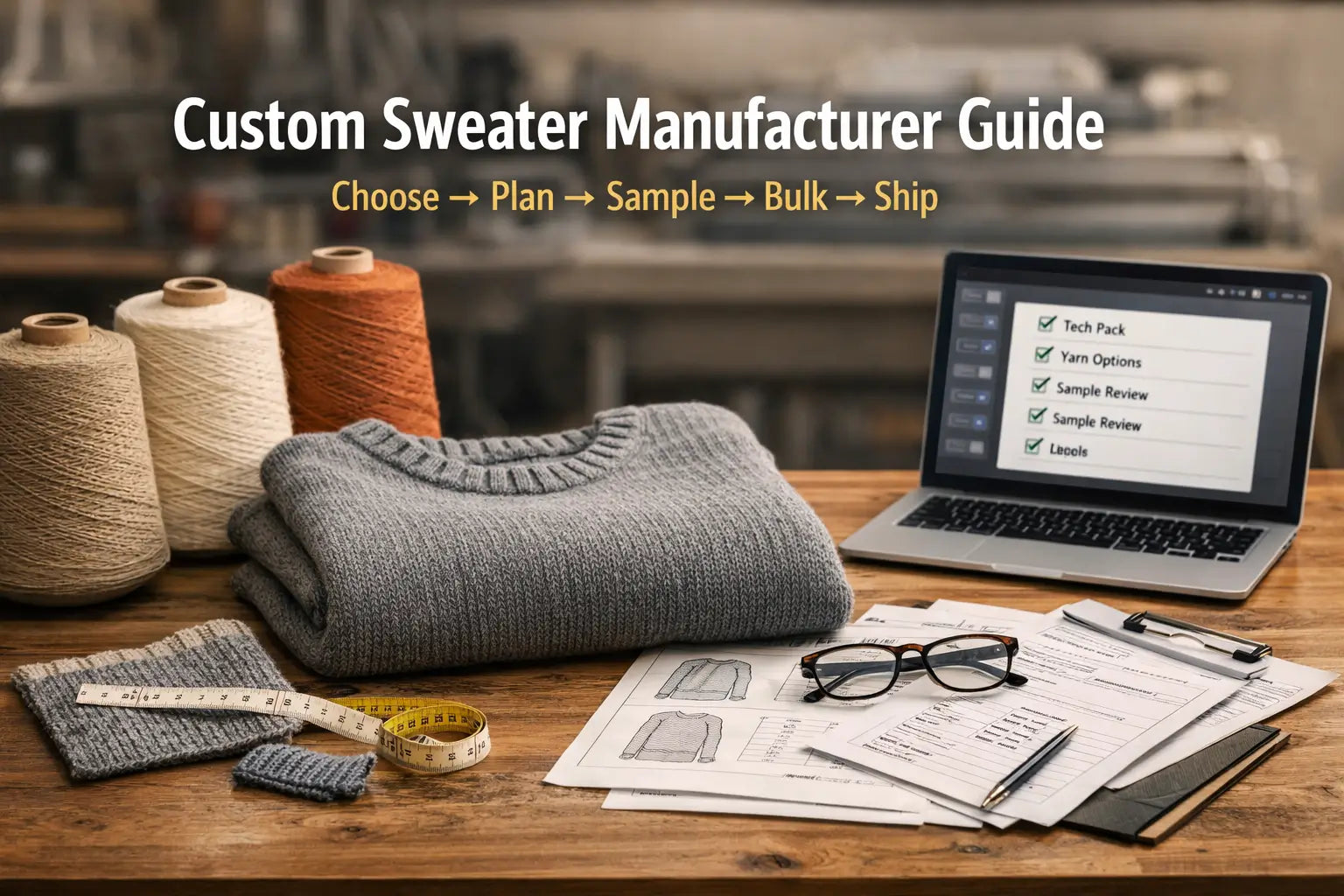
A good custom sweater manufacturer isn’t just “who can knit it”—it’s who can produce your design consistently at your scale, with a clear sampling workflow, measurable quality checks, and realistic constraints (MOQ, timeline, shipping responsibilities).
Because every sweater is different, anything involving MOQ, lead time, or shipping should be treated as variable until your supplier reviews your exact specs (technique, gauge, yarn, sizes/colors, and quantity).
The Buyer Journey This Article Follows (Choose → Plan → Sample → Bulk → Ship)
If you’re:
- Shortlisting suppliers: go to How to Choose a Manufacturer + OEM vs ODM
- Getting quotes & samples: go to What to Send for a Quote + Sampling to Bulk
- Reducing quality surprises: go to Knitwear QC + Technique/Yarn choices
- Shipping internationally: go to Shipping & Terms (Incoterms)
How to Shortlist the Right Manufacturer (Plus a Quote-Ready Checklist)
To shortlist the right custom sweater manufacturer, match capability + process + constraints to your design: can they produce your technique and gauge, confirm yarn options, run a clear sampling workflow, and align on QC checkpoints, MOQ structure, and delivery terms.
60-second shortlist checklist
| What to verify | What to ask (copy/paste) |
|---|---|
| Technique fit (jacquard/intarsia, gauge range) | “What knit techniques/gauges can you produce for this design? Any limits?” |
| Yarn & color feasibility | “Which yarn options match this handfeel/care target? Can you confirm shade control?” |
| Sampling workflow | “How many sample rounds do you typically run, and what are the approval checkpoints?” |
| MOQ structure | “Is MOQ per style, per color, or both? Can sizes be mixed?” |
| QC & acceptance | “What QC checkpoints do you run, and can we align on an acceptance checklist?” |
| Communication & change control | “How do you handle spec changes after sampling, and what info do you need to prevent delays?” |
Quote-ready mini checklist (send this with your inquiry)
- Tech pack (or minimum viable spec)
- Measurements + tolerance notes
- Artwork files (logos, pattern placement)
- Technique/gauge intent + yarn preference/handfeel target
- Quantity by size/color + target ship window
- Label/packaging needs + destination + preferred delivery terms (Incoterms)
How to Choose a Custom Sweater Manufacturer (Criteria Table + Red Flags)
Choose a custom sweater manufacturer by prioritizing repeatability (consistent bulk quality) over marketing claims—then validate with a simple criteria table and proof questions.
The 6-Criteria Selection Table (What to Check + What to Ask)
| Criteria | What to check | What to ask |
|---|---|---|
| 1) Capability fit | Technique/gauge match; finishing ability (linking/seaming, trims) | “Have you produced similar constructions? What’s the closest reference you can share?” |
| 2) Materials readiness | Yarn options, blend control, color consistency approach | “How do you confirm yarn spec (fiber %, count) and manage dye-lot/shade risk?” |
| 3) Sampling workflow | Clear stages + feedback loops + approval gates | “What’s your sample workflow from first sample → size set → bulk approval?” |
| 4) MOQ alignment | MOQ structure (style/color), size mix rules, reorder expectations | “How is MOQ calculated for this style/color? What’s the most efficient first run plan?” |
| 5) QC checkpoints | Inline checks + final inspection + measurable acceptance criteria | “Can we align on tolerances, defect rules, and inspection checkpoints?” |
| 6) Communication | Response speed, clarity, change control | “If something is not feasible, how will you flag it and propose alternatives?” |
Brand stage lens: what matters most for you
- Startup / first collection: MOQ structure + sampling clarity + minimum viable spec support
- Growing brand: repeatability, size sets, QC checkpoints, reorder stability
- Procurement/buyer teams: acceptance checklist, documentation readiness, responsibilities under delivery terms
Red Flags That Usually Lead to Delays or Quality Disputes
- Vague “yes we can do it” without confirming gauge/technique/yarn constraints
- No clarity on tolerances (how much measurement variation is acceptable)
- Unclear handling of spec changes after sampling (who approves, what changes trigger rework)
- “Strict QC” statements with no usable inspection checklist
- Shipping promises without defining delivery terms (who pays/handles freight, insurance, duties)
OEM vs ODM for Knitwear: Which Model Fits Your Readiness?
OEM vs ODM is mainly about who owns the design/spec work: OEM fits buyers with a clear tech pack, while ODM fits buyers who need more development support—but the exact scope varies by supplier.
Quick Comparison Table + “Choose This If…” Rules
| Topic | OEM (you provide spec) | ODM (supplier supports development) |
|---|---|---|
| You bring | Tech pack/spec, measurements, artwork | Concept + references + target feel/fit |
| Supplier does | Manufacture to spec (and sample iteration) | Helps translate concept into spec + sample |
| Best for | Brands with defined designs | Brands needing product development help |
| Risk to control | Spec errors → production issues | Scope ambiguity → misaligned expectations |
| What to clarify | Tolerances, yarn spec, approvals | Deliverables, revisions, approval checkpoints |
Choose OEM if: you already have a tech pack (or can create one quickly) and want maximum control.
Choose ODM if: you need help converting a concept into a manufacturable sweater—but confirm what “development” includes (files, revisions, approvals).
MOQ for Custom Sweaters: What It Means and How to Plan Your First Order
MOQ (minimum order quantity) is the supplier’s minimum production commitment—often influenced by style setup, yarn/color requirements, and production efficiency—and it may be defined per style, per color, or both.
A 4-Step First-Order Plan (Reduce SKUs, Lock Specs, Plan Reorders)
- Confirm MOQ structure early: ask “per style or per color?” and whether sizes can be mixed.
- Start with fewer SKUs: limit colors and avoid unnecessary variations for your first run.
- Lock the spec before bulk: finalize measurements, tolerances, yarn spec, and artwork placement at sample approval.
- Plan reorder logic: treat the first run as validation; scale after fit/handfeel/QC are confirmed.
Boundary note: MOQ is not universal—your technique, gauge, yarn availability, and order size can shift feasibility.
What to Send for an Accurate Quote and Sample (Knitwear-Specific Checklist)
You’ll get faster, more accurate quotes (and fewer sample rounds) when you send a supplier a knitwear-ready “quote package” that removes guesswork.
Knitwear Quote Package Checklist (send as one bundle)
- Tech pack (preferred), including sketches, measurements, BOM, and construction notes
- Size range + key measurements (and which points are most critical)
- Tolerance guidance (where small variation is okay vs not okay)
- Technique & gauge intent (e.g., jacquard vs intarsia; target weight/handfeel)
- Yarn preference (fiber %, feel target, care expectations, allergen concerns if any)
- Artwork files (logos/pattern placement, repeats, color references)
- Quantity breakdown (by size and color)
- Target ship window (date range, not a single “must”)
- Private label needs (neck label, care label, hangtag, packaging)
- Destination + delivery terms preference (so responsibilities are clear)
Minimum Viable Spec (If You Don’t Have a Full Tech Pack Yet)
If you only have references, send:
- Clear reference photos (front/back/inside seams/labels) + close-ups of key details
- A measurement sheet for at least the core points (chest, body length, sleeve length, etc.)
- Desired fabric handfeel (soft/structured), warmth level, and care expectation
- A simple construction note: technique (jacquard/intarsia), rib details, neckline/cuff/hem style
- Label/packaging requirements + quantity + target ship window
Boundary note: Changing yarn, technique, or measurements after sampling typically affects timeline and cost—treat sample approval as the “lock point.”
Want to speed up your quote process?
Send your “quote package” (tech pack or minimum viable spec), quantities, and target ship window. We’ll confirm feasibility, the sampling path, and what variables may affect MOQ and delivery.
Sampling to Bulk: A Realistic Workflow and What Usually Delays It
A realistic sampling-to-bulk plan is a set of approval checkpoints, not a promised calendar—because the biggest timeline variable is usually spec clarity + approval speed.

The 6-Step Workflow (Inquiry → Sample → Size Set → Bulk → Final QC → Ship)
- Spec review: confirm technique, gauge, yarn feasibility, and key measurements
- Material & color confirmation: align yarn spec and color targets
- First sample: evaluate fit, handfeel, construction, and artwork execution
- Revisions + re-sample (if needed): make controlled changes and re-approve
- Size set / pre-production confirmation: confirm grading/measurements and “locked spec”
- Bulk + final QC + shipment: inspect against acceptance checklist; pack; ship under agreed terms
Where Delays Usually Happen (and How to Reduce Them)
- Unclear tolerances: add tolerance notes to prevent fit disputes
- Late approvals: set internal turnaround deadlines for feedback
- Yarn/color changes: confirm availability early; avoid changing yarn after sample approval
- Technique complexity surprises: confirm feasibility constraints early (gauge limits, artwork constraints)
Boundary note: total calendar time depends on design complexity, yarn availability, order quantity, and how quickly approvals happen.
Technique Choices: Jacquard vs Intarsia (and When Each Works Best)
Pick the technique that matches your artwork and risk tolerance: jacquard is often better for repeating or all-over patterning, while intarsia is often used for larger color blocks—then confirm feasibility with your manufacturer’s machine capability.

Technique Comparison Table + “Ask Your Manufacturer” Prompts
| Technique | Often best for | Common feasibility questions |
|---|---|---|
| Jacquard | Repeating patterns, all-over motifs | “What’s the max complexity/repeat size? How do you control floats/back structure?” |
| Intarsia | Large color blocks, logo panels | “What are your limits on color areas and transitions? Any constraints at this gauge?” |
| Embroidery / appliqué | Small logos, patches | “What stabilizers/backing do you use? Any risk to handfeel?” |
| Print (where applicable) | Graphic effects on certain bases | “Does the base construction support printing cleanly? How is durability tested?” |
Boundary note: different factories have different capabilities—always confirm against your exact design, gauge, and yarn.
Yarn Options: How Material Choice Changes Feel, Care, and Risk
Your yarn choice shapes the product’s handfeel, warmth, care requirements, and common risk areas (like pilling or shrinkage), so treat it as a design decision, not a last-minute swap.

Yarn Comparison Table (Buyer View)
| Yarn (common) | Feel & performance | Care & common risks | What to specify to reduce surprises |
|---|---|---|---|
| Wool | Warm, resilient; premium feel | Can shrink/felt if mishandled; sensitivity concerns | Fiber %, handfeel target, care label intent |
| Cotton | Breathable, softer drape | Can stretch/lose shape; weight varies | Fiber %, target weight/handfeel, shrink expectations |
| Acrylic | Often softer-feel at lower cost | Can pill; heat sensitivity | Anti-pilling preference, handfeel and durability expectations |
| Blends | Balance warmth, softness, care | Behavior depends on mix and finishing | Exact fiber % + yarn spec (don’t rely on “similar”) |
Boundary note: availability and dye-lot consistency can vary—confirm yarn spec and color targets early.
Knitwear QC: Acceptance Checklist + Common Defects to Inspect
The best way to prevent bulk surprises is to define QC expectations at the sample stage and verify them again before shipment with a clear acceptance checklist.

The Buyer’s Acceptance Checklist (Sample Stage vs Pre-Shipment)
Sample stage (prevention):
- Measurements match spec at key points (and tolerances are agreed)
- Stitch consistency and evenness (no uneven tension zones)
- Linking/seaming neatness (neckline, armholes, side seams)
- Artwork accuracy (placement, proportions, readable details)
- Handfeel and stretch/recovery meet your expectation
- Care label intent aligns with material reality
Pre-shipment stage (verification):
- Measurement spot-check against the same points/tolerances
- Shading consistency (especially across panels and within color areas)
- Pilling risk checks (basic handling/inspection; define test expectations if needed)
- Finishing (thread ends, steaming/pressing quality)
- Labels/tags/packaging accuracy (placement, spelling, barcode/SKU where relevant)
Common Knitwear Defects (Plain-Language Watchlist)
- Uneven stitches / tension lines: visible bands, inconsistent knit density
- Seam/linking issues: bulky joins, weak points, visible gaps
- Shading/mismatch: panels don’t match in tone due to yarn lot differences
- Twisting/shape distortion: garment hangs unevenly after finishing
- Excess pilling early: fuzz balls appear quickly (often material + finishing dependent)
Boundary note: acceptable tolerances and testing expectations vary by product and destination market—define acceptance criteria up front.
Private Label Basics: Labels, Tags, Packaging, and File Prep
Most private label sweater programs can support neck labels, care labels, hangtags, and basic packaging—but you’ll get better outcomes when you provide clear files and confirm destination-market labeling rules.

Typical private label components (what to ask for)
- Neck label (brand ID)
- Care label (fiber content + care instructions; placement varies)
- Hangtag (brand story, SKU/barcode if needed)
- Packaging (polybag, size sticker, carton marks)
File prep mini-checklist (send with your quote package)
- Artwork files (vector preferred where possible) + dimensions
- Placement notes (exact location on garment)
- Required languages (destination market)
- Fiber content statement source (your BOM/yarn spec)
- Any compliance notes your market requires
Compliance reminder (keep it market-specific)
- In the United States, federal guidance commonly emphasizes that textile labels include fiber content, country of origin, and the identity of the responsible company (name or RN). (ftc.gov)
- In the European Union, the textile labelling framework includes rules on textile fibre names and fibre composition labelling/marking. (eur-lex.europa.eu)
Boundary note: labeling rules vary by destination—verify requirements for your sales market before mass production.
Shipping & Terms: Express vs Air vs Sea, Incoterms, and “Customs Support” Boundaries
International shipping works best when you separate “how it moves” (mode) from “who does what” (delivery terms): Incoterms are widely used rules that define buyer/seller responsibilities, costs, and risk allocation in international transactions. (iccwbo.org)

Shipping Mode Trade-Off Table
| Mode | Often chosen when | Typical trade-off |
|---|---|---|
| Express | Samples, urgent replenishment | Faster but higher cost per unit |
| Air freight | Mid-sized orders with deadlines | Balanced speed; still cost-sensitive |
| Sea freight | Large bulk orders | Lower cost per unit; longer and more variable transit |
What to confirm in writing (before shipment)
- Incoterms / delivery terms: who pays freight, who handles export/import formalities, and who bears risk at which point (iccwbo.org)
- Importer responsibility: in many countries, the importer of record is responsible for proper entry and compliance—confirm who is acting as importer and what documents are needed. (cbp.gov)
- Commercial invoice expectations: customs authorities typically require an adequate description, quantities, and values (and other entry details). (cbpcomplaints.cbp.gov)
- Document set (high-level): commercial invoice, packing list, and transport document (air waybill / bill of lading) are common starting points, but requirements can vary by destination and shipment. (cbp.gov)
Boundary note: delivery time varies by destination, carrier, and season—and customs outcomes depend on importer compliance; a supplier may support documentation/logistics but can’t guarantee clearance results.
FAQ (Quick Answers to the Most Common Buyer Questions)
How do I choose a custom sweater manufacturer for my brand stage?
Start with a shortlist criteria table: technique/gauge fit, yarn feasibility, sampling workflow clarity, MOQ structure, QC checkpoints, and communication/change control. For startups, prioritize MOQ structure and sampling clarity; for growing brands, prioritize repeatability and QC checkpoints; for procurement, prioritize acceptance criteria and documentation readiness.
What’s the difference between OEM and ODM in knitwear?
OEM means you provide the specs (tech pack) and the supplier manufactures to them; ODM means the supplier supports development from concept to spec and sample. ODM scope varies a lot, so confirm deliverables (files, revisions, approvals) before you proceed.
What does MOQ mean for custom sweaters?
MOQ is the minimum production commitment and can be defined per style, per color, or both. Plan your first order by reducing SKUs, locking spec at sample approval, and scaling after fit/handfeel/QC are confirmed.
What should I send to get an accurate quote and sample?
Send a knitwear “quote package”: tech pack (or minimum viable spec), measurements + tolerances, technique/gauge intent, yarn preference/handfeel, artwork files, quantity by size/color, label/packaging needs, destination, and preferred delivery terms.
How long does sampling to bulk usually take?
Treat it as a workflow with checkpoints (spec review → yarn confirmation → sample → revisions → size set/pre-production → bulk → final QC → ship). The biggest variables are spec clarity, yarn availability, design complexity, and approval speed.
What quality checks matter most for knitwear?
Define measurable acceptance at sample stage (measurements/tolerances, stitch consistency, seams/linking, artwork accuracy, handfeel). Then verify pre-shipment (shading consistency, finishing, labels/packaging accuracy) using a bucketed checklist.
Summary: Your Next 3 Actions Before You Contact a Manufacturer
- Build a shortlist using the 6-criteria table (capability + process + constraints).
- Prepare a quote package (tech pack or minimum viable spec + quantities + target ship window).
- Define acceptance criteria early (tolerances + QC checkpoints) so sampling and bulk stay aligned.
Ready to start?
Share your design (tech pack or reference), target yarn/handfeel, quantities by size/color, and destination. We’ll confirm feasibility, sampling steps, and what variables could affect MOQ and delivery.
)