
How to Wear a Cardigan Without Looking Frumpy: Fit Rules + 10 Outfit Formulas
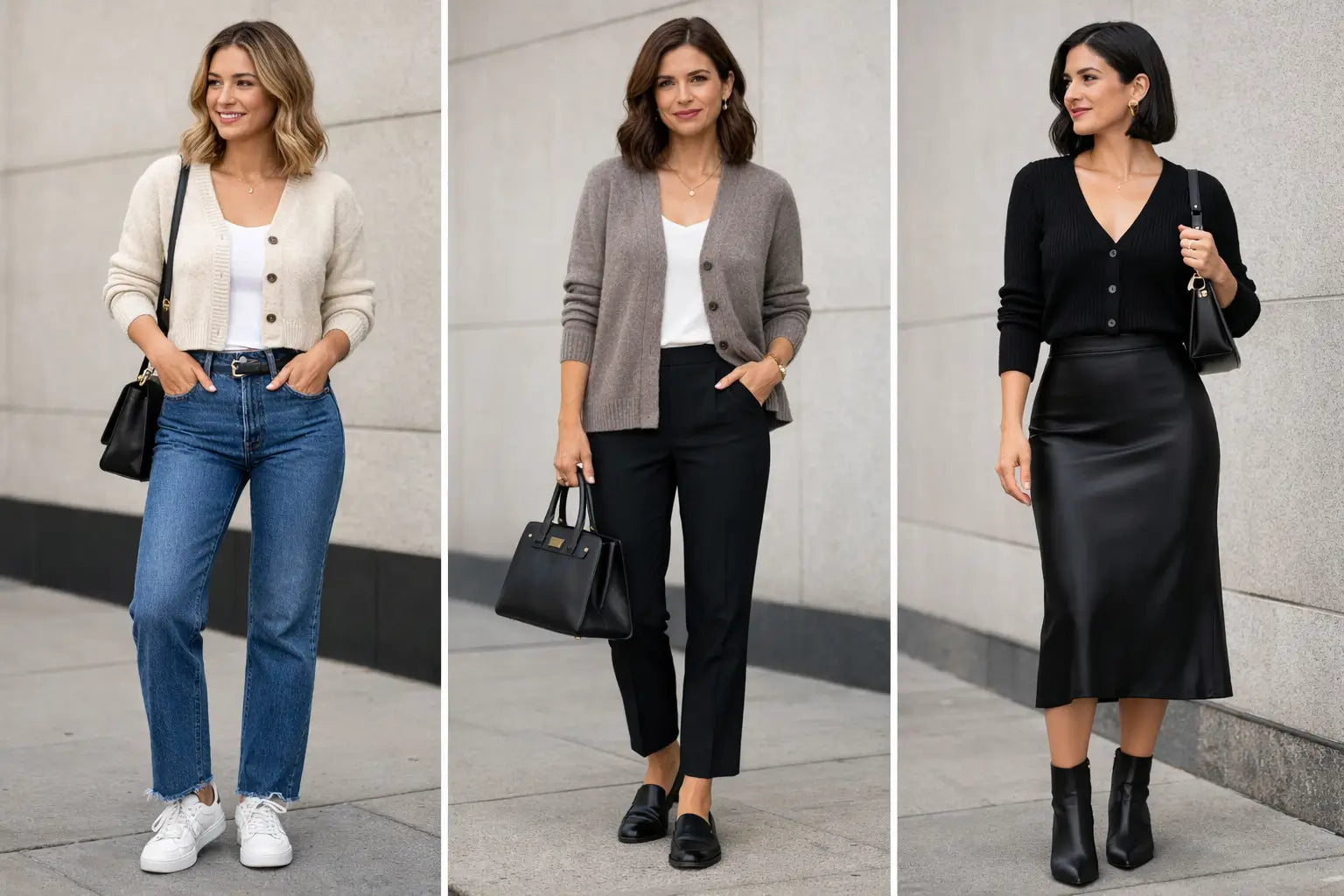
How to Wear a Cardigan Sweater (3 Rules + 3 Outfit Formulas)
Wearing a cardigan well is mostly about fit + proportions + one “polish” element (structure, shoes, or accessories) so the outfit looks intentional instead of shapeless.
- Rule 1: Balance volume. If the cardigan is oversized or longline, keep the rest of the outfit more streamlined.
- Rule 2: Use one structure cue. A crisp collar, belt (when the knit allows), tailored trousers, or a structured bag instantly reads “put together.”
- Rule 3: Match the knit weight to the vibe. Fine-gauge looks dressier; chunky knits look cozier and need simpler layering.
| Quick outfit formula | Top | Bottom | Shoes | Finish |
|---|---|---|---|---|
| Casual classic | Tee or tank | High-rise straight jeans | Sneakers | Half-tuck the tee or add a structured bag |
| Work-ready | Buttoned cardigan (fine-gauge) | Ankle trousers or midi skirt | Loafers or flats | Simple jewelry + tidy hemline |
| Elevated | Cardigan as a top | Sleek skirt or dark straight jeans | Boots or heels | Statement earrings or a small shoulder bag |
- Boundary notes:
- Chunky knits add bulk, so layering works best with fewer, cleaner pieces.
- Proportions vary by height and comfort preference—use the rules as a guide, not a guarantee.
Once you’ve got the basic rules, choosing the right cardigan type makes styling much easier.
Pick Your Cardigan Type First (Length + Knit Weight)
The easiest way to get a modern look is to start by identifying the cardigan’s length and knit weight, because those two choices determine what silhouettes look balanced.

- Key points:
- Cropped (hits at waist/high hip): Great for high-rise jeans/trousers; creates longer-looking legs.
- Hip-length: The “most flexible” length; works with jeans, trousers, and many skirts.
- Longline (mid-thigh or longer): Best with slim-to-straight bottoms or a defined waistline to avoid a boxy column.
- Fine-gauge knit: Layers cleanly; reads more polished for work.
- Chunky knit: Cozy and casual; keep layers simple to avoid bulk.
| Cardigan type | Best for | Pair with | Watch-outs (quick fix) |
|---|---|---|---|
| Cropped | Defining the waist; modern proportions | High-rise straight/wide jeans; tailored trousers | If it rides up, size up or choose a longer hem |
| Hip-length | Everyday outfits; easy layering | Straight jeans; trousers; midi skirts | If it looks “meh,” add one structure cue (shoe or bag) |
| Longline | Cozy layers; travel | Slim/straight pants; leggings (casual); column dress + belt | If it looks shapeless, define waist or sharpen shoes |
| Fine-gauge | Workwear; dressier styling | Trousers; skirts; layered under blazer | Shows fit issues more—avoid button strain |
| Chunky | Casual; cold weather | Simple base layers; streamlined bottoms | Too many layers = bulk—keep the rest minimal |
- Boundary note:
- “Fall” can mean very different temperatures by region—choose weight based on your climate, not the calendar.
With your cardigan type in mind, the fastest upgrade is to fix the common “frumpy” triggers.
How to Wear a Cardigan Without Looking Frumpy (Checklist + Fixes)
You can avoid the “frumpy” look by making sure the cardigan isn’t fighting your silhouette: no pulling at buttons, no all-over volume, and at least one intentional finishing detail.

Anti-frumpy checklist (5–7 bullets):
- Start with fit: shoulders sit where they should; buttons don’t pull; sleeves don’t swallow your hands.
- Keep one area streamlined: oversized on top → straighter/slimmer on bottom (or define the waist).
- Choose a clean hemline: avoid a cardigan hem that ends at the widest point of hips if it makes you feel boxy—try shorter or longer.
- Add structure: a belt (if the knit isn’t bulky), a crisp collar underneath, or a blazer/coat on top.
- Upgrade the shoe line: sleek boots/loafers read sharper than soft slippers or overly “house shoe” silhouettes.
- Use contrast on purpose: a fitted base layer under a relaxed cardigan can look modern and intentional.
- Keep accessories simple but deliberate: structured bag, minimal jewelry, or one statement piece.
Quick “if/then” fixes:
- If the cardigan looks shapeless, define a waistline (belt, tuck a base layer, or pick higher-rise bottoms).
- If you look “swallowed,” shorten the visual line (cropped cardigan, sleeves pushed up, lighter base layer).
- If the outfit feels too “cozy-only,” sharpen one element (structured bag, loafers, or cleaner trousers).
- Boundary notes:
- Oversized can be a style choice—balance it rather than fighting it.
- Chunky knit + longline often needs extra structure (or a streamlined bottom) to avoid shapeless bulk.
A “frumpy” outfit is often a fit issue in disguise, so it helps to do a quick fit check before you keep styling.
How Should a Cardigan Sweater Fit? (Fit Checklist + Quick Fixes)
A cardigan fits well when it sits cleanly at the shoulders, closes (if you want it to) without strain, and doesn’t bunch or droop in a way that changes the silhouette unintentionally.
Fit checklist (6–8 bullets):
- Shoulders: seam sits near the shoulder edge (unless intentionally dropped for an oversized look).
- Sleeves: you can move comfortably; cuffs don’t cover most of your hands unless that’s the style.
- Buttons/closure: no pulling “X” wrinkles across the chest or waist when buttoned.
- Body width: fabric drapes rather than clinging (unless you want a fitted cardigan-as-top look).
- Hem placement: cropped/hip/longline should match your outfit goal and proportions.
- Armholes: not uncomfortably tight (a common cause of “I hate how this looks”).
- Back/side drape: doesn’t balloon out unless intentionally oversized.
| Fit point | What to look for | Quick fix (no tailoring) |
|---|---|---|
| Button strain | Pulling, gaping, “X” wrinkles | Wear open, size up, or switch to a relaxed cut |
| Droopy shoulders | Shoulder seam falling far down arm | Choose a smaller size or a less slouchy silhouette |
| Too-long sleeves | Hands disappear; looks sloppy | Push sleeves up, cuff once, or choose shorter sleeves |
| Hem hits “wrong” spot | Emphasizes widest point | Try cropped (waist) or longer (mid-thigh) instead |
| Tight armholes | Restricts movement; bunching | Choose a style with roomier armholes or lighter layering |
- Boundary notes:
- “Perfect fit” depends on your goal: fitted, relaxed, or intentionally oversized.
- If buttons pull when closed, fix sizing/fit first—styling tricks can’t fully hide strain.
Once the cardigan fits the way you want, outfit formulas make getting dressed almost automatic.
What to Wear With a Cardigan: Outfit Formulas by Occasion (Table)
A cardigan pairs best when you treat it like a layering tool: pick a base layer, choose a bottom silhouette that balances the cardigan’s length/volume, then set the vibe with shoes and one finishing detail.

| Occasion | Cardigan | Top | Bottom | Shoes | Finish |
|---|---|---|---|---|---|
| Casual 1 | Oversized | Fitted tee | High-rise straight jeans | Sneakers | Sleeves pushed up |
| Casual 2 | Hip-length | Tank/cami | Wide-leg jeans | Sneakers | Structured bag |
| Casual 3 | Cropped | Tee | Relaxed trousers | Sneakers | Simple belt (optional) |
| Casual 4 | Longline | Fitted base layer | Straight pants | Boots | One statement accessory |
| Work 1 | Fine-gauge | Buttoned cardigan | Ankle trousers | Loafers | Minimal jewelry |
| Work 2 | Fine-gauge | Blouse | Midi skirt | Flats | Tidy hem + structured bag |
| Work 3 | Hip-length | Tee + blazer | Trousers | Loafers | Clean color palette |
| Date 1 | Cardigan as top | — | Sleek skirt | Boots/heels | Earrings |
| Date 2 | Cropped | Fitted top | Dark straight jeans | Boots | Shoulder bag |
| Date 3 | Fine-gauge | Camisole | Tailored trousers | Heels | Light layering (no bulk) |
- Boundary note:
- You can “dress up” a cardigan quickly by swapping shoes (sneakers → loafers/boots) and choosing a cleaner bottom (jeans → trousers).
If you want outfits that feel effortless, start with the casual formulas and adjust one piece at a time.
Casual formulas (weekends, errands, travel)
Casual cardigan outfits look modern when you balance comfort with one clean line—either a tidy base layer or a structured shoe/bag.
- Easy formulas:
- Oversized cardigan + fitted tee + straight jeans + sneakers
- Hip-length cardigan + tank + wide-leg jeans + sneakers + structured bag
- Longline cardigan + fitted top + straight pants + boots
- Quick swaps:
- Want more polish? Swap sneakers for loafers and add a structured bag.
- Want more comfort? Keep sneakers and switch to relaxed trousers, but keep the top more fitted.
- Boundary note:
- If the cardigan is very bulky, keep the rest of the outfit simpler (fewer layers, cleaner lines).
Work outfits need the same formula—just with a slightly more refined knit and sharper finishing details.
Work / business-casual formulas (polished, office-safe)
A cardigan can look professional when the knit is refined and the outfit has structure—clean trousers, a tidy hemline, and shoes that match your dress code.
- Office-safe formulas:
- Fine-gauge cardigan buttoned as a top + ankle trousers + loafers
- Cardigan over a blouse + midi skirt + flats
- Cardigan layered under a blazer (fine-gauge) + trousers + loafers
- Color/print guidance (neutral base + one accent)
- “Polish checklist” (steam/depill; tidy hem; appropriate shoe)
- Boundary note:
- For stricter offices, fine-gauge knits and cleaner silhouettes usually read more formal than chunky, slouchy knits.
For dressier occasions, the easiest upgrade is to wear the cardigan as the top and keep the rest sleek.
Date-night / going-out formulas (elevated but easy)
A cardigan looks elevated at night when you treat it like a top and keep the bottom sleek, then use shoes and accessories to set the mood.
- Elevated formulas:
- Cardigan as a top (buttoned) + sleek skirt + boots/heels + statement earrings
- Cropped cardigan + fitted top + dark straight jeans + boots + small shoulder bag
- Fine-gauge cardigan + tailored trousers + heels + minimal jewelry
- Boundary note:
- If the knit is bulky, avoid stacking a bulky coat on top—choose a cleaner outer layer or keep the rest of the look minimal.
If you’re curious about the “cardigan as a top” trend, the mechanics below make it feel intentional, not improvised.
How to Wear a Cardigan as a Top (Buttoning + Tucking Steps)
Wearing a cardigan as a top works best when the knit is stable enough to hold its shape and the fit doesn’t pull at the buttons.

- Key points:
- A more fitted or fine-gauge cardigan usually looks cleaner as a top than an ultra-chunky, oversized knit.
- Buttoning is a styling tool—your goal is comfortable coverage and a shape that feels balanced.
- Tucking works best when the knit isn’t too thick.
Steps (3–6):
- Choose the right base. If the cardigan is sheer, scratchy, or low-cut, add a cami or thin tank for comfort and coverage.
- Pick a buttoning plan. Button more for a clean top silhouette; leave a top or bottom button open for a relaxed V-shape (as long as it doesn’t gape).
- Check for strain. If buttons pull, choose a different size or wear it open—strain is hard to hide.
- Decide on a tuck. Try a full tuck for polish, a front tuck for ease, or no tuck with high-rise bottoms.
- Balance the bottom. Sleek trousers, straight jeans, or a skirt keep the look intentional.
- Finish with one “dress-up” detail. Boots, heels, or a statement accessory.
Do / Don’t
- Do keep the rest of the outfit streamlined if the cardigan texture is prominent.
- Do push sleeves up slightly to show wrists (often looks more styled).
- Don’t force a tight tuck with a bulky knit—it can bunch.
- Don’t ignore gaping/pulling; it’s usually a fit issue.
- Boundary notes:
- Loose or sheer knits may need layering for coverage.
- If the cardigan pulls at the buttons, adjust sizing or switch silhouette before styling.
Once you can wear it as a top, seasonal layering becomes the next lever for keeping outfits comfortable and sharp.
Seasonal Layering: Spring vs Fall/Winter (No-Bulk Rules)
Seasonal cardigan styling is mostly about layer order and bulk control—use lighter layers in spring and fewer, cleaner layers in colder months.

- Spring / mild weather:
- Fine-gauge or cotton-blend cardigan
- Tee, tank, or light blouse underneath
- Straight jeans, trousers, or a midi skirt
- Sneakers or loafers depending on how polished you want it
- Fall / winter:
- Heavier cardigan or fine-gauge layered under a coat
- Add warmth with a turtleneck or long-sleeve base layer
- Keep bottoms streamlined if your cardigan is chunky
- Boots are an easy seasonal “polish” upgrade
No-bulk rules:
- Use one bulky layer at a time (chunky cardigan OR chunky coat, not both).
- Keep the base layer thin if the cardigan is thick.
- If you’re layering a coat, a fine-gauge cardigan often sits more comfortably underneath.
- Boundary note:
- Climate varies widely—adapt the knit weight and base layers to your actual temperature range.
If your goal is office-ready, the same seasonal logic applies—just with cleaner lines and sharper finishing.
How to Wear a Cardigan to Work (Business-Casual Formulas)
A cardigan looks work-appropriate when the knit is refined and the outfit has clean structure—tailored bottoms, tidy shoes, and a neat hemline.
- Work formulas (easy to repeat):
- Fine-gauge cardigan buttoned + ankle trousers + loafers
- Cardigan over a blouse + midi skirt + flats
- Fine-gauge cardigan layered under a blazer + trousers + loafers
- Cardigan + simple knit top + tailored pants + structured bag
Polish checklist (quick):
- Make sure the cardigan hangs smoothly (no bunching at the waistline).
- Keep colors cohesive (neutral base + one accent is often easiest).
- Choose shoes that match your office vibe (loafers/flats read more professional than athletic sneakers).
- Boundary note:
- If your office is more formal, prioritize fine-gauge knits and tailored silhouettes; if it’s casual, you can go cozier but keep one “sharp” element.
For people who want men’s outfit ideas, a few simple buckets cover most cardigan situations.
Men’s Cardigan Outfits: Casual to Business-Casual
Men can wear cardigans in a modern way by treating them like a relaxed jacket: keep the base layer clean, match the knit weight to the occasion, and choose shoes that set the formality.
- Key points:
- Heavier knits read more casual; finer knits can look sharper.
- Collared shirts usually pair best with cleaner, less bulky cardigans.
Casual formulas (2–3):
- Cardigan + tee + straight jeans + sneakers/boots
- Cardigan + henley + chinos + boots
- Chunky cardigan + hoodie/tee + dark jeans + boots (cozy casual)
Business-casual formulas (2–3):
- Fine-gauge cardigan + OCBD + chinos + loafers
- Fine-gauge cardigan + tee + tailored trousers + loafers
- Cardigan (clean knit) + collared shirt + dark trousers + dressier shoes (if your office allows)
- Boundary note:
- “Business-casual” varies—if in doubt, choose a finer knit and cleaner shoes.
Shoes and accessories are the fastest way to shift a cardigan outfit from “cozy” to “intentional.”
Shoes & Accessories That Finish a Cardigan Outfit
The simplest way to elevate cardigan outfits is to match shoe formality to the occasion and add one accessory that signals intention.
- Shoes by vibe:
- Casual: sneakers
- Polished casual: loafers, clean leather sneakers, ankle boots
- Dressier: heeled boots, heels, sleek loafers
- Accessories that add structure:
- Structured bag (instant polish)
- Simple jewelry (small hoops, chain, watch)
- Belt (only if the knit isn’t too bulky)
- Belt rule of thumb:
- Belting works best with finer knits or soft belts; bulky knits can bunch and add volume.
- Boundary note:
- If a belt creates bulk, skip it and define the waist with high-rise bottoms or a tucked base layer instead.
If you want your cardigans to look good longer, a few buying and care habits make a noticeable difference.
Choosing & Caring for Cardigans (Pilling, Washing, Storage)
A cardigan will usually look better longer when you choose a knit that fits your lifestyle (comfort, climate, abrasion) and follow the care label to avoid unnecessary friction and stretching.
Buying checklist (quick):
- Feel the fabric: does it feel like it will snag or pill easily with friction (bags, seatbelts)?
- Check the knit weight: fine-gauge is easier to layer and often looks sharper; chunky is cozy but shows bulk faster.
- Inspect closures: buttons sit flat and don’t tug.
- Think about use: everyday wear needs easy-care; occasional wear can be higher-maintenance.
Care checklist (keep it simple):
- Read and follow the garment care label (care instructions are required on most apparel sold in the U.S.).
Source: FTC Care Labeling Rule guidance (https://www.ftc.gov/business-guidance/resources/clothes-captioning-complying-care-labeling-rule) - Before washing, check whether your sweater is machine-washable, hand wash-only, or dry clean-only.
Source: American Cleaning Institute sweater care (https://www.cleaninginstitute.org/cleaning-tips/clothes/fabric-care/sweater-care) - Reduce pilling risk by minimizing friction and washing gently (inside-out can help; avoid unnecessary abrasion).
Source: Woolmark pilling guide (https://www.woolmark.com/care/pilling/) - Dry flat when possible to help knits hold shape, especially heavier sweaters.
If pilling happens (normal for many knits):
- Remove pills gently with a fabric shaver/comb, working on a flat surface.
Source: Patagonia guide to removing pilling (https://www.patagonia.com/stories/guides/care-repair/how-to-remove-pilling-from-clothes/story-167962.html)
- Boundary notes:
- Care varies by fiber blend—always default to the care label on your specific garment.
- Some pilling is normal, especially in high-friction areas; it’s often about abrasion rather than “bad quality.”
Common questions tend to repeat, so the FAQ below gives quick, extractable answers in one place.
FAQ: Cardigan Styling Questions (Quick Answers)
-
Q: How to wear a cardigan without looking frumpy?
A: Focus on fit first, then balance volume: if the cardigan is oversized or longline, keep the rest streamlined and add one structure cue (sharper shoes, a belt if the knit allows, or a structured bag). -
Q: What to wear with a cardigan sweater?
A: Use a simple formula: base layer + balanced bottom + shoes that match the vibe. For example, tee + straight jeans + sneakers (casual) or buttoned fine-gauge cardigan + trousers + loafers (work). -
Q: How should a cardigan sweater fit?
A: It should sit cleanly at the shoulders and close (if you want it to) without button strain. If buttons pull or gape, sizing or silhouette needs adjusting before styling tricks. -
Q: How do you wear a cardigan as a top?
A: Choose a stable knit and a fit that doesn’t pull at buttons, decide on a comfortable buttoning plan, and pair it with high-rise bottoms. If it’s sheer or low-cut, add a thin cami for coverage. -
Q: How to style cardigans in fall/winter vs spring?
A: In spring, use lighter layers and fine-gauge knits; in fall/winter, keep bulk controlled (one bulky layer at a time) and choose streamlined bottoms if the cardigan is chunky. -
Q: How do you wear a cardigan sweater to work?
A: Choose a refined knit (often fine-gauge), pair with tailored trousers or a midi skirt, and finish with loafers/flats and a tidy hemline. Dress code matters—sharpen one element if your office is stricter. -
Q: How should men wear a cardigan sweater?
A: Treat it like a relaxed jacket: tee or OCBD underneath, jeans/chinos on bottom, and shoes that match the occasion. Finer knits dress up more easily than chunky ones. -
Q: What shoes and accessories go best with cardigan outfits?
A: Sneakers read casual; loafers and boots read more polished. Add one structured accessory (bag, watch, simple jewelry), and belt only if it doesn’t create bulk.
If you’re creating a cardigan collection (not just styling one), the last section translates these looks into clear, producible specs.
For Brands/Designers: Turn These Looks Into a Cardigan Spec Checklist (Optional)
If you’re developing a cardigan style, the fastest path to fewer sample revisions is to define the silhouette and the “feel” in clear specs—length, fit intent, knit weight, and trims.
- Key points:
- Styling trends map to specs (cropped vs longline, fine-gauge vs chunky, fitted vs relaxed).
- The clearer the measurements and construction details, the easier it is for a sampling team to match the look consistently.
Simple spec workflow (steps):
- Pick the silhouette: cropped / hip-length / longline, and fitted / relaxed / oversized.
- Define knit weight and hand feel (e.g., fine-gauge for layering vs chunky for warmth).
- Specify fit measurements (key points: body width, sleeve length, hem length, neckline depth).
- List construction details: rib widths, collar style (if any), pocket placement, button size/count, and finishing.
- Confirm branding needs: labels and packaging requirements if you have them.
Minimum checklist for a cardigan tech pack:
- Reference images (front/back) + target fit (fitted/relaxed/oversized)
- Measurement spec (including tolerance expectations if you use them internally)
- Yarn/fiber goals (comfort, season, drape) and knit weight direction
- Trims: buttons (size/color), labels, hangtags, packaging notes
- Color and size range plan (even if initial sampling is limited)
- Boundary note:
- MOQ, lead time, and cost depend on yarn choice, complexity, and order quantity—avoid locking numbers until sampling and materials are confirmed.
If you’re a brand or designer building a cardigan line, XTCLOTHES positions itself as an OEM/ODM knitwear manufacturer offering development support from sampling to bulk production, plus customized labels/packaging and logistics/customs support (as stated by the company). Share a tech pack (or reference images + measurements) and your target quantity/date to start a sampling and quotation conversation—final feasibility and timelines will vary by style and materials.
To wrap up, here’s a short cheat sheet you can use the next time you get dressed.
Summary: Cardigan Styling Cheat Sheet
A cardigan looks modern when the fit is comfortable, the proportions are balanced, and you add one finishing detail that matches the occasion.
- 3 rules to remember:
- Balance volume (one relaxed piece, one streamlined piece).
- Add one structure cue (shoes, bag, belt when the knit allows).
- Match knit weight to the vibe (fine-gauge = sharper; chunky = cozier).
- Quick paths by scenario:
- Casual: fitted tee + straight jeans + sneakers + sleeves pushed up.
- Work: fine-gauge cardigan + trousers/midi skirt + loafers/flats + tidy hemline.
- Going out: cardigan as a top + sleek bottom + boots/heels + one statement accessory.
- Boundary reminder:
- Height, climate, and dress code change what feels “right”—use the formulas as a starting point and adjust one piece at a time.
