
What’s the Difference Between a Cardigan and a Sweater? (Quick Definition + Checklist)
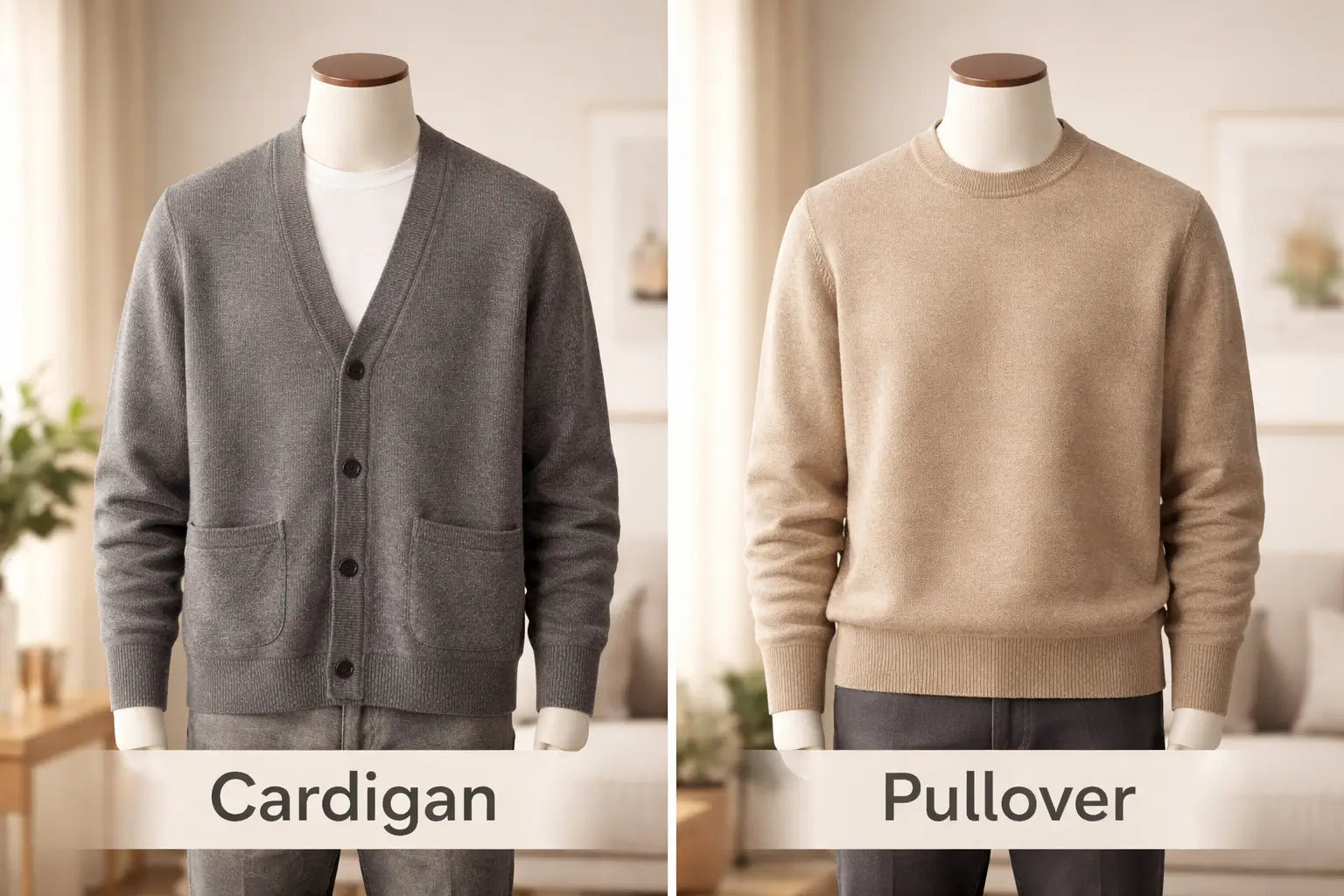
Cardigan vs Sweater: the 10-second answer (and what you’ll learn)
A cardigan is a knit top that opens at the front; a sweater is often used as the umbrella word for knit tops, including both pullovers and cardigans.
- In the next sections you’ll get: a fast comparison box, a 3-step “tell at a glance” checklist, edge-case naming rules, and a spec checklist.
- Quick note: labels can vary by retailer/region, so we’ll rely on construction features first.
Want the cleanest definition? Jump to the Fast Answer Box.
Cardigan vs Sweater vs Pullover (quick comparison)
A cardigan is typically defined by its open front, while a pullover sweater has no full front opening and is pulled over the head. In many US contexts, “sweater” can describe either type. (merriam-webster.com)

| Term | Front opening? | How you put it on | What it usually includes |
|---|---|---|---|
| Cardigan | Yes (full length) | Worn like a light jacket | Buttons, a zipper, ties, or no closure at all (merriam-webster.com) |
| Pullover sweater | No (full opening) | Pulled over your head | Crewneck/V-neck/turtleneck; may have a short zip at the neck |
| “Sweater” (umbrella term) | Either | Either | Often used to mean “knit top,” including cardigans and pullovers (merriam-webster.com) |
Key points
- If it opens down the front, it’s cardigan-like.
- If it doesn’t open down the front, it’s pullover-like.
- “Sweater” can mean “any knit top,” so when you need precision, add the subtype: cardigan sweater or pullover sweater.
Boundary conditions / caveats
- Retail categories overlap (e.g., “sweater jacket”), so use the front-opening rule plus the edge-case criteria below.
- Some regions use different everyday words (see “jumper” in a later section).
Now let’s make it practical—here’s a 3-step checklist you can use on any product page.
How to tell at a glance (3-step checklist)
To tell a cardigan from a pullover sweater, check (1) the front opening, then (2) the closure, then (3) the placket/edge finish that supports it.
Key points
- The front opening is the primary classifier.
- The closure type (buttons, zip, ties, none) helps you name it and spec it.
- The placket/edge finish (the reinforced strip at the front) is what often “gives away” the construction.
Steps
-
Look for a full front opening.
- Full opening = cardigan-like.
- No full opening = pullover-like.
-
Check how it closes (if it closes).
- Buttons: classic cardigan.
- Full-length zipper: often still treated as a cardigan (see edge cases).
- No closure: commonly called an open-front cardigan.
-
Look at the front edges.
- Cardigans often have a placket (or reinforced edge) to prevent stretching/waviness.
- Pullovers don’t need a front placket because there’s no full opening.
Boundary conditions / caveats
- “Do cardigans always have buttons?” No—many modern cardigans are open-front by design, and some use zips or ties.
- If the zipper is short (quarter-zip/half-zip) and there’s no full opening, treat it as a pullover style.
Still unsure about zip-ups, no-button styles, or “sweater jackets”? The next section is the decision rule set.
Edge cases: zip-ups, open-front/no buttons, and “sweater jackets”
Most “what do I call this?” confusion comes from one thing: a zipper (or jacket-like styling) changes how retailers label knitwear, even when the underlying rule is still “front opening vs not.”
Key points
- Full-zip knit = cardigan-like (because it opens fully).
- Half-zip / quarter-zip = pullover-like (because it doesn’t open fully).
- “Sweater jacket” is often a category label (how it’s styled or merchandised), not a strict construction class.
Decision bullets (use this as a naming mini decision tree)
- If it has a full-length opening (buttons or full zip): name it cardigan (or “zip cardigan”) in most cases.
- If it has no full-length opening (even with a short zipper): name it pullover sweater (or “half-zip sweater”).
- If it’s heavy, structured, and sold like outerwear: expect labels like “sweater jacket” or “knit jacket”; clarify with a feature phrase: “full-zip knit” or “open-front knit.”

Boundary conditions / caveats
- Retailer naming varies; the safest approach in product copy is feature + category (e.g., “full-zip cardigan”).
- Some wrap/robe-like knits may be called “robe cardigan” or “knit wrap”—describe what it does (open front + tie belt).
Want quick examples of what people usually mean by “cardigan styles”? Let’s list the common types.
Common cardigan types (quick examples)
Most cardigan names describe a feature you can see: closure, collar, or silhouette.
Key points
- Closure-based names help shoppers and manufacturers align: button vs zip vs open-front.
- Collar/neck details (shawl collar, V front) usually signal styling and warmth at the neckline.
Common types (grouped)
-
By closure
- Button-up cardigan: buttons down the front.
- Zip cardigan / full-zip knit: zipper down the front (often called a cardigan because it opens fully). (collinsdictionary.com)
- Open-front cardigan: no closure; worn open.
-
By collar/neck
- Shawl-collar cardigan: a folded, rounded collar.
-
By silhouette
- Cropped cardigan: ends above the hip/waist.
- Longline cardigan: longer length (often mid-thigh or below).
Boundary conditions / caveats
- Trend names (e.g., “grandpa cardigan”) vary; use fit + features when you need a stable description.
Now compare the main sweater (pullover) styles and necklines so you can name them consistently.
Common sweater types and necklines (quick examples)
Sweater types usually map to neckline or construction details, especially for pullovers.
Key points
- Neckline affects layering (what fits underneath) and perceived warmth at the neck.
- A short zip at the neck changes ventilation, but it’s still usually a pullover if there’s no full opening.
Common types
-
By neckline
- Crewneck: round neckline.
- V-neck: V-shaped neckline (often layers easily over a collared shirt).
- Turtleneck: tall, folded neck.
- Mock neck: shorter, less folded neck than a turtleneck.
-
By construction/styling
- Quarter-zip / half-zip: short zipper at the neck; typically pullover-style.
Boundary conditions / caveats
- “Sweater” can also mean a knitted jacket in some definitions; when in doubt, specify “pullover” vs “cardigan.” (merriam-webster.com)
Choosing between them? Let’s cover warmth and layering in a way that doesn’t rely on myths.
Which is warmer and which layers better? (what actually matters)
Neither a cardigan nor a sweater is automatically warmer—the warmth comes mostly from thickness + knit density + fit, and how much air the clothing traps. (iloencyclopaedia.org)
Key points
- Warmer usually means: thicker fabric, denser knit, better fit (less draft), and effective layering.
- A cardigan’s front opening can let in drafts when worn open—but it also makes layering and venting easier.
How to decide (quick factors checklist)
- Thickness/weight: thicker knits trap more air.
- Knit density (gauge): denser knit often blocks more air movement.
- Fit & openings: looser fit and open fronts can draft; tighter cuffs/hem reduce it.
- Layering plan: cardigan over a tee vs pullover under a coat are different systems.
Boundary conditions / caveats
- Wind and outerwear matter a lot: a thin cardigan under a windproof jacket can be warmer than a thick pullover worn alone.
- Avoid assuming “cardigan = less warm” or “pullover = always warmer”—design details dominate.
When to choose a cardigan vs a sweater (3–5 scenarios)
If you’re deciding between them, pick based on temperature swings, layering, and how often you’ll take it on/off.
Key points
- Cardigans win when you need adjustability.
- Pullovers win when you want simple, sealed warmth.
Scenarios
- Office / indoor A/C: cardigan over a base layer lets you vent or remove without messing up hair/makeup.
- Travel days: cardigan is easy to put on/off in transit.
- Under a structured coat: a pullover often sits flatter (no front placket bulk).
- Outdoor breeze: a pullover (or a fully zipped cardigan) can feel less drafty than an open-front cardigan.
Boundary conditions / caveats
- Fit and fabric change everything; treat these as “often works well,” not hard rules.
If you sell into the US, the next term to know is “jumper.”
Regional wording: “jumper” vs “sweater” (US vs UK)
In the US, “jumper” often means a sleeveless dress worn over a top, while in UK usage “jumper” commonly means what Americans call a sweater. (dictionary.cambridge.org)
Key points
- US: jumper = dress/pinafore-style garment (often worn over a blouse or shirt). (dictionary.cambridge.org)
- UK: jumper = sweater/pullover. (dictionary.cambridge.org)
- For US product pages, use “sweater” (and specify “cardigan” or “pullover” for clarity).
Boundary conditions / caveats
- International retailers sometimes mix terms; optimize the wording for your target market and add the alternate term in the description if needed.
If you’re buying or producing knitwear, the naming difference matters most in the tech pack.
If you’re sourcing knitwear: spec checklist for cardigan vs pullover
For sourcing, the cardigan vs pullover distinction matters because a cardigan usually adds front components (placket/closure) that change patterning, trims, and QC checks.
Key points
- Cardigans often require extra specs: placket width, button/zip details, and front-edge stability.
- Pullovers concentrate on neckline/shoulder fit and overall body measurements.
Mini-table: what to specify (tech pack starter)
| Spec field | Cardigan (open-front) | Pullover sweater |
|---|---|---|
| Garment type naming | “Cardigan” + closure type (button/full-zip/open-front) | “Pullover sweater” + neckline (crew/V/turtleneck/half-zip) |
| Measurements | Add front opening details (placket width, button placement) | Focus on neck opening, chest, body length, sleeve |
| Closure details | Button size/count, button spacing; or zipper length/type | If half-zip: zip length and placement only |
| Edge finishing | Placket structure, reinforcement to prevent stretching | Neck rib/finish; hem/cuff stability |
| Trims & labels | Buttons/zip tape, spare buttons, care label placement | Neck label, care label placement |
| QC checkpoints | Placket waviness, button alignment, zipper rippling | Neckline symmetry, shoulder seams, rib recovery |
How to use this checklist (practical workflow)
- Name the item as category + subtype (e.g., “button cardigan” or “crewneck pullover”).
- Lock the fit points with measurements (and add cardigan front opening/placket specs if applicable).
- Confirm materials + knit details (yarn content, gauge/weight target, and any pattern/texture).
Boundary conditions / caveats
- These are starter fields; every design adds its own details (pockets, collars, lining, special trims).
- If you’re unsure, share photos and a reference sample so the factory can confirm construction details before sampling.
Want a quick “what to send” list for a quote or sample? It’s right below (and kept separate from the core reference content).
Ready to request a sample or quote? What to send
To get a clearer quote and fewer back-and-forth questions, send:
- A tech pack (or at least front/back photos + measurements)
- Target quantity per color/size range
- Yarn/fiber preference (or target hand-feel and season)
- Desired closure type (buttons/full-zip/open-front) and trim details
- Artwork needs (labels, hang tags, packaging) if applicable
- Target delivery window and destination (shipping options vary)
Before you send anything, scan the naming/spec mistakes checklist below.
Common mistakes when naming or specifying knitwear (risk checklist)
Most problems come from missing one structural detail in naming or specs—especially around closures and front edges.
Key points
- “Sweater” alone is vague; add cardigan or pullover when it matters.
- Zip length matters: full-zip vs half-zip changes classification and construction.
- Plackets and edges are stress points; if they’re not specified, fit and appearance can drift.
Risk checklist (use before publishing product copy or sending a tech pack)
- ☐ You stated whether it opens fully in front (yes/no).
- ☐ If it has a closure, you specified type + length (buttons vs full-zip vs half-zip).
- ☐ For cardigans, you included button spacing / zipper details and placket width.
- ☐ You described the neckline (crew/V/turtleneck/mock) for pullovers.
- ☐ You clarified the fit intent (oversized vs regular vs slim) with measurements.
- ☐ You listed key QC checkpoints (placket waviness, alignment, rib recovery).
Boundary conditions / caveats
- Retail category labels (like “sweater jacket”) are fine for merchandising, but specs still need construction detail.
Care & durability quick notes (buttons, zips, pilling)
Closures add snag points, so care is less about “cardigan vs sweater” and more about fiber + friction + hardware.
Key points
- Buttons/zippers can snag other garments; gentler washing and reduced abrasion help.
- Pilling is often driven by fiber and friction; looser knits can pill faster with rubbing.
Quick care steps (generic, always defer to the care label)
- Close buttons/zips before washing to reduce snagging.
- Turn inside out and use a laundry bag if machine washing.
- Dry flat to help prevent stretching (especially for heavier knits).
- Use a fabric shaver or sweater comb gently for pilling.
Boundary conditions / caveats
- Always follow the garment care label; wool, cotton, and synthetics can require different handling.
Need quick, direct answers? Here’s the FAQ.
FAQ
These are the fastest answers to the questions people ask when they’re trying to label knitwear correctly.
Key points
- Each answer restates the main rule (front opening vs no full opening) and the “it depends” caveat where labels overlap.
- If you’re writing product copy or a tech pack, use the wording patterns from the checklist and spec table above.
Boundary conditions / caveats
- Retailer category labels can vary; construction features are more consistent than marketing names.
Is a cardigan a type of sweater?
In many US contexts, yes—a cardigan is commonly treated as a sweater subtype because it’s a knit top, just with a front opening. “Sweater” can also be used more narrowly to mean “pullover,” so adding the subtype avoids confusion. (merriam-webster.com)
- Cardigan sweater = open-front sweater.
- Pullover sweater = no full front opening.
What’s the difference between a cardigan and a pullover?
A cardigan opens down the front; a pullover doesn’t and is pulled over the head. (merriam-webster.com)
- Full front opening = cardigan-like.
- No full opening = pullover-like.
Do cardigans always have buttons?
No. Many cardigans have buttons, but they can also use a full-length zipper, ties, or be designed to hang open with no closure. (merriam-webster.com)
- Closure is optional; the front opening is the defining feature.
Is a zip-up sweater considered a cardigan?
If it has a full-length zipper and opens fully, it’s often categorized as a cardigan (a “zip cardigan”). If the zipper is short (quarter/half-zip) and the garment doesn’t open fully, it’s usually treated as a pullover style. (collinsdictionary.com)
- Full-zip = cardigan-like.
- Half-zip = pullover-like.
Which is warmer—cardigan or sweater?
Neither is automatically warmer; it depends on thickness, knit density, fit, and wind exposure. Clothing insulation depends heavily on trapped air in and around the layers. (iloencyclopaedia.org)
- Thickness and density usually matter more than the name.
- Cardigans can draft when worn open but layer easily.
What’s the difference between “jumper” and “sweater” in the US?
In US usage, a “jumper” often means a sleeveless dress worn over a top; in UK usage, “jumper” commonly means a sweater/pullover. (dictionary.cambridge.org)
- US: jumper = dress/pinafore style.
- UK: jumper = sweater.
Summary: quick takeaways + next steps
It gets easy when you name the construction.
- Front opening is the main rule: opens fully = cardigan-like; doesn’t = pullover-like. (merriam-webster.com)
- “Sweater” is often an umbrella term—use cardigan or pullover for clarity. (merriam-webster.com)
- Edge cases are manageable: full-zip is cardigan-like; half-zip is pullover-like.
- For sourcing, your best friend is a tech pack with closure + placket + measurement details (see the checklist above).
Boundary conditions / caveats
- If a product name feels ambiguous (e.g., “sweater jacket”), add the feature term (full-zip/open-front/half-zip) to remove doubt.
If you’re creating product copy or a tech pack, reuse the checklist tables as your internal naming standard.
)