
How to Wash a Cardigan Sweater (Hand or Machine) and Help Prevent Shrinkage
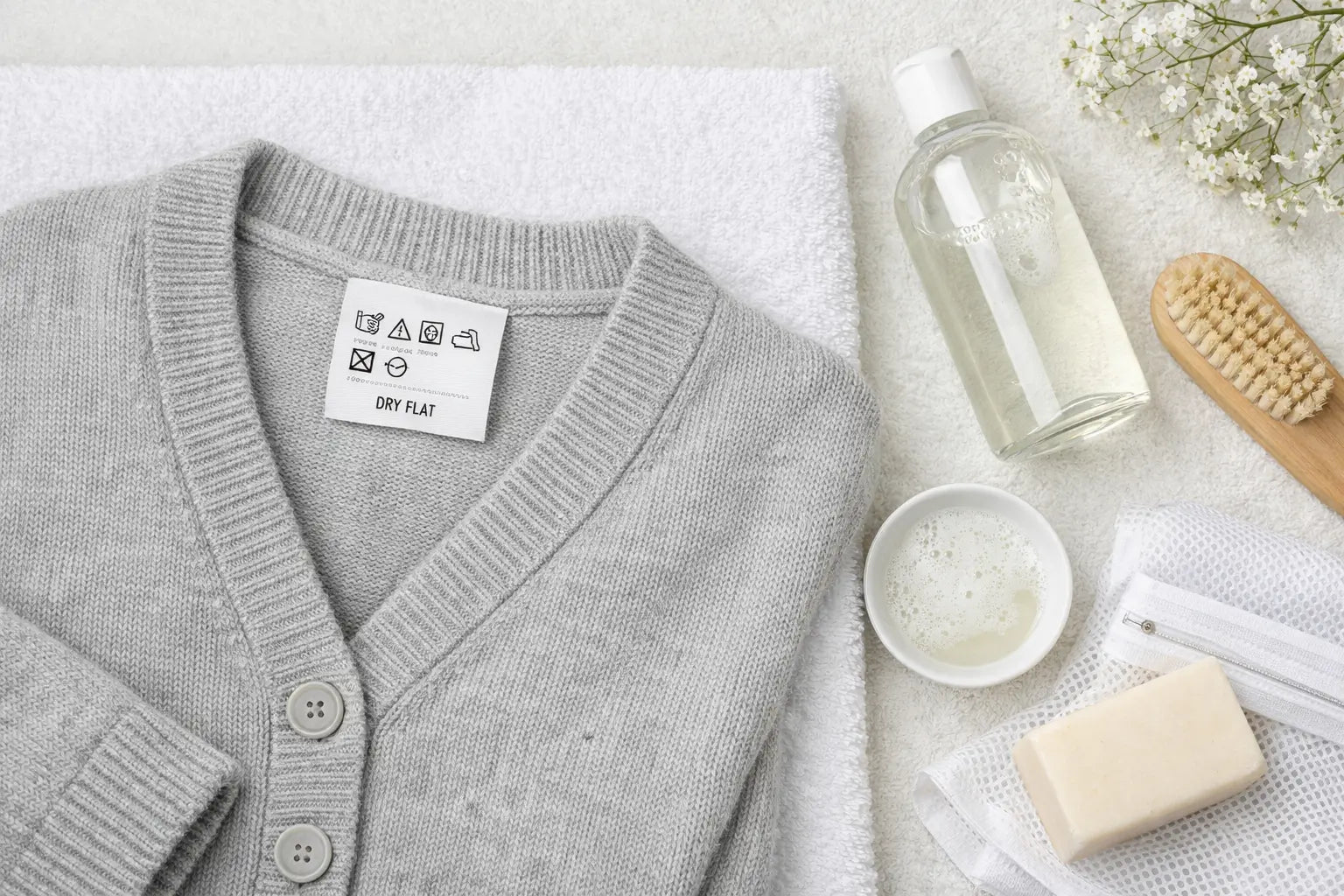
Washing a cardigan is mostly about two things: following the care label and protecting the knit structure from heat, friction, and stretching. Use the steps below to choose the safest method and keep your cardigan’s shape.
How to wash a cardigan sweater safely (label-first)
The safest way to wash a cardigan is to read the care label first, then use the gentlest method it allows—usually cool water, low agitation, and flat drying to prevent stretching.
- If the label says dry clean only: choose professional cleaning.
- If it says hand wash: hand wash in cool water with a gentle detergent, then press water out in a towel and dry flat.
- If it says machine wash: use a mesh bag, cold/cool water, a delicate/wool cycle, and the lowest practical spin; dry flat afterward.
Quick rules that prevent most damage
- Reduce friction: inside out + mesh bag + avoid washing with towels/denim.
- Avoid heat: hot water and tumble dryers raise shrink/warp risk, especially for wool-like fibers.
- Avoid stretching: never hang a wet cardigan; reshape and dry flat.
Caveats
- Results can vary by fiber blend, knit density, dye/finish, and washer type (agitator vs gentle wash action).
- When instructions conflict, follow the most restrictive safe path shown on the label.
If you’re unsure what your label symbols mean, the label decision table below makes the choice clearer.
Step 1: Read the care label (decision table + boundaries)
Your care label is the most reliable guide because it’s meant to indicate the most severe safe treatment for that specific garment, not a generic “sweater rule.” (ISO 3758 overview: https://www.iso.org/standard/42918.html)

Key points
- Care symbols and wording are designed to prevent irreversible damage during cleaning and aftercare.
- The label can be stricter than the fabric you think you have (because trims, dyes, or construction details may be the real constraint).
- If the label says “dry clean only,” treat that as a hard boundary for home machine washing.
Mini decision table: label wording/symbol → what to do
| Label says / shows | Safest method to use | Wash settings (if applicable) | Drying rule to protect shape |
|---|---|---|---|
| Dry clean only | Professional cleaning | — | Follow professional-care guidance |
| Hand wash | Hand wash in cool/cold water | Minimal swishing/pressing | Press water out in towel, reshape, dry flat |
| Machine wash cold / delicate | Machine wash only if allowed | Cold/cool + delicate/wool + low spin + mesh bag | Dry flat; avoid hanging wet |
| Do not tumble dry | No tumble dryer | — | Dry flat (airflow, not heat) |
| Tumble dry low (only if shown) | Only if explicitly allowed | — | Use low heat; remove promptly; reshape if needed |
Caveats
- If multiple instructions exist, follow the most restrictive safe path.
- If the label is missing or unreadable, start with the gentlest approach (hand wash + dry flat) and test carefully.
Once you’ve confirmed what the label allows, you can choose the hand-wash method (lowest risk) or the machine method (only if permitted).
Option A: Hand wash a cardigan (safest default)
Hand washing is usually the lowest-risk option for knit cardigans because you control friction, water temperature, and handling—three things that drive stretching, pilling, and shrink risk.

Key points
- Use cool/cold water and gentle handling to reduce fiber stress.
- Press and support the knit; avoid rubbing and twisting.
- Close buttons/zippers first so the cardigan keeps its shape and doesn’t snag.
Hand-wash steps (6–8 steps)
- Prep the cardigan: close buttons/zippers, turn inside out (optional but helpful), and spot-check for stains.
- Fill a basin with cool/cold water and dissolve a small amount of gentle detergent before adding the garment.
- Submerge and gently press the cardigan in the water; avoid scrubbing high-friction areas (cuffs, underarms).
- Rinse by pressing, not wringing: drain and refill with clean cool water, then press water through the knit until it feels clean.
- Lift with support: slide hands under the cardigan so its weight doesn’t pull it out of shape.
- Remove water with a towel press: lay it on a clean towel, roll, and press to absorb water (no twisting).
- Reshape on a flat surface: align seams, straighten edges, and set sleeves/hem.
- Dry flat with airflow (details in the drying section below).
Caveats
- Dark or saturated dyes may bleed; test an inside seam and avoid long soaking if color runs.
- Very loose/open knits stretch easily—minimize handling and keep the garment fully supported.
If your label allows machine washing and you want a faster option, use the machine-wash checklist below to reduce friction and snagging.
Option B: Machine wash a cardigan (only if the label allows)
You can machine wash a cardigan only when the label permits it, and the goal is to minimize friction: mesh bag, gentle cycle, cool water, and low spin.
Key points
- “Machine washable” does not mean “any cycle.” Use delicate/wool and low agitation.
- Reduce abrasion: inside out + mesh bag + wash with soft items only.
- Remove promptly; leaving a wet knit in a pile can set creases and distort edges.
Machine-wash checklist: prep + safest settings
-
Before washing
- Close buttons/zippers; check for loose threads or fragile embellishments.
- Turn inside out.
- Place in a mesh laundry bag (especially for finer knits).
- Wash with lightweight, non-abrasive items (avoid towels/denim).
-
Settings
- Water: cold/cool
- Cycle: delicate or wool (whichever your washer provides)
- Spin: lowest practical (high spin can stretch knits)
-
After the cycle
- Remove immediately and support the cardigan’s weight.
- Skip the tumble dryer unless the label explicitly allows it.
- Move straight to towel-press + reshape + dry flat.
Caveats
- Do not override “hand wash” or “dry clean only.”
- Agitator-style top-load washers can increase friction; if you can’t reduce agitation, hand washing is usually safer.
Drying is where knit cardigans most often lose shape, so follow the drying workflow even if washing went perfectly.
Drying & reshaping (keep your cardigan’s shape)
Drying correctly matters as much as washing: a wet knit is heavy, and hanging it can stretch shoulders, sleeves, and hems out of shape.

Key points
- The safest default is dry flat after removing water with a towel press.
- Heat and tumbling can raise shrink/warp risk—especially for wool and cashmere.
- Reshaping while damp helps the cardigan dry in the right dimensions.
The 3-stage drying workflow: press → reshape → dry flat
-
Press out water (no twisting)
Lay the cardigan on a clean towel, roll it up, and press to absorb moisture. Repeat with a dry towel if needed. -
Reshape while damp
Lay it flat and align seams, button bands, and hems. Smooth the knit into place—avoid pulling lengthwise. -
Dry flat with airflow
Dry on a flat surface (or a mesh drying rack). Ensure airflow around the garment; choose airflow over heat.
Caveats
- If the label shows do not tumble dry, treat that as a hard rule. (GINETEX symbols reference: https://www.ginetex.net/gb/labelling/care-symbols.asp)
- Thick knits dry slowly; improve airflow rather than using high heat.
- If the label allows tumble drying, use low heat and remove promptly, then reshape if needed.
If you’re not sure how fiber type changes the risk (wool vs cotton vs acrylic), the material guide below helps you choose the safest default.
Material guide: wool, cashmere, cotton, acrylic, and blends
Different fibers react differently to heat, agitation, and friction, so your “safest default” can change—especially for wool and cashmere. (Woolmark care: https://www.woolmark.com/care/how-to-wash-wool-sweater/)
Key points
- Wool/cashmere are typically more sensitive to heat and agitation; gentle washing and flat drying are especially important.
- Cotton knits can still stretch when wet; drying and reshaping habits matter.
- Acrylic/synthetics can be heat-sensitive and may pill with friction.
- For blends, the safest approach is usually dictated by the most sensitive fiber and the care label.
Fiber matrix table: safest default + biggest “avoid” + drying note
| Fiber type | Safest default method | Biggest “avoid” | Drying note |
|---|---|---|---|
| Wool | Hand wash or wool cycle if label allows | Hot water + heavy agitation (shrink/felt risk) | Dry flat; reshape while damp (Woolmark drying: https://www.woolmark.com/care/how-to-dry-wool-sweater/) |
| Cashmere | Gentle hand wash (unless label says otherwise) | Heat + friction | Dry flat; avoid hanging wet |
| Cotton knit | Hand wash or delicate cycle if allowed | High spin + hanging wet | Dry flat or supported; reshape cuffs/hem |
| Acrylic / synthetics | Delicate cycle if allowed | High heat (dryer or hot water) | Dry flat if shape is drifting; avoid hot tumble |
| Blends | Follow label; treat as the most sensitive component | “Assuming” it’s machine-safe because it’s a blend | Dry flat as a conservative default |
Caveats
- “Machine-washable wool” is label-dependent; don’t assume based on fiber name.
- Knit density, trims, dyes, and finishes can change real-world behavior even within the same fiber category.
For brands: turn this into a care card (label wording + customer guidance)
If you sell cardigans, a short care card can reduce returns and “it shrank” complaints—especially when fiber blends and trims make care less obvious.
- Use label-first wording: “Follow the care label on your garment. When in doubt, use cool water, gentle handling, and dry flat.”
- Call out construction: “Close buttons/zippers before washing. Use a mesh bag if machine washing is permitted.”
- Include one clear drying line: “Press water out in a towel, reshape, and dry flat.”
If you want care guidance aligned to a specific fiber blend, gauge, and trims, share your spec and decide on care instructions early in development.
Cardigan construction can change the safest method even when the fiber seems straightforward, so check the cardigan-specific prep rules below.
Cardigan-specific prep: buttons, zippers, embellishments, loose knits
Cardigans have more snag and distortion points than pullovers, so small prep steps (closures, bagging, and gentle handling) matter more.
Key points
- Close buttons/zippers to stabilize shape and reduce snagging.
- Embellishments and loose/open knits snag easily—reduce mechanical action.
- If trims are not washable, the entire garment may effectively become “non-washable at home.”
Checklist
- Buttons: close if possible; avoid catching on other items; consider a mesh bag.
- Zippers: zip fully to prevent snagging; bag the cardigan.
- Embroidery/sequins/beads: prefer hand washing if allowed; avoid rubbing; consider professional care if the label is strict.
- Loose/open knits: support the cardigan fully; avoid spinning hard; don’t wash with anything abrasive.
Caveats
- Some trims (leather/suede-like patches, fragile appliqués) may require professional cleaning even if the base knit is washable.
- If you see loose yarns, avoid machine washing until secured.
If your cardigan is pilling (or you want to prevent it), the pilling section below focuses on reducing friction and safe depilling.
Pilling: prevent it in the wash and remove it safely
Pilling is often caused by friction—during washing, wearing, and even storage—so your best prevention is reducing abrasion.

Key points
- Less friction = less pilling: inside out, mesh bag, gentle cycle, and avoid abrasive loads.
- Depilling should be gentle and done on a flat surface.
- Some pilling is normal for certain fibers and blends, and doesn’t automatically mean a garment is “bad.”
Prevention checklist
- Wash inside out.
- Use a mesh laundry bag (if machine washing is allowed).
- Choose cold/cool water and the gentlest cycle available.
- Avoid towels, denim, and overloading the washer.
Safe removal
- Use a sweater comb or fabric shaver lightly.
- Work on a flat surface; support the knit with your hand.
- Don’t pull pills off by hand (it can weaken yarns).
Caveats
- Delicate fibers need lighter pressure when depilling.
- If the knit is very loose, test depilling gently in a small area first.
If you’re trying to wash less often (to reduce wear) or handle a stain without a full wash, the stain/odor guidance below helps you decide.
Stains, odors, and wash frequency (spot clean vs refresh vs wash)
You don’t need to fully wash a cardigan after every wear; in many cases, spot cleaning and airing out reduce wear on the knit and help it last longer.
Key points
- Wash when there’s a stain, strong odor, or heavy skin-contact wear; otherwise consider refreshing.
- Spot cleaning can prevent unnecessary full washes (less friction and shape stress over time).
- Always keep the label in mind—especially for “dry clean only” items.
Spot-clean steps (blot, treat gently, rinse by pressing)
- Blot first with a clean cloth—don’t rub.
- Apply a small amount of mild detergent (or a gentle cleaner) to the stained area.
- Dab and lift the stain; work from the outside toward the center.
- Rinse by blotting with a cloth dampened in clean water.
- Press moisture out with a towel and reshape the area as it dries.
Refresh options (when it’s not truly dirty)
- Air it out on a hanger briefly, then store folded (avoid hanging for long periods).
- Brush gently with a clothing brush (light pressure).
- Spot clean small marks instead of washing the entire garment.
Caveats
- Avoid numeric “wear counts”—how often you wash depends on climate, wear intensity, and fiber.
- If the label says “dry clean only,” keep spot cleaning minimal and consider professional care for major stains.
If you want to prevent stretching between wears, storage matters—especially for heavier knit cardigans.
Storage: fold vs hang (quick rules)
For most knit cardigans, folding is safer than hanging because hanging can stretch shoulders and length over time—especially when the cardigan is heavy.

Key points
- Fold knits for long-term storage; hang only briefly if needed for airing out or steaming.
- Store clean cardigans to reduce odor buildup and potential pest attraction.
- Avoid overstuffing drawers; friction can contribute to pilling.
Do / Don’t
- Do fold heavier knits and store flat.
- Do use breathable storage and keep the area dry.
- Don’t store damp or dirty knits for long periods.
- Don’t hang heavy cardigans for weeks—shoulders and button bands can stretch.
Caveats
- Some lightweight, stable knits may tolerate short-term hanging, but folding remains the conservative default.
- If you must hang briefly, use a supportive hanger and avoid stretching the shoulders.
If you’re not sure what commonly goes wrong, the risk checklist below consolidates the main “don’t do this” mistakes.
Common mistakes that ruin cardigans (risk checklist)
Most cardigan damage comes from heat, friction, or stretching while wet—often from just one bad wash or dry cycle.
Key points
- Heat + agitation can cause shrink/warp risk, especially for wool-like fibers.
- Hanging wet knits can stretch them out of shape.
- Abrasive loads increase pilling and snagging.
Risk checklist
- Washing in hot water when the label doesn’t allow it
- Using a rough cycle or heavy agitation on knitwear
- Skipping the mesh bag when machine washing delicate knits
- Washing with towels/denim or overloading the washer
- Wringing/twisting to remove water
- Hanging wet (stretching shoulders/sleeves/hem)
- Using a tumble dryer when the label forbids it
- Leaving a wet cardigan in a heap (creases and distortion)
Caveats
- If the care label is stricter than any of the rules above, follow the label.
- Construction details (buttons, trims, loose knits) can require gentler handling than fiber alone suggests.
If you still have a quick “yes/no” question about dryers, machine washing, or label wording, the FAQ below answers the most common ones.
FAQ
1) What does “dry clean only” mean on a cardigan care label?
It means the manufacturer is indicating professional cleaning as the safe method for that garment; home machine washing may risk irreversible damage (shape loss, shrink, trim damage). If you want the lowest-risk path, follow that instruction. (Care symbols context: https://www.ginetex.net/gb/labelling/care-symbols.asp)
2) Should I hand wash or machine wash my cardigan sweater?
Use the label as the decision gate: if it allows machine washing, use a gentle cycle, cold/cool water, and a mesh bag; if it says hand wash, hand wash; if it says dry clean only, choose professional care. (Sweater-care fundamentals: https://www.cleaninginstitute.org/cleaning-tips/clothes/fabric-care/sweater-care)
3) Can you put a cardigan in the washing machine?
Only if the label allows it. Prep matters: close buttons/zippers, turn inside out, use a mesh bag, choose delicate/wool, cold/cool water, and low spin.
4) Is it okay to put a cardigan sweater in the dryer?
Only if the label explicitly allows tumble drying. When unsure, avoid the dryer and dry flat to protect shape—heat and tumbling can increase shrink/warp risk for many knits.
5) How do you remove excess water from a cardigan without wringing it?
Press it in a towel: lay the cardigan flat on a towel, roll it up, and press to absorb water. Repeat with a dry towel if needed, then reshape and dry flat.
6) How do you wash a wool or cashmere cardigan at home?
Follow the label. As a conservative default, use gentle hand washing with lukewarm/cool water and a wool-safe detergent, then press water out in a towel and dry flat. Woolmark provides step guidance and strongly emphasizes flat drying for wool knitwear. (Wash: https://www.woolmark.com/care/how-to-wash-wool-sweater/ ; Dry: https://www.woolmark.com/care/how-to-dry-wool-sweater/)
7) How do you stop a cardigan from pilling in the wash?
Reduce friction: inside out + mesh bag + gentle cycle + cold/cool water, and avoid washing with towels/denim. Don’t overload the washer.
8) Should you fold or hang a cardigan sweater for storage?
Fold for long-term storage. Hanging can stretch shoulders and length over time—especially with heavier knits. Hang briefly only for airing out or steaming.
If you want a one-minute routine you can repeat every time, the checklist below summarizes the safest defaults.
Summary: a one-minute cardigan washing checklist
Use this as a repeatable routine when you want to reduce risk and protect shape:
- Check the care label first (dry clean only vs hand wash vs machine wash allowed).
- Reduce friction: inside out + mesh bag if machine washing is permitted.
- Use cold/cool water and the gentlest cycle/handling that fits the label.
- Never wring; towel-press water out.
- Reshape while damp and dry flat with airflow.
- Fold for storage (especially heavier knits).
%20and%20Help%20Prevent%20Shrinkage)