
Norwegian Sweater Pattern Guide: Motifs, Setesdal Style, and How to Turn Inspiration Into a Knit Tech Pack
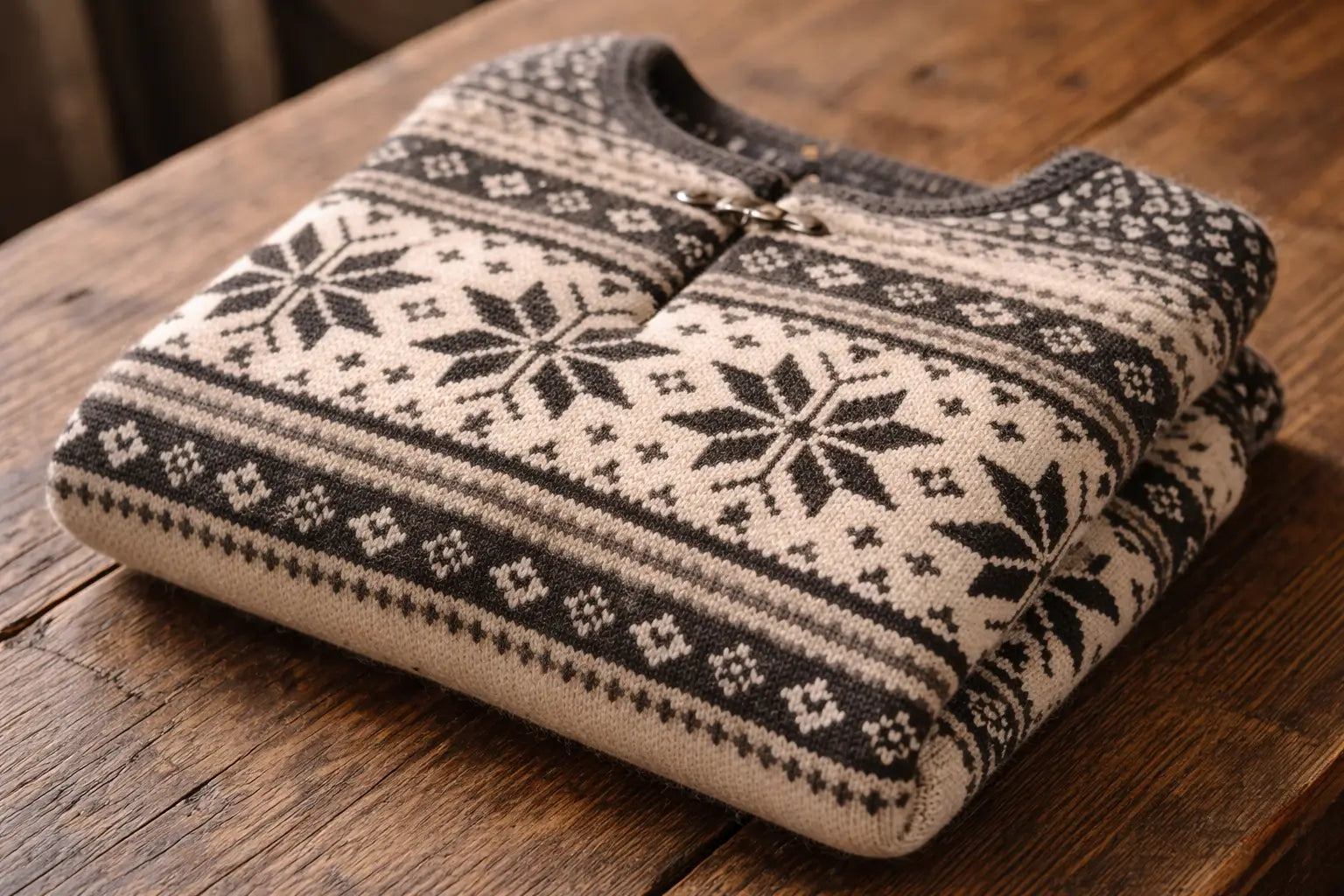
What makes a “Norwegian sweater pattern”?
A “Norwegian sweater pattern” usually means a Nordic-looking, chart-friendly design built around geometric motifs and repeating bands—often knit as stranded colorwork—rather than a single large picture motif.
Key cues (quick checklist):
- Geometric motifs (stars/roses, dots, crosses, stepped borders) arranged in clean repeats
- Strong symmetry and “banded” layouts (yoke motifs, cuff/hem borders, or all-over repeats)
- Stranded colorwork feel (often a limited number of colors per row in traditional-looking styles)
- High contrast palettes (classic looks often use neutrals plus one accent), though modern versions vary
- Motifs that “read” clearly at a distance (repeat size and spacing are consistent)
Keep in mind:
- Online, “Norwegian”, “Nordic”, and “Scandi” are often used loosely; treat these labels as style hints, not strict guarantees of origin.
- Traditional patterns vary by region and era, and modern patterns frequently blend influences.
If you want to search more effectively, learning a few key terms (like “kofte” and “Setesdal”) makes the results far more precise.
Key terms & search keywords: Norwegian vs Nordic + “kofte” + local pattern names
“Kofte” and regional pattern names can help you get closer to the sweater style you actually mean—especially when “Norwegian sweater pattern” results feel too broad.
Search keywords that narrow results fast:
- “kofte” (often used for traditional knit jackets/cardigans; usage varies)
- “lusekofte” (often tied to Setesdal-style “lice” dots)
- “Setesdal”, “Fana”, “Valdres”, “Telemark” (regional style names you’ll see in Norwegian knitting guides)
- “Selbu rose” / “selburose” (the eight-point star/rose motif)
- “Nordic jumper chart” / “Scandinavian colorwork chart” (if you primarily want charts)
- “stranded colorwork” (the technique label, especially when people misuse “Fair Isle”)
Keep in mind:
- A pattern name can describe a look, a region, or a modern designer’s product—so it doesn’t automatically tell you anything about commercial rights.
- The same word can be used differently across sites; use it as a search filter, then confirm details on the actual pattern page.
A quick glossary makes the rest of this guide easier to skim without losing the thread.
Quick glossary: kofte, lusekofte, Setesdal, Selbu rose
- Kofte: commonly used for a traditional knitted jacket/cardigan style in Norwegian knitting context (usage can vary). (Reference overview: https://www.visitnorway.com/typically-norwegian/knitting/)
- Lusekofte: a traditional Norwegian-style sweater/jacket associated with Setesdal, often recognized by small contrasting dots (“lice”) in the pattern. (Reference: https://snl.no/lusekofte)
- Setesdal: a region/style label often connected to lusekofte-type pattern traditions. (Overview: https://www.visitnorway.com/typically-norwegian/knitting/)
- Selbu rose (Selburose): the well-known eight-point star/rose motif often seen in Nordic/Norwegian-style colorwork. (Background motif reference: https://snl.no/%C3%A5ttebladrose)
Now let’s anchor one of the most common sub-queries—lusekofte/Setesdal—so you can recognize it instantly.
Lusekofte / Setesdal sweater: what it is and how to recognize it
A lusekofte is a traditional Norwegian-style sweater/jacket often associated with the Setesdal area, commonly recognized by small contrasting “lice” dots and banded geometric motifs.
Key recognition points:
- The “lice” look: small repeated contrast stitches/dots sprinkled across darker areas (a signature visual cue). (Reference: https://snl.no/lusekofte)
- Banded structure: motifs often appear in horizontal sections rather than random placement
- Many traditional-looking versions are cardigans/jackets (kofte) with distinctive closures, though pullovers exist
- Modern takes may change colors, fit, and motif density while keeping the dot-and-band DNA

Keep in mind:
- “Setesdal sweater” can mean different modern adaptations; treat it as a family resemblance, not a single fixed template.
- Don’t assume every sweater with dots is a lusekofte—confirm the motif layout and context on the pattern page.
Once you know how lusekofte reads visually, the next big unlock is understanding the motif vocabulary—especially the Selbu rose and related shapes.
Motifs 101: Selbu rose and other common Norwegian-style motifs
Norwegian-style patterns are often built from a small motif toolkit—stars/roses, dots, crosses, and stepped borders—arranged in repeats and bands that stay legible across sizes.
Common motif families you’ll see:
- Eight-point star/rose (“Selbu rose” look) used as a repeating emblem or within bands (motif background: https://snl.no/%C3%A5ttebladrose)
- Geometric border bands (stepped lines, chevrons, small crosses, zig-zags)
- Small contrast dots (the “lice” effect in Setesdal-associated looks)
- Mirror symmetry and repeated spacing (helps the sweater read “Nordic” from a distance)
Practical tip for choosing motifs:
- Prefer motifs that look good both close-up and at a distance; tiny high-detail motifs can disappear on darker yarns or at looser gauges.

Keep in mind:
- Motif origin stories can be debated; it’s safer to describe motifs as “commonly associated with” Norwegian/Nordic knitting rather than making strict historical claims.
- Similar stars appear in many cultures; the “Nordic” feel often comes from layout + repetition + palette, not a single shape.
Where you place motifs matters almost as much as which motifs you choose.
Motif placement cheat sheet: yoke vs bands vs all-over
Motif placement is the fastest way to change the “type” of Nordic sweater you’re making—even if you keep the same motif.
Common placement patterns:
- Yoke focus: motifs concentrate around the shoulders/upper chest for a classic “statement” look
- Banded edges: cuffs + hem + sometimes chest bands for a cleaner, wearable everyday style
- All-over repeat: dense pattern coverage for a bold, traditional-inspired feel
Quick decision rules:
- If you want easier outfit pairing, keep motifs concentrated (yoke or bands).
- If you want maximum tradition-inspired impact, use an all-over repeat—but double-check fit and drape expectations.

Keep in mind:
- Placement interacts with sizing: if you grade up/down, motif spacing and seam alignment can shift unless you plan repeats carefully.
- For brand production, placement should be specified as a motif map (where each repeat starts/ends).
Before you choose or label a pattern, it helps to clear up the biggest terminology confusion in this space: Norwegian vs Fair Isle vs “stranded colorwork”.
Norwegian vs Fair Isle vs stranded colorwork
“Stranded colorwork” is the general technique; “Fair Isle” is a specific tradition from Fair Isle in Shetland; and “Norwegian-style” often refers to a Nordic look that may use stranded colorwork but isn’t automatically Fair Isle.
| Term | What it usually means | Typical visual cues | Best label to use when describing your design |
|---|---|---|---|
| Norwegian-style (as used in many pattern searches) | A Nordic look based on geometric repeats and banded layouts; often stranded colorwork | Stars/roses, dots, borders; symmetry; yoke or bands | “Norwegian-style” or “Nordic-inspired stranded colorwork” |
| Fair Isle (the specific tradition) | A named style/heritage linked to Fair Isle in Shetland; a subset of stranded knitting (heritage reference: https://heritagecrafts.org.uk/craft/fair-isle-knitting/) | Often small repeating motifs with distinctive color patterning | “Fair Isle” when the pattern is explicitly in that tradition |
| Stranded colorwork (generic) | The technique of carrying unused yarn behind the work (floats) | Can look like many regional styles | “Stranded colorwork” for technique-focused descriptions |
Keep in mind:
- Many modern patterns blend influences; it’s more accurate to describe (1) technique and (2) motif/layout cues than to force a single regional label.
- If you’re selling or marketing, precise naming helps avoid confusing customers—and can reduce IP risk by not implying association you can’t support.
Now that the terminology is clear, you can focus on the practical part most people came for: where to find patterns and how to choose one confidently.
Where to find Norwegian sweater patterns & charts (free vs paid) + how to choose one
Most “Norwegian sweater pattern” searches are really “I want charts I can trust, in a style I like, in my size.” You can get there faster by choosing the right source type and checking a few details before you commit.
Reliable source types (use these as filters, not endorsements):
- Pattern libraries with searchable categories (often the fastest way to find Nordic jumpers and charts)
- Designer pattern shops (great for a specific aesthetic and support; usually paid)
- Pattern marketplaces/community directories (wide variety; quality varies, read reviews carefully)
- Books focused on Nordic/Norwegian knitting traditions (often strong on motif cohesion and layout)
Before you choose a pattern, verify:
- Size range and how sizes are constructed (especially if you need extended sizing)
- Construction method (yoke vs set-in sleeves; top-down vs bottom-up)
- Chart clarity (is the chart readable and are there notes for color changes?)
- Yarn requirements (fiber type, yardage, and whether substitutes are suggested)
- Usage terms (personal use vs commercial permissions), especially if you plan to sell products
Keep in mind:
- Some high-ranking pages show finished sweaters but do not provide an actual pattern.
- Pattern permissions vary widely; don’t assume “free pattern” means “free to sell products from” unless the terms say so.
If you’re deciding between free and paid sources, a quick “what you get” comparison helps set expectations.
Free vs paid sources: what you get and what to verify
| Source type | What you typically get | What to verify before starting |
|---|---|---|
| Free patterns (libraries/blogs) | Quick access, good variety, sometimes limited support | Clear charts, complete sizing, update history, usage terms |
| Paid designer patterns | Strong sizing/fit work, better support, cohesive design language | License terms, chart format, size inclusivity, yarn substitution guidance |
| Books | Curated motifs and traditional layouts; great inspiration | Construction assumptions, sizing standards, chart readability |
Even if you love the motif, choosing the right construction and difficulty level can make or break the experience.
Pattern choice checklist (difficulty, construction, gauge, sizing)
Use this checklist to avoid the most common “I wish I knew that earlier” problems:
- Difficulty: if you’re newer, prefer 2-color stranded sections and avoid very long floats at first
- Construction: choose yoke for a strong Nordic look; choose banded edges for versatility
- Gauge: confirm the gauge in the pattern and whether the motif looks good at that stitch density
- Sizing: verify finished measurements (not just “size S/M/L”) and ease
- Motif scaling: make sure the main motif repeat doesn’t distort at the widest parts of the body
- If you plan to adapt for production: treat this as concept selection only—you will still need a production spec (repeat size, gauge target, and placement map)
Once you move from “knit for yourself” to “sell products”, the most overlooked topic is rights and licensing—especially for famous named designs.
Commercial use & licensing/IP risk checklist (Marius example)
If you plan to sell products, treat famous named Norwegian-style patterns as potentially protected—some are actively licensed as brands—and verify rights before you commit to a design direction. (Licensing activity example reference: https://www.mynewsdesk.com/bullslicensing/pressreleases/bulls-licensing-appointed-master-agent-for-iconic-norwegian-brand-marius-r-2124677)
A practical risk checklist (not legal advice):
- Is it a named modern pattern/brand (for example, “Marius” is often discussed as a brand/licensing case)? If yes, assume rights may exist and investigate.
- Are you copying a highly distinctive motif layout, not just a generic star or border? The more distinctive, the higher the risk.
- Do you have written permission, a license, or terms that explicitly allow commercial products? If not, don’t assume.
- Can you design an “inspired-by” version that is clearly original (different motif arrangement, different borders, different spacing, different palette), while keeping the Nordic feel?
- Can you document your design process (references, drafts, changes) in case questions arise later?
Keep in mind:
- Licensing and rights questions can vary by country and product category.
- This section is general risk awareness, not legal advice; if commercial stakes are high, consult qualified counsel and/or rights holders.
With rights risk handled, the next big decision drivers are material and color—because the same chart can look completely different depending on fiber and palette.
Yarn/fiber + color planning for the Nordic look (trade-offs)
For Norwegian-style motifs, you usually want a fiber and palette that keep shapes crisp while staying comfortable and durable for the intended use.
Fiber trade-offs (practical, not absolute):
- Wool: often strong for warmth and motif definition; can be more “grippy” for stranded sections, but may itch for some wearers
- Wool blends: can soften handfeel or improve easy-care performance; definition depends on blend and yarn structure
- Acrylic/synthetics: can be cost-effective and easy-care; motif crispness varies and pilling can be a concern depending on yarn quality
- Cotton: breathable but can be heavier and less springy; stranded motifs may behave differently in drape
Color planning tips:
- Start with high contrast for classic motif readability, then soften contrast if you want a modern look
- Limit the number of colors per row if you want fewer float-management issues
- For “Nordic-inspired” without copying: choose a fresh palette and alter border geometry rather than mirroring a famous named layout
Keep in mind:
- “Best fiber” depends on your wearer comfort goals, care requirements, and target price point.
- Always test a swatch (or production sample) for shrinkage, stretch recovery, and how the motif reads after washing.
If you’re developing a product line, this is where the process changes: you’re no longer just choosing a pattern—you’re turning an idea into a manufacturable specification.
For brands: turning “pattern inspiration” into manufacturable knitwear (what changes)
For a brand, a “pattern” is inspiration; production needs measurable inputs (repeat size, gauge target, placement map, sizing, and acceptable tolerances) so sampling can be controlled and repeatable.
What changes when you go from hobby pattern to production:
- Motif becomes a spec: you must define stitch repeat dimensions and where repeats begin/end on the garment
- Gauge becomes a target: production needs a target gauge tied to your yarn choice and fit requirements
- Sizing needs grading logic: motifs may need adjustment across sizes so spacing stays consistent
- Technique matters: the same look can be achieved differently (jacquard vs intarsia vs embroidery/print) depending on complexity and cost targets
- QC becomes explicit: alignment, distortion, and repeat consistency must be checked on samples and monitored in bulk

Keep in mind:
- Feasibility depends on yarn availability, gauge, motif complexity, and how many colors appear per row.
- Sampling is essential; assume you will refine the spec after the first sample feedback.
To make sampling efficient with any manufacturer (including XTCLOTHES), a clear tech pack is the single highest-leverage document you can provide.
Tech pack steps for OEM/ODM sampling (what to send a factory)
To turn a Norwegian-style motif idea into a sample-ready request, you need to translate “what it should look like” into “how it should be made” in a way a production team can execute consistently.
Step-by-step (brand-ready, practical):
- Define your reference: include photos/sketches and label which elements are must-have vs flexible
- Create a motif map: mark motif zones (yoke/bands/all-over) and where patterns must align (center front, sleeve joins, side seams)
- Provide the repeat: define the stitch repeat size (width/height in stitches) and how it tiles across the garment
- Specify colors: list yarn colors (names/IDs) and how many colors appear per row in patterned sections
- Specify yarn/fiber: fiber blend, yarn count/weight, and handfeel goals (soft vs rugged)
- Set gauge targets: stitch and row gauge targets for the main body and any rib structures
- Define measurements: size chart, grading rules, and intended ease
- Detail trims and labels: closures (if any), neck/cuff/hem finishes, labels, packaging requirements
- Define care expectations: target care instructions and testing expectations (shrink, colorfastness where relevant)
- Plan approvals: agree what must be approved on the first sample (fit, motif clarity, alignment, handfeel), and what can be adjusted later

Keep in mind:
- If a motif is too dense, too small, or uses many colors per row, you may need to simplify or change technique to hit your target price and quality goals.
- Treat the first sample as a learning cycle; revise the tech pack based on actual sample behavior.
A copy-and-paste field checklist makes it easier to send a complete inquiry without back-and-forth.
Tech pack field checklist (motif map, sizes, materials, trims)
Include these fields in your request to reduce sampling loops:
- Reference images + notes (must-have vs flexible)
- Motif placement map (front/back/sleeves) with alignment requirements
- Motif chart or vector + stitch repeat size and tiling rules
- Color palette (including which colors appear together per row)
- Yarn/fiber spec + handfeel target
- Gauge targets (body + ribs) and acceptable tolerance ranges (if you have them)
- Size chart + grading rules + intended ease
- Construction notes (yoke type, sleeve type, rib structure)
- Trims/closures (buttons/clasps/zipper if applicable) and label/packaging needs
- QC checkpoints to confirm on samples (alignment, distortion, repeat consistency)
- Target ship window and quantities (avoid fixed promises; this supports planning)
Once the spec is clear, technique choice becomes a decision about feasibility and the exact look/handfeel you want.
Technique choice for production: jacquard vs intarsia vs embroidery/print
Norwegian-style motifs can be produced multiple ways; the best choice depends on whether the motif is repeating, how many colors appear per row, and how important stretch/handfeel is to your product.
| Technique | Best for | Watch-outs | When to choose it |
|---|---|---|---|
| Jacquard (knit-in patterning) | Repeating geometric motifs, banded layouts, many Nordic looks | Float management, potential bulk on the inside, tension consistency | When you want the motif truly knitted into the fabric with classic texture |
| Intarsia | Large placed motifs with clean color blocks | More complex joining, less ideal for tiny all-over repeats | When the motif is a few big shapes rather than repeated small patterns |
| Embroidery | Adding motif detail on top of a base knit | Can change drape/handfeel; thread durability and snag risk | When you need sharp detail or want to simplify the knit structure |
| Visual motif without knit-in structure | Does not replicate the true knit texture of stranded motifs | When the visual look matters more than traditional knit texture |
Keep in mind:
- Technique choice changes the inside finish, stretch behavior, and how “authentic” the knit texture feels.
- If you need a very traditional stranded look, jacquard-style knit-in methods are often closer than print—but sampling is the only way to confirm the final handfeel.
Even with the right technique, patterned sweaters fail most often on QC details—alignment, distortion, and consistency.
QC & common mistakes for patterned sweaters (mistake → prevention checklist)
Most “Nordic motif” quality issues are predictable; you can prevent them by checking the right things early and often.
Common mistakes and how to prevent them:
- Misaligned motifs at seams or sleeve joins → define alignment points in the motif map and inspect alignment on the sample laid flat
- Puckering/distortion in high-contrast areas → control tension, avoid overly long floats, and confirm gauge stability after wash/relaxation
- Motifs that look “squashed” or “too busy” → adjust repeat scale or spacing; confirm readability at intended viewing distance
- Inconsistent repeat size across panels → standardize repeat rules and verify panel measurements before assembly
- Color mismatch between batches → lock color references early and verify swatches before bulk runs
- Fit changes after washing → test wash/relaxation behavior during sampling, not after bulk is made
Keep in mind:
- Some issues appear only after washing or relaxation; include at least one care-cycle test during sampling.
- QC criteria should be written down (what counts as acceptable vs reject) so the team is aligned.
If you want quick answers to the most common questions people ask while searching, the FAQ below is designed to be skimmed in under two minutes.
FAQ
-
What defines a Norwegian sweater pattern?
Typically: geometric motifs in repeats, banded or yoke layouts, and a “Nordic” symmetry that works well with charts and stranded colorwork. -
What is a lusekofte (Setesdal sweater)?
A traditional-style sweater/jacket associated with Setesdal and often recognized by small contrasting “lice” dots and geometric bands. (Reference: https://snl.no/lusekofte) -
What is the Selbu rose motif?
A well-known eight-point star/rose motif commonly associated with Nordic/Norwegian-style colorwork aesthetics. (Background motif reference: https://snl.no/%C3%A5ttebladrose) -
What’s the difference between Norwegian patterns and Fair Isle?
“Fair Isle” is a specific tradition; “Norwegian-style” is often used as a style label; “stranded colorwork” is the general technique. (Heritage reference: https://heritagecrafts.org.uk/craft/fair-isle-knitting/) -
Where can I find Norwegian sweater patterns and charts?
Look for pattern libraries, designer pattern shops, marketplaces, and books; prioritize clear charts, sizing details, and readable terms of use. -
How do I turn inspiration into a tech pack?
Define motif placement, repeat size, gauge targets, sizing/grading, yarn spec, and QC checkpoints—then confirm via sampling and revise the spec from real sample feedback. -
Can I sell products with the Marius pattern?
Treat famous named patterns as potentially protected and verify rights before selling; licensing programs exist for some iconic brands. (Example reference: https://www.mynewsdesk.com/bullslicensing/pressreleases/bulls-licensing-appointed-master-agent-for-iconic-norwegian-brand-marius-r-2124677) -
What are common mistakes in Norwegian-style patterned sweaters?
Misalignment, distortion/puckering, inconsistent repeats, and post-wash fit changes—most can be prevented with a motif map, controlled gauge, and early wash/relaxation testing.
Summary + send-to-manufacturer checklist + next steps
A “Norwegian sweater pattern” search gets easier when you (1) use the right vocabulary (kofte/Setesdal/Selbu), (2) recognize the motif families and placement styles, and (3) label technique accurately (stranded colorwork vs Fair Isle).
Send-to-manufacturer checklist (copy/paste):
- Reference images + notes (must-have vs flexible)
- Motif placement map + alignment rules
- Motif chart/vector + stitch repeat size and tiling rules
- Color palette + colors-per-row constraints
- Yarn/fiber spec + handfeel targets
- Gauge targets (body + ribs)
- Size chart + grading rules + intended ease
- Construction notes (yoke/bands/all-over; sleeve type; rib structures)
- Trims/closures + labels/packaging requirements
- QC checkpoints for sample approval (alignment, distortion, repeat consistency)
- Quantities and target ship window (acknowledging variability)
If you’re developing a Norwegian/Nordic-inspired sweater for your brand and want sampling support, sharing a complete tech pack (or even a draft plus reference images) helps a manufacturer quote and prototype more accurately.
To start a conversation with XTCLOTHES (OEM/ODM knitwear):
- Send: your design/tech pack, target quantities, target ship window, preferred yarn/fiber, size range, and any motif/placement notes.
- If you don’t have a full tech pack yet: send reference images and tell us which details are non-negotiable (motif layout, palette, fit) so we can help you structure the spec for sampling.
