
Roll Neck Sweater Pattern Guide: How the Rolled Collar Works + Fit & Spec Checklist
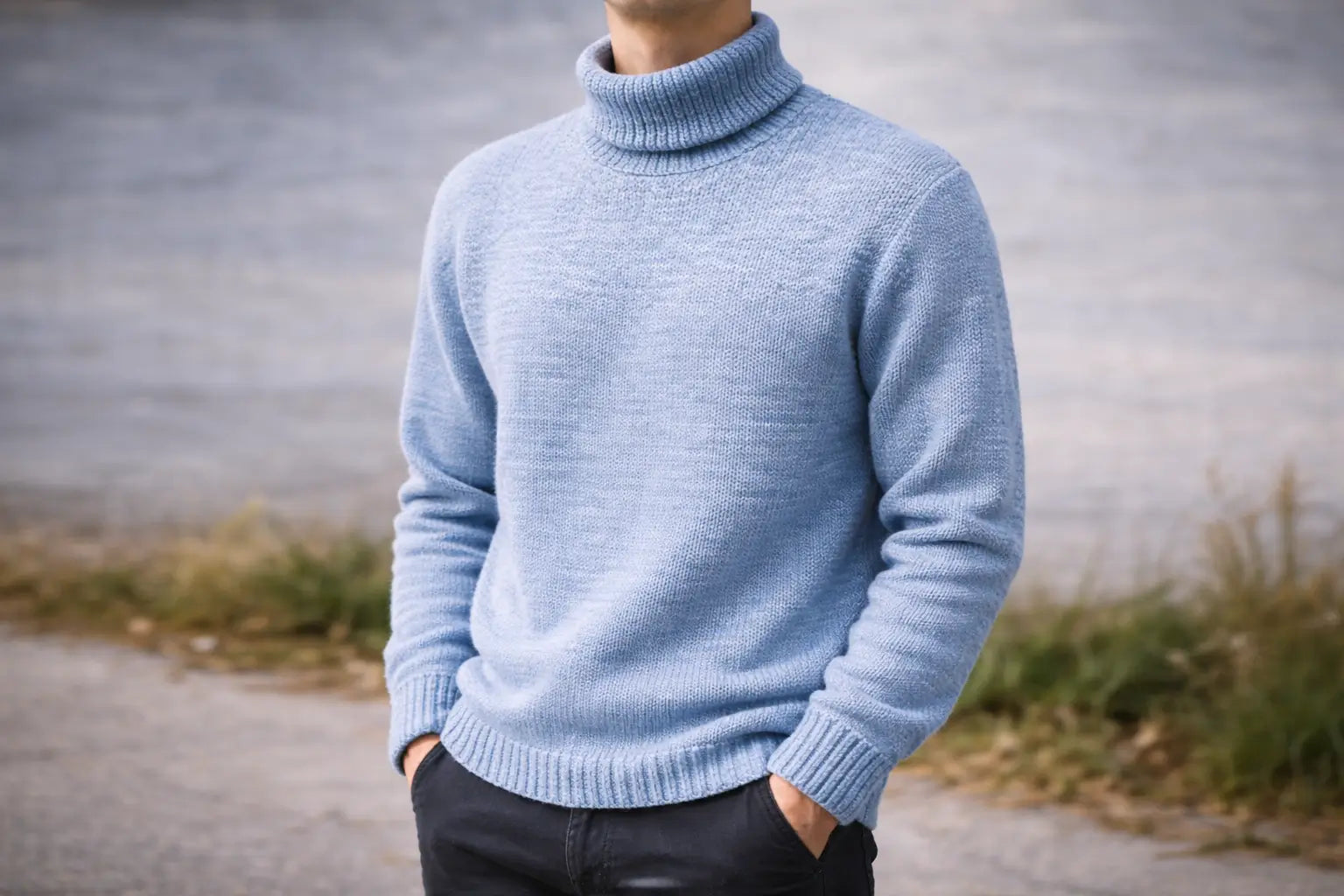
If you searched “roll neck sweater pattern,” you’re probably trying to get one thing right: that clean, intentional roll at the neckline—without a collar that chokes, flares, or rolls the “wrong” way.
This guide is not a downloadable knitting pattern. Instead, it explains how the roll-neck effect works, what controls it (gauge, yarn stiffness, length, stitch choice), how to adjust comfort and fit, and—if you’re a brand or designer—what to include in a sample-ready brief for a knitwear manufacturer.
Roll-neck “pattern” essentials (what makes the roll + what to control)
A roll neck is created either by (a) a high collar that folds/rolls over in fashion terminology, or (b) a collar edge that rolls naturally because of fabric behavior (common in knitting patterns). The look is controlled mostly by stitch structure, gauge, yarn stiffness, and collar length.
Key points:
- What makes the roll: stockinette/jersey-style fabric tends to curl, which creates a natural roll at the edge. (Source: S5)
- What controls roll size: tighter gauge and stiffer fabric usually create a smaller, firmer roll; looser gauge and softer fabric make a larger, softer roll. (Sources: S1, S5)
- What controls direction: which side of the fabric faces out (knit vs purl side) and how the collar edge is built. (Source: S5)
- What controls comfort: neckline opening + collar height + a bind-off/edge finish that keeps stretch. (Sources: S3, S4, S6)
- For brands: write the roll as measurable targets (neck opening, collar height, desired roll direction/height) and verify on the sample. (Source: S8)
Boundary conditions:
- There is no universal “correct” stitch count for a neckline—pick-up frequency depends on your gauge and the edge you’re picking up from. (Sources: S3, S4)
- Final behavior changes with yarn, finishing, and washing/blocking. (Sources: S5, S6)
Now let’s define what “roll neck” means (and what it’s not), so you choose the right construction.
What is a roll neck sweater?
A roll neck sweater is a sweater with a high neck area that creates a rolled/rolled-over collar appearance—either as a folded tube (common in general fashion definitions) or as a deliberately rolled edge finish (common in knitting pattern language). (Source: S7)
Roll neck vs turtleneck vs ribbed/folded collars
If you want a sleek, structured neck: go ribbed or folded. If you want a softer, casual, “relaxed” neck edge: a roll-neck finish often gets you there with fewer structural elements.
Key points:
- Ribbing adds stability and stretch recovery (often reduces rolling).
- Folded collars look clean and stable but can feel bulkier.
- A rolled edge looks effortless, but it’s more sensitive to gauge/yarn/finishing.
Comparison table:
| Collar type | How it’s made | Look | Comfort & stretch | Best for |
|---|---|---|---|---|
| Roll neck (rolled edge) | Stockinette/jersey-like collar that curls naturally | Soft, casual, “effortless” roll | Can feel comfy, but can also tighten if the opening is small | Minimalist sweaters, relaxed styling |
| Turtleneck / fold-over tube | Tall tube that folds over itself | Classic, structured, warm | Warm; can feel tight if collar circumference is too small | Cold weather, layering |
| Ribbed neckband | Rib stitch neckband | Clean neckline, less curl | Good stretch/recovery | Everyday sweaters, stable finish |
| Folded neckband | Knit double length and fold/sew/bind down | Cleanest, most stable | Can add bulk; usually comfortable if sized well | Premium finish, “tidy” neckline |
Boundary conditions:
- In everyday fashion language, “roll-neck” can be used similarly to “turtleneck/polo neck,” but knitting patterns may use “roll neck” to mean a rolled edge finish. (Source: S7)
- Comfort depends on neckline opening and yarn feel; always verify on the wearer. (Sources: S2, S6)
Once you choose the collar style, the next step is understanding why the collar rolls—and how to control it.

Why does a roll-neck collar roll?
A roll-neck collar rolls because some knit fabrics (especially stockinette/jersey) curl at the edges due to how knit and purl stitches balance tension across the fabric. (Source: S5)
The simple mechanism: why stockinette curls
Stockinette tends to curl because the stitch structure pulls the fabric in different directions at the edges, making the edge curl instead of lying flat. (Source: S5)
Key points:
- Curling is “normal” fabric behavior, not a mistake.
- Ribbing and garter/seed stitches resist curling more than stockinette because they balance tension differently. (Source: S5)
How to use this (instead of fighting it):
- If you want a strong, clean roll: use a consistent stockinette-like collar fabric, keep the edge simple, and tune gauge/yarn.
- If you want less roll: introduce ribbing, garter/seed details, or a folded/structured finish.
Boundary conditions:
- Finishing/blocking and washing can relax or tighten curl behavior depending on fiber and construction. (Sources: S5, S6)
Curl explains the “why.” Next, let’s control direction and roll size so it looks intentional.
Controlling roll direction (outward vs inward)
The roll direction is mainly determined by which side of the fabric you present outward and the balance of stitches at the edge; a collar can appear to roll “inward” if the purl side is ending up outward or if the fabric is turning toward the side with greater pull. (Source: S5)
Key points:
- If your collar rolls inward unexpectedly, it’s usually a fabric-orientation or edge-structure issue, not “bad luck.”
- Small changes in stitch pattern at the edge can flip or tame the roll.
Practical controls:
- Choose the “face” deliberately: decide whether you want knit-side-out or purl-side-out visual texture.
- Add a tiny transition detail (e.g., a few rounds/rows) if you need to “steer” the roll (test on swatch first).
Boundary conditions:
- Outcomes depend on yarn stiffness and gauge; what works in one yarn may behave differently in another. (Sources: S1, S5)
Direction is one thing—roll size and firmness is another. Let’s cover the control levers next.
What makes the roll tighter/looser (gauge, yarn, finishing)
Roll tightness is mostly about fabric stiffness: tighter gauge and stiffer yarns usually make a firmer, smaller roll; looser gauge and drapier yarns make a softer, larger roll. (Sources: S1, S5)
Key points:
- Tight gauge → firmer roll, but can feel tighter around the neck.
- Loose gauge → softer roll, but may flare or collapse.
- Collar length also matters: longer collars can create a bigger roll.
Boundary conditions:
- Always verify with a swatch; the same “yarn weight” category can vary across yarns. (Source: S1)
With the roll behavior understood, the next decision is choosing a pattern construction you can fit and adjust confidently.

Choosing a roll neck sweater “pattern style” (without a roundup)
The best roll neck sweater pattern is the one whose construction matches how you like to fit garments: top-down helps you try on early; bottom-up can be more predictable for some shaping—but you’ll typically try on later.
Top-down vs bottom-up: which makes neckline adjustments easier?
Top-down patterns generally make neckline and collar adjustments easier because you can try on early and adjust collar depth and opening while you knit. (Source: S6)
Key points:
- Top-down: early try-on, easier incremental changes.
- Bottom-up: stable planning, but changes may come later.
Mini decision table:
| Approach | Why it’s useful | Watch-outs |
|---|---|---|
| Top-down | Adjust collar height and neckline opening earlier | You still need to keep good records for repeats/sizing |
| Bottom-up | Stable planning for body/sleeves | Fit changes may require more rework later |
Boundary conditions:
- “Easier” depends on your comfort with measuring and checking gauge. (Sources: S3, S6)
Construction sets your workflow; next is sleeve style (raglan vs set-in) and how it affects fit and finishing.
Raglan vs set-in sleeves: fit and finishing trade-offs
Raglan often pairs well with top-down because shaping is continuous; set-in sleeves can look sharper but require more finishing precision.
Key points:
- Raglan: simpler shaping flow, often easier to try on.
- Set-in: tailored shoulder line, often more seaming/precision.
Boundary conditions:
- The neckline/collar behavior still depends on collar construction and fabric choice, regardless of sleeve type.
Once you’ve picked a build style, the real make-or-break is the neckline opening and pick-up strategy.
Fit & comfort: neckline opening, pick-up stitches, collar depth
A comfortable roll neck depends on measurable fit targets (neckline opening and collar height) and a pick-up method that matches your gauge—there’s no single “magic number” of stitches.
Measure first: what to record (neck opening + collar height)
Before you knit the collar, decide your target neckline opening (circumference) and collar height, then use those targets during try-on or sample checks. (Source: S2)
Key points:
- Neckline opening controls “choking vs gaping.”
- Collar height controls warmth and the visual roll size.
- For consistency (multiple sizes or repeats), write these as measured specs, not vibes.
Boundary conditions:
- Body sizing charts can guide measurement names and points, but you still need garment measurements and wearer preference. (Source: S2)
Once you know what you’re aiming for, the next step is picking up stitches evenly—without waviness or holes.

Pick up stitches evenly (method-first; no universal stitch counts)
The cleanest roll-neck collars come from even pick-up spacing and a pick-up frequency based on your stitch gauge vs row gauge—often expressed as a ratio, not a single fixed number. (Sources: S3, S4)
Key points:
- Knit fabrics are not “square”: rows and stitches differ, so you usually don’t pick up 1 stitch per row along vertical edges. (Sources: S3, S4)
- Ratio thinking prevents waviness (too many stitches) and tight puckering (too few stitches).
Step list:
- Measure your stitch gauge and row gauge on the fabric you actually knitted (not the ball band). (Source: S3)
- Identify the edge type you’re picking up from (bind-off edge, cast-on edge, vertical edge, shaped neckline edge). (Source: S3)
- Mark the neckline into quarters (or more sections) so your pick-ups distribute evenly.
- Use a ratio approach for vertical edges (examples like “3 stitches for 4 rows” may appear in tutorials; your exact ratio depends on your gauge). (Sources: S3, S4)
- Pick up with consistent spacing; avoid “clumping” multiple pick-ups in one small area unless shaping requires it.
- Knit 1–2 rounds/rows and try on early (or test stretch) before committing to full collar height.
- If it’s too tight or too wavy, adjust immediately—small changes early are cheaper than rework later.
Boundary conditions:
- The correct ratio depends on your gauge and the edge structure; treat examples as starting points, not rules. (Sources: S3, S4)
- Some neckline shaping (short rows, decreases) changes the edge geometry—expect to adapt.
After pick-up, collar depth and bind-off decide whether it feels great or feels restrictive.
Setting collar depth/height so it’s comfortable
Start with a conservative collar height, try on, then extend—especially in top-down sweaters—because comfort is easier to validate than to predict. (Source: S6)
Key points:
- Shorter collar: less warmth, often less restrictive.
- Longer collar: warmer, larger roll, but more likely to feel tight if the opening is small.
How-to (practical workflow):
- Knit a short collar segment, then do a quick try-on test.
- Adjust by changing collar length and/or the neckline opening (by revisiting pick-up count).
Boundary conditions:
- Yarn elasticity and finishing affect how “clingy” the collar feels. (Sources: S1, S6)
Even with perfect height, a tight bind-off can ruin comfort. Let’s fix that next.
Bind-off comfort: keep stretch and avoid “choking” feel
A collar must stretch over the head and sit comfortably at the neck, so prioritize a stretchy edge finish and avoid over-tightening your last row. (Sources: S4, S6)
Key points:
- Tight bind-off = collar feels smaller than intended.
- A slightly stretchier finish often improves comfort without changing the look.
Boundary conditions:
- Different stitch patterns and yarns behave differently; always test stretch before finalizing.
Now that you can build a comfortable collar, let’s cover common variations like ribbing and neckline conversions.
Variations: ribbing, raglan finishes, and converting other necklines
You can combine ribbing and roll-neck styling, but ribbing naturally resists rolling—so the more ribbing you add, the less “roll” you’ll see.
Can you add ribbing and still keep a roll-neck look?
Yes, but you usually need to limit ribbing length or place it strategically so the rolled edge remains visible.
Key points:
- Ribbing stabilizes edges (less curl). (Source: S5)
- A hybrid approach can keep comfort and still show a roll.
Common options:
- Short ribbing at the base (for stretch), then switch to stockinette/jersey to create the roll.
- Mostly stockinette collar with minimal structural detail to guide the roll.
- If you want a “clean” collar without roll unpredictability, consider a folded neckband instead. (Source: S6)
Boundary conditions:
- The visual result is sensitive to gauge and collar length—swatch first.
If you’re starting from a different neckline, you’ll need a safe conversion plan.
Converting a crew neck to a roll neck (high-level)
A crew-to-roll conversion is mainly a neckline opening and collar-fabric decision: you either pick up and knit a stockinette collar designed to roll, or you restructure the neckline for a fold-over style.
Key points:
- Keep neckline opening comfortable before adding height.
- Treat the first attempt as a prototype and keep notes.
High-level steps:
- Verify the current neckline opening is comfortable.
- Decide whether you want a natural rolled edge (stockinette) or a fold-over tube.
- Pick up stitches evenly using ratio thinking. (Sources: S3, S4)
- Knit a short collar, try on, then adjust.
Boundary conditions:
- Conversions can change the way the neckline sits; validate on the wearer or sample.
With variations handled, the next big lever is yarn and gauge—because fabric behavior drives the roll.
Yarn & gauge choices: structured roll vs soft drape
Yarn weight categories and typical gauge ranges are standardized in many craft references, but your specific yarn and gauge choice determines roll stability, warmth, and comfort. (Source: S1)
How yarn weight and stitch density change roll stability and warmth
The roll is more stable in fabrics that have enough stiffness to hold shape; it’s softer and more “collapsed” in drapier fabrics.
Key points:
- Stiffer fabric → defined roll.
- Drapier fabric → larger, softer roll, but can feel less controlled.
- Tightening gauge increases structure but may reduce comfort at the neck.
Boundary conditions:
- Fiber content and finishing/washing can change stiffness substantially. (Sources: S5, S6)
Here’s a simple decision table for matching your goal to yarn/gauge tendencies.
Decision mini-table: goal → yarn/gauge tendency → trade-offs
Choose yarn and gauge based on the look you want to repeat consistently, not just what’s available.
| Your goal | Tendency that helps | Trade-offs |
|---|---|---|
| Small, crisp roll | Slightly tighter gauge, more structured yarn | Can feel tighter; less drape |
| Bigger, softer roll | Slightly looser gauge, drapier yarn | May flare/collapse; less crisp |
| Stable neckline with minimal roll | Ribbing or structured finishing | Less “rolled edge” look |
Boundary conditions:
- Always swatch the collar area if the roll is the main visual feature. (Sources: S1, S5)
If you change yarn weight, you must re-check more than you think—here’s the short list.
If you change yarn weight: what else must be re-checked
Any yarn change can alter gauge, fabric thickness, and roll behavior—so re-check gauge, neckline opening, and collar length.
Key points:
- Re-check stitch and row gauge. (Source: S3)
- Re-check neckline opening stretch (comfort).
- Re-check collar height to get the same roll size.
- Re-check finishing/wash behavior if you care about repeatability. (Source: S6)
Boundary conditions:
- Yarn weight categories are helpful labels, but yarn-to-yarn variation is real. (Source: S1)
Yarn and gauge set fabric behavior—now let’s set sizing and ease so it feels right on a body.
Sizing & ease: choosing comfort on a roll neck sweater
Ease is the difference between body measurement and garment measurement, and it affects both comfort and how the collar “reads” visually on the wearer. (Source: S2)
What “ease” means in practice (and why it matters for neck comfort)
Too little ease can make a roll neck feel restrictive; too much ease can make the neckline sit wide and reduce warmth.
Key points:
- Close fit: cleaner silhouette, but collar comfort becomes more sensitive.
- Relaxed fit: easier wear, but neckline can sit wider.
Boundary conditions:
- Preferred ease is style-dependent; use body sizing charts as a vocabulary reference, then validate with actual garment measurements. (Source: S2)
The easiest way to avoid mistakes is to focus on a few key measurement points.
Measurement priorities: chest/bust + neckline opening + collar height
For roll neck comfort, prioritize measurements that control fit and neck feel: chest/bust (overall ease), neckline opening (circumference), and collar height. (Source: S2)
Key points:
- Chest/bust drives overall ease.
- Neck opening drives comfort at the neck and over-the-head wearability.
- Collar height drives roll size and warmth.
Boundary conditions:
- Different constructions (raglan vs set-in) change how the sweater sits; measure consistently.
Here’s a quick table to choose ease based on your fit goal.
Mini-table: fit goal → ease tendency → collar comfort notes
Choose ease that matches the wearer’s tolerance for neck height and closeness.
| Fit goal | Ease tendency | Collar comfort note |
|---|---|---|
| Close/clean | Lower–moderate ease | Ensure neck opening is generous enough for comfort |
| Standard everyday | Moderate ease | Balanced warmth and movement |
| Relaxed/oversized | Higher ease | Neckline may sit wider; collar may feel less “snug” |
Boundary conditions:
- This is guidance, not a guarantee—measure the garment and test comfort. (Source: S2)
Even with good planning, things can go wrong. Let’s fix the most common roll-neck failures fast.
Troubleshooting: common roll-neck mistakes and fixes
Most roll-neck problems come from one of three causes: too many/few stitches picked up, a fabric behavior mismatch (gauge/yarn), or an edge/finishing choice that changes stretch.
Symptom → likely cause → fix (quick reference)
Use the table below to diagnose the fastest fix—then decide whether it’s a small adjustment or worth redoing.
Troubleshooting table:
| Symptom | Likely cause | Fix |
|---|---|---|
| Collar rolls inward (wrong side showing) | Fabric orientation / edge structure pulls the opposite way | Flip orientation choice; test a small edge change; swatch collar fabric. (Source: S5) |
| Neckline is wavy | Too many stitches picked up | Reduce pick-up frequency; use ratio approach based on gauge. (Sources: S3, S4) |
| Neckline is tight / choking | Too few stitches, tight bind-off, or too-tight gauge | Increase pick-up count slightly; use stretchier edge finish; re-check gauge |
| Holes at pick-up edge | Picking up in the wrong place or inconsistent spacing | Pick up through a consistent edge structure; distribute evenly. (Source: S3) |
| Collar flares out | Too loose gauge or too many stitches | Tighten gauge slightly or reduce stitch count; shorten collar length |
| Collar feels stiff/scratchy | Yarn/finishing choice | Change yarn or finishing; verify after wash/finish where applicable |
Boundary conditions:
- Some issues can be fixed by reworking just the collar; others require re-picking up stitches. (Sources: S3, S4)
Prevention is easier than repair—here’s the short checklist before you start the collar.
Prevention checklist (before you start the collar)
A few setup habits prevent most roll-neck mistakes.
Risk checklist:
- Swatch the collar fabric if the roll is the hero feature. (Source: S5)
- Measure stitch gauge and row gauge on the actual fabric. (Source: S3)
- Mark neckline sections so pick-up spacing stays even.
- Try on early (or stretch test) after 1–2 rounds/rows.
Boundary conditions:
- If you’re producing for multiple sizes, keep written notes for repeatability.
If you’re a brand or designer, the next step is turning “pattern intent” into a sample-ready brief you can send to a manufacturer.
For brands & designers: turn a “pattern idea” into a sample-ready brief
A sample-ready brief turns the roll-neck look into measurable, verifiable targets—so the factory can develop a sample with fewer rounds of back-and-forth. (Source: S8)
The sample brief checklist (grouped)
If you can only send one packet to start sampling, make it: reference images + measurement spec (incl. neck opening + collar height) + fabric targets (yarn, gauge, hand-feel). (Source: S8)
Key points:
- Photos alone are not enough for repeatability.
- Measurements and fabric targets are what make the look manufacturable.
Checklist:
1) Reference + intent
- 2–6 reference photos (front/side/inside collar if possible)
- Fit intent: close vs standard vs relaxed (tie to ease)
2) Measurement spec (core)
- Chest/bust width (garment measurement)
- Body length
- Sleeve length
- Neckline opening circumference
- Collar height (finished)
- Notes on desired roll direction/height
3) Fabric targets
- Yarn composition target (or “factory to propose,” if you’re open)
- Stitch density target (gauge) and hand-feel goal (soft/structured)
4) Construction notes
- Raglan vs set-in
- In-the-round vs seamed
- Collar finish: rolled edge vs ribbed vs folded
5) Trims/branding
- Labels, hangtags, packaging preferences (if applicable)
Boundary conditions:
- Roll behavior is fabric-dependent; even with a clear brief, you still validate on the physical sample.
A brief is strongest when each spec item has a “why” and a “how to verify.” Use the table below.
Spec table: spec item → why it matters → how to verify on sample
The fastest sampling cycles happen when specs are measurable and the approval criteria are explicit.
| Spec item | Why it matters | How to verify on sample |
|---|---|---|
| Neck opening circumference | Comfort + over-the-head wearability | Measure + try-on test; check stretch and recovery |
| Collar height (finished) | Roll size + warmth | Measure finished height; photo match vs reference |
| Collar finish type | Controls roll predictability | Confirm stitch structure, edge behavior, and look |
| Gauge / stitch density | Controls fabric behavior and roll firmness | Measure stitch & row count on sample fabric |
| Yarn/fiber target | Controls hand-feel and stiffness | Hand-feel check; wash/finish check if relevant |
| Ease target | Controls silhouette + neckline sit | Compare garment measurements vs fit intent |
Boundary conditions:
- If you don’t know the yarn yet, you can still define the “feel goal” and confirm options in sampling. (Source: S8)
Once the brief is ready, the next step is confirming the sampling workflow and approval checkpoints with your manufacturer.

What to confirm with your knitwear manufacturer before sampling
Before sampling, confirm who owns which decisions (OEM vs ODM), what the approval criteria are, and how changes will be handled—so you don’t lose time in unclear revisions. (Source: S8)
Before sampling: responsibility + approvals + evaluation criteria
A good pre-sample alignment is: responsibilities (who provides specs), materials approval steps, and clear evaluation criteria for collar behavior and comfort.
Key points:
- Responsibility: OEM (you provide specs) vs ODM (factory supports development) - Yarn/material selection process: proposal, approval, substitutions
- Collar evaluation criteria: neck opening, collar height, roll direction/firmness, hand-feel
- Change control: what counts as a revision vs a new version
Boundary conditions:
- Feasibility and timelines depend on design complexity and material availability—avoid fixed promises. (Source: S8)
After the sample arrives, your approval checklist determines whether bulk will match what you saw.
During sample approval: measurement checks + collar behavior checks + trims confirmation
Approve the sample using measurable checkpoints, not just “looks good,” especially for roll neck collars.
Key points:
- Measurement verification: key garment points + tolerances you can live with
- Collar behavior checks: roll direction, roll size, comfort during wear
- Post-finish behavior: if finishing/wash is part of the product, re-check after it. (Source: S6)
- Labels/packaging placement confirmation (if applicable)
Boundary conditions:
- If the collar behavior changes after wash/finish, adjust fabric targets or construction details before bulk.
After workflow alignment, a short CTA can help you start sampling with fewer rounds of revision.
Need a sample or quote for a roll-neck sweater?
Send your reference images + a measurement spec (include neckline opening + collar height) + your yarn/fabric target (even provisional)
If you have a tech pack, include it. If you don’t, start with the checklist above and your target quantity and ship date. (Services such as OEM/ODM knitwear manufacturing, sampling/bulk production, labels/packaging, and logistics/customs support are described as part of a one-stop offer on the XTCLOTHES site; specifics can vary by design and destination.) (Source: S8)
FAQ
What is a roll neck sweater?
A roll neck sweater is a high-neck sweater style that creates a rolled or fold-over collar appearance; in knitting patterns, it can also mean a collar that rolls naturally due to fabric curl. (Sources: S5, S7)
Key points:
- Fashion usage may overlap with turtleneck/polo neck terminology.
- Knitting usage often focuses on the rolled edge behavior.
Boundary conditions:
- Confirm the intended construction in the pattern description (rolled edge vs fold-over tube).
If you’re deciding between roll neck and turtleneck, use the comparison below.
What’s the difference between a roll neck and a turtleneck?
A turtleneck usually describes a taller collar designed to sit high and often fold over, while a roll-neck in knitting can refer to a collar that rolls naturally at the edge (or a similar fold-over style in general fashion language). (Source: S7)
Key points:
- Turtleneck: more structured warmth.
- Rolled edge: softer, more casual, more dependent on fabric behavior.
Boundary conditions:
- Terminology varies; check the construction details.
If you want the “rolled edge” look, the next question is why it rolls and how to control direction.
Why does the collar roll (and why does it sometimes roll inward)?
The collar rolls because stockinette/jersey-like knit fabric curls at edges; it may roll “inward” if the fabric orientation or edge structure pulls the opposite way from what you expected. (Source: S5)
Key points:
- Curl is normal fabric behavior.
- Small changes in orientation, gauge, or edge detail can change direction.
Boundary conditions:
- Yarn and finishing can change curl behavior.
If your issue is comfort or fit, focus on neckline opening and pick-up strategy.
How many stitches should I pick up around the neckline for a roll neck?
There isn’t one correct number—your pick-up count should be based on your gauge and the edge you’re picking up from, often using a ratio mindset (stitch gauge vs row gauge) to avoid waviness or tightness. (Sources: S3, S4)
Key points:
- Use measured stitch and row gauge.
- Distribute pick-ups evenly (mark quarters).
Boundary conditions:
- Shaped necklines and different edges need different approaches.
If you’re adding ribbing or converting a neckline, stitch choice becomes the next lever.
Can you add ribbing and still keep a roll neck look?
Yes—keep ribbing short or place it at the base, then switch to stockinette/jersey so the edge can roll; long ribbing will usually reduce rolling. (Source: S5)
Key points:
- Ribbing stabilizes.
- Stockinette encourages rolling.
Boundary conditions:
- Gauge and collar length affect the visual result; swatch first.
For comfort, the next decision is ease and neckline opening.
How do you choose size and ease for a roll neck sweater so it’s comfortable?
Choose ease based on the intended silhouette, then verify neckline opening and collar height for comfort—those two measurements often decide whether a roll neck feels cozy or restrictive. (Source: S2)
Key points:
- Close fit needs more attention to neck opening.
- Relaxed fit may widen the neckline sit.
Boundary conditions:
- Preferences vary; always measure and try on when possible.
If you’re producing this as a brand, translate these choices into a spec sheet.
If I’m making this for a brand, what measurements and specs should I send a knitwear manufacturer for sampling?
Send reference photos plus a measurement spec that includes neckline opening circumference and collar height, and include fabric targets (yarn direction, stitch density/gauge, hand-feel). (Source: S8)
Key points:
- Measurable targets reduce revisions.
- Verify each spec on the physical sample.
Boundary conditions:
- Exact outcomes depend on yarn, gauge, and finishing—confirm in sampling.
For best results, also confirm the sampling workflow and approval checklist before you start.
Summary + next steps
A roll neck look is a fabric-and-fit problem, not a mystery: control stitch structure, gauge, yarn stiffness, collar length, and neckline opening.
Key points (recap):
- Define the collar type first (rolled edge vs fold-over).
- Use fabric behavior (curl) intentionally instead of fighting it.
- Fit comes from neckline opening + collar height (verify early).
- Use ratio thinking for pick-up stitches; don’t chase universal stitch counts.
- For brands: convert the look into specs + a verify-on-sample checklist.
Always validate on a swatch or sample—roll behavior is fabric-dependent.
