
Striped Sweater Knitting Pattern Guide: Choose a Style, Swatch Right, Knit Clean Stripes
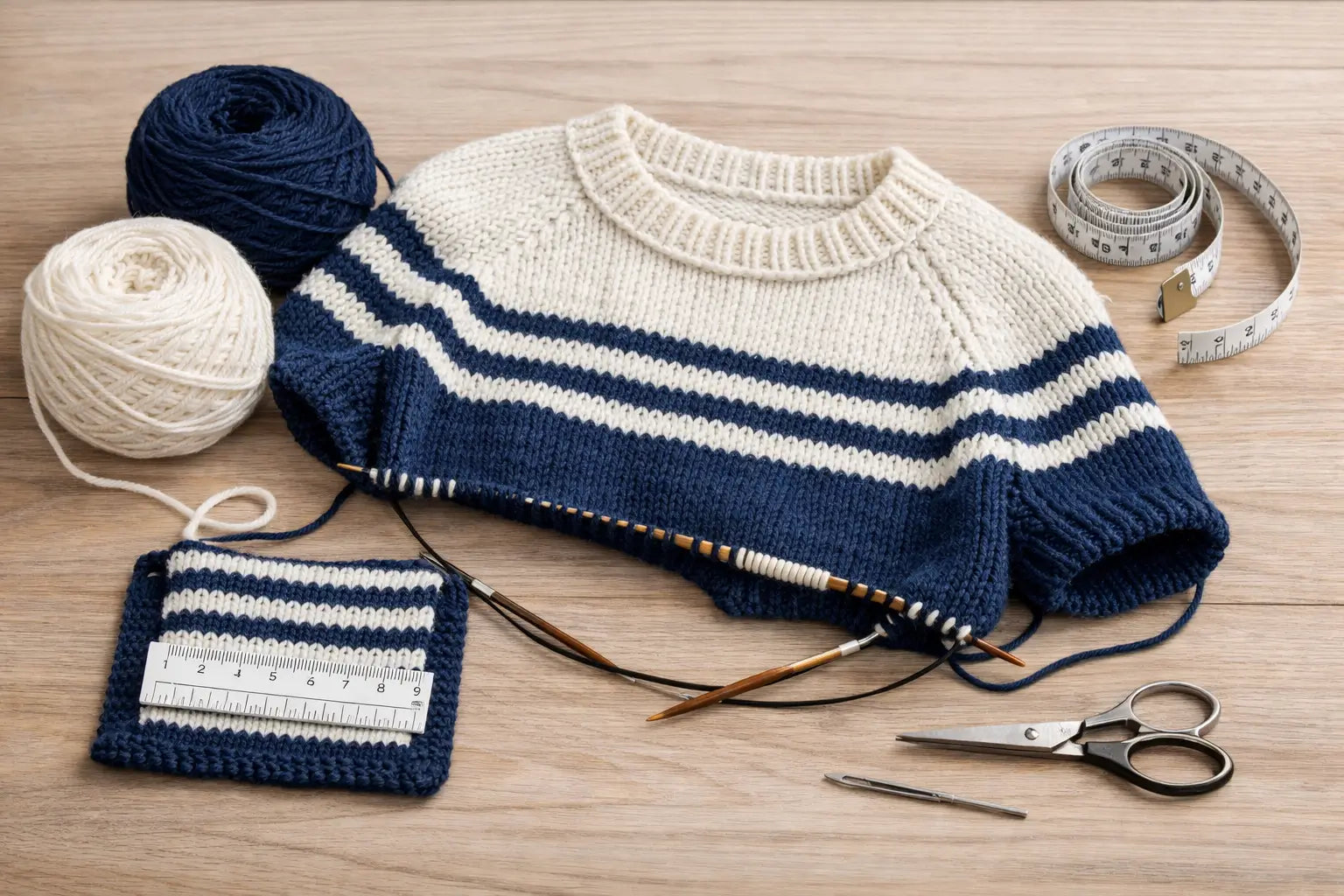
Knitting a striped sweater is mostly the same as knitting any sweater… until the stripes start affecting tension, alignment, and finishing. This guide helps you choose a striped sweater pattern style (even if you haven’t picked a specific pattern yet), swatch in a way that predicts fit, knit clean stripes (including jogless stripes in the round), plan a simple stripe map, and troubleshoot the most common stripe problems.
Note: Fit and fabric can vary with yarn, needles, technique, and blocking. Treat this as practical guidance, not a guarantee.
Striped Sweater Success Checklist (Do This First)
- Choose a sweater construction (top-down or bottom-up; seamless or seamed).
- Pick two (or more) yarn colors that are the same weight and have similar care needs.
- Swatch with both colors (stripes can change your tension).
- Decide your stripe approach: cut yarn each stripe (cleanest edges) or carry yarn (fewer ends).
- If knitting in the round, choose a jogless stripe method before you start.
- Make a quick stripe map (stripe sequence + where stripes start/stop on body and sleeves).
- Knit, block, then re-check key measurements (chest, body length, sleeve length).
Jump to:
- Swatching for stripes
- Jogless stripes in the round
- Stripe map template
- Troubleshooting table
How to Choose a Striped Sweater Knitting Pattern (Beginner → Advanced)
You don’t need the “perfect” pattern—just a construction that matches how much adjusting, finishing, and stripe alignment you want.
Pick a construction that matches your goals
If you want to try it on as you go:
- Choose top-down (often raglan or yoke). Easy to adjust length.
If you care about perfectly matching stripes at seams:
- Choose a seamed sweater (knit pieces flat, then seam). Seams make alignment more controllable.
If you want fewer finishing steps:
- Choose seamless in the round (but plan for jogless stripes).
If you’re a beginner:
- A simple top-down raglan or drop-shoulder in a medium yarn weight is usually easiest to fit and modify.
Choose size and ease without guessing
Ease = the difference between your body measurement and the sweater’s finished measurement at the chest.
Positive ease (sweater larger than body) is common for pullovers.
- For stripes, moderate ease often looks cleaner because the fabric isn’t stretched so much that stripe lines distort.
Quick tip: Measure a sweater you already like (flat, not stretched) and compare that to the pattern’s finished measurements.
Yarn + Color Choices for Crisp, Clean Stripes

Stripes look best when both colors behave similarly in the fabric.
The best yarn traits for stripes
Look for:
- Same yarn weight for all stripe colors (mixing weights can cause wavy edges).
- Good stitch definition (plenty of plies, not overly fuzzy) if you want sharp lines.
- Similar fiber / similar care across colors (reduces uneven growth or shrink after washing).
- High contrast for bold stripes; closer tones for subtle stripes.
Avoid (or test carefully):
- One color that’s much slipperier or stretchier than the other.
- Extremely fuzzy yarns if you want crisp edges (they can blur stripe boundaries).
- Yarns with very different wash behavior across colors (can change gauge unevenly).
Choosing stripe colors (contrast + bleed risk)
High-contrast stripes can sometimes show dye transfer in the first washes, depending on yarn and dye. To reduce surprises:
- Swatch, then wash the swatch the way you’ll wash the sweater.
- If you’re nervous about bleeding, wash the swatch with a plain white cloth and see if color transfers.
- Consider a slightly lower contrast combo if you want a softer, more forgiving look.
Swatching for a Striped Sweater (So It Actually Fits)
Stripes can change tension because you’re switching colors, carrying yarn, or tightening at joins.
Swatch for stripes: step-by-step
- Use the needles you plan to use for the sweater body.
- Cast on enough stitches to measure gauge in the middle (a too-small swatch lies).
- Knit a few rows in Color A, then introduce Color B and knit stripes (even simple 2–4 row stripes is enough).
- If the sweater will be seamless, consider swatching in the round (or simulate it) because many knitters’ tension changes in the round.
- Knit until the swatch is tall enough to measure row gauge comfortably.
- Wash and block the swatch the way you’ll treat the finished sweater (don’t skip this).
- Let it dry fully, then measure gauge in the center: stitches and rows per the pattern’s measurement unit.
- If you’re off gauge, adjust needle size and repeat (small changes matter).
If your gauge changes between colors (what to do)
If Color A looks looser/tighter than Color B:
- Try a different needle size (or a different hand tension) when switching colors.
- If carrying yarn, ensure the carried strand isn’t too tight (tight carries can pucker stripes).
- Check that both yarns are truly the same weight and behave similarly after washing.
How to Knit Stripes Neatly (No Holes, No Messy Joins)
Clean stripes are mostly about consistent tension at color changes.
Clean color changes (do/avoid)
Do:
- Keep a consistent routine for switching colors at the same point each stripe.
- Give the new color a gentle snug on the first stitch to close gaps—without pulling tight.
- Neaten the “turn” area if knitting flat (edge tension matters for stripes).
Avoid:
- Pulling the first stitch of the new color too tight (causes puckering and uneven gauge).
- Letting the old color hang so loose that a gap forms at the join.
Carry yarn vs cut yarn (how to reduce ends)
Carry yarn if:
- Stripes are frequent (short stripe heights).
- You want fewer ends to weave in.
- You can keep the carry tension relaxed and tidy.
Cut yarn if:
- Stripes are wide (long gaps between colors).
- You care most about a clean inside finish without long carries.
- You’re working in the round and want simpler tension control.
Tip: If carrying yarn, periodically stretch the fabric on the needle to ensure the carry isn’t tightening the circumference.
Jogless Stripes in the Round (Simple Method)
What causes the “jog”?
In the round, each round begins slightly above the previous one. When you change colors, that step creates a visible “jog” where the stripe meets.
Jogless stripes: step-by-step (simple method)
This is a simple, widely used approach for single-round transitions between colors:
- Knit to the end of the round in Color A.
- Switch to Color B and knit one full round.
- At the start of the next round, lift the stitch below the first stitch of the round and knit it together with the first stitch (or use a similar “blend” step at the boundary).
- Continue knitting the round normally in Color B.
- Repeat the same boundary behavior each time you introduce a new stripe color.
- After a few stripes, check the boundary line—your goal is a less noticeable step, not absolute invisibility.
- Block the finished sweater; blocking often improves stripe transitions.
When to use:
- Best for simple, repeating stripes where you want the boundary to look smoother without adding complicated structure.
Note: There are multiple jogless methods. If the boundary still bothers you, try a different method (some work better depending on yarn and stitch pattern).
Stripe Planning That Looks Balanced (Stripe Map Template)
What is a stripe map?
A stripe map is your written plan for stripe sequence and placement—what color goes where, how wide each stripe is, and how stripes line up on body and sleeves.
A simple stripe-map method (body + sleeves)
- Decide your stripe repeat (example: A/B/A/B) and stripe height (rows per stripe).
- Pick “anchor points” that matter:
- Hem ribbing end
- Underarm join
- Start of yoke shaping (if any)
- Plan where stripes should land at those anchors (especially underarm and sleeve start).
- For sleeves, decide whether you want stripes to:
- Match the body at the underarm, or
- Run independently (simpler, often fine visually)
- Write it down before you cast on.
Stripe Map Template (fill-in)
Body
- Ribbing: ______ rows (Color ____)
- Stripe sequence: __________________________________
- Stripe height: ______ rows each (or list varying heights)
- Key anchors:
- Hem to underarm: ______ rows total
- Underarm to yoke/top: ______ rows total
- Notes (contrast ribbing? neckline color?): ___________________________
Sleeves
- Cuff ribbing: ______ rows (Color ____)
- Stripe sequence: __________________________________
- Stripe height: ______ rows each
- Key anchors:
- Cuff to underarm: ______ rows total
- Matching rule:
- ☐ Match body at underarm
- ☐ Doesn’t need to match (independent stripes)
How to match stripes on sleeves and body
- Seamed sweaters: You can align stripes by counting rows on each piece before seaming.
- Seamless sweaters: Use your stripe map and count rows from a consistent anchor (like the underarm) for both body and sleeves.
- If exact matching creates stress, choose visual consistency over perfection—most people won’t notice small offsets.
Troubleshooting Uneven Stripes (Tension, Jogs, Weird Lines)
Quick fixes table: symptom → likely cause → fix
| Symptom | Likely cause | Quick fix | Prevent next time |
|---|---|---|---|
| Stripes look wavy or “smile/frown” | Different yarn weights or tension shift at color change | Re-swatch with both colors; adjust needle size | Use same weight yarns; practice relaxed color change |
| One color stripe is taller/shorter | Row gauge changes between colors | Block and re-measure; consider needle change by color | Swatch with stripes; keep consistent tension |
| Puckering where yarn is carried | Carry strand too tight | Stretch fabric on needle; loosen carry | Carry loosely; space out carries |
| Visible holes at color change (flat knitting) | Loose first stitch of new color | Snug first stitch gently; tidy edge | Consistent join routine |
| Obvious jog in the round | Standard round join step | Use a jogless method | Build boundary technique into stripe routine |
| Stripes don’t align at seams | Row counts differ between pieces | Block pieces; re-count rows; adjust before seaming | Track row counts; use stripe map |
When to block first vs rip back
- Block first if the issue is mild and likely tension-related—blocking can smooth a lot.
- Rip back if stripe placement is wrong (landed badly at underarm/yoke) or carries are tight enough to distort the fabric.
Finishing + Care for Striped Sweaters (Blocking, Measuring, Washing)

Blocking basics
- Soak or wash as appropriate for the yarn (follow yarn label guidance).
- Remove excess water gently (no aggressive wringing).
- Lay flat and shape to measurements (don’t overstretch).
- Let dry fully.
- Re-measure key points: chest, body length, sleeve length.
First wash precautions for high-contrast stripes
- Wash the first time separately if you’re worried about dye transfer.
- Avoid dramatic temperature swings.
- If you saw any transfer on your swatch test, be extra gentle on early washes.
FAQ – Striped Sweater Knitting Pattern Questions
What’s the easiest striped sweater knitting pattern for beginners?
A simple top-down raglan or drop-shoulder pullover is often easiest because you can try it on as you go and adjust length. Choose a pattern with straightforward shaping, a clear size chart, and minimal finishing. Stripes add complexity, so keep everything else simple.
Do I need to swatch for a striped sweater?
Yes—especially for stripes. Switching colors can change your tension and make the fabric wider or narrower than expected. A striped swatch helps you predict sizing, check color behavior, and confirm you like the stripe look before committing.
Should I swatch in the round for a seamless sweater?
If your sweater will be seamless, swatching in the round (or simulating it) can be more accurate. Many knitters’ tension differs between flat and circular knitting. At minimum, include color changes in your swatch.
How do you avoid the jog in stripes?
Use a jogless stripe method at the round boundary. The goal is to “blend” the step created by circular knitting so the stripe transition looks smoother. Try a simple boundary adjustment method and confirm the look after a few repeats and blocking.
How do you change colors without holes?
Keep the first stitch of the new color gently snug and consistent each time you switch. Holes usually come from loose joins or inconsistent edge tension. Practice your join routine on a swatch and stick to the same method throughout.
Can I carry yarn instead of cutting every stripe?
Yes, especially for frequent stripes. Carrying yarn reduces ends, but you must keep the carry strand relaxed so it doesn’t pucker the fabric. If stripes are wide, cutting yarn is often cleaner and avoids long carries.
Why do my stripes look uneven?
Common causes are tension changes between colors, mismatched yarn weights, or tight carried yarn. Re-swatch with both colors, check needle size, and block the fabric before judging. If one color behaves differently, you may need to adjust technique or materials.
What yarn is best for crisp stripes?
Yarns with consistent thickness and good stitch definition usually show crisp stripes best. Using the same yarn base (same weight and similar fiber/care) for both colors reduces wavy edges and uneven gauge after washing.
How do I plan stripe widths and placement?
Make a stripe map: decide stripe sequence, stripe height, and which “anchor points” matter (hem, underarm, yoke). Planning prevents stripes from landing awkwardly at shaping points and helps sleeves look intentional.
How do I match stripes on sleeves and body?
Use a shared anchor (often the underarm) and count rows from that point for both body and sleeves. Seamed sweaters make matching easier because you can align pieces during assembly. Seamless sweaters need a clear stripe map and row tracking.
How do I block a striped sweater?
Wash/soak as appropriate, lay flat, shape to measurements, and let dry completely. Blocking helps even out tension differences between stripes and improves overall drape. Always measure after blocking for the most realistic fit check.
How do I prevent color bleeding?
Test on a swatch first, wash gently at first, and avoid harsh agitation or hot/cold shocks. Some yarns are more prone to transfer than others; the swatch wash test is the safest way to know what to expect.
For Brands/Designers: Spec a Striped Sweater for Production (Optional)
If you’re just knitting at home, you can skip this section. If you’re turning a striped sweater design into a sellable product, the biggest win is translating “stripe idea + fit intent” into a factory-ready spec.
Stripe map spec checklist (factory-ready fields)
Include:
- Stripe sequence (e.g., A/B/A/B), stripe heights, and where stripes start/stop
- Placement anchors (hem, underarm, yoke, neckline)
- Matching rules (must match at side seams? at sleeve underarm?)
- Color codes (Pantone/TCX or your internal color IDs)
- Stitch pattern notes (jersey, rib, texture panels) and whether stripes apply everywhere
Measurement spec + grading checklist
Include:
- Target fit description (slim/regular/oversized)
- Size range and grading logic (how measurements change by size)
- Points of measure (POM) list (chest, body length, sleeve length, bicep, cuff, etc.)
- Tolerance approach (set by the brand; confirm during sampling)
BOM checklist (materials + trims + labels + packaging)
Include:
- Yarn: fiber blend, yarn count/weight, supplier preference (if any), colorways
- Trims: labels, care label requirements, hangtags (if used)
- Packaging: polybag, folding method, size sticker rules (if applicable)
What to send for sampling (and where xtclothes can help)
To request sampling support, prepare:
- Reference images or sketches (front/back/sleeve)
- Stripe map + measurement spec (even a simple version is better than none)
- Target size range and quantities (approximate is fine at first)
- Material preferences and handfeel goals
- Target shipping window (note: timelines depend on design and sampling iterations)
XTCLOTHES services are positioned around OEM/ODM knitwear manufacturing, sampling, bulk production, custom labels/packaging, and logistics/customs support (as described in project configuration).
Summary
To knit a striped sweater you love:
- Pick a pattern construction that matches your goals,
- Choose compatible yarns and test them,
- Swatch with stripes,
- Use a jogless method if knitting in the round,
- Plan a stripe map,
- Troubleshoot with a simple symptom/cause/fix mindset.
If you’re developing a striped sweater as a product, start with a clear stripe map, measurement spec, and BOM—then move into sampling with a manufacturer.
