
Sweater and Jeans Outfit Ideas: 12 Easy Formulas + Proportion Rules
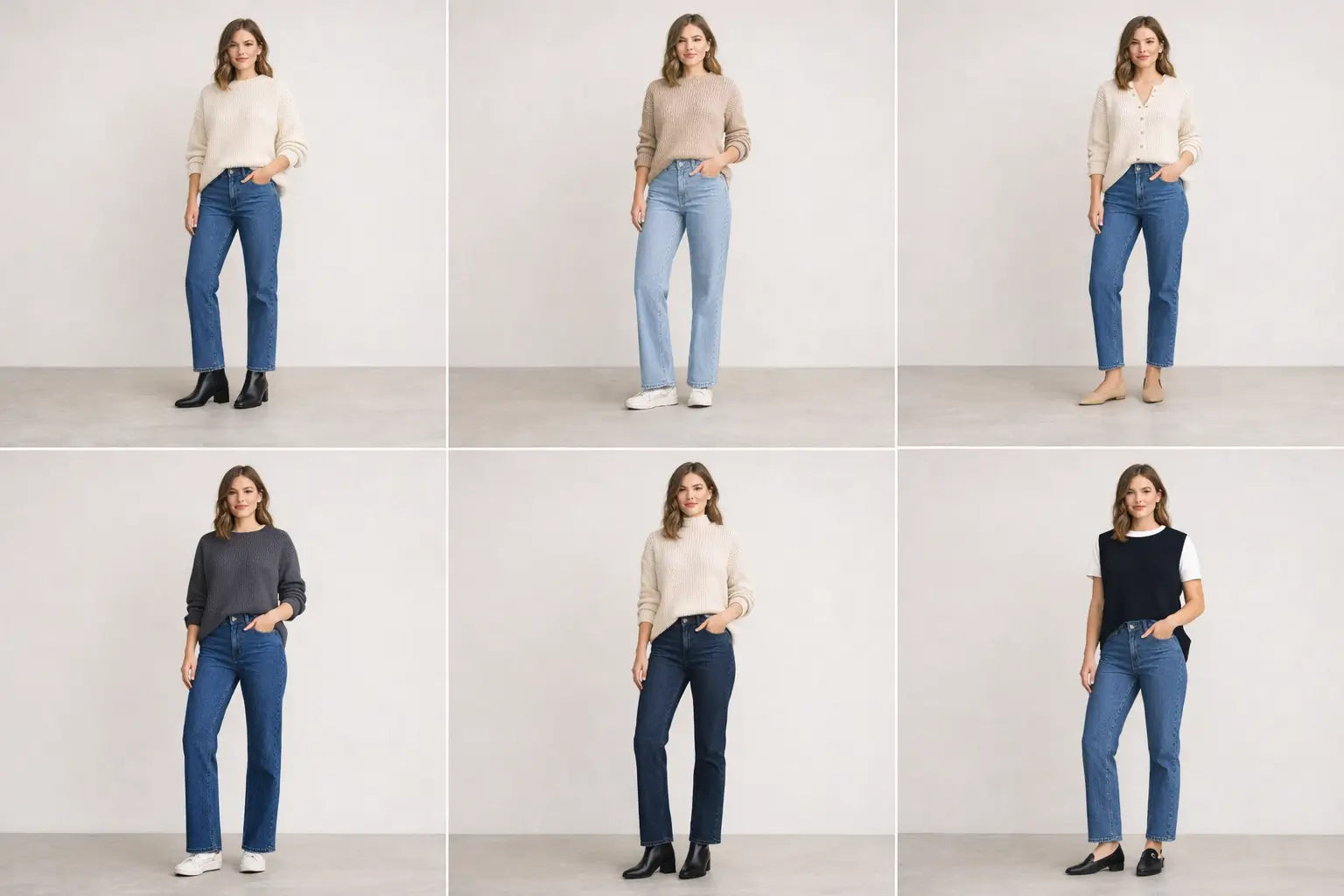
A sweater + jeans outfit is basically a cheat code: it can read cozy, cool, polished, or work-appropriate depending on just a few choices (fit, hem, shoes, and one layer).
This guide is built so you can copy an outfit formula in 10 seconds—and also understand why it works, so you can remix it for your body, your closet, and your day.
Why the sweater + jeans combo works (and how to make it look intentional)
A sweater-and-jeans outfit looks intentional when the silhouette has a clear “shape” (waist placement, balanced volume) and the finishing pieces match the vibe (shoes + outerwear).
Key points
- Start with one clear silhouette choice: fitted top + relaxed jeans or relaxed sweater + cleaner jeans.
- Use the waistline on purpose: cropped length, a partial tuck, or a belt = instant polish.
- Match the “weight” of your shoes to your jeans hem (chunky shoes with wide hems, sleek shoes with tapered hems).
- Add one structured layer when you want it to look less casual (blazer, trench, tailored coat).
Boundary conditions / caveats
- The same outfit can look different depending on jean rise and sweater thickness.
- Climate and dress code matter as much as style.
If you want the fastest version of all that, the next section is a copy/paste shortcut.
5 proportion rules + 3 go-to outfits
Use these five rules to make almost any sweater-and-jeans outfit look balanced, then steal one of the three default outfits if you don’t want to think.
Key points (mini-table)
| Quick rule | What to do | Why it works |
|---|---|---|
| 1) Balance volume | If the sweater is roomy, keep jeans cleaner (straight/slim). If jeans are wide, keep sweater shorter or more defined. | Prevents the “all-over bulk” look |
| 2) Place the waist | Cropped hem, French tuck, belt, or a structured layer that hits at the waist/hip | Creates shape without trying hard |
| 3) Match sweater length to rise | Higher rise = easier with cropped/hip-length sweaters; lower rise = better with longer hems or an open layer | Keeps proportions from feeling “cut off” |
| 4) Fix the hem + shoe relationship | Wide hems like chunkier shoes; skinny/straight can go sleek; avoid pooling unless it’s intentional | Makes the outfit look finished |
| 5) Upgrade with structure | Add a blazer, trench, or tailored coat when you want “smart casual” | Instantly raises the formality |
3 go-to outfits
- Go-to #1 (everyday): crewneck sweater + straight-leg jeans + sneakers + optional baseball cap
- Go-to #2 (polished casual): cardigan + high-rise straight jeans + loafers + belt
- Go-to #3 (dressier): fitted turtleneck + dark jeans + ankle boots + long coat
Boundary conditions / caveats
- Chunky knits don’t always tuck cleanly—use a partial tuck or belt trick instead.
- If your workplace is strict, stick to darker denim + cleaner knits.
Now that you’ve got defaults, let’s build a full menu of outfit formulas you can rotate all week.
12 sweater and jeans outfit formulas to copy (casual → smart-casual)
The easiest way to style sweaters with jeans is to repeat proven formulas: sweater type + jean fit + shoe + optional layer.

Key points
- Each formula below has: what to wear + a quick why it works + an easy swap.
- If something feels “off,” don’t change everything—swap one piece (shoe, hem, or outer layer).
Casual formulas (weekend, errands, travel)
-
Oversized crewneck sweater + straight-leg jeans + sneakers
Why it works: relaxed top + classic leg = easy balance.
Swap: add a baseball cap or a crossbody bag for “off-duty” polish. -
Cropped sweater + high-rise wide-leg jeans + low-profile sneakers
Why it works: cropped hem puts the waist in the right place for wide legs.
Swap: add a denim jacket for an extra casual layer. -
Cardigan (buttoned as a top) + mom/relaxed jeans + flats
Why it works: cardigan gives shape; relaxed jeans keep it easy.
Swap: half-tuck or add a belt if you want more waist definition. -
Lightweight knit + light-wash straight jeans + retro sneakers
Why it works: light-on-light reads fresh and casual.
Swap: add a pop-color bag or scarf.
Polished casual (coffee dates, dinners, “put together” days)
-
Turtleneck + straight-leg jeans + ankle boots
Why it works: sleek neckline + clean denim = sharp silhouette.
Swap: add a long coat for instant structure. -
V-neck sweater layered over a crisp shirt + straight jeans + loafers
Why it works: the collar adds detail and the loafers signal “smart casual.”
Swap: cuff the jeans once to show the ankle. -
Boxy sweater + dark-wash jeans + pointed flats/boots
Why it works: darker denim reads dressier; pointed shoes lengthen the line.
Swap: add simple jewelry (small hoops, a watch). -
Long cardigan + slim-straight jeans + knee-high boots
Why it works: long top works best when the leg is cleaner.
Swap: belt the cardigan (or belt your jeans) to prevent “drapey” vibes.
Smart-casual (office-friendly in many dress codes)
-
Fine-knit sweater + black jeans + loafers + blazer
Why it works: fine knit + blazer keeps the look structured.
Swap: switch loafers to heeled boots if you want it dressier. -
Fitted sweater + flare jeans + heeled boots
Why it works: fitted top balances the flare; heels elongate.
Swap: add a trench for an extra “grown-up” layer. -
Monochrome sweater + jeans (same color family) + sleek boots
Why it works: low-contrast reads elevated and intentional.
Swap: add one statement accessory (belt, bag, scarf). -
Sweater vest over a tee + straight jeans + loafers/sneakers
Why it works: vest adds structure without bulk.
Swap: switch the tee to a button-down for a preppier version.
Boundary conditions / caveats
- If you’re petite or have a short torso, you’ll usually prefer slightly shorter sweaters or a partial tuck.
- If a sweater is very chunky, keep at least one other element “clean” (jeans or shoes).
To make these formulas look great on you, proportions matter more than buying new stuff—so let’s lock in the rules.
Proportion rules: sweater length, jean rise, and tuck options (polished-not-basic)
The most flattering sweater-and-jeans outfits come down to two decisions: where the waist sits (rise + hem) and how volume is distributed (sweater shape vs jean shape).
Key points
- Higher rise makes it easier to wear cropped or tucked sweaters.
- Lower rise often looks better with longer hems or an open layer (cardigan/coat) to create vertical lines.
- If your outfit looks “boxy,” define the waist or clean up the leg line (don’t try to fix everything at once).

Sweater length × jean rise quick guide
| Jean rise | Sweater length that’s easiest | Tuck strategy | Common mistake to avoid |
|---|---|---|---|
| High rise | cropped to hip-length | French tuck or full tuck (thin knits) | Too much fabric stuffed in (bulk) |
| Mid rise | hip-length | partial tuck or belt + “blouse” | Hem hitting the widest hip point without shape |
| Low rise | hip-length to tunic | no-tuck or very light partial tuck | Cropped sweater + low rise creating awkward proportions |
Boundary conditions / caveats
- Thick, chunky knits rarely full-tuck well—use partial tucks or belts.
- Comfort matters. If a tuck feels fussy all day, pick a sweater length that works untucked.
You don’t need a perfect tuck—just the right tuck for the sweater’s thickness.
Tuck methods: full tuck vs French tuck vs no-tuck (when to use each)
Choose your tuck based on sweater thickness and how much waist definition you want; the goal is a clean line, not a perfectly flat front.
Key points
- Full tuck: best for thin, fine knits (and higher-rise jeans).
- French tuck: a partial front tuck that defines the waist while staying relaxed. (Definition: Cambridge Dictionary.) (dictionary.cambridge.org)
- No-tuck (intentional hem): best when the sweater length already hits well or when layering (open cardigan/coat).
Steps (quick how-to)
- Full tuck (thin knits): tuck evenly, then gently pull a little fabric back out so it doesn’t look strained.
- French tuck: tuck just the center-front (1–3 inches), leave the sides/back loose, then smooth the waistband area.
- No-tuck: set the hem on purpose—either slightly cropped, or long enough to create a clean vertical line.
Boundary conditions / caveats
- If fabric bunches at the waist, stop and switch strategies (partial tuck, belt, or no-tuck).
- If you sit a lot (desk day), partial tucks are usually more comfortable.
If your outfit still feels “off,” it’s usually one of a few fixable issues—here’s the quick diagnostic list.
Common mistakes + quick fixes (the “why does this look off?” checklist)
Most sweater-and-jeans outfits look “wrong” for one of three reasons: bulk at the waist, competing volumes, or mismatched hem + shoe.
Key points
- Change one variable at a time (hem, shoe, or layer) so you can see what’s actually fixing it.
- Your first “fix” should usually be waist definition or hem cleanup.
Checklist: mistake → fix
- Sweater looks too long → try a French tuck, add a belt, or switch to a shorter sweater.
- Outfit looks boxy → pair oversized sweater with straighter jeans, or wide jeans with a shorter/more defined top.
- Waist looks bulky → avoid full tuck with thick knits; use partial tuck or belt-under-sweater trick.
- Jeans bunch at the ankle → cuff once, hem (if possible), or switch shoes to match the opening.
- Wide-leg jeans look heavy → choose a shorter sweater or add structure (blazer/trench).
- Skinny jeans feel dated → keep the sweater modern (cropped/boxy) and use current shoes (loafers/boots).
Boundary conditions / caveats
- Some “mistakes” are preference—if you like a slouchy look, lean into it with intentional shoes and simple accessories.
If you’re bored of the combo, you don’t need a whole new outfit—one swap changes everything.
2-minute upgrades (make it more interesting with one swap)
Pick one upgrade (texture, structure, or contrast) so the sweater-and-jeans outfit reads styled—not accidental.
Key points (quick upgrade menu)
- Add structure: blazer, trench, tailored coat.
- Add contrast: darker denim with a light knit (or vice versa).
- Add a focal point: belt, bold shoes, statement bag, or a collar peeking out.
- Add texture: cable knit + smooth denim, or fine knit + slightly rigid denim.
Boundary conditions / caveats
- If the occasion is casual, keep upgrades simple (one statement max).
Once proportions are clear, the easiest “choose-your-own-adventure” is picking jeans based on sweater type.
Sweater type → best jeans (oversized, cropped, cardigan, turtleneck)
Start with your sweater silhouette, then choose jeans that balance it—either by keeping the leg clean or by clearly defining the waist.
Key points
- Oversized sweater = usually best with straight or slim-straight jeans.
- Cropped sweater = easiest with high-rise straight or wide-leg jeans.
- Cardigan = flexible; buttoned = more defined, open = more relaxed.
- Turtleneck = naturally sleek, so it can carry bolder jeans (wide/flare) if you want.

Sweater type → jeans match table
| Sweater type | Best jeans | Also works | Avoid if you don’t want bulk |
|---|---|---|---|
| Oversized/relaxed | straight-leg, slim-straight | skinny, tapered | super wide-leg + long oversized hem |
| Cropped | high-rise straight, high-rise wide-leg | flare | low-rise (can feel “cut off”) |
| Cardigan (buttoned) | straight-leg, mom/relaxed | wide-leg | extremely baggy top + baggy jeans |
| Cardigan (open) | slim-straight, skinny | straight | very wide-leg unless waist is defined |
| Turtleneck/fitted | straight, flare, wide-leg | skinny | none (it’s usually the easiest top to balance) |
Boundary conditions / caveats
- Chunky knits amplify volume; keep either jeans or shoes cleaner to balance.
- Rise changes everything—higher rise makes cropped/tucked looks much easier.
If you prefer starting from your jeans (because denim is the consistent piece), this next mapping is the fastest decision tool.
Jean fit → best sweaters (straight, wide-leg, skinny, flare)
Pick sweaters based on the jean silhouette: wide jeans need waist/hem clarity, while cleaner jeans can handle more sweater volume.
Key points
- Straight jeans are the most flexible: they work with nearly any sweater shape.
- Wide-leg jeans look best with shorter hems or a defined waist.
- Skinny jeans look freshest with modern sweater shapes (boxy, cropped, or structured layers).
- Flare jeans love fitted tops and heeled boots for a long line.
A quick fit note: Levi’s describes straight jeans as “the same width at the knee and at the leg opening,” which is why they’re so easy to pair with different tops. (levi.com)
Jeans fit → sweater match table
| Jeans fit | Best sweaters | Best sweater length | Shoe note that helps |
|---|---|---|---|
| Straight-leg | almost anything | cropped to hip-length | sneakers, loafers, ankle boots all work |
| Wide-leg | cropped, fitted, or tuck-friendly knits | cropped/waist or clear tuck | chunkier shoes or sleek heels—avoid tiny shoes with huge hems |
| Skinny | boxy, cropped, oversized + structure | hip-length or slightly cropped | ankle boots, loafers, chunkier sneakers |
| Flare | fitted, fine-knit, turtleneck | waist/hip-length | heeled boots or pointed shoes elongate |
Boundary conditions / caveats
- Wide/flare silhouettes depend heavily on hem length and shoes.
- If you dislike showing the waist, use an open layer (cardigan/coat) to create vertical lines.
Shoes are the “final edit”—and they’re usually the reason an outfit reads casual vs polished.
Shoes + hem cheat sheet (sneakers, ankle boots, loafers, heels)
The right shoe makes the jeans hem look intentional; match shoe “weight” (chunky vs sleek) to the jeans opening.
Key points
- Wide hems usually need more visual weight (chunky sneaker, boot, or a heel).
- Straight and skinny jeans can go sleek or casual depending on the day.
- If you’re wearing ankle boots, a clean hem (no pooling) tends to look the most polished.

Shoe cheat sheet table
| Shoe type | Best with | Hem tip | Quick polish move |
|---|---|---|---|
| Sneakers | straight, wide-leg, relaxed jeans | cuff if bunching | choose a cleaner, low-profile sneaker for dressier days |
| Ankle boots | straight, skinny, flare | aim for a clean break (no heavy stacking) | match boot color to denim for a longer line |
| Loafers | straight, cropped, slim-straight | show a bit of ankle | add a belt or structured layer |
| Heels / heeled boots | flare, wide-leg, straight | avoid pooling; let the shoe show | keep sweater more fitted or cropped |
A fit definition that helps: Wrangler describes bootcut jeans as fitting close through the seat and thigh and then flaring after the knee to leave room for boots—so pairing them with boots that show (even a little) usually looks intentional. (wrangler.com)
Boundary conditions / caveats
- Weather and walking comfort matter—choose practical shoes first, then adjust hem/outerwear to keep it polished.
- If you can’t change the hem, a shoe swap is the easiest fix.
Now let’s make the combo work year-round, because layering changes everything.
Seasonal layering: cold weather vs transitional vs mild weather
Seasonal styling is about changing your knit weight and adding (or removing) structure without adding bulk at the waist.
Key points
- Cold weather: warmth first, then keep the waistline clean (avoid too many thick layers tucked in).
- Transitional: this is where structure shines (blazer/trench = instant polish).
- Mild weather: lighter knits + cleaner hems keep the outfit from feeling heavy.
Steps (3-season playbook)
- Choose knit weight: chunky for cold, medium for transitional, fine/light for mild weather.
- Pick one main outer layer: coat (cold), blazer/trench (transitional), light jacket (mild).
- Adjust shoes and hem for the forecast (boots when wet/cold; sneakers/loafers when dry).
Boundary conditions / caveats
- If you feel bulky, remove one layer before changing the whole outfit.
- Precipitation changes footwear choices more than style preferences do.
Cold weather (warmth first, but keep the waist clean)
In cold weather, you’ll look more polished by simplifying the middle of the outfit (waist area) rather than stacking thick layers there.
Key points
- Choose one chunky piece: chunky sweater or chunky coat—not both.
- Use a longer coat to create a clean vertical line over jeans.
Steps
- Base: straight or slim-straight jeans + boots.
- Mid: chunky sweater (no full tuck) or a medium knit with a partial tuck.
- Outer: long coat or puffer; keep the front line clean.
Boundary conditions / caveats
- If the sweater is very thick, skip belts and keep the front simple.
Transitional weather (the easiest way to look polished)
In transitional weather, adding structure (blazer/trench) is the fastest upgrade you can make.
Key points
- Transitional is “smart casual season”—light layers and cleaner shoes shine.
- Darker denim reads sharper when the weather is unpredictable.
Steps
- Start with a simple formula: fine-knit sweater + straight jeans.
- Add a blazer or trench.
- Finish with loafers or ankle boots.
Boundary conditions / caveats
- If your office is stricter, choose darker denim and a cleaner knit.
Mild weather (lighter knits + cleaner hems)
When it’s mild, keep the outfit light: fine knits, breathable layers, and hems that don’t stack.
Key points
- A lightweight knit (or a sweater draped over shoulders) keeps the “sweater” vibe without overheating.
- Clean hems look fresher in warm weather.
Steps
- Light knit + straight jeans.
- Sneakers or loafers.
- Optional: light jacket for morning/evening.
Boundary conditions / caveats
- If you’re warm, change the knit weight before changing the whole silhouette.
Once season is handled, color is the next easiest “make it look styled” lever.
Color + wash pairing: easy palettes with dark, light, and black denim
Use contrast to control how casual vs polished the outfit reads: darker washes and lower contrast look dressier; lighter washes and higher contrast look more casual.
Key points
- Dark denim = easiest for smart-casual.
- Light denim = fresh and casual; keep sweaters lighter or add a crisp layer.
- Black denim = sleek; great with monochrome palettes.
Quick pairing mini-table
| Denim wash | “Always easy” sweater colors | If you want it dressier | If you want it more playful |
|---|---|---|---|
| Dark wash | cream, gray, camel, navy | monochrome (navy/black) + loafers/boots | a single bright sweater or bold accessory |
| Light wash | white/cream, light gray, soft pastels | add structure (blazer/trench) + sleeker shoes | stripes, color-block knits, fun sneakers |
| Black | black, gray, cream, deep jewel tones | keep contrast low, add sleek boots | add a bold bag or statement jewelry |
Boundary conditions / caveats
- Personal coloring matters—treat these as starting points, not rules.
If you’re trying to wear this combo to work, your “upgrade levers” are structure, wash, and shoes.
Office & smart-casual: make sweater + jeans work for “real life” dress codes
Yes—many workplaces allow sweater + jeans if you choose darker denim, a cleaner knit, and one structured piece.
Key points
- Dark wash or black denim reads more formal than light wash.
- Fine knits look sharper than very chunky knits (in office contexts).
- Loafers or ankle boots are the easiest office-friendly shoes.
Steps (3-step office upgrade)
- Choose the base: dark straight jeans + fine-knit sweater.
- Add structure: blazer, trench, or tailored coat.
- Finish clean: loafers/ankle boots + simple accessories.
Three office-leaning examples
- Fine-knit crewneck + dark straight jeans + loafers + blazer
- Turtleneck + black jeans + ankle boots + long coat
- Cardigan (buttoned) + dark jeans + flats + trench
Boundary conditions / caveats
- Dress codes vary; when in doubt, go darker, cleaner, and more structured.
If you’re still unsure about proportions, small tweaks based on body and fit preferences can make the outfit feel more “you.”
Body & fit tweaks (petite, tall, plus-size): quick proportion fixes
“Flattering” is personal—but proportion tweaks (rise, hem length, and where volume sits) can help you get the look you want with less trial and error.
Key points
- If you want longer legs: higher rise + shorter hem + pointed/heeled shoes.
- If you want a longer torso: mid rise + hip-length sweater + minimal waist emphasis.
- If you want less bulk: define the waist or keep the leg line clean.
Mini-table: common scenarios → easiest tweak
| Scenario | Easiest tweak | Why it helps |
|---|---|---|
| Petite / shorter legs | high rise + cropped/partial tuck | lifts the waist visually |
| Short torso | mid rise + slightly longer sweater (hip) | avoids “all legs, no torso” feel |
| Tall | long cardigan + straight jeans | uses vertical lines intentionally |
| Plus-size (reduce waist bulk) | avoid full tuck with thick knits; use partial tuck or structured layer | keeps the midsection clean and comfortable |
Boundary conditions / caveats
- Fit varies by brand and fabric; treat these as adjustable knobs, not fixed rules.
If you’re building products (not just outfits), the same pairing logic can help you design sweaters customers can actually style with their denim.
(Optional) For brands: denim-friendly sweater silhouettes + what to send for a quote
If your customers already live in denim, your safest sweater assortment is built around a few “denim-friendly” silhouettes: a clean crewneck, a modern boxy/cropped shape (for high-rise), a cardigan, and a fitted turtleneck.
Key points
- Offer at least one waist/short option and one hip-length option so different rises are covered.
- Build around easy-to-style colors (neutrals + a few seasonal accents).
- Sample early for length and hem behavior (it’s the #1 fit variable in sweater + denim styling).
What to prepare before you request pricing or samples
- Tech pack (or clear reference photos + measurements)
- Target fabric/yarn direction (or the hand-feel you want)
- Size range and grading expectations
- Estimated quantities per colorway
- Target ship window (so the factory can sanity-check feasibility)
If you’re developing a custom sweater line and want sampling support, you can contact XTCLOTHES here: https://xtclothes.com/pages/contactus (share your references/tech pack, size range, and target quantities so the team can respond efficiently).
Boundary conditions / caveats
- Timelines and minimums vary by design complexity, yarn, and order size—avoid treating any generic number as a guarantee.
To wrap up, here are quick answers to the most common sweater-and-jeans questions people ask.
FAQ: sweater + jeans styling questions (quick answers)
-
Q: What to wear with jeans and a sweater?
A: Pick one “finisher”: sneakers for casual, loafers for polished, or ankle boots for dressier—then add a structured layer (blazer/trench) if you want it to look more intentional. -
Q: How to wear a sweater over jeans?
A: Aim for a clear waist/hem decision: cropped hem, partial tuck, or a belt. If the sweater is chunky, skip a full tuck and use a French tuck or no-tuck with clean lines. -
Q: Should you tuck your sweater into jeans (and how)?
A: Tuck only if the sweater is thin enough to sit smoothly; otherwise use a partial tuck or belt so you don’t create bulk at the waist. -
Q: What is a French tuck (half-tuck)?
A: It’s when you tuck only the front of your top into the waistband and leave the back and sides loose, which defines the waist without a full tuck. (dictionary.cambridge.org) -
Q: What jeans look best with an oversized sweater?
A: Straight-leg or slim-straight jeans are the safest pairing; they balance the sweater volume. If you wear wide-leg jeans, keep the sweater hem shorter or define the waist with a partial tuck. -
Q: What sweaters look best with wide-leg jeans?
A: Cropped, fitted, or tuck-friendly sweaters work best—anything that gives the wide hem a clear waistline to “start from.” -
Q: What shoes go best with a sweater and jeans outfit?
A: Sneakers for casual, loafers for polished, ankle boots for dressier, and heels for a long line—then adjust the hem (cuff/clean break) so it doesn’t bunch. -
Q: Can you wear a sweater and jeans outfit to work?
A: Often yes: choose darker denim, a cleaner knit (fine/medium), and add structure (blazer, trench, tailored coat). If your dress code is strict, keep colors and accessories minimal.
If you want a simple way to remember everything: decide your silhouette first, then let shoes and outerwear set the vibe.
Summary: the simplest way to build your go-to sweater + jeans uniform
Build your “uniform” around 2–3 repeatable formulas, then rotate shoes and layers to match your day.
Key takeaways
- Balance volume: roomy top + cleaner jeans, or wide jeans + shorter/defined top.
- Place the waist intentionally: cropped hem, partial tuck, or belt.
- Treat shoes like the final edit: match shoe weight to the hem opening.
- Add structure when you want polish: blazer, trench, tailored coat.
- Fix problems by changing one variable at a time (hem, shoe, layer).
Boundary conditions / caveats
- The best combo depends on your jean rise, sweater thickness, and comfort preferences.
If you’re getting dressed fast tomorrow, grab the “Go-to #2” outfit and swap shoes to match the occasion.
