
Sweater Dress Outfits: 18 Easy Outfit Formulas (Shoes, Boots, and Tights)
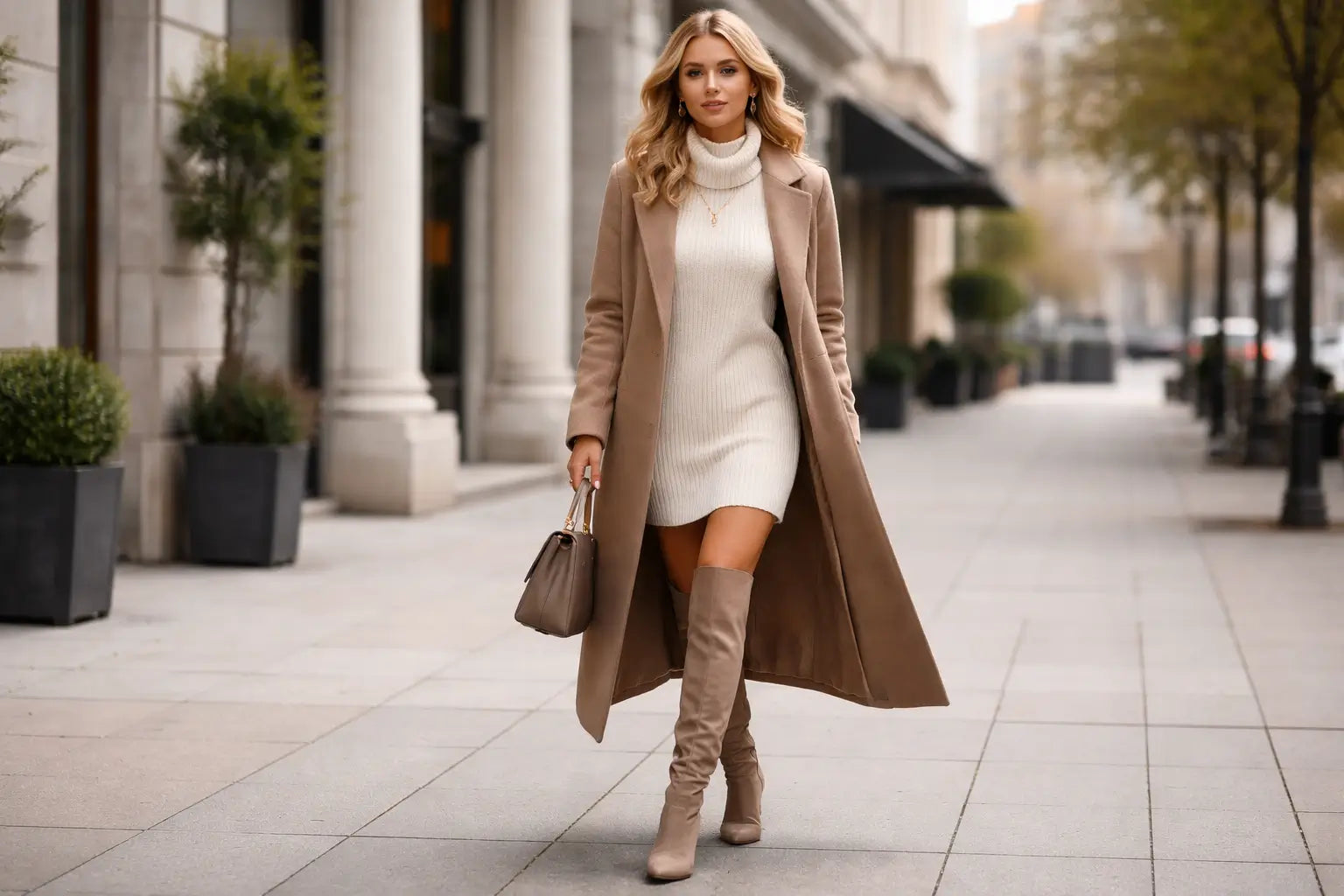
A sweater dress is one of the easiest “one-piece outfits” you can wear—until you get stuck on the details: shoes, boots, tights vs. leggings, and how to keep the look from feeling shapeless.
This guide gives you:
- a 60-second decision framework,
- fast answers to the top questions,
- and 18 plug-and-play sweater dress outfit formulas (work, weekend, night out).
Sweater Dress Outfits: the 60-second decision framework
Use this order and the outfit gets easier:
- Pick the vibe: sleek (fitted + clean lines) or cozy (relaxed + layered).
- Match hemline to footwear: mini/midi/maxi changes what looks balanced.
- Adjust for weather and dress code: tights/leggings + outerwear decide comfort and “polish.”
If you only remember one rule: Add structure in one place (shoes, belt, or outerwear). That’s usually enough to keep a sweater dress outfit looking intentional.
Shoes, leggings, and frumpy fixes
Use this section as a quick “what do I do right now?” reference.
| Question | Quick pick |
|---|---|
| What kind of shoes do I wear with a sweater dress? | Start with your hemline + vibe. Mini often loves knee-high or OTK boots. Midi pairs well with ankle boots, sleek knee-high boots, loafers, or sneakers (casual). Maxi usually looks best with sleek boots or clean sneakers. Avoid making every piece chunky at once (chunky knit + chunky shoe + bulky coat). |
| Do you wear leggings with a sweater dress? | Yes—when the dress is relaxed/long enough and the outfit needs warmth. For work or dressier looks, opaque tights usually read more “dress-like” than leggings. For a tunic vibe, choose a longer sweater dress + slim leggings + structured outerwear. |
| How do I wear a sweater dress without looking frumpy? | Pick 1–2 structure levers: (1) belt (or subtle waist definition), (2) structured coat/blazer, (3) sleek boots (not bulky), (4) tonal colors (same-family shades), (5) clean bag (less slouch), (6) tights instead of leggings when you want polish. Don’t stack all fixes—one strong change usually works. |
Shoes to wear with a sweater dress
Best practice: match the “weight” of your shoes to the “weight” of your knit and the occasion.
Shoe options that work most of the time
- Sleek ankle boots: easy default for midi sweater dresses; looks polished fast.
- Knee-high boots: great for mini and midi (especially in colder weather).
- Over-the-knee boots: statement option; works best with mini lengths (more on this below).
- Sneakers: weekend/casual; looks best when the dress is simple and the rest of the outfit is clean.
- Loafers or flats: office-friendly when paired with tights and a structured layer.
- Heeled boots or simple heels: “night-out” upgrade; keep the rest minimal so the knit remains the star.
Best-when / avoid-when
- Best when: the shoe matches your vibe (sleek dress → sleek shoe; chunky knit → stable shoe, but not necessarily chunky).
- Avoid when: everything is oversized or bulky at once (oversized dress + chunky sneaker + puffer + huge tote).

Shoes by vibe: casual vs polished
Use these quick swaps without changing the dress:
- More casual: sneakers + denim jacket or relaxed coat + crossbody bag
- More polished: ankle boots/loafers + blazer/long coat + structured bag
- More “night”: heeled boots + long coat + minimal jewelry
Shoes by hemline: mini, midi, maxi (quick tips)
- Mini sweater dress: knee-high or OTK boots look intentional; sneakers can work if the dress is simple and the weather is mild.
- Midi sweater dress: ankle boots are the easiest; sleek knee-high boots create a clean line.
- Maxi sweater dress: keep shoes sleek so the hem doesn’t feel heavy—clean sneakers or streamlined boots.
Boots: match boot height to sweater dress length (mini/midi/maxi)
Quick rule: your hemline decides how much leg (or boot shaft) you “show,” which changes the outfit’s proportions.

Boot-height × hemline table (quick pick)
| Sweater dress length | Best boot heights | Why it works | Avoid when |
|---|---|---|---|
| Mini | Knee-high or OTK, or sleek ankle boots | Boots “finish” the leg line and keep the look intentional | Very chunky boot + very chunky knit + bulky coat |
| Midi | Sleek ankle boots or sleek knee-high boots | Keeps the silhouette balanced and polished | Boots that cut the leg awkwardly and a bulky outer layer |
| Maxi | Streamlined ankle boots (under the hem) or sleek sneaker | Minimizes visual heaviness at the bottom | Heavy platform boots that fight the long hemline |
Over-the-knee boots: when it works (and when it feels “too much”)
OTK boots work best when:
- the dress is mini or has a shorter hemline that clearly shows the boot,
- the outfit is otherwise simple (tonal color, minimal accessories),
- you want a confident, statement vibe.
OTK boots feel like “too much” when:
- the sweater dress is already bold (busy texture + loud color + oversized fit),
- you add a dramatic coat and loud accessories on top,
- the setting is conservative (in those cases, switch to knee-high or sleek ankle boots).
Tights vs leggings vs jeans: what to wear under a sweater dress
Yes, you can wear all three—the key is what the outfit is trying to be: a dress look, a warm winter look, or a tunic look.

Legwear decision matrix (best for / watch-outs)
| Option | Best for | Pair with | Watch-outs |
|---|---|---|---|
| Opaque tights | Work, date night, “this is a dress” look | Loafers, ankle boots, knee-high boots + blazer/coat | Sheer tights can feel less winter-ready; choose opaque for polish |
| Leggings | Cozy casual, cold days, tunic-style outfits | Longer/relaxed sweater dress + sneakers or boots + structured outerwear | Can read too casual for some workplaces; keep the rest polished if needed |
| Jeans | A deliberate tunic look (more street/modern) | Long sweater dress + slim jeans + ankle boots or sneakers | Needs length/coverage; short sweater dresses can look awkward over jeans |
Warmth without bulk: base layers and simple underpinnings
If you want warmth but hate bulk:
- choose a thin, smooth base layer under the dress (especially in cold weather),
- keep bottoms slim when the knit is thick (tights beat bulky leggings),
- add warmth with outerwear length (a long coat often looks cleaner than piling on layers under the dress).
Always check the care label before adding heat-heavy layers (some knits don’t love friction or high heat).
How to wear a sweater dress without looking frumpy
“Frumpy” usually means one of these happened:
- the shape is undefined everywhere, or
- the outfit is visually heavy everywhere, or
- the outfit has no intentional “finish” (shoes/outerwear/accessories don’t match the vibe).
Fix it by choosing 1–2 structure levers, not a complete overhaul.

Quick fixes checklist (pick 1–2, don’t do all)
- Add a belt (or subtle waist definition) to create shape
- Swap to sleeker boots (or cleaner sneakers) to reduce “bulk at the bottom”
- Choose structured outerwear (blazer or tailored coat) instead of a slouchy layer
- Go tonal (same-color-family dress + coat + shoes) for an instantly polished look
- Use opaque tights when you want the outfit to read “dressy”
- Pick a structured bag (or less slouchy tote) to clean up the silhouette
- Keep accessories intentional (one focal point—earrings, scarf, or bag—not all at once)
Common mistakes (and the easiest swaps)
-
Mistake: oversized dress + oversized coat + chunky shoes
Swap: keep one oversized piece and make the other two sleek (sleek boots + structured coat, or fitted dress + cozy coat). -
Mistake: hemline and boot height fight each other
Swap: use the boot-height × hemline table above. -
Mistake: leggings look too casual for the setting
Swap: opaque tights + loafers/ankle boots + blazer. -
Mistake: no “finish”
Swap: add one structured element (belt, blazer, or a clean bag).
Belting a sweater dress: placement and belt width
Belting is optional, but it’s the fastest way to change the silhouette.
Belt placement steps (simple and reliable)
- Put the dress on and choose your shoes first. Shoes affect proportions.
- Find your natural waist (or go slightly higher if you want longer-looking legs).
-
Choose belt width based on knit bulk:
- thin belt: best for fine knits and sleek outfits
- medium/wide belt: best for thicker knits if it doesn’t bunch
- Check the side view (the belt should define shape, not create a bulge).
- Adjust gently: if the knit bunches, loosen the belt, shift it slightly, or skip the belt and use a structured coat instead.

No-belt alternatives (still looks intentional):
- structured blazer/coat
- tonal color story (dress + coat + shoe in the same shade family)
- a crossbody bag worn high (creates subtle waist definition visually)
Outerwear: what coat or jacket to wear over a sweater dress
Outerwear decides whether your sweater dress outfit reads work-ready, weekend casual, or night-out polished.

Outerwear selection table (best for / vibe / pairing tips)
| Outerwear | Best vibe / occasion | Pairing tips | Avoid when |
|---|---|---|---|
| Blazer | Work, meetings, smart casual | Great with midi + tights/loafers or ankle boots | With very chunky knits (can bunch at the arms) |
| Long tailored coat | Polished, classic winter | Creates a clean vertical line; works with mini/midi/maxi | If the coat is bulky and the dress is bulky |
| Trench coat | Transitional weather, daytime polish | Looks great with ankle boots or sneakers (clean) | In very cold weather without enough insulation |
| Leather jacket | Weekend, edgy casual | Balances cozy knits; pair with boots or clean sneakers | If the dress is overly formal or very long and heavy |
| Puffer | Warmth-first casual | Choose sleeker boots and keep accessories minimal | If you’re also wearing chunky shoes + chunky knit (too heavy overall) |
How to avoid bulk with puffers and chunky knits
If you need a puffer (weather wins):
- choose sleeker boots (or clean sneakers) instead of chunky footwear,
- keep the bottom half streamlined (opaque tights often look cleaner than bulky leggings),
- use one strong accessory (structured bag or simple scarf), not multiple.
Outfit formulas: work, weekend, night out
These are plug-and-play. Pick a row, then customize with one “swap lever” (shoe, outerwear, or accessory).

18 sweater dress outfit formulas (table)
| # | Scenario | Dress type / fit | Shoes | Legwear | Outerwear | Accessory lever | Vibe notes |
|---|---|---|---|---|---|---|---|
| 1 | Work | Midi, ribbed, fitted | Loafers | Opaque tights | Blazer | Structured tote | Office-ready, clean lines |
| 2 | Work | Midi, relaxed | Ankle boots | Opaque tights | Long coat | Simple earrings | Cozy but polished |
| 3 | Work | Mini, modest fit | Knee-high boots | Opaque tights | Long coat | Belt | Keeps mini work-appropriate |
| 4 | Work | Midi, turtleneck | Ankle boots | Opaque tights | Trench | Minimal necklace | Transitional polish |
| 5 | Work | Midi, fine knit | Loafers | Opaque tights | Blazer | Scarf (tonal) | Soft, professional |
| 6 | Work | Maxi, streamlined | Sleek boots | Opaque tights (if needed) | Long coat | Structured bag | Elegant and covered |
| 7 | Weekend | Mini, cozy | Sneakers | Bare legs or tights | Denim jacket | Crossbody | Easy daytime casual |
| 8 | Weekend | Midi, relaxed | Sneakers | Leggings (cold) | Trench | Baseball cap | Sporty-clean |
| 9 | Weekend | Midi, chunky | Ankle boots | Tights | Leather jacket | Hoop earrings | Cozy + edge |
| 10 | Weekend | Maxi, relaxed | Clean sneakers | Optional leggings | Long coat | Beanie | Warm and minimal |
| 11 | Weekend | Midi, sweater dress-as-tunic | Ankle boots | Slim jeans | Long coat | Long pendant | Intentional “tunic” look |
| 12 | Weekend | Mini, oversized | Knee-high boots | Tights | Puffer | Simple scarf | Warmth-first without chaos |
| 13 | Night out | Mini, fitted | Heeled boots | Opaque tights | Long coat | Statement earrings | Sleek + confident |
| 14 | Night out | Midi, fitted | Heeled ankle boots | Opaque tights | Leather jacket | Small shoulder bag | Modern night look |
| 15 | Night out | Midi, wrap-style knit | Heels | Opaque tights (cold) | Trench | Belt | Defines waist, very polished |
| 16 | Night out | Mini, simple knit | OTK boots | Bare legs or tights | Long coat | Minimal jewelry | Statement boots, simple rest |
| 17 | Night out | Maxi, streamlined | Sleek boots | Optional tights | Long coat | Clutch | Elevated, minimal |
| 18 | Night out | Midi, ribbed | Heeled boots | Opaque tights | Blazer | Red lip / bold bag | “Work-to-night” swap |
Swap levers: change one thing to dress it up (or down)
- Shoes: sneakers → ankle boots → heeled boots (instant formality shift)
- Outerwear: denim jacket → trench → long tailored coat
- Accessories: slouchy tote → structured bag; minimal jewelry → one statement piece
Wear it across seasons: winter to spring
A sweater dress can work across seasons by changing legwear + outerwear first.

Deep winter (cold + windy)
- Add a thin base layer under the dress.
- Choose opaque tights (or slim leggings if you’re going tunic-style).
- Wear knee-high or weather-ready boots.
- Finish with a long coat (clean silhouette) or a puffer (if needed).
Transitional fall / spring (cool mornings, mild afternoons)
- Start with ankle boots or loafers + tights (optional).
- Use a trench or lighter coat you can take off easily.
- Keep accessories light (one scarf or one structured bag).
Mild days (you still want the look, not the heat)
- Choose a lighter-feel knit (or a less bulky silhouette).
- Wear clean sneakers or loafers.
- Skip heavy legwear; use a light layer (denim jacket or trench).
If you include any technical claims about warmth or fiber performance, treat them as general guidance and prioritize the care label and manufacturer instructions.
Buying checklist: fit, knit, stretch (so it styles well)
A “sweater dress” is simply a knit dress with sweater-like texture/weight—often designed for warmth and layering.
What to look for when buying a sweater dress (fit, knit, stretch)
| Check | Why it matters for outfits | Quick test |
|---|---|---|
| Fit goal (sleek vs cozy) | Drives shoes/outerwear choices | Try it with your most-worn coat; does it feel balanced? |
| Knit thickness | Thick knits add “visual weight” | If it feels bulky, go sleeker on shoes and coat |
| Stretch + recovery | Helps the dress keep shape | Gently stretch a small area; does it bounce back? |
| Length (mini/midi/maxi) | Determines boot height and legwear options | Use the boot-height table in this guide |
| Neckline | Impacts layering (scarves, coats, blazers) | Try your usual jacket; does it sit comfortably? |
| Layering room | Prevents bulk frustration | Wear your base layer underneath during try-on |
Two fast fit tips
- If you want a more “dressy” look, fitted + opaque tights + structured outerwear is the reliable formula.
- If you want a cozy tunic vibe, choose a longer relaxed sweater dress so leggings/jeans look intentional.
FAQ: Sweater dress outfits (7 quick answers)
What kind of shoes do I wear with a sweater dress?
Choose shoes based on hemline + vibe: mini often suits knee-high/OTK boots, midi works with ankle boots/loafers/sneakers, maxi looks best with sleek boots or clean sneakers. If the knit is chunky, keep the shoe streamlined.
Do you wear leggings with a sweater dress?
Yes—especially for casual or very cold days. For a more polished look (or conservative workplaces), opaque tights usually read more “dress-like” than leggings.
Can I wear a sweater dress with jeans?
Yes, if the sweater dress is long enough to read like a tunic. Keep jeans slim (straight/slim) and pair with ankle boots or clean sneakers so the look feels deliberate.
How do I wear a sweater dress without looking frumpy?
Pick 1–2 structure levers: a belt, structured outerwear, sleeker boots, tonal colors, or opaque tights. Avoid stacking oversized + bulky pieces all at once.
How do I match boot height to sweater dress length (mini/midi/maxi)?
Mini: knee-high/OTK or sleek ankle boots. Midi: ankle boots or sleek knee-high boots. Maxi: streamlined boots (often hidden) or clean sneakers. Use the table above and adjust for comfort and weather.
What jacket or coat should I wear over a sweater dress?
Work/polish: blazer or long tailored coat. Transitional: trench. Weekend: leather jacket. Warmth-first: puffer (then keep the rest streamlined).
Should I belt a sweater dress, and where should the belt sit?
Belting is optional. Start at your natural waist; move slightly higher for longer-looking legs. Thin belts suit fine knits; wider belts can work on thicker knits if they don’t bunch.
Quick recap: build your outfit in 3 steps
- Decide your vibe: sleek (fitted + structured) or cozy (relaxed + layered).
- Pick footwear by hemline: use the boot-height table when in doubt.
- Finish with one structure lever: belt, structured outerwear, or sleek boots—choose one, not all.
For brands: private-label sweater dress spec checklist
If you’re developing a private-label sweater dress (OEM/ODM), you’ll move faster in sampling when the specs are clear.
Spec checklist to decide first
- Target silhouette: fitted vs relaxed; mini/midi/maxi
- Material direction: fiber blend preference (keep options open if you’re early)
- Knit look: rib/cable/plain; texture level
- Size range and measurement points (what matters most: bust/waist/hip/length/sleeve)
- Trims and branding: labels, hangtags, packaging
- Order plan: estimated quantity per color/size + target delivery window (timelines can vary by design and order details)
What to send when requesting a sample/quote
- Tech pack (or sketches + reference photos)
- Measurement specs and grading notes (if available)
- Target yarn/fiber direction (or “open to suggestions”)
- Quantity estimate + target market requirements
XTCLOTHES positions itself as a knitwear/sweater manufacturer offering OEM/ODM and one-stop support (design/sampling/bulk/labels & packaging/logistics support, as stated on our website). If you want a quote or sample plan, share your draft specs and timeline and we’ll respond with next-step suggestions.
Sources & further reading (for care/layering basics)
- Woolmark – “What is pilling?” and pilling prevention tips: https://www.woolmark.com/care/pilling/
- American Cleaning Institute – Sweater care (washing/drying basics): https://www.cleaninginstitute.org/cleaning-tips/clothes/fabric-care/sweater-care
- REI – Layering basics (base/mid/shell framework): https://www.rei.com/learn/expert-advice/layering-basics.html
)