
Sweater Tank Top Outfit Ideas: 15 Easy Formulas + Layering & Fit Tips
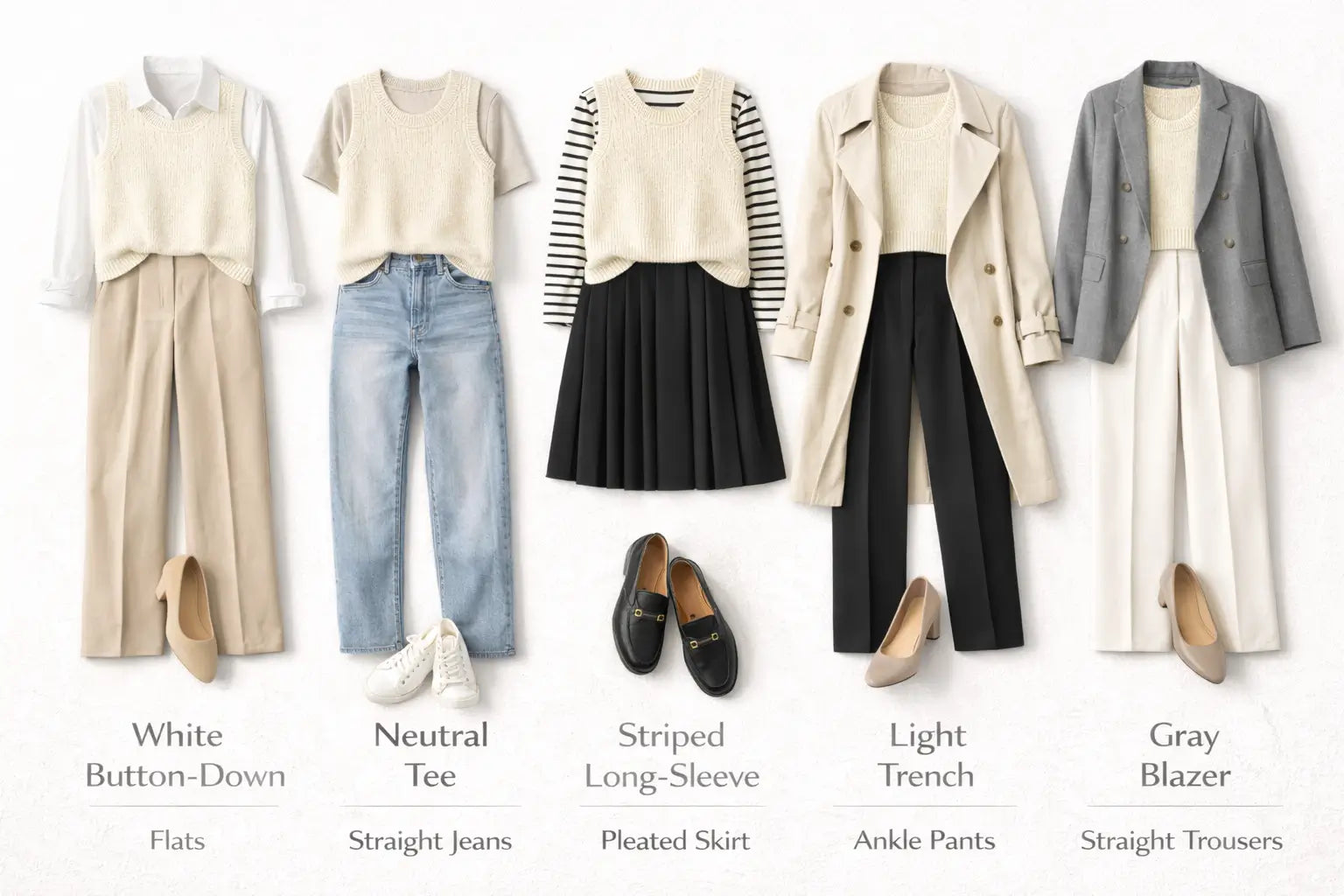
5 sweater tank outfit formulas you can repeat
A sweater tank outfit is easiest when you treat it like a simple formula: pick an under-layer (or none), add a bottom that balances the silhouette, then finish with shoes that match the vibe.
| Formula (copy & wear) | Under-layer | Bottom | Shoes | Why it works |
|---|---|---|---|---|
| Weekend clean | White tee | Straight jeans (mid/high rise) | Sneakers | Simple base + tidy proportions |
| Preppy classic | Button-down | Pleated mini or midi | Loafers | Crisp collar + structured bottom reads intentional |
| Office smart-casual | Fine knit tank | Tailored trousers | Loafers or low heels | Tailoring “lifts” the knit instantly |
| Winter warm (no bulk) | Thin turtleneck | Wide-leg trousers | Boots | Thin-to-thick layering keeps warmth without a puffy look |
| Warm-weather solo | Sweater tank (alone) | Midi skirt or shorts | Sandals or sneakers | One-piece top keeps the outfit light and easy |

Quick rules that make these formulas look polished:
- If the tank is boxy, add waist definition (half-tuck, belt, or high-rise bottom).
- If the knit is chunky, keep the under-layer thin and the bottom structured.
- If you want it to feel “new,” mix textures (knit + denim, knit + satin, knit + leather).
Boundary notes:
- These formulas shift with climate (AC office vs outdoor heat) and dress code.
- Knit thickness changes what layers feel comfortable and what looks bulky.
- Footwear is the fastest “vibe switch,” so adjust shoes first before changing the whole outfit.
Once you’ve got a few go-to formulas, it helps to clarify what counts as a sweater tank and why it’s often called a vest.
What is a sweater tank (vs sweater vest) + are they still in style?
A sweater tank is basically a sleeveless sweater—many people use “sweater tank” and “sweater vest” interchangeably, depending on where they shop and how the item is cut. For a clean baseline definition, a “sweater vest” is commonly defined as a sleeveless sweater. (Merriam-Webster: “sweater-vest”) (merriam-webster.com)
Key differences you’ll actually notice when styling:
- Neckline: V-necks read preppy; crew/mock neck reads modern/minimal.
- Armholes: Deeper armholes show more under-layer (great for shirts, trickier for solo wear).
- Fit: Fitted tanks layer cleanly; oversized ones need waist definition to avoid a boxy look.
- “Tank top” vs “sweater tank”: The “sweater” part usually implies knit texture and warmth compared to a typical ribbed cotton tank.
Are they still in style (including 2025-style questions)?
- Yes, they don’t read dated—they’ve become a repeatable staple you’ll still see in outfit formulas, especially for workwear, preppy looks, and transitional seasons.
- The safest “trend” approach is to style it with modern proportions (clean lines, higher-rise bottoms, and intentional shoes).
Boundary notes:
- Naming varies by retailer/region, so search both “sweater tank” and “sweater vest.”
- What looks “current” depends more on fit + styling than the garment label.
If you understand the item, the biggest decision becomes what to wear underneath—and when to skip the under-layer entirely.
What to wear under a sweater tank top (comparison table)
What you wear under a sweater tank should match your goal: warmth, coverage, or a more polished look. The fastest way to decide is to pick the thinnest layer that still gives you the vibe you want.
- Want polished? Start with a button-down.
- Want warm without bulk? Start with a thin turtleneck.
- Want simple? Start with a tee.
- Want solo wear? Check armholes + neckline first.
| Under-layer option | Best for | Pro tip | Watch out for |
|---|---|---|---|
| Cami / bra top | Solo wear, warm weather, low bulk | Choose a neckline that matches the tank (V with V; crew with crew) | Deep armholes may show straps |
| Fitted tee | Casual, weekend, easy layering | Slightly fitted sleeves keep the shoulder line clean | Thick tees can bunch under fitted knits |
| Button-down | Preppy + office, “instant structure” | Pop the collar or roll sleeves to prevent stiffness | Too much fabric can balloon at the waist |
| Thin turtleneck | Fall/winter layering | Keep the knit fine-gauge to avoid a puffy torso | Chunky layers can feel restrictive |
| Long-sleeve tee | Transitional weather, casual polish | Choose smooth fabric so the tank slides on easily | Too long/loose sleeves can look sloppy |

Quick “layering fixes” that solve most problems:
- If the under-layer bunches, switch to a thinner fabric or a more fitted cut.
- If the armhole gapes, try a more fitted tank or a slightly thicker strap under-layer.
- If you want the outfit to look intentional, match necklines (V with V; crew with crew).
Boundary notes:
- Comfort and sensitivity are personal—choose what feels right and avoid forcing layers.
- Armhole shape and knit weight vary a lot, so test-move your arms before committing.
After layering, fit and proportion are what separate “cute outfit” from “why do I look boxy today?”
Fit & proportions: how to avoid a frumpy sweater tank outfit (checklist)
To avoid a frumpy look, aim for clean shoulder lines, a visible waistline (or a clear long line), and balanced volume between your top and bottom.
Do / don’t checklist:
- Do let the shoulder seam sit close to your shoulder; don’t size up so far that the armholes collapse.
- Do define the waist (half-tuck, belt, high-rise bottom); don’t let a boxy hem float over low-rise bottoms.
- Do balance volume (oversized tank → slimmer bottom, or fitted tank → wider-leg bottom); don’t stack “wide + wide” unless you add structure.
- Do keep layers thin if the tank is chunky; don’t put a thick hoodie under a thick knit (it usually looks puffy).
- Do choose intentional shoes (loafers/boots/clean sneakers); don’t let worn-out shoes make the outfit read accidental.
Quick fixes (when the outfit feels “off”):
- Swap to higher-rise bottoms to pull the silhouette upward.
- Add a structured layer (blazer, trench, leather jacket) to sharpen the outline.
- Use a front tuck to show the waist without fully tucking bulky knits.
- Choose a longer tank with side slits if you want coverage without boxiness.

Boundary notes:
- No single fit is “flattering for everyone”—your comfort and style preference matter.
- Knit thickness and layering choices change how the same size looks on the body.
If you want more ideas without overthinking, styling by “vibe” is the easiest way to keep the same tank and rotate the rest of the outfit.
Outfit ideas by vibe: casual, preppy, elevated
You can make one sweater tank do a lot by changing only three things: under-layer, bottom shape, and shoes.
- Casual: tee + denim + clean sneakers
- Preppy: button-down + pleats + loafers
- Elevated: texture contrast (knit + satin/leather) + sharper shoes
Boundary notes:
- Occasion formality matters—keep one “structured” piece for anything beyond casual.
- Climate matters—swap under-layers first before swapping the whole outfit.
Casual weekend formulas (easy, not sloppy)
Casual sweater tank outfits look best when you keep the lines clean: simple base, one strong silhouette choice, and sneakers that look intentional.
- Sweater tank + white tee + straight jeans + sneakers
- Sweater tank + long-sleeve tee + denim shorts + sneakers
- Sweater tank (solo) + relaxed trousers + sandals
- Sweater tank + fitted tee + midi skirt + sneakers

Boundary notes:
- If the knit is thick, choose thinner tees and avoid bulky denim jackets underneath.
- If you’re petite, try a cropped tank with high-rise jeans to keep leg line long.
A slightly more structured under-layer turns the same tank into a preppy/classic look quickly.
Preppy/classic formulas (button-downs, pleats, loafers)
Preppy sweater tank outfits work when the shirt is crisp and the bottom is structured—then you can keep accessories minimal.
- Sweater tank + button-down + tailored trousers + loafers
- Sweater tank + button-down + pleated mini + loafers (or ballet flats)
- Sweater tank + thin turtleneck + midi skirt + ankle boots
- Sweater tank + striped tee + chinos + clean sneakers

Boundary notes:
- Office dress codes vary—swap mini skirts for midi skirts or trousers when needed.
- If the shirt balloons under the knit, choose a slimmer shirt or do a partial tuck in front.
If you’re dressing up, you usually don’t need a totally different tank—you just need smarter texture and shoe swaps.
Dressy/night-out upgrades (texture swaps + accessories)
To dress up a sweater tank, add contrast and sharper finishing pieces: smooth fabrics, sleeker shoes, and one statement accessory.
- Sweater tank (fitted) + satin slip skirt + heeled sandals + statement earrings
- Sweater tank + leather-look pants + ankle boots + mini bag
- Sweater tank + wide-leg trousers + pointed flats/heels + sleek belt

Boundary notes:
- Comfort matters—choose shoes you can actually wear for the event.
- If the tank is chunky, keep the bottom fabric smoother to avoid looking heavy.
When you want the outfit to be work-appropriate, a simple step-by-step build keeps you from guessing.
Sweater tank outfits for work (step-by-step)
For work, a sweater tank looks professional when you add structure: a crisp under-layer or blazer, tailored bottoms, and shoes that match the office formality.
Work outfit anchors:
- Tailoring beats trend: trousers and blazers make the knit look intentional.
- Neutrals are easy: black, navy, cream, gray, and pinstripe bottoms pair fast.
- Keep bulk low: fine-gauge knits + thinner under-layers are the most “office safe.”
Step-by-step build:
- Choose the under-layer: button-down (most polished) or fitted tee (smart casual).
- Pick the bottom: tailored trousers or a midi skirt for a reliable silhouette.
- Add structure: blazer, trench, or a sharp cardigan (avoid overly slouchy).
- Finish with work shoes: loafers, low heels, or clean minimalist sneakers (if allowed).
- Add one accessory: belt, watch, or small hoops—keep it simple.
Office-ready formulas:
- Sweater tank + button-down + tailored trousers + loafers
- Sweater tank + fitted tee + straight jeans + blazer + low heels
- Sweater tank + thin turtleneck + midi skirt + ankle boots

Boundary notes:
- Dress codes vary (business casual vs formal), so adjust hem lengths and shoe choices accordingly.
- Office temperatures vary—keep a thin layer option in your desk drawer.
Cold weather changes the game, so the goal becomes warmth without stacking bulky layers.
How to wear a sweater tank in fall and winter (warmth without bulk)
In fall and winter, a sweater tank works best as a mid-layer: thin base, sweater tank, then a structured outer layer that keeps your silhouette clean.
Winter layering priorities:
- Thin-to-thick layering keeps you warm while avoiding puffiness.
- Structure on the outside (coat/blazer) keeps the outline sharp.
- Smooth base layers reduce bunching and friction.
Step-by-step winter stack:
- Start with a thin base (thin turtleneck or fitted long-sleeve tee).
- Add the sweater tank (avoid oversized if you’re layering heavily).
- Choose a structured outer layer (wool coat, trench, tailored jacket).
- Finish with winter-friendly shoes (ankle boots, knee boots, or sleek sneakers).
- Add warmth accessories (scarf, gloves) without adding torso bulk.
Avoid-bulk checklist:
- Keep at least one layer fine-gauge (either base or tank).
- Avoid stacking two chunky knits on top of each other.
- If your coat is oversized, keep the layers underneath slimmer.
Winter formulas:
- Thin turtleneck + sweater tank + wide-leg trousers + boots + wool coat
- Fitted long-sleeve tee + sweater tank + straight jeans + ankle boots + trench
- Button-down + sweater tank + midi skirt + tights + knee boots + coat

Boundary notes:
- Climate and indoor heating vary—adjust base layer thickness first.
- Heavier sweater tanks usually need thinner under-layers to stay comfortable.
When the weather flips warm, you can still wear sweater tanks—just treat them like a light top instead of a layer.
Warm-weather sweater tank outfits (wear it solo)
Yes, you can wear a sweater tank in warm weather, especially if it’s fine-gauge and you pair it with lighter bottoms and breathable shoes.
Warm-weather formulas:
- Sweater tank (solo) + linen-look trousers + sandals
- Sweater tank (solo) + midi skirt + sneakers
- Sweater tank (solo) + denim shorts + sandals
- Sweater tank over a thin tee + lightweight trousers + sneakers (for heavy AC)
Micro-checklist for staying comfortable:
- Choose a lighter knit or a more open stitch if you run warm.
- Keep the bottom lightweight (skirt/shorts/light trousers).
- Keep the outfit simple—one knit statement is enough.

Boundary notes:
- Comfort is personal—test it in your climate and don’t force a knit on the hottest days.
- Deep armholes and necklines may make solo wear feel less secure, so choose cuts you’re comfortable in.
Once the season is right, the quickest “upgrade” is picking the bottom shape that balances your tank.
What bottoms pair best with a sweater tank (table)
The best bottom depends on your tank’s length and volume: cropped tanks usually love high-rise bottoms, and oversized tanks usually look best with slimmer or more structured bottoms.
- If the tank is cropped: try high-rise jeans, trousers, or midi skirts.
- If the tank is hip-length: try straight jeans, tailored trousers, or A-line skirts.
- If the tank is oversized: define the waist (tuck/belt) or choose a slimmer bottom.
| Bottom type | Best sweater tank length | Easy under-layer | Shoe match |
|---|---|---|---|
| Straight jeans | Cropped or hip-length | Tee or solo | Sneakers, loafers |
| Wide-leg trousers | Fitted or cropped | Button-down or thin turtleneck | Loafers, boots, low heels |
| Midi skirt | Cropped or fitted | Tee, cami, or turtleneck | Sneakers, ankle boots, heels |
| Mini skirt | Hip-length (slimmer) | Button-down or fitted tee | Loafers, boots |
| Shorts | Cropped or fitted | Solo or tee | Sandals, sneakers |
Boundary notes:
- Fabric drape changes the look (stiffer bottoms feel sharper; drapey bottoms feel softer).
- Personal style matters—use the table as a starting point, not a rulebook.
If you’re buying a new sweater tank (or trying to make one last), a few details matter more than brand names.
Shopping checklist: fit, knit texture, and care
A great sweater tank is the one you’ll actually re-wear: the fit shouldn’t gape at the armholes, the knit weight should match your climate, and the care routine should prevent pilling and stretching.
Fit checklist (try-on or product page checks):
- Armholes: no collapsing or gaping when you move your arms
- Shoulder line: not drooping past your shoulder
- Length: works with your most-worn bottoms (high-rise vs mid-rise)
- Neckline: matches how you like to layer (V for shirts, crew for tees, mock for minimal)
- Stretch recovery: fabric bounces back instead of staying stretched out
Knit detail mini-guide:
| Knit detail | Best for | Styling note |
|---|---|---|
| Fine-gauge / smooth knit | Layering, work outfits | Looks more “tailored” under blazers |
| Chunky / textured knit | Casual, winter | Keep under-layers thin to avoid bulk |
| Rib knit | Fitted silhouettes | Easy to wear solo with high-rise bottoms |
| Cable / heavy texture | Cozy statement | Pair with simpler bottoms for balance |
| Pointelle / openwork | Transitional/warm weather | Consider a cami if you want more coverage |
Care basics (label-first):
- Follow your garment’s care label first, then keep friction low to reduce pilling.
- Pilling is often caused by rubbing during wear, especially in high-friction areas (underarms, elbows, sides). (The Woolmark Company: “What is pilling?”) (woolmark.com)
- Store most knits folded (not hung) to reduce stretching. (A practical care overview: The Guardian knitwear care guide) (theguardian.com)
Boundary notes:
- Materials vary by brand, so avoid “one fabric is always best” thinking.
- If you’re between sizes, decide based on how you plan to wear it (solo vs layered).
If you’re developing sweater tanks for a brand, a clear spec sheet is what turns “cute idea” into a smooth sample.
For brands (optional): private-label sweater tank spec checklist
A private-label sweater tank is easiest to sample when your tech pack removes ambiguity: measurements, knit details, and trims should be explicit so the factory can match your intent.
Spec checklist (what to include):
- Style sketch + key design notes (neckline, armhole shape, hem finish)
- Measurements (POM list, tolerance expectations, graded size set)
- Yarn/material direction (fiber preference + handfeel target)
- Knit construction notes (gauge/weight direction, stitch pattern like rib/cable/jacquard if applicable)
- Trims and branding (labels, hangtags, packaging)
- Colorways + artwork files (if you need jacquard/intarsia/print details)
- Fit intent (fitted vs relaxed) and how it should layer (over tee vs solo)
Sampling workflow (high-level):
- Send the tech pack + quantity targets + target ship window.
- Align on materials and construction direction (what the knit should feel/look like).
- Review the first sample, mark fit/measure changes, then approve for bulk planning.
- Confirm labels/packaging requirements before production starts.
Boundary notes:
- Lead times, MOQ, and shipping depend on design complexity, materials, and order size, so treat timelines as variable.
- If your website or vendor has multiple stated timelines, avoid locking to a single number without “typically / may vary” language.
If you’re producing sweater tanks (or other knitwear) for your label, XTCLOTHES (Zhongshan Xingtai Clothing Co., Ltd.) positions itself as an OEM/ODM knitwear manufacturer offering sampling → bulk production, plus customized labels/packaging and logistics/customs clearance support (as stated).
To get a faster, cleaner quote, send:
- Your tech pack or reference photos
- Quantity by colorway + size range
- Preferred material/yarn direction (if you have one)
- Target ship date window
If you’re here for styling (not manufacturing), the FAQs below answer the most common quick questions people ask.
FAQ
-
Q: Should I wear a tank top under a sweater?
A: Wear a base layer if you want more coverage, warmth, or a cleaner neckline. A cami or fitted tee keeps bulk low, while a button-down makes it look more polished; the best choice depends on the sweater tank’s armholes and knit thickness. -
Q: Are sweater vests still in style in 2025?
A: Yes—they’ve become a recurring staple and don’t read dated when styled with modern proportions. If you’re unsure, keep the fit clean and pair it with tailored bottoms or intentional shoes to make the look feel current. -
Q: How to not look frumpy in a sweater?
A: Avoid a boxy silhouette by defining the waist and balancing volume. Choose a shoulder fit that doesn’t droop, pair with higher-rise or more structured bottoms, and add a blazer or coat if the outfit needs sharper lines. -
Q: What to wear with a tank top in winter?
A: Treat it as a mid-layer: thin base (like a fitted turtleneck) + sweater tank + structured coat. This keeps warmth up without stacking bulky knits, and boots or loafers finish the look cleanly. -
Q: Can you wear a sweater tank without layering (by itself)?
A: Yes, especially in warm weather or indoors, as long as you’re comfortable with the neckline and armhole coverage. A fine-gauge knit and high-rise bottoms usually make solo wear feel more secure and balanced. -
Q: What are 5 easy sweater tank outfits I can repeat weekly?
A: Use a repeatable rotation: tee+jeans+sneakers, button-down+trousers+loafers, fitted tee+straight jeans+blazer, thin turtleneck+wide-leg trousers+boots, and solo tank+midi skirt+sneakers. Adjust shoes or outerwear to match your day’s dress code and temperature.
If you want a simple “capsule” approach, the summary below helps you build a repeatable sweater tank wardrobe without buying a whole new closet.
Summary: build your sweater tank capsule
Key takeaways:
- Treat sweater tank outfits like formulas: under-layer → bottom shape → shoes.
- Fit and proportions matter more than “trend”: shoulders, armholes, and waist definition keep it polished.
- For work, add structure (tailoring + neutral palette).
- For winter, layer thin-to-thick and avoid stacking chunky knits.
- For warm weather, go fine-gauge and keep bottoms lightweight.
Practical next steps by scenario:
- If you want work looks, start with: button-down + sweater tank + trousers + loafers, then add a blazer.
- If you want winter looks, start with: thin turtleneck + sweater tank + coat, then pick boots.
- If you want weekend looks, start with: tee + jeans + sneakers, then swap in a skirt or trousers for variety.
For brands building a private label, preparing a clean tech pack (measurements, knit direction, trims/labels, colorways) is the fastest way to reduce sampling loops and get accurate quotations.
