
Custom Ugly Christmas Sweater Manufacturer: MOQ, Techniques, Lead Times (Buyer’s Guide)
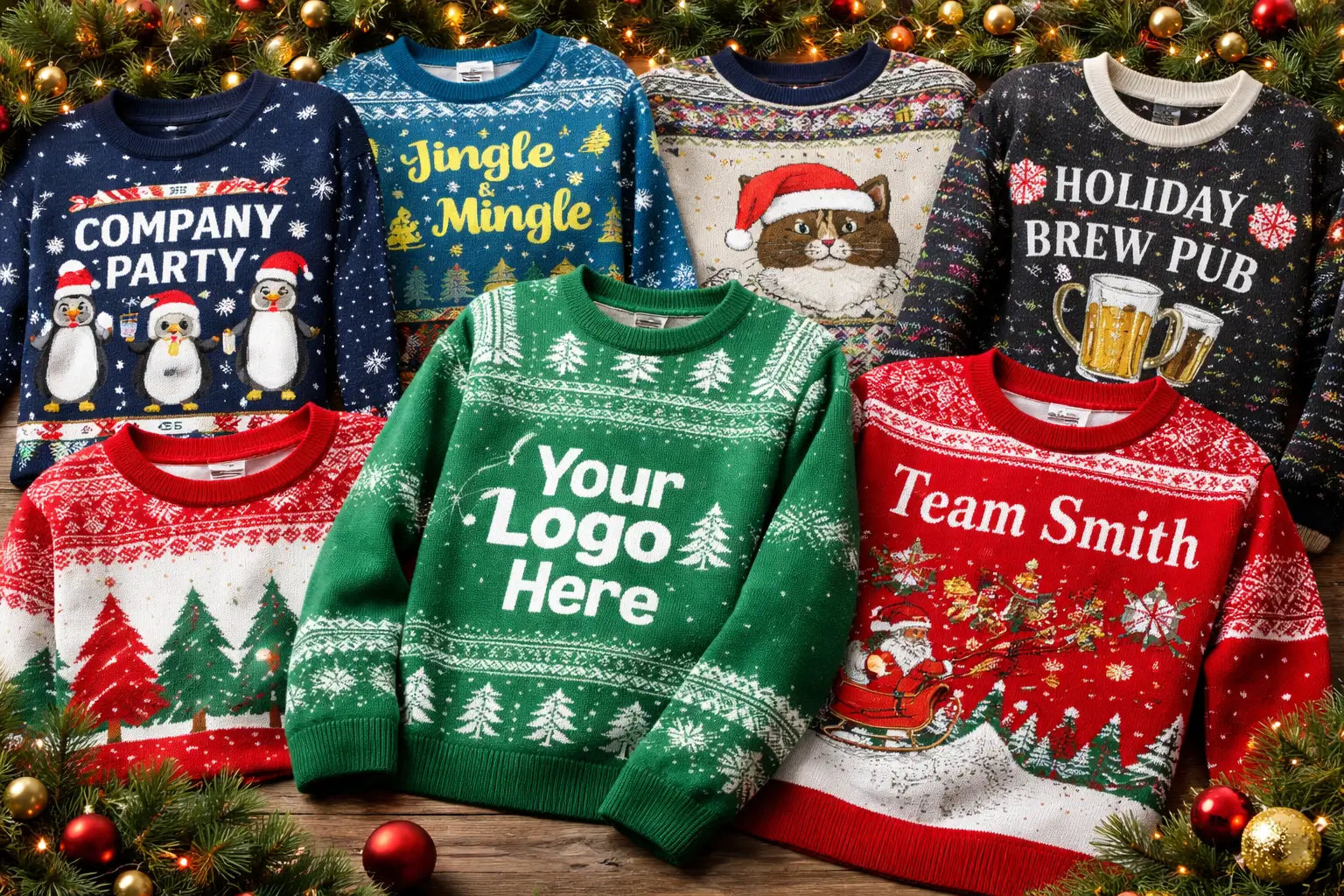
This guide is for brands, procurement teams, and corporate/event buyers who want custom “ugly Christmas” sweaters and need a manufacturer-ready way to plan MOQ, customization technique, and deadline risk—without relying on vague promises.
Read this first
If you only remember 3 things:
- Route: Use a platform when you need very small quantities fast and can accept preset constraints. Use a manufacturer when you need deeper control over fit/material/knit technique, consistent bulk, and private label options.
- Quote pack: The fastest accurate quote happens when you send artwork + placement + size chart + quantity by size + destination + required arrival date.
-
Timeline: Plan in stages, not a single “turnaround time”:
- spec review
- sampling
- sample approval (revision loop)
- bulk + QC
- packing + shipping
Mini decision snapshot (platform vs manufacturer)
| You need… | Platform is usually better | Manufacturer is usually better |
|---|---|---|
| Quantity | 1–small batches | Bulk / repeatable production |
| Control | Limited (preset options) | Higher (technique/fit/material/branding) |
| Speed | Fast “design → order” | Needs sampling/approval cycles |
| Risk | Constraints are hidden until checkout | Risk is managed via samples + QC plan |
Next: Decide your route (platform vs manufacturer) before you worry about details like packaging and shipping.
Manufacturer vs Platform: Which Route Fits Your Order?
If your priority is small quantities and speed, a platform can work. If your priority is control (technique/fit/material), consistent bulk, and private label, work with a manufacturer.
Key points (decision rules)
- Choose a platform when:
- You need very small quantities (including “one-off” or short runs)
- You can accept preset constraints (colors, knit structure, sizing choices, fabric/hand feel)
- You want a self-serve design flow and simple ordering
- Choose a manufacturer when:
- You need bulk production and repeatability
- You need deeper control of knit technique (jacquard/intarsia), sizing/fit, and material/yarn choices
- You want private label & packaging options and a clearer QC/approval process
- Mixed approach is common:
- Use a platform for a quick test, then shift to a manufacturer for a brand program or corporate bulk.
Table: Platform vs Manufacturer (more detail)
| Factor | Platform (self-serve) | Manufacturer (OEM/ODM) |
|---|---|---|
| Best for | 1pc–small runs, fast teams, gifts | Bulk orders, brand programs, repeat production |
| Customization depth | Usually constrained (preset knit + limited design rules) | More control over technique, fit, yarn/material, branding |
| How risk is managed | Constraints are “baked in” | Sampling + approval + QC checkpoints |
| Typical workflow | Pick base → upload/design → order | Spec review → sample → approve → bulk → ship |
| Main trade-off | Less control, may not match brand-level requirements | More planning needed; approvals affect timeline |
OEM vs ODM in one minute
- OEM: you provide design/specs; the factory produces.
- ODM: you start from a concept; the factory supports development (still faster when you provide clear references and constraints).
Boundary conditions / caveats
- Some “ugly Christmas sweater” offers are not fully knitted sweaters (they may be printed fleece/sweatshirts). Confirm the base product and technique early.
- Platforms and manufacturers can both be “good”—the right choice depends on order size, deadline buffers, and control requirements.
If you choose the manufacturer route, the biggest speed lever is your quote pack—what you send in the first message.
Quote Checklist: What to Send a Sweater Manufacturer
Send a quote-ready spec pack: artwork + placement + size chart + quantity by size + destination + required arrival date. This reduces back-and-forth and prevents re-quoting after sampling.
Key points (what matters most)
- Quotes are fastest when you make assumptions explicit (technique, yarn/material preferences, variants).
- Most delays come from missing: placement details, size spec, variant breakdown, or deadline constraints.
- Your spec pack is a “contract draft”—it sets the scope for sampling and bulk.
Must-have checklist (minimum quote pack)
- Artwork file: preferably vector for logos/text; include a reference mockup image if available
- Placement map: front/back/sleeves/neck area + approximate size (cm/in)
- Technique intent: “knitted-in graphic (jacquard/intarsia)” vs “embroidery” vs “print” (if unsure, ask for recommendation)
- Size chart: sizes you want (e.g., XS–XXL) + key measurements
- Quantity: total units + breakdown by size
- Variants: how many designs + how many colorways (and which sizes per colorway)
- Destination + required arrival date: where it must arrive and by when
- Branding needs: private label (neck label/care label/hangtag) and packaging needs (if any)
Nice-to-have (speeds quoting and sampling)
- Target buyer use case: corporate event vs retail program (affects fit, packaging, and timeline pressure)
- Yarn/material preference (or “factory recommend for warmth/softness/cost balance”)
- Reference photos of the look/hand feel you want
- Any compliance constraints you already know (market-specific; keep high-level if unsure)
- IP note: confirm you have rights for any logos/characters you provide
Mini-template (copy/paste): Variant table
| Design name | Colorway | Sizes | Qty per size | Notes (technique/placement/label) |
|---|---|---|---|---|
| Design A | Red base | S–XL | S:__ M:__ L:__ XL:__ | Front jacquard; neck label |
| Design A | Green base | S–XL | S:__ M:__ L:__ XL:__ | Same art; color swap |
| Design B | Navy base | M–XXL | M:__ L:__ XL:__ XXL:__ | Add sleeve logo embroidery |
What to ask in your first message (so you don’t get vague quotes)
- Which technique is recommended for my artwork, and why?
- What is counted as a “style” vs a “colorway” for MOQ purposes?
- What does the sampling process look like (and what approvals do you need from me)?
- What QC checks happen before shipment?
- What shipping modes do you support, and what inputs do you need to estimate delivery risk?
Boundary conditions / caveats
- Quotes are often conditional until sampling confirms feasibility (artwork detail, colors, knit structure, finishing).
- Timelines depend heavily on your approval speed and how many revisions you make.
Once your quote pack is ready, the next decision is technique—jacquard, intarsia, embroidery, or print?
If you want a feasibility check or quote from XTCLOTHES, send: artwork + placement notes + size chart + variant table + destination + required arrival date. Keep it simple—clear inputs beat long descriptions.
Choose Your Customization Method: Jacquard vs Intarsia vs Embroidery vs Print
Use jacquard for repeating multi-color patterns, intarsia for clean color blocks and larger motifs, embroidery for small logos/accents, and print when you’re not truly knitting the artwork into the fabric.
Key points (how to choose quickly)
- If your design is pattern-heavy (snowflakes, repeats): start with jacquard
- If your design is a big “scene” or large blocks (Santa, reindeer): start with intarsia
- If your design needs small crisp logos: consider embroidery (or simplify for knit-in)
- If your supplier offers “print,” confirm the base: it may be a printed layer or a different garment type
Technique comparison table
| Method | Best for | Look/feel | Detail tolerance (qualitative) | Common trade-offs | When to choose |
|---|---|---|---|---|---|
| Jacquard | All-over patterns, repeats, multi-color motifs | Knitted-in, classic sweater look | Medium | Can feel thicker; pattern planning matters | You want repeat patterns and scalable production |
| Intarsia | Large motifs, clear color blocks | Knitted-in blocks | Medium–High (for larger elements) | More complex color block transitions | You want bold graphics that read from a distance |
| Embroidery | Small logos, patches, accents | Raised stitched detail | High for small marks | Adds a production step | You need crisp small branding without reworking knit art |
| Print (varies) | Photo-like graphics (often not knit-in) | Depends on base | High visually (if printed) | May not be a “true knit-in sweater” | You prioritize image fidelity over knit-in authenticity |
Simple selection rules (practical)
- If your artwork has lots of tiny elements, simplify first (see next section), then pick jacquard/intarsia.
- If the artwork must be exact, clarify whether you accept “knit texture interpretation” or need a non-knit method.
Boundary conditions / caveats
- Feasibility depends on color count, line thickness, placement size, and knit gauge.
- Mixing techniques (e.g., jacquard base + embroidered chest logo) can look great but adds coordination steps.
Before you finalize technique, make sure your artwork will “read” when knitted—what limits should you plan for?

Artwork Limits: Colors, Details, and “Knit Readability”
Knitted graphics have “pixel-like” limits. Designs with thin text, gradients, or tiny details often need simplification to avoid blurry or broken results.
Key points (what causes rework)
- Small text is the #1 problem: it looks sharp on screen but can blur in knit texture.
- Too many micro-icons creates busy knit charts and increases revision cycles.
- Sleeve/neck placements reduce space, so detail limits arrive faster.
Do / Don’t checklist (artwork simplification)
Do
- Thicken thin lines and enlarge small text
- Reduce the color palette to a clean set of core colors
- Increase spacing between elements
- Use bold shapes that read at a distance (holiday motifs are perfect for this)
Don’t
- Use gradients or photo-style shading (unless you accept a non-knit method)
- Use very thin outlines or tiny serif fonts
- Stack too many small icons close together
- Assume the on-screen mockup equals final knit texture
Placement notes (small but important)
- Chest center / front panel: best for legibility
- Sleeves: narrower canvas; simplify more
- Neck/shoulder areas: detail constraints increase; avoid tiny text
Boundary conditions / caveats
- Limits vary by technique and gauge; ask the supplier for an “artwork feasibility” confirmation before sampling.
- Yarn texture and finishing can soften edges; approve the physical sample for the final look.
After you simplify artwork, plan MOQ and variants—because variants drive complexity, cost, and lead-time risk.

MOQ + Variants: Plan Sizes and Colorways Without Surprises
MOQ isn’t just a number—it’s a counting rule. Confirm whether MOQ is counted by design, by colorway, or by a combination, and keep variants simple early to reduce delays.
Key points (how to avoid MOQ confusion)
- Ask: “What counts as a new style?” (design change vs colorway change vs placement change)
- Keep early orders simple: fewer colorways, fewer last-minute changes
- Plan sizes up front; “mixed sizes” is often possible, but confirm how it affects counting and production flow
How MOQ is often counted (what to confirm)
Common approaches you’ll encounter:
- By design: one MOQ for the design, with colorways treated as variants
- By colorway: each colorway triggers its own MOQ
- By complexity: certain techniques or yarn choices may change feasibility
Your job is not to guess the rule—it’s to get it in writing on the quote.
Variant planning tips (reduce complexity early)
- Lock artwork and technique before you add more colorways
- Use the variant table (from the Quote Checklist section)
- Confirm whether changing any of these triggers a new MOQ:
- base sweater color
- graphic colors
- placements (adding sleeve/back artwork)
- sizing/fit changes
Mini scenarios (how complexity creeps in)
-
Scenario A (simple): 1 design, 1 colorway, sizes S–XL
- Easier to quote, sample, and produce
-
Scenario B (complex): 1 design, 3 colorways, plus sleeve logo, plus two fit options
- More approvals, more risk of delays, more chances of re-quoting
Boundary conditions / caveats
- MOQs vary by supplier, technique, and season; treat any single number as “typical,” not guaranteed.
- More variants usually increase coordination effort and extend approval cycles.
Now plan lead time like a project: stages, approvals, buffers—and a shipping decision that matches your deadline.
Lead Time Planning for Holiday Deadlines
The safest way to hit holiday deadlines is to plan by stages and build buffer time for sample revisions and shipping uncertainty.
Key points (how to reduce deadline risk)
- The biggest controllable risk is late approvals (not “factory speed”).
- Sampling is a loop: the more you change after sampling begins, the more the schedule shifts.
- Choose shipping mode early; don’t leave logistics to the last week.
Timeline stages (step list, no promises)
- Spec review + quote assumptions (technique, yarn/material, variants, packaging)
- Sampling (first sample based on your spec pack)
- Sample approval (revision loop, measurement/appearance checks)
- Bulk production + QC (in-line checks + final inspection)
- Packing + shipping (mode selection + customs/document handling)
What causes delays (and how to prevent them)
- Unclear specs → prevent by using the quote checklist + variant table
- Artwork changes late → prevent by feasibility review before sampling
- Variant changes midstream → prevent by locking colorways early
- Slow approvals → prevent by setting internal deadlines for feedback
- Peak season congestion → prevent by starting earlier and avoiding last-minute shipping choices
Risk checklist (avoid holiday delays)
- [ ] Confirm the base product is truly a knit sweater (not printed sweatshirt)
- [ ] Lock technique (jacquard/intarsia/embroidery/print) before sampling begins
- [ ] Approve artwork in a knit-feasible form (simplified where needed)
- [ ] Lock variants (designs/colorways/placements) before bulk
- [ ] Approve the sample only after checking measurements + finishing state
- [ ] Decide shipping mode early; share destination + required arrival date in writing
Boundary conditions / caveats
- Timelines vary by design complexity, yarn availability, revision rounds, and destination logistics.
- Even with good planning, customs and carrier capacity can create variability—buffers are not optional for fixed-date events.
To protect your schedule, you need a strong sample approval checklist—what exactly should you check before bulk?
Deadline-driven order? Share your destination and required arrival date up front so the supplier can assess feasibility and recommend the right production + shipping plan.

Sample Approval QC: What to Check Before Bulk
Approve bulk only after you confirm measurements, fit, artwork clarity, color, hand feel, and finishing state on the sample. A careful approval prevents the most expensive bulk surprises.
Key points (what “approval” really means)
- Approval is not “looks okay on a photo”—it’s agreeing to a measurable standard.
- Knitwear can change after washing/finishing; verify the finished condition.
- Consolidated feedback reduces misunderstandings and repeated mistakes.
Sample approval checklist (copy/paste)
-
Measurements & fit
- Check key garment measurements against your size chart
- Confirm tolerances (what is acceptable variation)
-
Artwork clarity
- Does the design read at normal viewing distance?
- Are text and small details legible?
-
Color & consistency
- Compare to physical references where possible (not only screen)
-
Hand feel & comfort
- Confirm thickness, softness, itchiness, stretch/recovery expectations
-
Workmanship
- Seams/linking, loose threads, puckering, pattern alignment
-
Finishing state
- Confirm whether the sample has been washed/finished the same way as bulk will be
Document your approval (reduce disputes)
Keep one approved reference pack:
- photos (front/back/sleeves/close-ups)
- measurement sheet
- change log (what was revised)
- “approved as is” note
Boundary conditions / caveats
- If you approve a sample without confirming finishing and measurements, you may accept hidden bulk risk.
- Late changes after approval are one of the fastest ways to miss holiday deadlines.
Once quality and specs are locked, decide branding and packaging—because labels and packaging can add steps and time.
Private Label & Packaging Options
Most manufacturers can support private label (labels/tags) and packaging options, but you must provide brand assets, label text, and packaging requirements early—especially for deadline-driven orders.
Key points (what to decide early)
- Private label affects: lead time (printing/sourcing), compliance checks, and packing flow
- Packaging affects: protection, presentation, and shipping efficiency
- Keep compliance high-level unless you have official guidance for your market
Private label menu (typical options)
- Neck label (brand label)
- Care label (fiber/care info as applicable)
- Hangtag (branding and SKU/barcode if needed)
- Size sticker / barcode label (optional, depending on your system)
Packaging options (typical)
- Polybag (basic protection)
- Inserts (branding card, gift note, size info)
- Gift-ready packaging (presentation-focused; may add time/cost)
- Carton marks (outer box labeling for warehouse receiving)
“Verify your market” labeling note (high-level)
If you sell into major markets, labeling rules can apply. As a starting point, verify requirements such as:
- fiber composition disclosure
- country of origin marking
- business identity (company name or registered ID, market-dependent)
- any market-specific labeling frameworks
(For references, see the official links in the References section.)
Boundary conditions / caveats
- Labeling rules vary by market; confirm official requirements for your destination market.
- Packaging components can add sourcing/printing steps, so decide them early.
With packaging decided, shipping becomes the next big risk lever—express vs air vs sea.
Shipping Choices + Delivery Risk (Express vs Air vs Sea)
Choose shipping mode based on deadline strictness and risk tolerance: express for urgency, air for a balance, and sea for cost efficiency when you have buffer time.
Key points (how to choose without guessing)
- If the deadline is strict and close, prioritize faster modes (and accept higher cost).
- If you have buffer time and higher quantities, slower modes may be workable.
- Clarify “who does what” using trade terms (Incoterms) so costs and responsibilities don’t surprise you.
Decision rules (no numbers)
- Choose express when:
- You need the fastest transit and can’t absorb delays
- Choose air freight when:
- You need speed but want a middle ground
- Choose sea freight when:
- You have longer buffers and want cost efficiency
Incoterms (high-level): what to clarify in writing
Incoterms are standardized trade terms that clarify who handles and pays for key steps (shipping, insurance, documentation, customs clearance). Confirm:
- which party controls the shipment booking
- who pays duties/taxes (if applicable)
- where risk transfers (origin vs in transit vs destination)
Customs/document risk (buffers matter)
- Even well-planned shipments can face variability at customs or during peak season congestion.
- Reduce risk by aligning paperwork early and building buffer time into your plan.
Boundary conditions / caveats
- Transit times vary by destination, carrier, season, and service level—avoid planning with “perfect-case” assumptions.
- This section is general information, not legal advice; confirm requirements for your specific shipment and market.
If your order is for a group, sizing strategy can prevent leftovers—how should you plan fit and size collection?
Sizing & Fit Strategy for Group Orders
For group orders, choose a fit strategy that reduces sizing friction: unisex standard or slightly relaxed fits often simplify collection, while split fits (men/women) increase complexity.
Key points (what reduces leftovers)
- Fewer fit options = easier ordering and fewer mistakes
- Collect sizes early and align them to a clear size chart
- Confirm fit on the sample before bulk
Fit approaches (common options)
- Unisex standard: simplest ordering; good for teams
- Oversized/relaxed: forgiving fit; confirm style expectations
- Split men/women fits: better tailoring feel, but more complexity
- Kids: consider additional compliance checks for your market (high-level)
Simple size collection workflow (corporate)
- Share a size chart and a fit note (e.g., “standard unisex”)
- Collect sizes from participants by a fixed internal deadline
- Confirm final counts and lock the variant table
- Approve fit and measurements on the sample before bulk
Boundary conditions / caveats
- Knit stretch and finishing can affect measurements; align on how measurements are taken (finished condition).
- More size/fit options increase variant complexity and can affect planning and timelines.
Quick check: do you still have unanswered questions? The FAQ below covers the most common ones.
FAQ
What is a custom ugly Christmas sweater manufacturer (and how is it different from a retailer)?
A manufacturer produces sweaters to your specification (often with OEM/ODM options), while a retailer sells finished products. Platforms sit in between: they may offer customization, but often within preset constraints.
Manufacturer vs online design platform: which is better for bulk team/company orders?
For bulk orders needing consistent quality, private label, or deeper control, manufacturers are usually a better fit. Platforms can be better for small runs, fast ordering, and when you can accept preset limits.
What do I need to send to get a quote (tech pack, artwork, sizes, quantities)?
Send artwork + placements + size chart + quantity by size + variants (designs/colorways) + destination + required arrival date. Add technique preference and labeling/packaging needs if you know them.
What’s the difference between jacquard, intarsia, embroidery, and print for ugly Christmas sweaters?
Jacquard and intarsia knit the design into the sweater (different pattern strengths). Embroidery adds stitched detail on top. “Print” varies—confirm whether it’s truly a knit sweater or a different base garment.
Are there limits on colors and small details when turning artwork into a knitted sweater?
Yes. Thin text, tiny details, and gradients often need simplification. Thicken lines, enlarge text, reduce micro-icons, and use bold shapes that read well in knit texture.
What MOQ should I expect for custom ugly Christmas sweaters, and can sizes be mixed?
MOQ depends on the supplier’s counting rules (by design or by colorway) and the technique/complexity. Mixed sizes are often possible, but confirm how variants are counted and documented on the quote.
How long does sampling + bulk production take, and what can delay it?
Plan by stages: spec review → sampling → approval loop → bulk + QC → packing + shipping. Delays usually come from unclear specs, late approvals, variant changes, and peak-season logistics.
Express vs air vs sea: how do I choose shipping to hit a fixed holiday deadline?
Choose based on deadline risk: express for urgency, air for a balance, sea for cost efficiency when you have buffer time. Clarify responsibilities with trade terms and plan for customs variability.
Next Steps
The fastest path to a successful custom ugly Christmas sweater order is: pick route → send quote pack → choose technique → lock variants → plan buffers → approve sample carefully → pick shipping mode early.
Quick start (3 steps)
- Create your quote pack (artwork + placement + size chart + variant table + destination + required arrival date)
- Ask the supplier to recommend the best technique and confirm feasibility
- Plan the timeline in stages and set internal deadlines for approvals
Boundary conditions / caveats
- MOQs, timelines, and shipping outcomes vary by design complexity, materials, approvals, season, and destination.
- Avoid last-minute changes; they’re the most common source of missed deadlines.
Ready to proceed? Start with the quote checklist section and send your spec pack.
Ready to start with XTCLOTHES? Send your concept/artwork + size chart + quantities by size + variants + destination + required arrival date. You’ll get faster, clearer feedback when the inputs are complete.
References (official / authoritative starting points)
- ICC Incoterms® rules overview: https://iccwbo.org/business-solutions/incoterms-rules/
- Incoterms® 2020 (ICC): https://iccwbo.org/business-solutions/incoterms-rules/incoterms-2020/
- U.S. FTC “Threading Your Way Through the Labeling Requirements”: https://www.ftc.gov/business-guidance/resources/threading-your-way-through-labeling-requirements-under-textile-wool-acts
- U.S. FTC Textile Fiber Rule (16 CFR Part 303): https://www.ftc.gov/legal-library/browse/rules/textile-fiber-rule
- EU Regulation (EU) No 1007/2011 (EUR-Lex): https://eur-lex.europa.eu/eli/reg/2011/1007/oj/eng
)