
What Material Is Best for a Long Cardigan Sweater? (Best Picks by Season & Style)
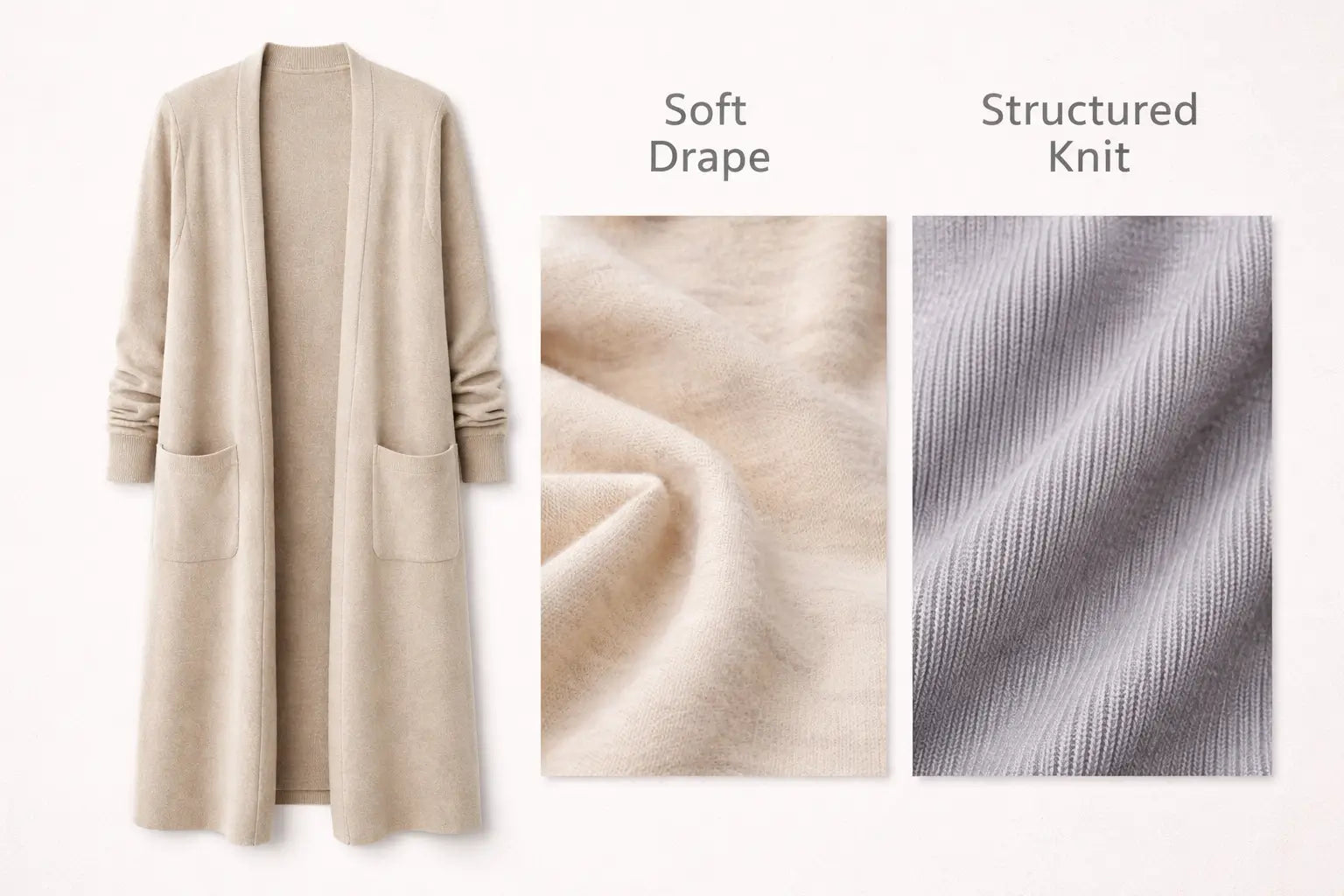
Best material picks for a long cardigan (longline/duster)
If you want one simple rule: the “best” material is the one that matches your climate, your itch tolerance, and how much structure you want in a long silhouette. Long cardigans are more likely to show sagging and abrasion than shorter knits, so durability and shape retention matter more than people expect.
| Your priority | Best material direction | Why it works for long cardigans |
|---|---|---|
| Warmth + cozy layering (cold weather) | Wool or wool-rich blends | Better warmth for weight; good for outer-layer cardigans when knit density is right |
| Breathable, everyday layering (mild weather) | Cotton or cotton blends | Comfortable and breathable; blends can help reduce sagging in long lengths |
| Easy care + less worry | Durable blends (often with synthetics) | Often easier maintenance and better shape retention than some 100% natural options |
| Sensitive skin / “no itch” | Soft-feel options or soft-feel blends | Comfort-first; focus on feel, finishing, and what you can tolerate all day |
Key points to keep you out of trouble:
- For long cardigans, “drape” and “recovery” are just as important as fiber. A long hem can “grow” if the knit is heavy or loosely constructed.
- Pilling is usually a friction problem, not just a fiber problem. Bag straps, hip abrasion, and washing friction matter.
- Don’t buy fiber content alone—buy fiber + knit quality. Two “cotton cardigans” can behave completely differently.
Boundary conditions (quick reality check):
- No fiber is “pill-proof” or “never-stretch.” This is about risk reduction.
- Knit density, yarn quality, and finishing can override general fiber expectations.
Once you know what a “long cardigan” really refers to, it’s easier to choose materials that look great and stay that way.
What counts as a “long cardigan”? (longline vs duster) + does length change material choice?
A “long cardigan” usually means a longline cardigan (below the hip) or a duster cardigan (often knee-length or longer). The longer the sweater, the more it behaves like a lightweight coat—so weight, drape, and shape retention become bigger deal-breakers.

Key points:
- Longline: typically below the hip or mid-thigh; great for layering and casual structure.
- Duster: longer, coat-like; needs better stability to avoid dragging or stretching.
- Length changes what “best” means: a long sweater magnifies hem weight, stretch, and abrasion zones.
Practical decision cues:
- Want a more structured look? Choose a material/knit that holds shape (often denser knits and supportive blends).
- Want a more drapey look? Choose a softer hand and a knit that flows—but accept slightly higher stretch/pill risk.
Boundary conditions:
- The “best length” depends on your proportions and layering goals; there’s no universal perfect number.
- Long, heavy cardigans need more stability than short, light ones.
With the silhouette clarified, the next step is choosing materials by the conditions you’ll actually wear it in.
Best materials by season & climate (winter vs spring/fall + year-round)
The best season choice usually comes down to warmth vs breathability and how heavy you want the cardigan to feel in a long silhouette.
| Season / climate | Best material direction | What to look for in a long cardigan |
|---|---|---|
| Winter / cold outdoors | Wool or wool-rich blends | Cozy warmth without excessive bulk; denser knit helps shape retention |
| Spring / fall / variable temps | Cotton blends or lighter wool blends | Breathability + easy layering; balanced drape (not too heavy) |
| Mild climates / indoor A/C | Midweight cotton blends or soft blends | Comfortable against skin; doesn’t overheat as easily |
| Year-round “one cardigan” | Balanced blends (or a lighter wool/cotton blend) | A middle ground: comfortable + more stable than many 100% options |
Key points:
- If you run hot, prioritize breathability and lighter knits—especially for indoor layering.
- If you need a coat-like cardigan, choose warmer fibers and denser construction.
- For year-round use, the “best” is usually the most balanced option, not the most extreme.
Boundary conditions:
- Indoor vs outdoor wear can flip the “best” choice (a warm wool cardigan can feel too hot indoors).
- Knit weight/density affects warmth as much as fiber does.
If you’re deciding between the most common options, the comparison below will help you pick with fewer regrets.
Wool vs cotton vs blends: which is better for cardigans?
For long cardigans, wool tends to win for warmth, cotton tends to win for breathability, and blends often win for everyday durability and shape retention—especially when you want a long hem to keep its line.

| Option | Best for | Feel & drape | Durability / pilling risk | Care reality |
|---|---|---|---|---|
| Wool (or wool-rich) | Cold weather layering | Can be cozy; drape varies by knit | Can pill with friction; quality matters | Often needs gentler care; follow label |
| Cotton | Mild weather, breathable comfort | Often comfortable; can feel heavier in long lengths | Can stretch/sag if heavy or loose knit | Can be easier, but not always “care-free” |
| Blends (natural + synthetic) | Everyday wear + shape retention | Often balanced drape and recovery | Often better recovery; pilling depends on yarn/finish | Often easier maintenance, but varies by product |
Takeaway picks (scenario-based):
- Choose wool/wool-rich if you want warmth and don’t mind more careful care.
- Choose cotton (or cotton blends) if you want breathability and a softer “everyday” feel.
- Choose blends if you want the long cardigan to keep its shape with fewer compromises.
Boundary conditions:
- “Wool” and “cotton” are categories, not guarantees—quality varies widely inside each group.
- Construction matters: a dense knit can outlast a loose knit even if the fiber content looks “better.”
Two quick fiber-specific notes make this comparison more actionable.
Wool: best for warmth (but check softness + care)
Wool is often a strong choice for a long cardigan when you want warmth and a cozy hand, but the best wool cardigan is the one that matches your comfort and care tolerance.
Key points:
- Wool-rich cardigans are often ideal for colder seasons and outer-layer styling.
- Softness is not automatic; it depends on fiber feel and finishing.
- Long cardigans benefit from a knit that doesn’t collapse under its own weight.
What to check before committing:
- Does it feel comfortable on bare skin, or do you need a layer underneath?
- Does the care label match your lifestyle (hand wash vs easy maintenance)?
Boundary conditions:
- Sensitive skin may prefer softer-feel options, blends, or layering.
- The warmest option isn’t always the most wearable indoors.
If you prefer breathability and easy everyday layering, cotton can be a great direction—when the longline risks are managed.
Cotton: breathable and easy-wearing (but watch longline sagging)
Cotton can be an excellent long cardigan material for mild weather and day-to-day comfort, but long silhouettes can reveal cotton’s biggest weakness: shape loss when the knit is heavy or loosely constructed.
Key points:
- Cotton is typically comfortable and breathable for spring/fall and indoor use.
- Long cardigans in cotton can feel “heavier” because the fiber doesn’t always recover like some blends.
- Cotton blends can help long hems keep their line better than some 100% cotton knits.
How to reduce sagging risk:
- Prefer a denser knit (less see-through, less floppy) for longline styles.
- If the cardigan feels heavy in hand, expect more “hem growth” over time.
Boundary conditions:
- Longer length amplifies stretch and distortion—especially at the hem and pockets.
- Care and drying method can change shape outcomes even with the same fiber content.
If comfort is your main concern—especially itch—use the framework below to choose more confidently.
Softness & itch control: least-itchy options and sensitive-skin tips
The softest long cardigan is usually the one that combines a comfortable handfeel with a knit that doesn’t irritate you after hours of wear. If you’re sensitive, pick the material direction based on what you know you can tolerate—and treat softness as something you verify, not assume.
Key points (comfort-first picks):
- If you want soft-to-the-touch, prioritize a smooth handfeel and avoid overly scratchy surfaces.
- If you want no-itch, favor options that feel comfortable on bare skin—or plan to layer.
- If you want soft + durable, be realistic: very soft finishes can sometimes trade off with pilling resistance.
A quick “softness” checklist you can use:
- Touch test: Does it feel comfortable on the inside of your forearm/neck area?
- Surface look: Very fuzzy, raised fibers can feel soft now but may pill faster with friction.
- Structure: Dense knits often feel smoother against skin than very loose, airy knits.
Sensitive-skin tips (practical, not medical):
- If you’re unsure, choose a cardigan that works with layering (a thin base layer can change comfort dramatically).
- Start with a material direction that feels safe for you, then optimize for warmth or durability second.
Boundary conditions:
- Sensitivity is personal; what’s “soft” for one person can be irritating for another.
- Finishing can change handfeel—and sometimes changes how quickly a surface shows wear.
Now let’s tackle what ruins long cardigans most often: pilling, stretching, and shape loss.
Durability: pilling + stretching + shape retention (long-cardigan-specific risks)
Long cardigans are more likely to pill and stretch because they experience more friction and more “lever effect” from length and weight. The best durability strategy is to combine sensible fiber choices with construction and care choices that reduce abrasion and help the garment recover.

Key points:
- Pilling is often driven by abrasion (wear + washing friction) as much as fiber content.
- Stretching and “hem growth” are driven by length + weight + knit looseness.
- The most durable long cardigan is the one that balances fiber, knit density, and care habits.
Boundary conditions:
- No material is “pill-proof”; this section focuses on reducing risk.
- Washing and drying choices can be as important as the original material choice.
A quick explanation of the “why” makes the prevention checklist easier to apply.
Why long cardigans pill and stretch more (simple mechanics)
Long cardigans tend to show wear faster because the silhouette increases friction and weight stress in predictable places.
Key reasons:
- More surface area means more rubbing against bags, desks, car seats, and your own movement.
- Abrasion zones (hips, sides, cuffs, under straps) repeatedly stress the yarn surface.
- Long hems carry weight, and that weight can slowly pull a knit downward.
- Loose knits move more, which can accelerate both pilling and distortion.
Boundary conditions:
- Frequent bag strap wear can accelerate pilling regardless of fiber choice.
- A stable knit can outperform a “premium” fiber in a loose construction.
With the mechanics in mind, use this checklist to lower your risk in a practical way.
Checklist: reduce pilling and hem growth (material + construction + care)
Use this as a “do more / do less” list when selecting or caring for a long cardigan.
Material + construction cues:
- Prefer denser knits for longline/duster styles when you want longevity.
- If you’re choosing cotton, consider cotton blends for better recovery in long hems.
- If you’re choosing soft-feel options, be aware that very fuzzy surfaces may show pilling sooner in high-friction use.
Care habits that reduce pilling:
- Reduce washing friction (gentler cycles when allowed, and avoid overloading).
- Keep high-friction items separated (zippers, rough fabrics, heavy denim) when washing.
- Drying method matters—follow the care label to reduce distortion.
Boundary conditions:
- This checklist reduces risk; it doesn’t guarantee outcomes for every garment.
- If you use the cardigan with high abrasion (daily bags/commutes), expect faster visible wear.
If easy maintenance is a must-have, the next section helps you choose materials without ignoring the realities of care labels.
Easy care: washability, shrinkage, and a quick care-label checklist
If you want easy care, choose a material direction that matches your real routine—and always treat the care label as the final authority for that specific garment. In the U.S., the FTC’s Care Labeling Rule requires manufacturers and importers to provide care instructions that consumers can easily find at the point of sale. (ftc.gov)
Key points:
- “Easy care” usually means predictable care, not “anything goes.”
- Shrinkage and distortion depend on fiber, knit structure, and the care method used.
- For long cardigans, drying choices can strongly affect shape over time.
Quick care-label checklist (before you buy):
- Look for whether it’s machine washable (and under what conditions).
- Check drying guidance (air dry / tumble dry / flat dry); long knits often prefer shape-friendly drying.
- If the label reads like a “high maintenance” routine and you won’t follow it, choose a different option.
Boundary conditions:
- Care instructions can differ across garments with the same fiber content.
- If a product is packaged or folded so you can’t see the label, care information should still be provided in a way consumers can access (e.g., on packaging or a hang tag), per FTC guidance. (ftc.gov)
Once care is covered, it helps to know how to spot better knitwear quickly—especially when two cardigans look similar online.
Quality cues before buying: how to spot better knitwear (and red flags)
You can’t guarantee sweater quality from fiber content alone, but you can reduce risk by checking a few high-signal cues around construction, surface, and labeling.
A practical quality checklist:
- Knit density: denser knits often hold shape better in long silhouettes than very loose knits.
- Surface: extreme fuzz can feel soft but may show wear faster under abrasion.
- Shape recovery: gently stretch a cuff/edge; does it bounce back or stay “relaxed”?
- Label clarity: clear fiber content and clear care instructions reduce surprises.
Red flags (especially for longline/duster styles):
- Very loose knit + long length + heavy pockets (higher sagging risk).
- High-friction lifestyle (daily bag straps) + very fuzzy surface (higher pilling visibility).
- Vague product descriptions that don’t match what the label typically needs to disclose.
Boundary conditions:
- A perfect-looking label doesn’t guarantee durability, but it’s a good starting filter when shopping online.
If you’re choosing materials for a collection (not just one cardigan), the next section translates these ideas into a production-ready checklist.
For brands/private label: yarn & material selection checklist for production
For long cardigans, the best production results come from locking your “definition of success” early—handfeel, drape, recovery, care target—then validating it through sampling before bulk. The goal isn’t to chase a single “best fiber,” but to choose a material direction + knit construction that consistently hits your product promise.
A simple end-to-end workflow:
- Define the use case (season, customer comfort expectations, care target, price tier).
- Choose the silhouette targets (length, drape vs structure, pocket weight considerations).
- Shortlist 2–3 material directions (including a blend option for stability).
- Develop samples that match the intended knit density and finishing.
- Validate comfort and durability through wear + wash checks.
- Lock specs before bulk to reduce drift.
Production-focused checklist (what to decide up front):
- Season/climate target (winter layering vs year-round vs shoulder season)
- Customer comfort target (soft-feel / non-itch tolerance expectations)
- Care target (easy care vs premium care)
- Drape vs structure (flowy vs coat-like)
- Durability tolerance (how much pilling/shape change is acceptable for your price tier)
Boundary conditions:
- Material feasibility depends on yarn availability, order quantity, and target price.
- Sampling outcomes can differ from bulk if construction and finishing controls aren’t locked.
If you’re developing a long cardigan style and want a manufacturer-ready material shortlist, prepare:
- a tech pack (or a clear reference sample),
- target order quantity range,
- target ship date,
- and your care requirement (easy care vs premium care). That information is usually enough to narrow yarn directions and plan sampling efficiently.
With the workflow in place, these two sub-checklists help you reduce sampling loops and quality surprises.
Tech pack must-haves for a long cardigan (to reduce sampling loops)
A long cardigan needs more clarity around stability than a shorter knit, because length magnifies drift.
Must-have spec areas (keep it practical):
- Fiber content targets (and acceptable variation ranges, if any)
- Knit density/gauge direction (dense vs airy; structured vs drapey)
- Handfeel target (smooth vs brushed; soft-to-touch vs crisp)
- Weight/drape expectations (how it should hang and move)
- Care target (the maintenance promise you plan to communicate)
Boundary conditions:
- Avoid over-specifying details you can’t validate—use sampling to confirm what’s realistic.
If you want fewer surprises, treat sampling as performance validation, not just a visual approval.
Sampling gates: what to test (pilling, shrinkage, stretch recovery) before bulk
A long cardigan should be validated for the risks that show up after real wear—especially abrasion and hem growth.
Practical sampling gates:
- Wear test in high-friction use (bags/commute) to see early pilling behavior.
- Wash-and-dry check aligned to the intended care instructions to observe shape drift.
- Stretch/recovery check at cuffs, hem, and pocket areas (where long cardigans often distort first).
Boundary conditions:
- Name specific test methods only when your lab/spec sheet verifies the exact method; otherwise, define the performance outcome you need.
If you’re selling into the U.S., it’s also worth aligning your product claims with the basics of labeling rules.
US basics: fiber content + care labeling (policy-guarded, high-level)
In the U.S., fiber and care labeling are not just “nice to have”—they’re part of meeting consumer expectations and reducing compliance risk. At a high level, the FTC’s Textile Fiber Rule requires certain textiles to carry labels that disclose generic fiber names and percentages by weight, the name (or RN) of the responsible company, and the country where the product was processed or manufactured. (ftc.gov)
Key points:
- Treat fiber content as a disclosure obligation, not marketing copy.
- Align product page claims with what the physical label will disclose.
- Keep care instructions consistent with the garment’s construction and finishing.
Common mistakes to avoid:
- Using vague or inconsistent fiber descriptions across hang tags, packaging, and product pages.
- Overstating performance (“won’t pill,” “never shrinks”) without real validation.
- Forgetting that consumers need care information in a way they can access at the point of sale. (ftc.gov)
Boundary conditions:
- Always verify exact requirements using official guidance (this is not legal advice).
- Requirements can vary by product context; use official references as the source of truth.
Two quick sub-sections keep this clear and usable without turning the article into a compliance manual.
Fiber content labeling (what to get right)
The practical goal is accuracy and consistency: consumers and retailers should see the same fiber story everywhere, and it should match the label’s disclosures.
Key points (high-level):
- Use generic fiber names and accurate percentages by weight where required.
- Include the responsible company identification and country-of-origin information where applicable. (ftc.gov)
Boundary conditions:
- When in doubt, rely on official FTC materials and compliance guides. (govinfo.gov)
Care labeling matters just as much for returns and customer satisfaction as it does for compliance.
Care labeling (what buyers and shoppers should check)
Care labels are where “easy care” becomes real. The FTC’s Care Labeling Rule requires care information to be provided and accessible to consumers at the point of sale. (ftc.gov)
What to check (practical):
- Can the buyer realistically follow the instructions (wash method, drying method)?
- Do the instructions match the product promise you plan to communicate?
Boundary conditions:
- Always follow the garment label for that specific product; “rules of thumb” can mislead. (ftc.gov)
If sustainability matters to your customers, keep claims specific and verifiable.
Sustainability & safe claims (what you can say vs what you must verify)
The safest approach is to avoid blanket “eco-friendly” claims and instead use specific, documentable statements. Many sustainability claims require certification or verified chain-of-custody systems to be credible.
Key points:
- “Sustainable” depends on sourcing and processing, not fiber name alone.
- If you’re referencing a standard, name the standard and ensure the supply chain is certified where required.
- Keep claims proportional: describe what you know and can document.
Examples of claim-safe directions (when verified):
- Responsible wool programs: Textile Exchange’s Responsible Wool Standard (RWS) is a voluntary standard that requires certification through the supply chain. (textileexchange.org)
- Recycled content claims: Textile Exchange’s RCS/GRS frameworks set criteria for third-party certification and chain-of-custody for recycled materials. (textileexchange.org)
- If you need a starting map of major standards, Textile Exchange lists common standards like GRS, OCS, RCS, and RWS. (textileexchange.org)
Boundary conditions:
- Don’t imply certification unless you can verify it with documentation.
- Avoid absolute claims (“100% sustainable,” “carbon neutral”) unless you have robust proof.
To wrap up the decision, here are quick answers to the most common questions shoppers and brands ask.
FAQ
-
Q: What is the best material for a cardigan sweater?
A: The best material depends on your climate, comfort needs, and care preference. Wool-rich options usually suit cold-weather layering, cotton suits breathable everyday wear, and blends often offer the best balance of shape retention and easy maintenance. -
Q: Is wool or cotton better for a cardigan sweater?
A: Wool is typically better for warmth, while cotton is typically better for breathability. For long cardigans, blends can be a practical middle ground when you want the garment to keep its shape with fewer care compromises. -
Q: Is 100% cotton good for a cardigan?
A: Yes—100% cotton can be great for mild weather and comfortable layering. The main watch-out for longline styles is sagging and shape drift if the knit is heavy or loosely constructed, so knit density and drying method matter. -
Q: What is a long cardigan called?
A: A long cardigan is commonly called a longline cardigan (below the hip) or a duster cardigan (often knee-length or longer). These longer silhouettes behave more like light outerwear, so drape and shape retention matter more. -
Q: What’s the best length for a long cardigan?
A: The best length is the one that fits your proportions and layering goals—there’s no single perfect number. If you want a coat-like look, longer “duster” lengths work well; if you want easy everyday wear, a longline length can be more practical. -
Q: What material pills the least for a long cardigan?
A: Lower pilling risk usually comes from a stable knit and lower friction use, not a single “magic” fiber. Denser knits and practical care habits often reduce visible pilling, while very fuzzy surfaces and high abrasion (bag straps) can increase it. -
Q: Why do long cardigans stretch out, and how do you prevent it?
A: Long cardigans stretch out because length and weight create more pull at the hem and pockets, and loose knits recover less. Prevent it by choosing stable construction (denser knits), avoiding heavy pocket loads, and following shape-friendly care and drying instructions. -
Q: What’s the best material for a year-round long cardigan?
A: A balanced blend is often the most versatile year-round choice because it can combine comfort with better shape retention. If you run hot, lean toward breathable options; if you run cold, lean warmer while keeping the knit weight manageable.
Before you decide, it helps to summarize the “quick picks” and the few factors that matter most.
Summary: quick picks + next steps
Quick picks:
- Want warmth and cozy layering? Choose wool or wool-rich blends, and prioritize stable knit construction.
- Want breathable everyday wear? Choose cotton or cotton blends, and watch longline sagging in heavy/loose knits.
- Want lower-maintenance, stable shape? Choose practical blends, then validate with wear and wash behavior.
- Want comfort-first / sensitive skin? Choose what feels good on skin, and treat softness as something you verify.
Next steps:
- If you’re a shopper: choose your scenario (cold vs mild, indoor vs outdoor), then check knit density and care instructions before buying.
- If you’re a brand: lock your care target and silhouette goals early, then use sampling to validate pilling, recovery, and post-wash shape before bulk.
- If you’re selling in the U.S.: keep fiber and care information consistent across label, hang tag, and product page, and verify details using official references. (ftc.gov)
)