
What to Wear Under a Cardigan Sweater: Best Tops, Neckline Rules, and Easy Outfit Ideas
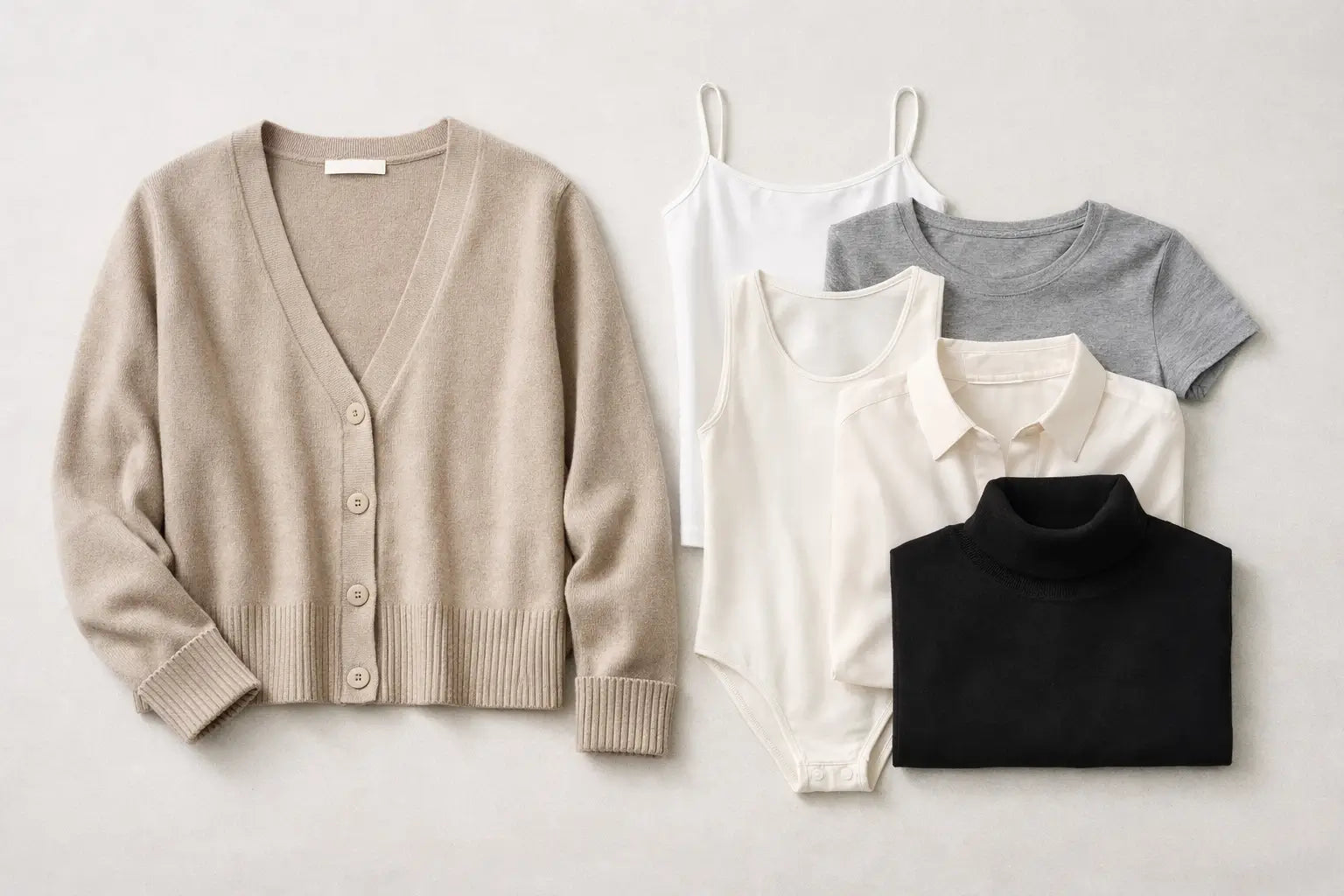
Cardigans are easy—until the outfit looks bulky, the neckline looks “off,” or the layers bunch up. This guide helps you pick the right top to wear under a cardigan based on the cardigan’s shape, knit weight, and where you’re wearing it.
What to Wear Under a Cardigan Sweater
The best thing to wear under a cardigan is a smooth, low-bulk top that matches the cardigan’s thickness and neckline. For chunky or oversized cardigans, go sleeker underneath; for fitted cardigans, keep the base thin so it doesn’t bunch.
Best underlayers (quick picks)
- Cami or tank: best for warm weather, open-front cardigans, or adding a comfortable “barrier” under itchier knits.
- Fitted tee (short or long sleeve): the easiest everyday option—low bulk, easy to tuck, and works with most cardigan types.
- Bodysuit: the cleanest silhouette (no rolling hem), especially under fitted cardigans or when you want a polished look.
- Blouse or silky shirt: best for work or dressier outfits—choose smooth fabrics to avoid lumps under knit sleeves.
- Button-down/oxford: great for business casual; works best under finer-gauge cardigans with enough sleeve room.
- Turtleneck or mock neck: best for cold weather and deep V cardigans; keeps the neckline intentional and warm.
Mini-table: underlayer → best for
| Underlayer | Best for | Quick note |
|---|---|---|
| Cami/tank | Warm weather, open cardigans | Choose smooth straps to reduce visible lines |
| Fitted tee | Everyday, most cardigans | Thin fabric helps prevent sleeve bunching |
| Bodysuit | Sleek, “no-bulk” outfits | Ideal under fitted cardigans |
| Blouse | Work, dressier looks | Keep seams minimal for a smoother drape |
| Button-down | Business casual | Best under fine-knit cardigans |
| Turtleneck/mock | Cold weather | Great with V-necks and open fronts |
Keep in mind
- If the cardigan sleeves are narrow, choose thinner fabrics and slimmer sleeves underneath.
- If you plan to button the cardigan, pick an underlayer that won’t show awkwardly at the neckline (or decide to wear none based on opacity and comfort).
If you’re choosing between a fitted cardigan and a chunky one, the comparison below will make the decision much faster.

Choose Your Underlayer by Cardigan Type (Fitted vs Chunky vs Cropped vs Longline)
As a rule: the thicker or roomier the cardigan, the sleeker the underlayer should be. This keeps your outfit from looking “puffy” and helps the cardigan drape the way it’s meant to.
Comparison table: cardigan type → best underlayers (and what to avoid)
| Cardigan type | Best underlayers | Avoid (most of the time) |
|---|---|---|
| Fitted / slim cardigan | Bodysuit, fitted tee, thin cami, smooth knit shell | Thick rib knits, bulky hems, layered collars that bunch |
| Chunky / oversized cardigan | Fitted tee, bodysuit, slim turtleneck, smooth tank | Another chunky sweater, hoodies (neck bulk), thick seams |
| Cropped cardigan | Shorter tee, bodysuit, slim tank | Long untucked tops that create “two hems” mid-hip |
| Longline cardigan | Longer tee/tank, bodysuit + tuck, slim turtleneck | Wide, boxy tops with lots of fabric at the waist |
Quick notes for cropped and longline cardigans
- Cropped cardigans look cleanest with a high-rise bottom and either a bodysuit or a top that can half-tuck without bunching.
- Longline cardigans look more intentional when the base layer is either slim and tucked (to show waist definition) or long enough to look like a deliberate layer (instead of an accidental mismatch).
Keep in mind
- “Knit-on-knit” layering can work, but it’s easiest when the underlayer is fine-gauge and smooth, not equally chunky.
- Sleeve room matters more than you think—if your cardigan sleeves are snug, a thin long sleeve tee will often look better than a blouse with extra fabric.
Once the silhouette is under control, neckline choices are the next biggest reason cardigan outfits look polished (or not).

Neckline Pairing Rules (V-neck, Crewneck, Deep Necklines, and Collars)
Necklines don’t need to “match,” but they should look intentional. The simplest way to get there is to pair similar shapes—or use a higher neckline when you want a clean, modern contrast.
Rule bullets: what to wear under V-neck vs crewneck cardigans
- V-neck cardigan (worn open): choose a V-neck, scoop, or square neckline underneath so the lines look deliberate.
- V-neck cardigan (buttoned): a higher neckline (crew or mock) can look modern and prevents “too much” plunge if that’s not your goal.
- Crewneck cardigan: choose a crewneck or mock neck base layer for a smooth, stacked look.
- Deep neckline cardigan: if you want more coverage, pick a higher neckline (crew, mock, turtleneck) so you don’t have to fuss with straps.
- Textured cardigan (cable, boucle): keep the underlayer simple (smooth fabric, minimal trim) so the neckline doesn’t look busy.
Collared shirt under a cardigan (how to keep it neat)
- Pick a thin, structured shirt (oxford or poplin-like) so the collar stays crisp.
- If the cardigan is fitted, choose a shirt with less fabric in the body (or tuck and smooth the waistline).
- Keep the collar look intentional: either let it sit cleanly outside the cardigan neckline, or wear a cardigan with enough opening that the collar doesn’t crumple.
- If sleeves bunch, switch to a fine-knit cardigan or a shirt with slimmer sleeves.
Keep in mind
- When a cardigan is worn open, your base-layer neckline is more visible—this is where neckline pairing matters most.
- When a cardigan is buttoned, the base layer is often less visible—comfort and smoothness become the priority.
If you’re dressing for work, these neckline rules pair best with a few “safe” office-ready underlayers.

What to Wear Under a Cardigan for Work (Business Casual Picks)
For work, aim for smooth fabrics, clean necklines, and minimal bulk under the cardigan sleeves. If your cardigan is fine-knit, you can wear slightly more structured tops; if it’s chunky, keep the base layer sleek.
Best work-ready picks
- Blouse (smooth, not ruffled): looks polished without adding bulk.
- Button-down/oxford: classic business casual; best under fine-knit cardigans.
- Knit shell top: sleek under any cardigan and easy to layer.
- Fine long-sleeve tee: the simplest “quiet” base layer for more conservative dress codes.
- Turtleneck/mock neck (cool offices): warm, tidy, and looks intentional under V-necks.
Mini outfit formulas
- Knit shell + fine cardigan + trousers + loafers (easy and polished)
- Button-down + fine cardigan + midi skirt + flats (clean layers, office-friendly)
- Blouse + cardigan + straight-leg pants + low heel (dressier but still comfortable)
Keep in mind
- In a chilly office, a thin long sleeve or light thermal-style base under a cardigan is often warmer (and less bulky) than stacking two chunky knits.
- If your workplace has neckline rules, start with a crew or mock base layer and adjust from there.
If you like the idea of wearing the cardigan as the top itself, the next section helps you decide whether you need anything underneath.

If You Button the Cardigan: Do You Need an Underlayer?
Sometimes yes, sometimes no. If the cardigan is opaque, comfortable, and fits without button gaps, you can often wear it on its own. If it’s sheer, gappy, itchy, or prone to pulling at the buttons, a thin underlayer makes the outfit look cleaner and feel better.
Wear an underlayer when…
- The knit is slightly sheer or you can see skin through the stitches.
- The buttons create gaps when you move (especially across the chest).
- The yarn feels itchy and you want a soft barrier.
- You want more coverage without constantly adjusting.
You can skip an underlayer when…
- The cardigan is thick/opaque and lies flat when buttoned.
- The neckline is what you want (and you’re comfortable with how it fits).
Low-profile underlayers that don’t “ruin the look”
- A tone-matching cami (so it disappears)
- A bodysuit (smooth under the buttons)
- A thin crewneck tee (clean and casual)
If temperature is the real problem—too warm outside or too cold indoors—use the seasonal picks below to keep layers comfortable and low-bulk.
Warm vs Cold Weather: Seasonal Underlayers (Plus Chilly Offices)
Your best underlayer changes more with temperature swings than with the calendar. In warm weather, prioritize breathability. In cold weather, prioritize warmth without stacking bulky layers.
| Situation | Best underlayers | Why it works |
|---|---|---|
| Warm / humid | Cami, tank, lightweight tee | Breathable and low bulk under open cardigans |
| Mild / transitional | Fitted tee, long-sleeve tee, knit shell | Easy to adapt indoors/outdoors |
| Cold / windy | Turtleneck/mock neck, thin long sleeve, light base layer | Warmth without adding thick seams under sleeves |
| Chilly office AC | Long-sleeve tee, mock neck, knit shell | Comfortable indoors; still layers cleanly |
Keep in mind
- If you’re warm indoors but need a cardigan “just in case,” a tank or thin tee underneath usually looks better than a thick base layer.
- If you’re cold outdoors, add warmth with a thin base layer first—then the cardigan—rather than piling on multiple heavy knits.
If your cardigan outfits tend to look bulky or “frumpy,” it usually comes down to a handful of fixable layering issues.
How to Avoid Bulk, Bunching, and “Frumpy” Cardigan Outfits
A cardigan looks most modern when the layers are smooth, the proportions are intentional, and the neckline looks clean. Most “frumpy” moments happen when there’s too much fabric at the waist, too much thickness in the sleeves, or too many competing necklines.
No-bulk checklist (do this first)
- Choose smooth fabrics (thin jersey, fine knits, streamlined blouses) under knitwear.
- Avoid thick hems and bulky trims under fitted sleeves.
- Keep underlayer sleeves slim if the cardigan sleeves are slim.
- Use a bodysuit or a clean tuck to prevent a rolling hem.
- Balance volume: chunky cardigan + slim base layer + straighter bottoms often looks sharper than “wide + wide.”
- Keep the neckline simple: one “statement” at a time (collar or necklace or deep V).
Quick swaps that fix the look
- Bulky hoodie under a cardigan → thin long-sleeve tee + scarf (less neck bulk)
- Thick ribbed top under a fitted cardigan → smooth tee or bodysuit
- Blouse that bunches in sleeves → knit shell or fine-gauge tee
Keep in mind
- Some cardigans are cut narrow in the arms—when that happens, the best fix is usually thinner fabric, not a different style “trick.”
- Textured knits layered over textured tops can increase bulk and friction; if the cardigan is very textured, keep the base layer simpler.
To avoid most layering problems entirely, it helps to know what not to wear under a cardigan—and what to swap in instead.

What Not to Wear Under a Cardigan (Common Mistakes + Easy Swaps)
You don’t have to avoid these items forever—just be aware they’re more likely to create lumps, bunching, or messy necklines under knitwear.
Common mistakes
- Hoodies under most cardigans: the hood adds bulk at the neckline and can distort the cardigan shape.
- Thick seams and bulky hems: they often show through or bunch at the waist.
- Two chunky knits stacked together: can look puffy unless both are fine-gauge and intentionally styled.
- Busy necklines (ruffles, large bows) under textured cardigans: creates a crowded look.
- Oversized tops under fitted cardigans: extra fabric has nowhere to go, so it bunches.
Easy swaps
- Hoodie → thin long-sleeve tee or mock neck
- Chunky rib knit → smooth tee or knit shell
- Very detailed blouse → minimal blouse or button-down in a thinner fabric
Keep in mind
- Oversized cardigans can handle slightly more volume underneath, but the base layer still looks cleaner when seams and hems are minimal.
If you want quick outfit ideas you can repeat without overthinking, use these formulas and adjust the base layer using the rules you’ve already seen.
Easy Outfit Formulas with a Cardigan (By Occasion)
These formulas keep the cardigan as the flexible layer and make the underlayer choice obvious. Swap the underlayer (tank/tee/blouse/turtleneck) based on the cardigan type and the temperature.
1) Everyday casual
- Fitted tee (or tank)
- Cardigan (open)
- Straight-leg jeans
- Sneakers or flats
2) Business casual
- Knit shell or blouse
- Fine-knit cardigan
- Trousers or midi skirt
- Loafers or low heel
3) Cozy weekend
- Long-sleeve tee
- Chunky cardigan
- Leggings or relaxed jeans
- Casual boots or sneakers
4) Dressier evening
- Bodysuit or sleek top
- Cardigan (fitted or cropped)
- Tailored pants or a skirt
- Heeled boot or sleek flat
5) Cold-weather layering
- Turtleneck/mock neck
- Cardigan (open or buttoned)
- Structured bottoms (denim, wool trousers)
- Boots + optional coat on top
Buttoned vs open rule
- Wear it buttoned when you want the cardigan to feel like the top (sleek base, clean neckline).
- Wear it open when your underlayer is the “outfit anchor” (neckline or blouse detail showing on purpose).
Keep in mind
- If your cardigan is chunky, keep the base layer slim; if your cardigan is fitted, keep the base layer thin and smooth.
If you’re shopping or styling for men, here’s the short version that covers the most common under-cardigan choices.

Men: What to Wear Under a Cardigan Sweater
Men’s cardigan layering works best when the underlayer is lightweight and the neckline looks intentional.
Go-to options
- Crewneck tee: easiest casual base under most cardigans.
- Oxford/button-down: best for smart casual, especially under fine-knit cardigans.
- Lightweight crew sweater: works under roomy cardigans (avoid stacking two bulky knits).
- Turtleneck: a clean cold-weather option, especially under open-front styles.
Keep in mind
- The cleaner the base layer (thin fabric, minimal seams), the better the cardigan drapes—especially when the cardigan is more fitted.
If you’re wondering whether cardigans are “still a thing” this year, the trend check below answers it briefly and then points you back to practical styling.
Are Cardigans Still in Style in 2026?
Yes—cardigans are still featured heavily in 2026 knitwear coverage, especially as statement layers and as buttoned-up tops. What changes year to year is the details (color, silhouette, closures, and styling).
Trend signals that look current in 2026
- Bolder colors and soft pastels show up repeatedly in cardigan and knitwear trend roundups. (whowhatwear.com)
- Cropped and set-style looks (cardigans styled with matching knit pieces) are widely highlighted. (whowhatwear.com)
- Statement necklines and shapes (including deeper V-necks and more sculpted silhouettes) appear in 2026 knitwear trend coverage. (vogue.co.uk)
- Buttoned-up cardigan-as-top styling continues to be a common “modern” way to wear the piece. (whowhatwear.com)
Sources for the 2026 trend note (URLs shown in code form):
- Who What Wear (Cardigan trends 2026):
https://www.whowhatwear.com/fashion/jumpers-sweaters/cardigan-trends-2026 - Vogue UK (Knitwear trends 2026):
https://www.vogue.co.uk/article/knitwear-trends-2026 - Glamour (Spring 2026 cardigan styling):
https://www.glamour.com/story/how-to-wear-a-cardigan-to-reinvent-the-wardrobe-staple
Keep in mind
- Trends vary by region and personal style—use these as signals, then apply the practical rules in this guide (fit, knit weight, and neckline) to make the look your own.
If you want the entire guide in one quick glance, the recap below summarizes the layering rules that prevent most cardigan outfit problems.
Quick Recap: 6 Rules for Clean Cardigan Layering
- Match thickness to thickness: the chunkier the cardigan, the slimmer and smoother the base layer.
- Respect sleeve room: narrow cardigan sleeves need thin, slim sleeves underneath.
- Use neckline intention: V with V/scoop, crew with crew/mock, and go higher if you want more coverage.
- Minimize hem bulk: bodysuits or clean tucks beat rolling hems under knitwear.
- Balance proportions: big cardigan + slim base layer + straighter bottoms is a reliable modern formula.
- Keep texture focused: if the cardigan is highly textured, keep the underlayer simpler.
If you’re still deciding between a couple of options, the FAQ answers the most common “what should I wear under it?” questions in a few lines each.
FAQ
What looks good under a cardigan?
-
Q: What looks good under a cardigan?
A: A smooth, low-bulk top almost always looks best—think a fitted tee, bodysuit, blouse, or slim turtleneck. If the cardigan is chunky, keep the underlayer sleek; if it’s fitted, keep the base thin so it doesn’t bunch at the sleeves.
What to wear under a chunky cardigan so it doesn’t feel bulky?
-
Q: What to wear under a chunky cardigan so it doesn’t feel bulky?
A: Choose a slim base layer like a fitted tee, bodysuit, or thin turtleneck. Avoid thick hems, hoodies, and equally chunky knits—those add volume at the waist and neckline and can make the outfit feel puffy.
Do you wear anything under a cardigan if you button it up?
-
Q: Do you wear anything under a cardigan if you button it up?
A: It depends on opacity and fit. If the knit is sheer, itchy, or gaps at the buttons, a tone-matching cami, bodysuit, or thin tee makes the look cleaner; if it’s opaque and comfortable, you can often wear it on its own.
What to wear under a cardigan for work?
-
Q: What to wear under a cardigan for work?
A: A smooth blouse, button-down, knit shell, or fine long-sleeve tee is the safest choice. Pair fine-knit cardigans with slightly more structured tops, and keep underlayers sleek if the cardigan is chunky to avoid bulk at the sleeves.
How to wear a cardigan and not look frumpy?
-
Q: How to wear a cardigan and not look frumpy?
A: Keep the base layer smooth and fitted, reduce hem bulk (tuck or bodysuit), and balance proportions (roomy cardigan with straighter bottoms). Clean necklines help too—avoid stacking collars, ruffles, and bulky layers at the neck.
What neckline should you wear under a cardigan?
-
Q: What neckline should you wear under a cardigan?
A: Match shapes for an intentional look: V-neck cardigans pair well with V, scoop, or square necklines; crewneck cardigans pair well with crew or mock necks. If the cardigan neckline is deep and you want coverage, choose a higher base layer like a mock neck or turtleneck.
What should you not wear under a cardigan?
-
Q: What should you not wear under a cardigan?
A: Avoid hoodies (neck bulk), thick hems, and equally chunky knits under fitted cardigans. If your cardigan is textured, skip busy necklines and heavy trims underneath and swap to smoother, thinner tops.
Are cardigans still in style in 2026?
-
Q: Are cardigans still in style in 2026?
A: Yes—cardigans continue to show up in 2026 knitwear and styling coverage, often as statement layers and as buttoned-up tops. What looks most current tends to be about details (color, silhouette, and neckline), so use the fit and neckline rules in this guide to keep the outfit feeling modern. (whowhatwear.com)
For Brands & Product Teams (Optional): Design Cardigans That Layer Well
If you’re developing a cardigan line (or sourcing custom knitwear), “layerability” is usually decided early—by knit weight, neckline depth, sleeve room, and closures.
Practical inputs that help sampling go faster:
- Intended wear: open vs buttoned-as-a-top
- Target climate: warm / transitional / cold
- Base-layer expectation: tee, blouse, turtleneck, etc.
- Knit weight and stretch goals (to reduce button gaps and bunching)
- Trims and hems that won’t add bulk
If you want a manufacturer to quote accurately, prepare: your design/tech pack, target quantity, preferred yarn/fiber direction, and target ship date—then confirm sampling and production timelines based on the specific style and materials.
