
Diamond Pattern Sweater (Argyle): Meaning + How to Spec a Custom Knit (Tech Pack Checklist & QC Points)
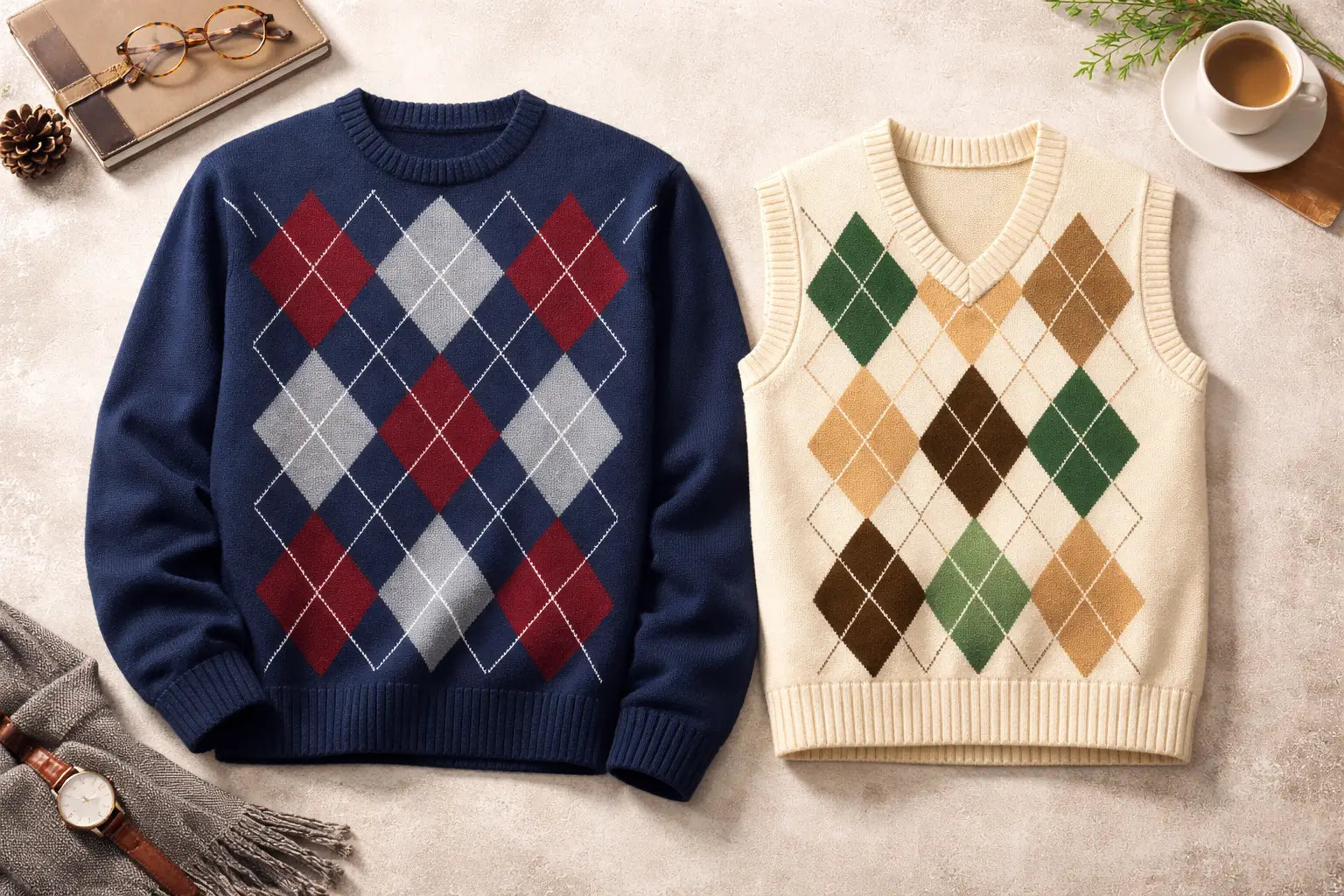
A “diamond pattern sweater” usually means a sweater with diamond (lozenge) motifs—and in many shopping results, it’s referring to argyle, a classic diamond layout often finished with diagonal overlay lines.
If you want this look made for a brand (OEM/ODM), the biggest success factors are: choosing the right knit method (intarsia vs jacquard), specifying the repeat + placement, and checking alignment and color approvals before bulk.
- Argyle: diamonds/lozenges arranged on the diagonal, commonly with crossing diagonal lines on top.
- “Diamond pattern”: broader term—can include argyle, but can also mean other diamond motifs (including textured diamonds).
- Best next step for custom production: lock your silhouette + size range, then define the motif repeat/placement and colorway clearly.
Boundary notes:
- “Diamond pattern” is used loosely in retail; a reference image is the safest way to confirm what you mean.
- Not every “diamond” sweater is argyle—some are textured stitches rather than color motifs.
A quick terminology check makes the rest (technique choice and specs) much easier.
What “Diamond Pattern Sweater” Means (and When It’s “Argyle”)
This section helps you name the pattern correctly so you can brief a factory clearly and avoid sampling revisions caused by misunderstood terminology.
Diamond pattern vs argyle: quick visual cues
A “diamond pattern sweater” describes the look (diamonds on the surface). Argyle is a specific diamond/lozenge pattern layout—typically diagonal diamonds with intersecting diagonal lines layered over solid diamonds.
Key cues you can use when brief-ing:
- Classic argyle look: flat color-block diamonds + thin diagonal lines crossing over (often forming an “X”).
- “Diamond pattern” (broad): diamonds may be outlined, filled, or simplified (sometimes without overlay lines).
- Textured diamonds: raised texture (like cables or stitch texture) forming diamond shapes—visually “diamond,” but not argyle.
Boundary notes:
- Some brands use “argyle” to mean “any diamond look,” even without overlay lines—confirm with an image.
- In knitwear discussions, “argyle” often implies a color motif (not a raised texture).
If your goal is custom production, the next decision is how the diamonds will be knitted into the fabric.
Mini glossary: argyle diamonds vs “diamond stitch” texture
These terms get mixed up, so it helps to separate them early:
- Argyle (motif/layout): diamonds/lozenges arranged diagonally; commonly has diagonal overlay lines.
- Diamond motif (generic): any diamond pattern, including simplified diamonds without overlay lines.
- Diamond stitch / textured diamond: diamonds created by knit structure (texture), not by multi-color motif.
Boundary notes:
- If you want crisp, graphic diamonds, you’re usually talking about a color motif (often argyle-style), not a textured stitch.
- If you want a heritage, tactile look, a textured diamond can be the intent—describe “raised texture” explicitly.
Now that naming is clear, you can choose a knit method that matches your design and constraints.
Common Diamond Motif Variations (Optional, Skimmable)
This is a quick menu of “diamond looks” you’ll see—useful if you’re selecting a direction from inspiration images.
Outlined diamonds, solid diamonds, textured diamonds, argyle-with-overlays
Most “diamond pattern sweaters” fall into a few repeatable motif families:
- Classic argyle: multi-color diamonds on the diagonal, often with diagonal overlay lines.
- Outlined diamonds: a single-line outline around diamonds (minimal, clean, easy to modernize).
- Solid diamonds: filled diamonds (bold, graphic; can be two-tone or multi-tone).
- Micro-diamonds: smaller repeats for an all-over texture-like effect (still a color motif).
- Textured diamonds: raised diamond shapes created by knit structure (not argyle).
Boundary notes:
- The “right” motif depends on your brand aesthetic and what you can specify clearly (repeat size and placement matter).
- Don’t assume overlay lines are included—state it explicitly.
Once you pick a motif family, the next step is choosing a technique that produces the look you want.
How Diamond/Argyle Patterns Are Made in Knitwear (Intarsia vs Jacquard)
This section helps you choose a construction method that fits your design (motif scale, color layout, and desired fabric feel).
Intarsia vs jacquard: what changes in fabric look and construction
For diamond/argyle knits, you’ll most often choose between intarsia and jacquard-style multi-color knitting (often discussed alongside stranded/Fair Isle concepts). In simple terms:
- Intarsia builds separate color areas without carrying unused yarn across the back—so you avoid long “floats.”
- Jacquard-style multi-color knitting can create repeating patterns, and depending on the exact structure, may involve floats or a patterned reverse/back behavior.
Key points to keep in mind:
- Intarsia is often associated with large, well-defined color blocks (logos, big shapes).
- Jacquard methods are often used for repeating multi-color patterns and can change fabric density/behavior.
Boundary notes:
- Terms can be used loosely in apparel discussions—define what you mean with a reference image and desired fabric behavior.
- The best method depends on your design goals and constraints, not a universal “winner.”
The comparison table below is the fastest way to decide.
Comparison table: Intarsia vs Jacquard for diamond/argyle
| Technique | Best for (design scenario) | Visual result | Common tradeoffs | What you must specify |
|---|---|---|---|---|
| Intarsia | Large, isolated diamonds/blocks; strong graphic shapes | Clean color blocks; no long carried yarn across the back | More planning for color areas; can add complexity at color joins | Diamond repeat size, exact color areas, placement map, and symmetry rules |
| Jacquard-style multi-color knitting | Repeating patterns across a panel or all-over designs | Strong repeat patterns; back side behavior depends on structure | Fabric feel/weight/back appearance varies; may manage floats or use structures that hide them | Repeat scale, color sequence, where pattern must align, and expectations for reverse/back appearance |
Boundary notes:
- If you care about the inside/back being neat (e.g., for unlined garments), say so early—construction choices follow.
- Color count, repeat complexity, and placement rules affect feasibility and quoting.
With a technique direction in mind, you can turn an inspiration photo into a production-ready brief.
Quick rules of thumb (scenario pickers)
Use these to choose faster—then confirm with your manufacturer using your reference image:
- If the design has big, isolated diamonds and you want no long carried yarn across the back, intarsia is often the starting point.
- If the design is a repeating multi-color pattern across a panel or all-over, jacquard-style methods are commonly considered.
- If you want crisp edges, keep repeat size and placement clear and avoid ambiguous “approximate” artwork.
- If the sweater must feel light and flexible, flag that—method and gauge choices should follow.
- If you need perfect symmetry at center front, state the alignment rules early (don’t assume it’s implied).
Boundary notes:
- These are direction-finders, not guarantees—final feasibility depends on yarn, gauge, and the exact motif layout.
- The best brief includes both a reference image and a simple placement sketch.
Next, here’s a simple workflow to move from “inspo” to a sample you can approve with confidence.
From Reference Photo to Production-Ready Sample (What to Confirm First)
This section is designed for brand owners and buyers who have a reference image (often from shopping or inspiration boards) and need to turn it into a clear sampling request.
Step flow: photo → spec → sample → approvals
A production-ready custom brief follows a predictable path:
- Choose the garment type (pullover, cardigan, vest) and the fit intent (regular vs oversized).
- Confirm the diamond/argyle motif family (classic argyle with overlay lines, outlined diamonds, solid diamonds, etc.).
- Define repeat scale (how big each diamond is) and placement (where diamonds start/end on body and sleeves).
- Set the colorway (colors per diamond/line) and how color will be approved (reference standard).
- Decide a technique direction (intarsia vs jacquard-style) based on your motif layout and fabric expectations.
- Send a tech pack / RFQ checklist (below) so the factory can sample accurately.
- Approve the sample using a QC checklist (alignment, color, measurements, finishing) before bulk.
Boundary notes:
- Sampling speed depends heavily on how complete your inputs are and how quickly approvals happen.
- Patterned knits amplify small spec ambiguities—clear placement rules reduce rework.
Before sampling starts, make sure these inputs are locked.
The “before sampling” confirmation checklist
If you confirm these items up front, you reduce the most common back-and-forth:
-
Silhouette & fit
- Garment type (pullover/cardigan/vest) and target fit (regular/oversized)
- Neckline and rib preferences (crew, V-neck, etc.)
-
Repeat & placement
- Diamond repeat size (relative scale) and whether diamonds must be centered
- Where the pattern begins/ends (neckline area, hem, cuffs)
- What happens at edges (full diamonds vs partial diamonds at seams/hem)
-
Alignment rules
- Center-front symmetry requirement (yes/no)
- Side seam alignment expectations (match/offset/okay if not aligned)
- Sleeve continuity expectations (match to body or independent)
-
Colorway & approvals
- Colors used and where they apply (diamond fill, outline, overlay lines)
- How color is approved (reference standard, approval sample)
-
Size range & measurements
- Size range and key points of measure (chest, body length, sleeve length)
Boundary notes:
- Color matching is approval-based—describe your process rather than expecting “perfect match” by default.
- If you need exact alignment across seams, say it explicitly; it’s not always assumed.
With those decisions made, you can send a clear tech pack and RFQ request.
Tech Pack / RFQ Checklist for Custom Diamond/Argyle Knits (Copy/Paste)
This is the core “send-to-factory” block. You can copy/paste it into an RFQ email or tech pack notes.
Send-to-factory checklist (copy/paste)
1) Design & silhouette
- Garment type: pullover / cardigan / vest
- Target customer + fit intent: regular / relaxed / oversized
- Neckline: crew / V-neck / turtleneck / other
- Rib details: collar/cuffs/hem style (what you want visually)
2) Artwork + repeat + placement
- Reference images (front/back; flat-lay if possible)
- Motif type: classic argyle with overlay lines / outlined diamonds / solid diamonds / other
- Repeat scale: how many diamonds across the body (or the target diamond width as a proportion of chest)
- Placement map: where diamonds start/end on body and sleeves
- Alignment rules:
- center-front symmetry required? (yes/no)
- side seams must align? (yes/no/acceptable tolerance described)
- sleeves must match body pattern? (yes/no)
3) Colors + approvals
- Colorway list (which colors appear in diamond fill, outline, overlay lines)
- Color standard for approval (reference sample, approved color card, or other)
- Notes on contrast: “high-contrast graphic” vs “subtle tonal”
4) Measurements + size range
- Size range (e.g., S–XL) and key points of measure:
- chest width, body length, shoulder width, sleeve length, cuff opening (as applicable)
- Fit notes: where you want ease (looser/tighter areas)
- Acceptable variation guidance (describe what matters most, rather than assuming)
5) Construction & finishing notes
- Preferred knit method direction (if known): intarsia vs jacquard-style multi-color knitting
- Fabric expectations: lightweight / medium / warm & dense (describe the feel you want)
- Inside/back expectation: okay if patterned / needs to be neat (state it)
- Seam/assembly notes (if you have preferences): linking/neat finish expectations
- Care expectations: “holds shape,” “soft handfeel,” etc. (describe, don’t promise)
6) Labels + packaging (basic)
- Label types needed: main label / care label / hangtag (yes/no)
- Artwork files for labels/tags (vector preferred if you have it)
- Packaging notes: individual bagging, size sticker, carton assortment requirements (if any)
Boundary notes:
- This checklist is meant to reduce ambiguity; exact feasibility and quoting still depend on yarn availability, gauge, technique, and order size.
- If your reference image shows overlay lines, specify line color and thickness intent (thin/medium/strong).
A short “why it matters” table helps you see what to prioritize if you’re short on time.
Mini-table: Spec item → Why it matters → What can go wrong if missing
| Spec item | Why it matters | What can go wrong if missing |
|---|---|---|
| Repeat scale + placement map | Controls the overall look and proportion | Diamonds look too big/small; pattern starts/ends awkwardly |
| Alignment rules (center front / side seams / sleeves) | Prevents “off-center” or mismatched visuals | Asymmetry, misaligned seams, inconsistent appearance between sizes |
| Colorway + approval standard | Reduces color disagreement during sampling/bulk | “Wrong color” disputes; inconsistent batches vs expectations |
| Technique direction (intarsia vs jacquard-style) | Impacts fabric behavior and reverse/back appearance | Unexpected thickness/feel; back side looks messy when you expected neatness |
| Key measurements + fit intent | Ensures the sample fits your customer | Repeated size revisions; pattern placement shifts between iterations |
Boundary notes:
- If you can only provide a few items, prioritize repeat scale/placement and alignment rules—these drive the “argyle look” most strongly.
- Always include at least one clear front reference image.
If you have a reference image plus your target fit and size range, share those inputs to start a sampling discussion (even if your tech pack isn’t fully finished yet).
Next, here’s how yarn and gauge choices can change how crisp the diamonds look—and how the sweater wears over time.
Yarn & Gauge Choices for Crisp Diamonds (and Durability)
This section helps you communicate fabric expectations without overpromising (“never pills,” “always soft,” etc.).
Decision bullets: crispness vs softness vs durability
If your main goal is crisp, graphic diamonds:
- Choose a fabric direction that supports clear stitch definition (avoid describing a fuzzy look if you want sharp edges).
- Keep the repeat and placement clear; crisp visuals come as much from specs as from materials.
- If the design relies on thin overlay lines, specify the line intent clearly (thin vs bold).
If your main goal is soft handfeel:
- Describe “softness” in practical terms: against-skin comfort, warmth level, drape.
- Provide a reference garment if possible (even a comparable sweater) to communicate feel.
If your main goal is durability and reduced pilling risk:
- Treat pilling as a risk to manage, not something that can be eliminated.
- Ask for a sample you can evaluate for appearance after handling/wear simulation, and include care expectations.
Vest vs sweater notes:
- Vests expose more armhole/neckline rib detail—placement near armholes becomes more visually important.
- Sleeves introduce additional alignment decisions (do sleeves need to “continue” the diamond flow or stand alone?).
Boundary notes:
- No fiber or yarn choice can guarantee “no pilling”; durability is a combination of material choice, construction, and care expectations.
- Gauge and yarn availability vary by supplier and season; plan approvals accordingly.
Next, use the QC checklist below to approve your sample before bulk—this is where patterned knits often succeed or fail.
QC: Common Issues in Diamond/Argyle Sweaters and How to Check Your Sample
This section is a practical “buyer-side QC” checklist focused on the most common pattern-related issues.

QC checklist: alignment, color, measurements, finishing
The most common issues in diamond/argyle knits are visible when the garment is laid flat. Check these before approving bulk:
Alignment & symmetry
- Center front: are diamonds symmetrical (if you required symmetry)?
- Side seams: do diamonds match or offset as specified?
- Sleeve continuity: does the sleeve pattern match the body where expected?
- Overlay lines (if used): do line intersections look consistent and intentional?
Color consistency
- Compare panels under consistent lighting (front vs back, left vs right sleeve).
- Verify colors against your approved standard (whatever you defined for approval).
- Confirm contrast intent: are outlines/overlay lines visible as intended?
Measurements & fit
- Measure key points of measure against your spec (chest, body length, sleeve length, openings).
- Check whether the pattern placement shifts across sizes (if multiple sizes are sampled).
- Confirm neckline and armhole comfort and proportions (especially important for vests).
Finishing & wear risks
- Rib recovery: collar/cuffs/hem should look neat and hold shape visually.
- Seams/joins: look for clean finishing where pattern meets seams.
- Snag risk: check if any floats or loose yarn areas are likely to catch (depends on construction).
Boundary notes:
- This checklist reduces risk, but it doesn’t “guarantee zero defects”—bulk production still needs ongoing QC and clear approvals.
- If you care about the inside/back appearance, evaluate that explicitly (don’t assume it will match retail expectations).
If you want a fast go/no-go decision, these are the highest-impact approval points.
Sample approval “go/no-go” points (practical)
- The motif looks like your reference at the right scale (repeat size feels correct).
- Center-front and key seams follow your alignment rules.
- Colors match your approved standard closely enough for launch expectations.
- Key measurements hit your target fit intent, and pattern placement still looks balanced.
- Finishing looks neat in high-visibility areas (neckline, armholes, cuffs, hem).
Boundary notes:
- If any of these are “no,” clarify the single biggest issue first (repeat scale, alignment rule, or color standard) before requesting revisions.
Next, here’s how to think about cost and lead time safely—using drivers and dependencies rather than fixed promises.
What Affects Cost and Lead Time (Drivers, Not Fixed Quotes)
This section explains what usually changes price and timing for patterned knits, so you can plan launches and approvals realistically.
Driver groups: design, materials, production, approvals, order size
For custom diamond/argyle knits, cost and lead time usually move with these drivers:
Design complexity
- Color count and how colors are distributed (large blocks vs frequent changes)
- Repeat complexity and how strict alignment rules are (center-front, seams, sleeves)
- Overlay lines and fine details that require extra clarity in specs
Materials
- Yarn availability and color availability (some colors take longer to confirm/replace)
- Handfeel expectations and seasonality (what you need the fabric to do)
Production choices
- Technique direction (intarsia vs jacquard-style) and how it affects fabric behavior
- Gauge/fabric direction (light vs dense) and finishing requirements
Approvals & revisions
- Speed of approvals (sample photos, measurement confirmation, color approval standard)
- Number of revision rounds caused by unclear specs (often preventable with the checklist above)
Order size
- Setup efficiency and production scheduling depend on quantity and factory queue
Boundary notes:
- These are drivers, not fixed quotes—exact pricing, MOQ, and timelines depend on your style, yarn, technique, quantity, and scheduling.
- The fastest way to reduce uncertainty is a complete brief plus quick approvals.
If you’re trying to move faster without confusion, focus on the levers you control.
How to speed decisions without sacrificing clarity
- Approve (or reject) repeat scale and placement early—this prevents late-stage redesign.
- Use one clear “source of truth” for color approval (and stick to it).
- Decide alignment rules explicitly (center-front, seams, sleeves) rather than leaving it implied.
- When requesting changes, change one variable at a time (repeat OR color OR fit) to avoid new uncertainty.
Boundary notes:
- Speed comes from clarity and fast approvals, not from skipping critical checks.
Finally, here’s a practical way to think about shipping options to the US without making transit-time promises.
Shipping Bulk Sweaters to the US: Express vs Air vs Sea (Tradeoffs)
This section helps you choose a shipping mode based on urgency, cost sensitivity, and planning stability.
Shipping mini-table
| Mode | Best for | Main tradeoff | Info needed for an estimate |
|---|---|---|---|
| Express | Very urgent launches or small urgent replenishment | Higher cost; capacity constraints during peak periods | Destination ZIP/city, ready date, carton count/weights (estimate), delivery window |
| Air freight | Faster than sea for time-sensitive bulk | Cost higher than sea; still needs booking planning | Destination, ready date, carton dimensions/weights, delivery window |
| Sea freight | Cost-focused bulk planning with stable timelines | Slowest; needs earlier planning and buffer | Destination port/warehouse, ready date, carton count/weights, buffer window |
Boundary notes:
- Transit time and cost vary by season, route, booking conditions, and local handling.
- Your packing method (cartons, weights) strongly affects shipping quoting accuracy.
If you want smoother planning, share the key shipment details upfront.
Checklist: info to include for shipping planning
- Destination (city/state or port/warehouse location)
- Target arrival window (earliest acceptable / latest acceptable)
- Estimated cartons + carton dimensions + estimated weights
- Packing method (assortment by size/color if relevant)
- Ready date (when goods can ship) and any launch constraints
Boundary notes:
- Shipping planning is easiest when the “ready date” and acceptable delivery window are clear.
- If your launch date is fixed, choose your mode based on risk tolerance and buffer.
FAQ (7)
-
Q: Is a diamond pattern sweater the same as an argyle sweater?
A: Often, yes—many people use “diamond pattern” to describe argyle-style diamonds. Argyle is a specific diamond/lozenge layout, commonly with diagonal overlay lines, while “diamond pattern” can also refer to non-argyle diamond motifs or textured diamond stitches. -
Q: What is an argyle pattern (and what makes it “argyle”)?
A: Argyle is a pattern made of diamonds or lozenges, typically arranged diagonally, and it’s commonly shown with intersecting diagonal lines layered over solid diamonds. The key is the overall layout and visual cues—not just “any diamond shape.” -
Q: Intarsia vs jacquard—what’s better for a multi-color diamond design?
A: It depends on how the colors repeat and what you expect the inside/back to look like. Intarsia is often used for large, isolated color areas without carrying unused yarn across the back, while jacquard-style multi-color methods often suit repeating patterns and can change fabric density or reverse/back behavior. -
Q: What should a tech pack include for a custom diamond/argyle sweater?
A: Include a clear reference image, silhouette/fit intent, size range with key measurements, the diamond repeat scale, a placement map, alignment rules (center front / seams / sleeves), and a colorway with an approval standard. Missing repeat/placement or alignment rules is a common reason patterned knits need extra revisions. -
Q: What are common mistakes in diamond/argyle sweaters (alignment, color, sizing)?
A: The biggest issues are off-center diamonds, mismatched side seams, inconsistent sleeve-to-body pattern flow, color variation vs the approval standard, and pattern placement shifting across sizes. Lay the sample flat, check symmetry and seams, verify colors under consistent light, and confirm measurements against your spec before bulk. -
Q: What affects the price of a custom diamond/argyle sweater?
A: Price typically moves with design complexity (color distribution, strict alignment rules, overlay details), material availability (yarn and colors), production choices (technique and fabric direction), the number of revision rounds, and order size. Exact quotes depend on your specific style, yarn, technique, and quantity. -
Q: What shipping method is best for bulk sweaters to the US—express, air, or sea?
A: It depends on how fixed your launch date is and how much buffer you have. Express is for urgent needs, air freight is faster than sea for bulk, and sea freight suits cost-focused planning with more lead time. Costs and timing vary by season and route, so share carton and ready-date details early.
:%20Meaning%20+%20How%20to%20Spec%20a%20Custom%20Knit%20(Tech%20Pack%20Checklist%20%26%20QC%20Points))