
How to Fold a Cardigan Sweater: Flat, KonMari, and Roll Methods
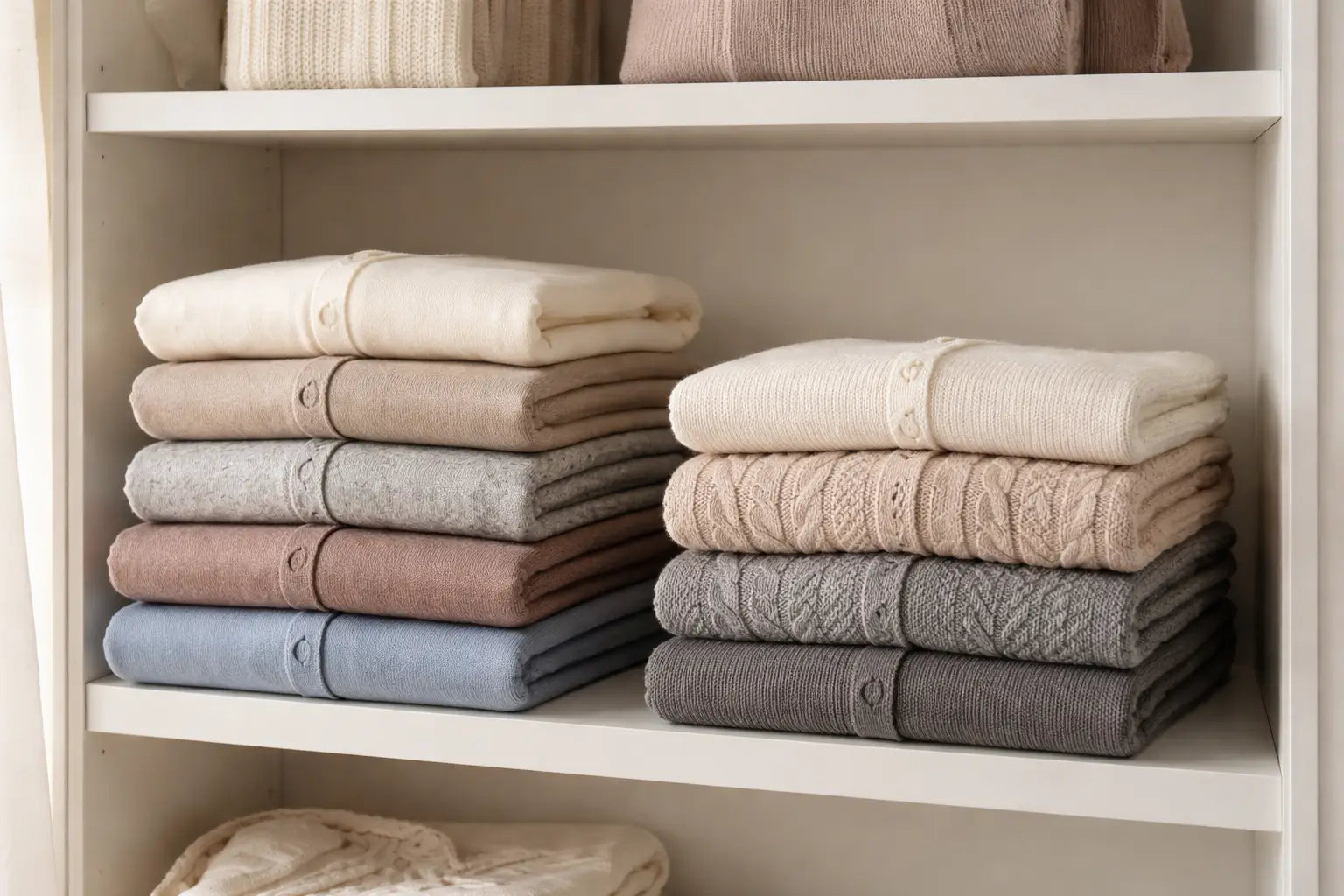
A cardigan folds best when you treat it like a soft “rectangle” first, then choose a finish based on where it’s going: drawer, shelf, or suitcase. Below you’ll get a fast default fold, a KonMari drawer fold, a travel roll, and fixes for open-front (no buttons), long, and chunky cardigans.
Fold a cardigan sweater in 60 seconds (default steps + method picker)
For most cardigans, lay it flat, smooth it, fold sleeves in to make a rectangle, then fold into halves or thirds based on your drawer/shelf depth.

Key points (2–6 bullets OR a mini-table):
- Rectangle first = cleaner stacks and fewer weird bulges.
- Drawer storage: consider a “standing” (KonMari-style) fold for visibility.
- Travel: rolling can reduce sharp crease lines compared with repeated tight folds.
- Heavy/chunky knits usually do better with looser folds and lower stacks.
- Buttons/trim: keep hardware off the main fold line to reduce imprints.
Method picker: Which fold should you use?
Pick the method by storage goal + cardigan type—then adjust how tight you fold based on bulk.
| Your goal / cardigan type | Lightweight knit | Chunky/heavy knit | Long cardigan (duster) | Open-front (no buttons) |
|---|---|---|---|---|
| Drawer (easy access) | KonMari (stand upright) | Flat rectangle (looser) | Lengthwise first, then fold | Overlap panels, then rectangle |
| Shelf (stacking) | Flat rectangle | Flat rectangle (low stack) | Lengthwise first | Overlap panels, then rectangle |
| Travel (packing cube/suitcase) | Roll (loose, even) | Loose fold (often better than tight roll) | Fold lengthwise + loose fold | Overlap panels + roll or loose fold |
Boundary conditions / caveats (1–3 bullets):
- If your drawer is shallow, you may need fewer folds (less compression = fewer hard creases).
- If the knit is very bulky, avoid tight thirds—go looser and accept a slightly larger fold.
Want the quickest “do it now” steps? Use the default fold below.
Default fold step:
This is the fastest fold that works for most cardigans and keeps them stackable.
How / Steps (ordered):
- Lay the cardigan flat on a bed/table and smooth the fabric with your hands.
- Fold one sleeve straight across the body (roughly at shoulder level).
- Fold that side of the cardigan inward so the outer edge lines up near the center (you’re building a rectangle).
- Repeat on the other sleeve and side—aim for a long, tidy rectangle.
- Fold the rectangle in half (shelf) or into thirds (most drawers) until it fits your space.
- Place it flat in a low stack, or stand it upright (if using a drawer filing style).
Boundary conditions / caveats (1–3 bullets):
- If buttons are bulky, fold so buttons sit inside the rectangle and not directly on a crease line.
- For chunky knits, fold fewer times (looser) to reduce pressure creases.
Unsure whether to fold or hang your cardigan at all? Use the fold-vs-hang guide next.
Fold vs Hang: Best way to store cardigan sweaters
Most cardigans store best folded, because hanging can stretch knits over time—especially heavier ones. (cleaninginstitute.org)
Key points (2–6 bullets OR a mini-table):
- Fold = weight is supported evenly; fewer shoulder bumps.
- Hang = convenient, but higher risk of stretching at shoulders/neckline for knits. (cleaninginstitute.org)
- If you must hang: use a “draped-over-hanger” method to reduce shoulder stress. (thespruce.com)
- Lightweight knits can sometimes hang OK with the right hanger + technique.
Decision table: Fold vs hang (and when each is OK)
Use this table to decide quickly—then follow the safe-hanging steps if hanging is your only option.
| Storage option | Best for | Watch-outs | What to do |
|---|---|---|---|
| Fold (drawer/shelf) | Most cardigans, especially heavy/chunky knits | Over-stacking can create creases | Keep stacks low; fold loosely for bulky knits |
| Hang (standard) | Rarely ideal for knits | Stretching, shoulder bumps | Avoid if the cardigan is heavy or drapey |
| Hang (draped-over-hanger) | When you’re short on drawer space | Can still crease if hanger is thin | Use a sturdy hanger; drape the folded cardigan over it (thespruce.com) |
Boundary conditions / caveats (1–3 bullets):
- Wire hangers are a common culprit for shoulder dents—use sturdy, supportive hangers instead. (thespruce.com)
- If you notice stretching, switch to folding and reduce stack height.
If you’re folding, start with the everyday rectangle fold (Method 1) for clean stacks.
Safe hanging steps (draped-over-hanger method)
If you need to hang a cardigan, drape it over a sturdy hanger so the weight rests on the hanger bar—not on the shoulders. (thespruce.com)
How / Steps (ordered):
- Fold the cardigan vertically (lengthwise) so sleeves line up.
- Place a sturdy hanger at about the underarm area.
- Drape the body over the hanger’s bottom bar so the “shoulder area” isn’t carrying the full weight.
- Smooth the fabric so it lies flat and doesn’t bunch into a hard crease.
Boundary conditions / caveats (1–3 bullets):
- This reduces risk, but folding is still safer for heavy knits. (cleaninginstitute.org)
- If the cardigan is very chunky, consider shelf folding instead.
Now let’s do the main fold: the everyday flat/rectangle method.
Method 1: Everyday flat/rectangle fold (step-by-step)
The rectangle fold is the best all-purpose method for drawers and shelves: it’s fast, stackable, and easy to adjust for different cardigan sizes.
Key points (2–6 bullets OR a mini-table):
- Your goal is a smooth rectangle before any final folds.
- Folding into thirds is often drawer-friendly; folding in half is often shelf-friendly.
- Keep hard details (buttons, zippers, thick seams) away from the sharpest crease line.
How / Steps (ordered):
- Lay flat & smooth: Lay the cardigan flat, front facing down if that helps it lie flatter. Smooth wrinkles with your hands.
- Square the shoulders: Gently straighten the neckline/shoulders so seams aren’t twisted.
- Fold sleeves in: Fold each sleeve across the body so sleeves lie flat (no bunching at the cuff).
- Fold sides inward: Fold each side inward to form a long rectangle (aim for symmetrical edges).
-
Choose your finish:
- For shelves: fold the rectangle in half once (or twice if needed).
- For drawers: fold into thirds so it fits and can be stacked or filed.
- Store smart: Keep stacks low and put heavier knits at the bottom.
Boundary conditions / caveats (1–3 bullets):
- For chunky knits, fewer folds (looser) usually means fewer deep pressure creases.
- For delicate trims, avoid rubbing embellished areas against zippers/buttons in the stack.
Want a drawer setup where cardigans “stand up” and you can see everything at a glance? Try the KonMari fold.
Prep step: button or unbutton before folding?
Buttoning can help keep the front aligned, but it can also create button imprints—choose based on how bulky the buttons are and where the crease will land.
Key points (bullets):
- Buttoned: helps alignment for some cardigans (especially open-front styles that shift).
- Unbuttoned: avoids pulling at buttonholes and can reduce imprint risk.
- If buttons are thick, fold so buttons sit inside the rectangle and not right on a fold line.
Boundary conditions / caveats (1–3 bullets):
- If the cardigan has delicate buttons or trim, keep hardware from pressing into the fabric.
- If alignment is the bigger issue, button lightly and fold loosely.
If you mainly store cardigans in drawers, vertical folding can make daily access easier.
Method 2: KonMari vertical fold (drawer-friendly)
The KonMari method folds a cardigan into a small rectangle that can stand upright in a drawer—like files in a cabinet—so you can see everything at once. (konmari.com)
Key points (2–6 bullets OR a mini-table):
- Works best when you start with a clean rectangle.
- Final folds (half vs thirds) depend on drawer depth and cardigan thickness.
- For bulky knits, don’t force compression—use fewer folds so it can still “stand” without crushing.
How / Steps (ordered):
- Lay the cardigan flat and smooth it.
- Fold one side toward the center.
- Fold the sleeve so it fits inside the rectangle’s width.
- Repeat for the other side and sleeve to form a neat rectangle.
- Fold the rectangle lengthwise (leave a small gap at the edge rather than folding super tight).
- Fold in half or thirds until it becomes a stable, smaller rectangle.
- Stand it upright in the drawer. (konmari.com)
Boundary conditions / caveats (1–3 bullets):
- Very chunky cardigans may not stand neatly—go with a looser flat fold instead.
- If standing it up causes a hard crease, reduce fold count and give it more space.
Packing for travel instead of storing at home? The travel roll can be better than multiple tight folds.
Method 3: Travel roll (plus roll vs fold mini-guide)
For travel, rolling a lightweight cardigan in a loose, even cylinder can reduce sharp crease lines—while bulky knits often do better with a loose fold instead. (thespruce.com)
Key points (2–6 bullets OR a mini-table):
- Roll is great for thin knits + packing cubes.
- Tight rolls + heavy knits can distort shape and create ridges.
- Your suitcase compression level matters as much as the folding method.
Mini-guide: Roll vs fold for travel
Use this rule-of-thumb table, then follow the matching steps.
| Cardigan type | Best travel method | Why |
|---|---|---|
| Lightweight / thin knit | Roll (loose, even) | Fewer sharp fold lines (thespruce.com) |
| Medium knit | Roll or loose fold | Depends on how full the suitcase is |
| Chunky/heavy knit | Loose fold | Rolling can create bulky ridges |
How / Steps (rolling method):
- Lay flat and smooth the cardigan.
- Fold sleeves inward to form a rectangle.
- If it’s open-front, overlap panels so edges line up.
- Roll from the hem upward in a loose, even roll (avoid tight “rope” rolling).
- Place in a packing cube or along a suitcase edge to reduce shifting.
Loose-fold alternative (for bulky knits):
- Make a rectangle, then fold in half once (or twice) without pressing a hard crease.
Boundary conditions / caveats (1–3 bullets):
- Overstuffed suitcases can crease anything—leave a little “give” if you can.
- Unpack early at arrival; laying flat for an hour often helps relax light creases.
If your cardigan is tricky (no buttons, very long, or very chunky), use the special-case fixes next.
Special cases: No buttons, long cardigans, chunky cardigans
Special cardigans fold well when you fix the “problem” first: align open-front panels, control length for dusters, and reduce compression for chunky knits.
Key points (2–6 bullets OR a mini-table):
- Open-front: overlap panels before you fold sleeves.
- Long cardigan: fold lengthwise first so hems line up.
- Chunky cardigan: fold looser and stack lower to protect shape.
Open-front cardigans (no buttons): keep panels aligned
For open-front cardigans, overlap the front panels into a rectangle before you fold—this prevents twisting and uneven bulges.
How / Steps (ordered):
- Lay the cardigan flat and smooth it.
- Bring the left front panel inward, then overlap the right panel on top to create one clean “front.”
- Fold sleeves inward (flat) to keep the rectangle tidy.
- Fold in half (shelf) or thirds (drawer) as needed.
Troubleshooting (quick bullets):
- Panels shift while folding: fold more slowly in smaller moves; smooth after each fold.
- Edges curl: smooth firmly and avoid folding too tightly (tight folds can “set” the curl).
Boundary conditions / caveats (1–3 bullets):
- Drapey knits shift more; a textured surface (bedspread, towel) can help.
- If it’s also long, use the “long cardigan” steps next.
If your cardigan is long, control the length first with a lengthwise fold.
Long cardigans (dusters): fold to fit drawers neatly
Fold long cardigans lengthwise first, then fold into sections—this keeps hems aligned and reduces long crease lines.
How / Steps (ordered):
- Lay flat and smooth.
- Fold sleeves in and form a rectangle.
- Fold the rectangle lengthwise once (so the cardigan becomes shorter and easier to manage).
- Fold into thirds or quarters until it fits your drawer depth.
Boundary conditions / caveats (1–3 bullets):
- If your drawer is shallow, use fewer folds and store on a shelf instead.
- If the knit is chunky, fold looser and avoid tall stacks.
If it’s bulky or heavy, use the chunky-knit checklist to prevent stretching and deep creases.
Chunky cardigans: avoid stretching and deep creases
Chunky cardigans keep their shape best when you fold loosely, distribute weight evenly, and avoid tall stacks.
Key points (bullets):
- Make a wide rectangle (don’t narrow it too much).
- Fold fewer times (looser folds).
- Stack low; keep the heaviest items at the bottom.
- If you must hang, use the draped-over-hanger method (see Fold vs Hang).
Boundary conditions / caveats (1–3 bullets):
- Chunky knits are the most likely to stretch on hangers, so folding is usually safer. (cleaninginstitute.org)
- If you see deep crease lines, reduce compression and stack height.
Trying to fit more cardigans in less space—without turning them into a wrinkled pile? Use the space-saving rules next.
Save space without wrinkles: stacking rules + common mistakes
To save space without extra wrinkles, focus on less compression (looser folds, lower stacks) and choose the fold method that matches your storage setup.

Key points (2–6 bullets OR a mini-table):
- Compression creates pressure creases; bulkier knits need looser folds.
- Vertical “file” storage improves visibility and reduces rummaging.
- Travel roll helps some knits, but tight rolling can backfire.
- The fastest way to create wrinkles is stacking too high.
Quick rules: stack, file-fold, or roll?
Use this mini recap when you’re deciding how to store a whole pile of cardigans at once.
| Storage style | Best for | Quick rule |
|---|---|---|
| Stack (shelf) | Most cardigans | Keep stacks low; heavier at the bottom |
| File-fold (drawer) | Frequent use | Stand folded items upright so you can grab one without disturbing others |
| Roll (travel) | Packing cubes/suitcases | Roll thin knits loosely and evenly |
Boundary conditions / caveats (1–3 bullets):
- If drawer depth forces extra folds, expect more crease risk—store looser on shelves when possible.
Avoid the most common mistakes below to keep cardigans looking better longer.
Mistakes that cause wrinkles, stretching, or shoulder bumps (and fixes)
Most storage problems come from the same few habits—fix them once and your cardigans will stay neater with less effort.
Checklist: Do this / avoid this
-
Avoid: folding tightly into hard thirds on a chunky knit
Do: fold fewer times and store in a lower stack -
Avoid: stacking too high
Do: split into two shorter stacks (or file-fold in drawers) -
Avoid: hanging heavy knits by the shoulders
Do: fold instead, or use the draped-over-hanger method if you must hang (cleaninginstitute.org) -
Avoid: folding directly on top of thick buttons/zippers
Do: position hardware inside the rectangle and away from the sharpest crease -
Avoid: stuffing a drawer until it won’t close
Do: leave a little space so folded items don’t get crushed
Boundary conditions / caveats (1–3 bullets):
- Some fibers relax after resting flat; others hold creases more—results vary by knit and compression.
- If you need a truly crisp look, steaming/pressing (per care label) may still be needed.
Storing cardigans for months (off-season) needs a different approach—use the long-term storage steps next.
Off-season storage: long-term cardigan care (moths + moisture)
For long-term storage, clean and fully dry your cardigans first, then fold and store in a way that balances breathability and pest protection—especially for wool. (iwto.org)
Key points (2–6 bullets OR a mini-table):
- Clean first: reduces residues and helps protect stored items. (iwto.org)
- Fold knits (don’t hang) to help retain shape over time. (iwto.org)
- Container choice is a trade-off: breathable storage helps air flow; airtight storage can help with moth protection (when items are clean and dry). (iwto.org)
- Check occasionally—storage conditions can change across seasons.
How / Steps (ordered):
- Wash/clean according to the care label, then fully dry.
- Fold into a rectangle (looser for bulky knits).
- For wool: consider storage that helps limit pests, especially for longer periods. (iwto.org)
- Use breathable garment bags (like cotton) if you want more airflow; use sealed containers if pest control is the bigger risk—but only if garments are clean and dry. (iwto.org)
- Store in a cool, dry area (avoid damp basements or hot attics).
- Re-check occasionally for moisture or signs of pests. (woolmark.com)
Boundary conditions / caveats (1–3 bullets):
- Wool/cashmere generally need more careful pest prevention than synthetics. (woolmark.com)
- If you live in a humid area, moisture control matters more; if you’ve had moth issues, pest prevention matters more.
If you’re a brand or seller, you can also standardize folding + labels so customers store knits correctly—see the optional note next.
Optional for brands/sellers: packing folds + care label wording
If you sell or ship cardigans, a standardized fold + simple storage guidance on the care label can reduce “arrived wrinkled” complaints and help customers store knits better.
Key points (bullets):
- Use one consistent fold (usually a rectangle fold) across SKUs for predictable packing.
- Add a short care-label storage line so customers know when to fold vs hang.
- Protect delicate trims/buttons with a simple barrier (e.g., tissue) so hardware doesn’t press into the knit.
How / Mini-process (ordered):
- Fold into a tidy rectangle (avoid sharp creases over buttons).
- Add tissue for delicate trims or prominent hardware (optional).
- Pack to reduce movement (snug, not crushed).
- Add a short storage line on the label or insert.
Care-label-ready storage wording (examples):
- “Store folded to help retain shape.”
- “If hanging is needed, drape over a sturdy hanger to reduce shoulder marks.”
Boundary conditions / caveats (1–3 bullets):
- Packing method depends on knit thickness and embellishments.
- Shipping compression varies, so avoid promising “wrinkle-free delivery.”
Need quick answers to the most-searched questions? The FAQ below mirrors common PAA phrasing.
Need custom knitwear for your brand?
XTCLOTHES works with brands on OEM/ODM knitwear and can support consistent folding + packaging details as part of a production workflow. If you have a tech pack or reference photos, share your target quantities and packaging preferences for a quote.
FAQ
How do you fold a cardigan sweater step by step?
Lay it flat, smooth it, fold sleeves and sides inward to form a rectangle, then fold in half (shelf) or thirds (drawer).
Boundary note: For bulky knits, fold looser and stack lower.
What is the best way to store cardigan sweaters—folded or hung?
Usually folded—hanging can stretch knits, especially heavy ones. (cleaninginstitute.org)
Boundary note: If you must hang, drape the folded cardigan over a sturdy hanger. (thespruce.com)
How do you fold a cardigan with no buttons (open front) so it stays aligned?
Overlap the front panels into a rectangle first, then fold sleeves in and finish like a normal rectangle fold.
Boundary note: Drapey knits shift more—smooth after each fold.
How do you fold cardigans to save space without wrinkles?
Use a method that reduces compression: file-fold for drawers, low stacks for shelves, and loose rolling for thin travel knits.
Boundary note: “No wrinkles” depends on bulk and how tightly the space is packed.
How do you fold a cardigan sweater using the KonMari method (so it can stand upright)?
Make a rectangle (sides + sleeves in), then fold lengthwise and fold in half or thirds until it stands upright in the drawer. (konmari.com)
Boundary note: Very chunky knits may not stand well—use a looser flat fold instead.
What’s the best way to fold or roll a cardigan for travel to minimize wrinkles?
Roll lightweight knits loosely and evenly; loosely fold bulky knits instead of tight rolling. (thespruce.com)
Boundary note: Overstuffed suitcases crease everything—leave a little space if possible.
Quick recap checklist (save/print)
- Make a rectangle first (smooth → sleeves in → sides in).
- Drawer: fold into thirds or KonMari-style “stand upright.”
- Shelf: fold in half and keep stacks low.
- Travel: roll thin knits loosely; loose-fold bulky knits.
- Avoid: wire hangers, tight folds on chunky knits, and tall stacks.
- If hanging is necessary: drape over a sturdy hanger (not standard shoulder hanging). (thespruce.com)
- Off-season: clean + fully dry, then fold and store with the right breathability vs pest-protection trade-off. (iwto.org)
