
How to Knit a Sweater Without a Pattern: A Simple Recipe Using Gauge + Measurements
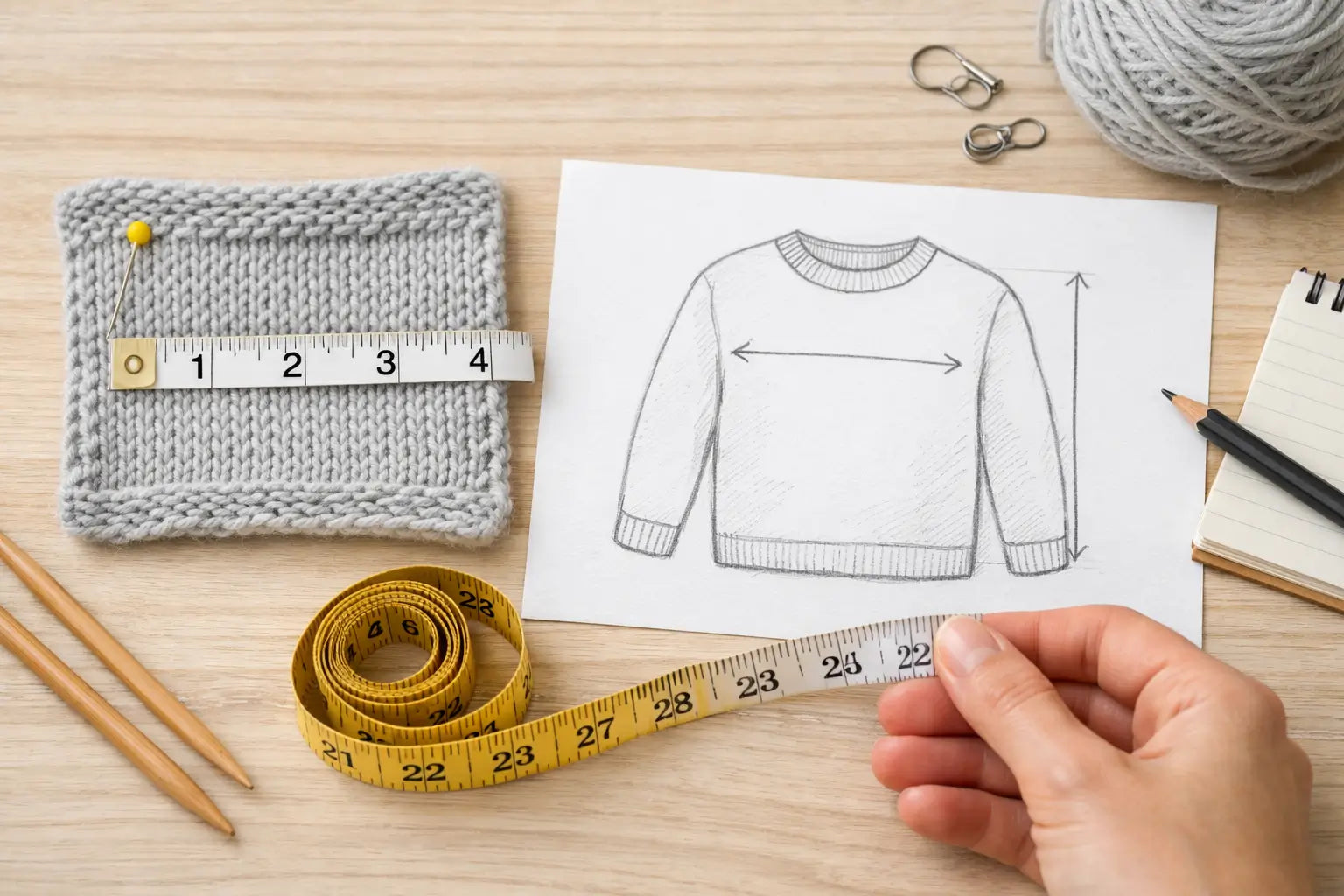
You can absolutely knit a sweater without following a written pattern—as long as you treat it like a repeatable recipe: choose a construction, swatch for gauge, convert measurements into stitch/row counts, and adjust fit as you go.
What “no pattern” means (and what you need before you start)
Knitting a sweater “without a pattern” usually means you’re creating your own plan using gauge + measurements, then writing down the numbers you choose so you can repeat (or refine) them.
Key points:
- A “no-pattern sweater” still has structure: construction style, stitch counts, shaping decisions, and finishing choices.
- Gauge is the input that turns your measurements into stitch/row math.
- Ease (how loose or fitted you want it) is a style choice you must decide before you calculate.
- Notes are what make it reproducible: if you don’t record counts and lengths, it’s hard to repeat.
Boundary conditions:
- Final fit depends on yarn behavior and blocking (many fabrics change after washing).
- Your first attempt may need small revisions, especially at neckline, yoke depth, or sleeve width.
If you want this to feel easy instead of chaotic, the fastest win is choosing a construction that’s forgiving and easy to fit as you knit.
The no-pattern sweater recipe (choose → swatch → math → shape → fit-check → finish)
A no-pattern sweater works when you follow a reliable sequence: decide what you’re building, lock gauge, do the math, then keep checking fit and adjusting before you commit to the whole garment.

Use this quick recipe:
| Step | What you do | What you get |
|---|---|---|
| 1 | Choose a construction (raglan, yoke, drop-shoulder, or simple seamed) | A blueprint for shaping |
| 2 | Knit and block a gauge swatch in your real stitch pattern | Stitches/rows per inch (or per 10 cm) |
| 3 | Measure your body (or a sweater you like) and choose ease | Target finished measurements |
| 4 | Do sweater math: stitches for width, rows for length | Cast-on + shaping targets |
| 5 | Knit the yoke/body, trying on and adjusting as you go | Fit you can refine mid-knit |
| 6 | Finish edges neatly and block the final sweater | Clean look + stable measurements |
Boundary conditions:
- Measure gauge the way you’ll knit the sweater (flat vs in the round can differ).
- If your blocked gauge changes, redo the math before you continue.
Once you’ve got the sequence, the next decision is choosing a construction that matches your skill level and how much control you want while fitting.
Choose your construction (raglan vs yoke vs drop-shoulder vs simple seamed)
The easiest no-pattern sweaters start with a construction that lets you check fit early and often, with minimal complicated shaping.

Here’s a practical comparison:
| Construction | Why it’s “no-pattern friendly” | Watch-outs |
|---|---|---|
| Top-down raglan (seamless) | Try on as you go; simple increase rhythm; clear sleeve/body split | Neckline fit can be tricky without short rows; underarm gaps need attention |
| Circular yoke (seamless) | Smooth look; good for colorwork-style aesthetics | Increase placement is less intuitive; yoke depth can be harder to tune |
| Drop-shoulder (seamed or seamless) | Very simple shaping; sleeves are straightforward tubes | Can feel boxy; shoulder fit matters more than you think |
| Simple seamed “rectangles” (beginner) | Minimal shaping; mostly measuring and knitting flat pieces | Less customizable fit; seam finishing matters a lot |
Quick decision guide:
- If you want maximum fit control while knitting: start with a top-down raglan.
- If you want the simplest math and don’t mind seams: try a simple seamed approach.
- If you love the look of a continuous yoke: try a yoke after you’ve done at least one sweater.
Boundary conditions:
- Stitch patterns (cables, colorwork, heavy textures) change gauge and make fitting less predictable.
- Seamless sweaters reduce seaming time, but they don’t eliminate finishing (you still need clean edges and sturdy joins).
Once you choose a blueprint, gauge becomes the “truth source” for every stitch count you’ll calculate.
Gauge, swatching, and blocking (the step you can’t skip)
If you’re designing your own sweater, a gauge swatch is the difference between “this fits” and “why is this four sizes off.”
A solid gauge workflow:
- Swatch in the stitch pattern you’ll actually use (not just a random sample).
- Make the swatch bigger than your measurement window so you can measure interior stitches (edges distort).
- Block the swatch the way you’ll treat the finished sweater (wash/soak and dry as you intend).
- Measure stitch gauge and row gauge over a larger span (often 4 inches / 10 cm) and average if needed.
- If gauge is off, change needle size (or yarn) and reswatch before doing your final math.

Two helpful references explain why measuring over a wider span and using interior stitches matters:
- Purl Soho’s gauge tutorial (what gauge is, how to swatch, why blocked gauge matters): https://www.purlsoho.com/create/all-about-gauge/
- Yarnspirations’ “How to Measure Knit Gauge” (measuring over 4 inches, using interior stitches, and adjusting needle size): https://www.yarnspirations.com/en-row/blogs/how-to/how-to-measure-knit-gauge
Boundary conditions:
- Gauge often changes after blocking; many guides recommend measuring after the swatch is treated like the final garment.
- Gauge can differ knit flat vs knit in the round; measure in the same mode you’ll use for the sweater.
With gauge in hand, you’re ready to decide what to measure and what kind of fit you actually want.
Measurements + ease (what to measure, what “ease” really means)
To knit a sweater without a pattern, you need a small set of measurements and a clear ease choice (fitted, classic, relaxed, oversized) so your math has a target.

What to measure (minimum set):
- Chest/bust circumference (or measure a sweater you love at the chest)
- Body length (from underarm or from shoulder—just be consistent)
- Sleeve length (from underarm or shoulder)
- Upper arm/bicep circumference
- Armhole depth / yoke depth target (especially important for top-down styles)
A useful sizing/measurement reference (including ease definitions and a list of common body measurements):
- Craft Yarn Council “Standard Body Measurements/Sizing”: https://www.craftyarncouncil.com/standards/body-sizing
A simple “measurements → used for” table:
| Measurement | Used for | Notes |
|---|---|---|
| Chest/Bust | Body circumference stitch count | Start here; it anchors the size |
| Armhole depth / yoke depth | When to stop yoke increases | Comfort and mobility matter |
| Upper arm | Sleeve circumference stitch count | Keeps sleeves wearable, not ballooning |
| Sleeve length | Rows (or rounds) to knit | Row gauge affects this |
| Body length | Rows (or rounds) to knit | Decide cropped/standard/tunic |
Ease in plain language:
- Positive ease means the sweater is larger than your body at the chest/bust.
- Zero ease means it’s roughly the same.
- Negative ease means it’s smaller (stretch fit), which is riskier for beginners.
If you want a concrete starting point, Craft Yarn Council also provides guideline ranges for different fits (and notes they’re guidelines): https://www.craftyarncouncil.com/standards/body-sizing
Boundary conditions:
- Ease is not a universal rule; it depends on style, yarn, stitch pattern, and personal preference.
- Measuring a sweater you already like is often more reliable than measuring your body alone.
Now you can turn those targets into stitch and row counts with a small amount of “sweater math.”
Sweater math: calculate cast-on stitches and lengths
Sweater math is straightforward: you’re converting a target measurement into stitches using your stitch gauge, and converting a target length into rows using your row gauge.
Core formulas:
stitches = (target circumference or width) × (stitches per inch or cm)rows = (target length) × (rows per inch or cm)
Steps to calculate a cast-on (or starting stitch count):
- Decide your target finished chest/bust measurement (body measurement + your chosen ease).
- Convert that measurement into stitches using your stitch gauge.
- Round to match your stitch pattern needs (for example, ribbing multiples) and any edge structure you want.
- For top-down sweaters, split stitches conceptually into front/back/sleeves according to your construction plan (you’ll refine this during fitting).
Worked example (illustrative, not a rule):
- Suppose your target chest is 44 inches and your gauge is 5 stitches per inch.
- Estimated chest stitches:
44 × 5 = 220 stitches. - If your ribbing needs a multiple of 4, you might round to 220 (already divisible by 4) or adjust slightly to suit your stitch pattern.
Length math:
- If your row gauge is 7 rows per inch and you want 16 inches from underarm to hem, that’s
16 × 7 = 112 rows.
Boundary conditions:
- If blocked gauge changes, the math changes—recheck before committing to large sections.
- Stitch patterns can dramatically change gauge versus stockinette; swatch in the real pattern when possible.
Once you can calculate stitch and row targets, the next challenge is shaping—starting with the neckline and then the yoke or shoulders.
Neckline planning without a pattern (and why short rows help)
A comfortable neckline is usually the first place a no-pattern sweater can go wrong, so it’s worth planning two things: opening size and neckline depth.
Key points:
- Opening size is about getting the sweater over your head (and feeling comfortable).
- Neckline depth is about how it sits on your body, especially at the back neck.
- Short rows add extra fabric to the back neck so the front doesn’t ride up.
A simple top-down neckline workflow:
- Cast on enough stitches for the opening you want (crew neck needs a larger opening than you think if it’s meant to be comfortable).
- Place markers for your construction (raglan markers or yoke sections).
- Work short rows across the upper back to raise the back neckline.
- Join in the round once the neckline depth and shape feel right, then continue into the yoke.
Boundary conditions:
- Neckline style changes the plan (crew, boat, V-neck all behave differently).
- There are multiple short-row methods; pick one you can execute cleanly and consistently.
With the neckline set, the next big “no pattern” skill is managing yoke shaping and knowing when to stop increasing.
Raglan/yoke planning: increases, “when to stop,” sleeve separation, underarms
For a top-down raglan, your main job is to increase at a steady cadence until the yoke is deep enough and the chest/sleeve widths are on track.
A practical planning loop:
- Start with your neckline stitches and place raglan markers (4 raglan lines).
- Choose an increase cadence (for example: increase rounds alternating with plain rounds, or another repeat that gives the fabric you want).
- Track yoke depth as you knit and try it on periodically.
- Stop increasing when:
- the yoke reaches a comfortable underarm depth, and
- the body and sleeve stitches look like they’re heading toward your target circumferences.
Sleeve separation (common top-down method):
- Put sleeve stitches on waste yarn or holders.
- Cast on a small set of underarm stitches to bridge the gap.
- Continue knitting the body in the round.
- Later, pick up the sleeve stitches, add underarm stitches, and knit sleeves down.
Tips to reduce underarm holes:
- Keep the underarm join snug.
- Pick up extra stitches at the gap and decrease them away over the next rounds if needed.
- Use a finishing pass (weaving) to close tiny gaps if they remain.
Boundary conditions:
- “When to stop” is primarily about armhole depth and comfort, not only chest width.
- If gauge drifts as you knit (fatigue, different needles, different tension), your yoke depth and circumferences can shift—fit checks catch this early.
Fit checks are what turn “math on paper” into a sweater you actually like wearing.
Fit checks + adjustments (try-on methods, lifelines, edits without restarting)
You can avoid a lot of ripping back by building a habit: check fit at predictable milestones and make small changes before they snowball.
Checklist for safer fitting:
- Use a long cable or scrap yarn to hold stitches for try-ons.
- Add a lifeline before major decisions (before sleeve separation, before big length commits, before complex stitch patterns).
- Decide what you’ll adjust and how:
- Length changes are usually rows (or rounds).
- Width changes are stitches (add/remove gradually).
Adjustment steps:
- Try on at the end of a shaping milestone (after a set of yoke increases, after sleeve separation, before hem).
- If body is too tight: add ease by increasing gradually at side-equivalent points (or reduce negative ease by recalculating).
- If body is too loose: decrease gradually (avoid sudden shaping unless it’s intentional).
- If sleeves feel wrong: adjust sleeve increases/decreases and re-check at upper arm before knitting the full length.
Boundary conditions:
- Try-on methods differ for knit-flat vs knit-in-the-round sweaters (pieces can be pinned together for fit checks).
- Blocking can change final fit; when possible, treat your swatch like the final garment to reduce surprises.
Once the fit is close, finishing is what makes it look intentional instead of improvised.
Finishing that makes it look clean (edges, pickup, bind-off stretch, blocking)
Finishing is where a lot of “good sweaters” become “great sweaters,” especially at necklines, cuffs, and hems.
Finishing checklist:
- Choose a bind-off that matches the stretch you need (tight hems and necks are common deal-breakers).
- Pick up stitches evenly for neckbands, cuffs, or button bands (consistency looks professional).
- Weave in ends securely along the fabric path so they don’t pop out.
- Block the finished sweater using the care method you’ll actually use long term.
If you want a quick reference for treating fabric and measuring consistently, both of these guides emphasize measuring on a stable surface and treating fabric like the finished item:
- Yarnspirations “How to Measure Knit Gauge” (includes washing/blocking guidance for swatches): https://www.yarnspirations.com/en-row/blogs/how-to/how-to-measure-knit-gauge
- Purl Soho “All About Gauge” (why gauge problems often explain “fit surprises”): https://www.purlsoho.com/create/all-about-gauge/
Boundary conditions:
- Different fibers respond differently to blocking (some grow, some relax, some bounce back).
- Edge comfort matters: a beautiful sweater that pulls at the neckline won’t get worn.
If something still goes wrong, troubleshooting is easier when you diagnose the likely cause instead of guessing.
Risks + troubleshooting: symptom → cause → fix (with stage-aware guidance)
Most “no pattern” fit problems come from a small set of causes: gauge issues, ease mismatch, or shaping decisions that don’t match your body.
Prevention checklist (do this before you troubleshoot):
- Block your swatch and measure interior stitches over a wider span.
- Measure both stitch gauge and row gauge if length matters.
- Decide ease intentionally (don’t let it happen by accident).
- Try on before sleeve separation and before final hem length.
- Keep notes on stitch counts and key lengths so you can adjust with confidence.
Troubleshooting table:
| Symptom | Most likely cause | Best next fix |
|---|---|---|
| Sweater is too big after blocking | Fabric grew; ease was higher than intended; gauge changed post-wash | Re-measure gauge and adjust (shorten length, add shaping, or accept a relaxed fit); plan differently next time |
| Sweater is too tight across chest | Not enough ease; stitch gauge tighter than expected | Increase width gradually, or rip back and recalculate based on measured gauge |
| Sleeves feel too wide | Sleeve stitch distribution too generous; no tapering | Add decreases down the sleeve; re-check upper arm fit early |
| Neckline feels tight | Opening too small; bind-off/pickup too tight | Rework neckline edge with a more elastic method; plan larger opening next time |
| Underarm holes | Loose join at sleeve separation; insufficient pickup | Pick up extra stitches and decrease away; close gaps during finishing |
| Body length is off | Row gauge mismatch; blocked length changed | Add/remove length at hem if possible; measure row gauge and recalc next time |
Stage-aware guidance:
- If you’re early (yoke still in progress), recalculating stitch counts and restarting is often the cleanest fix.
- If you’re mid-sweater, gradual increases/decreases can salvage fit without major rework.
- If you’re finished and blocked, your best options are targeted finishing fixes (edges) or accepting a style shift (more relaxed or more fitted than planned).
Boundary conditions:
- Some issues only reveal themselves after blocking; re-measure before making big decisions.
- Fix options depend on where you are in the knit; don’t assume the same remedy works at every stage.
Once you’ve solved (or prevented) the common issues, the final step is turning your sweater into a repeatable recipe you can reuse.
Document it so you can recreate it (mini worksheet + spec-style checklist)
The easiest way to make “no-pattern knitting” feel reliable is to document it like a recipe: measurements, gauge, stitch counts, and the decisions you made.

What to record (and why):
| What to record | Why it matters | Example notes |
|---|---|---|
| Yarn + needle info | Reproducibility | yarn name/fiber, needle size, fabric feel |
| Gauge (blocked) | The math input | stitches/rows per 4 in (or 10 cm) after blocking |
| Body or reference sweater measurements | Target sizing | chest, body length, sleeve length, upper arm |
| Ease choice | Fit intent | classic/relaxed/oversized (and your target chest size) |
| Construction choice | Blueprint | top-down raglan, drop-shoulder, seamed, etc. |
| Key stitch counts | Repeatability | cast-on count, sleeve split counts, underarm cast-on |
| Key lengths | Fit checkpoints | yoke depth, body length to hem, sleeve length to cuff |
| Fixes you made | Future learning | “added 8 stitches at sides after try-on” |
If you’re creating a spec-style document for sampling or manufacturing later, it helps to understand the difference between a measurement/spec sheet and a full tech pack; this explainer provides a clear definition and typical components:
- Techpacker: “What is a Garment Spec Sheet…” https://techpacker.com/blog/design/what-is-a-garment-spec-sheet/
Boundary conditions:
- A personal recipe is not the same as multi-size grading for production, but it’s a strong starting point.
- Feasibility for sampling depends on design complexity, yarn choices, and target quality expectations.
If you’re a brand or designer turning a sweater idea into a real product, this worksheet is also a practical “first message” package for a knitwear sampling conversation: share your target measurements, blocked gauge, construction choice, and reference images.
You can contact XTCLOTHES here (to discuss sampling and customization options): https://xtclothes.com/pages/contactus
A short FAQ can help you clear the last common questions that come up while you’re actually knitting.
FAQ
-
Q: Can you knit a sweater without a pattern?
A: Yes—if you use gauge and measurements to create your own stitch/row plan and keep notes. The fit still depends on yarn behavior, blocking, and the construction you choose, so expect small adjustments on your first try. -
Q: Which sweater construction is easiest to improvise without a pattern?
A: A top-down raglan is often the easiest because you can try it on and adjust as you go. A simple seamed sweater is also beginner-friendly if you prefer minimal shaping. -
Q: Do you have to swatch if you’re not following a pattern?
A: In most cases, yes, because your swatch tells you how many stitches/rows you get per inch or cm, which is the input for your sweater math. Swatch and block the way you’ll treat the final sweater to reduce fit surprises. -
Q: How do you calculate cast-on stitches from measurements and gauge?
A: Multiply your target measurement (including your chosen ease) by your stitch gauge. Then round the result to match ribbing or stitch-pattern multiples and keep the number consistent with your construction plan. -
Q: How much ease should you add for a sweater?
A: It depends on your style goal (fitted vs relaxed vs oversized) and the fabric behavior of your yarn and stitch pattern. Treat ease as a design choice: decide the look you want, then calculate stitch counts to match it. -
Q: How do you know when to stop raglan increases?
A: Stop when the yoke is deep enough to sit comfortably at the underarm and the body/sleeve stitch counts are close to your target circumferences. Try-on checks matter more than hitting a perfect number on paper. -
Q: Why doesn’t my sweater fit even though I did the math?
A: The most common reasons are gauge differences (especially after blocking), ease choices that didn’t match your intended fit, or shaping decisions (like yoke depth) that need adjusting. Re-measure blocked gauge first, then choose the least disruptive fix based on how far you are into the sweater. -
Q: How do I document a no-pattern sweater so I can knit it again (or share it for sampling)?
A: Record blocked gauge, your measurements and ease choice, construction type, key stitch counts, and milestone lengths (yoke depth, sleeve split, body/sleeve lengths). Add photos of the sweater and notes on any adjustments you made so the “recipe” is repeatable.
If you take away one thing, it’s that “no pattern” works best when you treat your sweater like a planned build, not a mystery.
Summary + next steps
Takeaways:
- Choose a construction that matches your skill level and how much fit control you want.
- Swatch, block, and measure gauge (interior stitches over a wider span) before doing any serious math.
- Convert measurements + ease into stitches/rows, then validate with try-ons at key milestones.
- Use finishing choices (especially edge stretch) to make the sweater comfortable and wearable.
- Write down what you did so you can recreate it—or improve it next time.
Scenario-based next steps:
- If you’re knitting your first sweater: pick one construction (top-down raglan or simple seamed), keep it plain, and focus on fit.
- If you’re chasing a specific silhouette: measure a sweater you already love and treat that as your target.
- If you’re making this for a product idea: build your “recipe worksheet” as you knit, so you can communicate it clearly later.
If you’re developing knitwear for a brand, a clean measurement/gauge worksheet plus reference images can significantly reduce back-and-forth in sampling. When you’re ready to discuss a sample or customization, start here: https://xtclothes.com/pages/contactus
